Focusing on good progression from Reception to Year 6, Maths 5–11 provides a clear and concise presentation of the fundamental knowledge that all primary mathematics teachers need. It provides readers with practical knowledge for the planning and assessment necessary to employ the theories expressed in the book.
Ranging from number sense and place value to looking in depth at the various aspects of fractions and mathematical reasoning, this book explores:
mathematical connections inside and outside of the curriculum;
the relation of mathematics to other primary subjects such as science, geography, and art;
mathematics teaching practices from high-performing jurisdictions across the world;
the progression of learning from primary school to secondary school;
the 'big ideas' in mathematics; and
activities that provide strategies for children to use responsively and creatively.
Helping primary teachers and mathematics coordinators improve and enhance their mathematical subject knowledge and pedagogy, Maths 5–11 will re-instil an excitement about teaching mathematics among its readers.
Number sense refers to ‘a well organised conceptual framework of number information that enables a person to understand numbers and number relationships and to solve mathematical problems that are not bound by traditional algorithms’ (Bobis 1996).
Knowing about, and having a sense of, number develops the skills which enable children to advance further in their mathematical understanding. We continue needing a sense of number when approaching new skills or concepts throughout our learning of mathematics. So, it is not something that children acquire in the early years of their education and not consider again in later years. Number sense is essential for all mathematical understanding. For example, when children encounter decimals, they need to have a sense of what decimal numbers are. They need to be able to count in decimal steps; they need to be able to compare them, know their composition, how they relate to one another and so on.
This section is therefore relevant to all phases in primary school, so please be sure to read it!
Over the years, various educational researchers have explored what they consider to be meant by number sense. I think the three key aspects that Sue Gifford, Jenni Back and Rose Griffiths refer to in their book Making Numbers: Using Manipulatives to Teach Arithmetic are simple and sum up what number sense is in a really helpful way:
Counting
Comparing
Composition
Counting
Children need to know the number names in order, first forwards and then backwards. They need to be able to understand how to count objects, events and actions, first, in ones and, then, in twos, fives and tens, other multiples and fractions, including decimals. Counting activities continue throughout primary school with increasing complexity.
In the 1970s, Gelman and Gallistell (1978) researched how children learn to count. The progression they developed is well known and still relevant now, decades later. This progression is called the Counting Principles; there are five:
The 1:1 principle: the ability to assign one number name to one object in the correct order and touch each object only once.
The stable order principle: knowing that numbers come in a particular order and being able to count consistently in that order. The numbers a child counts to in order may begin with just a few, but this will steadily increase over time, with practice.
The cardinal principle: the ability to count in order, understand the 1:1 principle and gradually notice that the final number in the count tells them how many there are in the group or set.
The abstract principle: knowing that anything can be counted, for example, objects, sounds, actions, words.
The order-irrelevance principle: understanding that in counting a group of objects, it does not matter where the objects are placed. This principle links to Piaget’s conservation of number, where an amount remains constant even when its appearance has changed. For example, children can count a line of objects and tell you that there are eight. They can tell you that there are still eight when the objects are positioned in two rows of four or covered so none can be seen. Children develop their understanding that the number of objects remains the same because none have been added and none have been taken away. This is often a sticking point for children in the Early Years Foundation Stage (EYFS). To help them with this principle, children need plenty of practice.
I am by no means in the same league as Gelman and Gallistell, but I actually like to rearrange these principles so that the stable order principle comes first because I believe that children need to know the number order first in order to succeed in the 1:1 principle. I also like to place the order-irrelevance principle before the abstract principle because it is so important and because when children have mastered this principle, they are then in a position to be able to count anything.
My preferred order in these principles is
the stable order principle;
the 1:1 principle;
the cardinal principle;
the order-irrelevance principle;
the abstract principle.
I hope that these two esteemed gentlemen will forgive me!
In an ideal world, children should have mastered these counting skills by the time they leave Reception. They will not be able to develop other skills in number sense if they cannot count. I often suggest that teachers assess their children’s ability to count, initially the stable order principle, in the Early Years and work with one or two children for a few minutes each day to practise counting to three, then four and so on until they can count competently to ten. Often, counting is carried out as a whole-class activity, which is good in many ways but is not necessarily the best way for all children. Some children in a class will be able to count, so for them, practising daily is probably unnecessary. Other children in the class will be in the very early stages of counting and may not be able to get past three, and they are likely to mumble the rest of the numbers inaccurately, so whole-class counting, if that is all that is done, is of little benefit to them. Small focus groups are possibly the best idea. Several teachers I know do this, and they say that it has had a massive impact. This idea works for all the counting principles. One Reception teacher told me that she had six children who had not mastered the 1:1 principle by the summer term of Year R. So, she spent a few minutes every day for a week with them, practising this skill, and by the end of the week, they had mastered it.
A few years ago, I carried out an assessment of 14 Reception children on their ability to count. I wanted to assess Gelman and Gallistell’s 1:1, cardinal and order-irrelevance principles. I set out eight little men in a line. All the children could tell me that there were eight, so they had achieved the first two of these principles. I then moved two men so there was a row of two and a row of six. All the children had to count them again, apart from one little girl who said, ‘Eight obviously.’ I then moved another two so that there were rows of two, four and two. All the children had to count again, except the one little girl who said, ‘Eight obviously.’ I then scooped them all into my hands, and all the children said there were none, even when I opened my hands to show them. They could not see any, so therefore there were ‘none’! The one little girl, again, said, ‘Eight obviously.’ I asked her why she kept saying, ‘Eight obviously’, and she said, ‘Well, you haven’t taken any away or added any to them so obviously there must be eight.’ Both her reasoning and explanation were great. That is where we would like all EYFS children to be by the end of Reception. I suspect that little girl has the potential to go far in her mathematics.
Young children like hearing and saying big numbers. So, if they can count in units of 1 to 10, they can count in units of 10 to ten hundred (some will know that ten hundred is equivalent to 1000), they can count in units of 1000, 1 million, 1 billion and 1 trillion. The principle of counting is the same no matter what we are counting. This can make counting more fun. I have seen children really excited when counting in these ‘big’ numbers to ten of a particular unit.
Counting in units of different measurements is also helpful so that children can use the abstraction principle from Gelman and Gallistell’s counting principles and understand that counting in centimetres, metres, kilograms, pence, pounds, minutes and so on works in the same way as counting numbers.
Children need to be able to count out a certain number of items from a larger group. I have seen teachers hold a handful of counters and ask the children to take five, counting as they do. When the child counts the fifth one, the rest are taken away! We cannot therefore assess whether children can do this because they have to stop counting as there are no more to count. We need to be mindful that we should keep the counters there so that we know whether the child has understood that they have taken five.
After 10, the children have to learn 11, 12 and the teens numbers. I call them the ‘blah, blah’ numbers. These are really tricky, and many children struggle with them. With a number like 14, at least you can hear that there must be a four in it somewhere. What about 13 and 15? Thir and fif do not sound much like three and five. In addition to pronouncing these numbers, young children often muddle the teens and tens numbers, saying, for example, 30 when they mean 13.
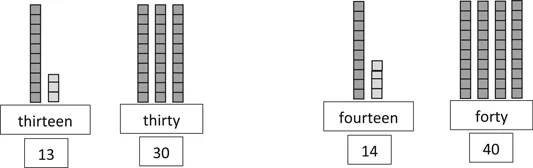
At the time of writing this book, I was trying out matching cards for the numbers 13 to 19 and 30 to 90, such as the following example, with children who have difficulty recognising and saying them correctly. First, the children sort the cards into all those that end with teen and all those ending with ty. They then pair them, a ‘teen’ card with the similar ‘ty’ card. Finally, take one pair and use manipulatives, such as Dienes or Numicon (published by Oxford University Press) to represent both numbers. In this way, they can see that, for example, 13 is made from one 10 and three 1s and that 30 is made from three 10s. They then do the same for another pair and then another. This is also a useful resource to display and make frequent reference to in the classroom.
Diagram 1.1
Interestingly, some schools using these cards are finding them very helpful, and some are already telling me that they are making a difference for some children because they can see the difference between the pairs of numbers and how they are made up. The visual clues of seeing the numbers in numerals and words and in quantities enable children to make verbal comparisons, and this aids their understanding.
Ordinal numbers
So far, we have thought about the cardinal aspect of counting; we also need to consider ordinal and nominal numbers. Ordinal numbers refer to the numbers in their positions when relating them to other numbers. We often begin teaching this by, for example, lining children or objects up and referring to number one in the line as first, the second in the line as second and so on. This example links to one to one correspondence as we are counting one item at a time, and they follow the stable order principle. When children begin ordering non-sequential numbers, such as 45, 67 and 98, we are referring their position compared with other numbers in that group. So, if ordering from the lowest number to the highest, 45 would be first in the order, 67 second and 98 third. Children should be thinking about how much greater, in this example, 67 is than ...
Table of contents
Cover
Half Title
Series Page
Title Page
Copyright Page
Contents
Acknowledgements
Introduction
Section 1 Number sense
Section 2 Numerical reasoning
Section 3 Additive reasoning
Section 4 Multiplicative reasoning
Section 5 Geometric reasoning
Index
Trusted by 375,005 students
Access to over 1.5 million titles for a fair monthly price.
Study more efficiently using our study tools.
Frequently asked questions
Yes, you can cancel anytime from the Subscription tab in your account settings on the Perlego website. Your subscription will stay active until the end of your current billing period. Learn how to cancel your subscription
No, books cannot be downloaded as external files, such as PDFs, for use outside of Perlego. However, you can download books within the Perlego app for offline reading on mobile or tablet. Learn how to download books offline
Perlego offers two plans: Essential and Complete
Essential is ideal for learners and professionals who enjoy exploring a wide range of subjects. Access the Essential Library with 800,000+ trusted titles and best-sellers across business, personal growth, and the humanities. Includes unlimited reading time and Standard Read Aloud voice.
Complete: Perfect for advanced learners and researchers needing full, unrestricted access. Unlock 1.5M+ books across hundreds of subjects, including academic and specialized titles. The Complete Plan also includes advanced features like Premium Read Aloud and Research Assistant.
Both plans are available with monthly, semester, or annual billing cycles.
We are an online textbook subscription service, where you can get access to an entire online library for less than the price of a single book per month. With over 1.5 million books across 990+ topics, we’ve got you covered! Learn about our mission
Look out for the read-aloud symbol on your next book to see if you can listen to it. The read-aloud tool reads text aloud for you, highlighting the text as it is being read. You can pause it, speed it up and slow it down. Learn more about Read Aloud
Yes! You can use the Perlego app on both iOS and Android devices to read anytime, anywhere — even offline. Perfect for commutes or when you’re on the go. Please note we cannot support devices running on iOS 13 and Android 7 or earlier. Learn more about using the app
Yes, you can access Maths 5–11 by Caroline Clissold in PDF and/or ePUB format, as well as other popular books in Education & Education General. We have over 1.5 million books available in our catalogue for you to explore.