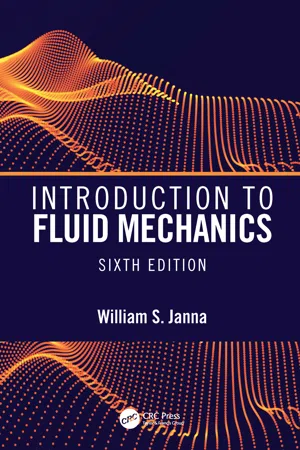
Introduction to Fluid Mechanics, Sixth Edition, is intended to be used in a first course in Fluid Mechanics, taken by a range of engineering majors. The text begins with dimensions, units, and fluid properties, and continues with derivations of key equations used in the control-volume approach. Step-by-step examples focus on everyday situations, and applications. These include flow with friction through pipes and tubes, flow past various two and three dimensional objects, open channel flow, compressible flow, turbomachinery and experimental methods. Design projects give readers a sense of what they will encounter in industry. A solutions manual and figure slides are available for instructors.
- 734 pages
- English
- ePUB (mobile friendly)
- Available on iOS & Android
eBook - ePub
Introduction to Fluid Mechanics, Sixth Edition
About this book
Information
1 Fundamental Concepts
Fluid mechanics is the branch of engineering that deals with the study of fluids—both liquids and gases. Such a study is important because of the prevalence of fluids and our dependence on them. The air we breathe, the liquids we drink, the water transported through pipes, and the blood in our veins are examples of common fluids. Further, fluids in motion are potential sources of energy that can be converted into useful work—for example, by a waterwheel or a windmill. Clearly, fluids are important, and a study of them is essential to the engineer.
After completing this chapter, you should be able to:
- Describe commonly used unit systems;
- Define a fluid;
- Discuss common properties of fluids;
- Establish features that distinguish liquids from gases; and
- Present the concept of a continuum.
1.1 DIMENSIONS AND UNITS
Before we begin the exciting study of fluid mechanics, it is prudent to discuss dimensions and units. In this text, we use two unit systems: the British gravitational system and the international system (SI). Whatever the unit system, dimensions can be considered as either fundamental or derived. In the British system, the fundamental dimensions are length, time, and force. The units for each dimension are given in the following table:
British Gravitational System | ||
Dimension | Abbreviation | Unit |
Length | L | foot (ft) |
Time | T | second (s) |
Force | F | pound-force (lbf) |
Mass is a derived dimension with units of slug and defined in terms of the primary dimensions as
| (1.1) |
Converting from the unit of mass to the unit of force is readily accomplished because the slug is defined in terms of the lbf (pound-force).
Example 1.1
An individual weighs 150 lbf.
- a. What is the person’s mass at a location where the acceleration due to gravity is 32.2 ft/s2?
- b. On the moon, the acceleration due to gravity is one-sixth of that on earth. What is the weight of this person on the moon?
Solution
- a. Applying Newton’s law, we write
-
- Substituting gives
-
- Solving for mass, we obtain
-
- or
-
- b. The mass is the same on the moon as on the earth. Again we apply Newton’s law,
-
- where m = 4.66 slug and the acceleration due to gravity is
-
- Substituting, the wei...
Table of contents
- Cover
- Half-Title
- Title
- Copyright
- Dedication
- Contents
- Preface
- Acknowledgments
- Author
- Introduction
- Chapter 1 Fundamental Concepts
- Chapter 2 Fluid Statics
- Chapter 3 Basic Equations of Fluid Mechanics
- Chapter 4 Dimensional Analysis and Dynamic Similitude
- Chapter 5 Flow in Closed Conduits
- Chapter 6 Flow over Immersed Bodies
- Chapter 7 Flow in Open Channels
- Chapter 8 Compressible Flow
- Chapter 9 Turbomachinery
- Chapter 10 Measurements in Fluid Mechanics
- Chapter 11 The Navier–Stokes Equations
- Chapter 12 Inviscid Flow
- Chapter 13 Boundary-Layer Flow
- Appendix A: Conversion Factors and Properties of Substances
- Appendix B: Geometric Elements of Plane Areas
- Appendix C: Pipe and Tube Specifications
- Appendix D: Compressible Flow Tables
- Appendix E: Miscellaneous
- Bibliography
- Index
Trusted by 375,005 students
Access to over 1.5 million titles for a fair monthly price.
Study more efficiently using our study tools.
Frequently asked questions
Yes, you can cancel anytime from the Subscription tab in your account settings on the Perlego website. Your subscription will stay active until the end of your current billing period. Learn how to cancel your subscription
No, books cannot be downloaded as external files, such as PDFs, for use outside of Perlego. However, you can download books within the Perlego app for offline reading on mobile or tablet. Learn how to download books offline
Perlego offers two plans: Essential and Complete
- Essential is ideal for learners and professionals who enjoy exploring a wide range of subjects. Access the Essential Library with 800,000+ trusted titles and best-sellers across business, personal growth, and the humanities. Includes unlimited reading time and Standard Read Aloud voice.
- Complete: Perfect for advanced learners and researchers needing full, unrestricted access. Unlock 1.5M+ books across hundreds of subjects, including academic and specialized titles. The Complete Plan also includes advanced features like Premium Read Aloud and Research Assistant.
We are an online textbook subscription service, where you can get access to an entire online library for less than the price of a single book per month. With over 1.5 million books across 990+ topics, we’ve got you covered! Learn about our mission
Look out for the read-aloud symbol on your next book to see if you can listen to it. The read-aloud tool reads text aloud for you, highlighting the text as it is being read. You can pause it, speed it up and slow it down. Learn more about Read Aloud
Yes! You can use the Perlego app on both iOS and Android devices to read anytime, anywhere — even offline. Perfect for commutes or when you’re on the go.
Please note we cannot support devices running on iOS 13 and Android 7 or earlier. Learn more about using the app
Please note we cannot support devices running on iOS 13 and Android 7 or earlier. Learn more about using the app
Yes, you can access Introduction to Fluid Mechanics, Sixth Edition by William S. Janna in PDF and/or ePUB format, as well as other popular books in Tecnologia e ingegneria & Meccanica dei fluidi. We have over 1.5 million books available in our catalogue for you to explore.