Eschewing the often standard dry and static writing style of traditional textbooks, Discrete Encounters provides a refreshing approach to discrete mathematics. The author blends traditional course topics and applications with historical context, pop culture references, and open problems. This book focuses on the historical development of the subject and provides fascinating details of the people behind the mathematics, along with their motivations, deepening readers' appreciation of mathematics.
This unique book covers many of the same topics found in traditional textbooks, but does so in an alternative, entertaining style that better captures readers' attention. In addition to standard discrete mathematics material, the author shows the interplay between the discrete and the continuous and includes high-interest topics such as fractals, chaos theory, cellular automata, money-saving financial mathematics, and much more. Not only will readers gain a greater understanding of mathematics and its culture, they will also be encouraged to further explore the subject. Long lists of references at the end of each chapter make this easy.
Highlights:
Features fascinating historical context to motivate readers
Text includes numerous pop culture references throughout to provide a more engaging reading experience
Its unique topic structure presents a fresh approach
The text's narrative style is that of a popular book, not a dry textbook
Includes the work of many living mathematicians
Its multidisciplinary approach makes it ideal for liberal arts mathematics classes, leisure reading, or as a reference for professors looking to supplement traditional courses
The fact that all Mathematics is Symbolic Logic is one of the greatest discoveries of our age; and when this fact has been established, the remainder of the principles of mathematics consists in the analysis of Symbolic Logic itself.
Bertrand Russell, Principles of Mathematics, 19031
If you are engaged in an argument and forced to admit that your opponent’s viewpoint is logical, you are in trouble. The only thing worse would be if he or she presents a proof. In that case, no response is possible. Mathematics is the only discipline that can claim proof. Therefore, it is important to develop a deeper understanding of what that means. The first step is to understand logic.
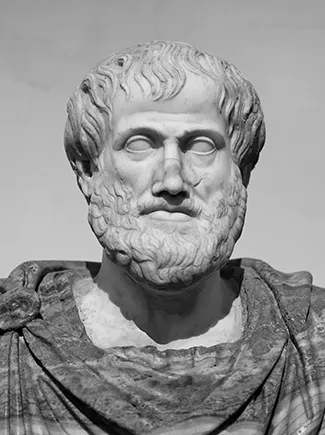
Credit for first establishing logic as a field of study goes to Aristotle (Figure 1.1). Socrates and Plato are sometimes cited, but they did not look at things as abstractly (generally) as Aristotle. Appeals may even be made going back farther to the Pythagoreans, for example, or others. This is not appropriate. To understand why we must make a subtle distinction. J. M. Bocheński explained, “Thinkers of these schools did indeed establish chains of inference, but logic consists in studying inference, not in inferring.”2
Figure 1.1
Aristotle (384 BCE–322 BCE).
Image created by jlorenz1. This file is licensed under the Creative Commons Attribution 2.5 Generic license.
Thus, Aristotle was the first to develop formal logic, intended as a set of rules by which one could reason correctly. He produced six works on logic. In collected form, they became known as the Organon.3 Questions have been raised concerning how much of these works should really be attributed to Aristotle, as opposed to his followers.4
In any case, Aristotle’s examples of logical reasoning are known as syllogisms. An example that is frequently given is
All men are mortal.
Socrates is a man.
Therefore, Socrates is mortal.
However, this is not the way Aristotle actually did things. His work is represented more accurately as
If all men are mortal
1 Taken here from http://www-history.mcs.st-and.ac.uk/Quotations/Russell.html, which has many other great quotes from Russell.
2 Bocheński, J. M., A History of Formal Logic (translated and edited by Ivo Thomas), University of Notre Dame Press, Notre Dame, IN, 1961, p. 11.
3 This collection can be downloaded from https://ia601407.us.archive.org/34/items/AristotleOrganon/AristotleOrganoncollectedWorks.pdf where it appears in a form translated under the editorship of W. D. Ross. Other works of Aristotle are included in this pdf as well.
4 Bocheński, J. M., A History of Formal Logic (translated and edited by Ivo Thomas), University of Notre Dame Press, Notre Dame, IN, 1961, pp. 40–41.
and all Greeks are men,
then all Greeks are mortal.5
But he did much more than demonstrate such commonsensical (to us anyway) arguments. He looked at things abstractly. This process seems to have begun with abbreviations. Using single letters to stand for men, mortal, and Greek, we can make the leap to treating these letters as variables.6 A pair of examples follow:7
Since if A (is predicated) of all B, and B of all C, A must be predicated of all C.
Similarly too if A (is predicated) of no B, and B of all C, it is necessary that A will belong to no C.
These are less clear (as often happens when things become more abstract), but much more general. Replacing the variables in 1) with specific choices gives8
If animal belongs to all man
and man belongs to all Greek,
then animal belongs to all Greek.
5 Taken here from http://planetmath.org/aristotelianlogic.
6 Bocheński, J. M., A History of Formal Logic (translated and edited by Ivo Thomas), University of Notre Dame Press, Notre Dame, IN, 1961, p. 42.
7 Taken from Bocheński, J. M., A History of Formal Logic (translated and edited by Ivo Thomas), University of Notre Dame Press, Notre Dame, IN, 1961, p. 64.
8 Taken from Bocheński, J. M., A History of Formal Logic (translated and edited by Ivo Thomas), University of Notre Dame Press, Notre Dame, IN, 1961, p. 66.
For 2), we have an example9 given by
If stone belongs to no man
and man belongs to all Greek,
then stone belongs to no Greek.
The abstraction from specific examples to the general syllogisms stated by Aristotle was a very important step. He also tried to build his logic on an axiomatic foundation. That is, he found that some syllogisms followed logically from others.
This also happens in every area of mathematics. That is, there are some statements that are deductive consequences, by specified rules of inference, of others. Wouldn’t it be nice if we could f...
Table of contents
Cover
Half Title
Series Page
Title Page
Copyright Page
Dedication
Table of Contents
Acknowledgments
Introduction
Author
0. Continuous vs. Discrete
1. Logic
2. Proof Techniques
3. Practice with Proofs
4. Set Theory
5. Venn Diagrams
6. The Functional View of Mathematics
7. The Multiplication Principle
8. Permutations
9. Combinations
10. Pascal and the Arithmetic Triangle
11. Stirling and Bell Numbers
12. The Basics of Probability
13. The Fibonacci Sequence
14. The Tower of Hanoi
15. Population Models
16. Financial Mathematics (and More)
17. More Difference Equations
18. Chaos Theory and Fractals
19. Cellular Automata
20. Graph Theory
21. Trees
22. Relations, Partial Orderings, and Partitions
Index
Trusted by 375,005 students
Access to over 1.5 million titles for a fair monthly price.
Study more efficiently using our study tools.
Frequently asked questions
Yes, you can cancel anytime from the Subscription tab in your account settings on the Perlego website. Your subscription will stay active until the end of your current billing period. Learn how to cancel your subscription
No, books cannot be downloaded as external files, such as PDFs, for use outside of Perlego. However, you can download books within the Perlego app for offline reading on mobile or tablet. Learn how to download books offline
Perlego offers two plans: Essential and Complete
Essential is ideal for learners and professionals who enjoy exploring a wide range of subjects. Access the Essential Library with 800,000+ trusted titles and best-sellers across business, personal growth, and the humanities. Includes unlimited reading time and Standard Read Aloud voice.
Complete: Perfect for advanced learners and researchers needing full, unrestricted access. Unlock 1.5M+ books across hundreds of subjects, including academic and specialized titles. The Complete Plan also includes advanced features like Premium Read Aloud and Research Assistant.
Both plans are available with monthly, semester, or annual billing cycles.
We are an online textbook subscription service, where you can get access to an entire online library for less than the price of a single book per month. With over 1.5 million books across 990+ topics, we’ve got you covered! Learn about our mission
Look out for the read-aloud symbol on your next book to see if you can listen to it. The read-aloud tool reads text aloud for you, highlighting the text as it is being read. You can pause it, speed it up and slow it down. Learn more about Read Aloud
Yes! You can use the Perlego app on both iOS and Android devices to read anytime, anywhere — even offline. Perfect for commutes or when you’re on the go. Please note we cannot support devices running on iOS 13 and Android 7 or earlier. Learn more about using the app
Yes, you can access Discrete Encounters by Craig Bauer in PDF and/or ePUB format, as well as other popular books in Mathematics & Operating Systems. We have over 1.5 million books available in our catalogue for you to explore.