One of the leading texts in the field, The Economics of Recreation, Leisure and Tourism is the ideal introduction to the fundamentals of economics in these industries, helping you to enjoy and pass an economics module as part of tourism, recreation, events or sport management degrees. International in its outlook, it will equip you with vital skills and knowledge for your future career as well as critical skills to help you understand and help tackle crucial challenges facing the world.
It is written in a clear and engaging style that assumes no prior knowledge of economics. It applies economic theory to a range of tourism industry issues at the consumer, business, national and international level by using topical examples to give the theory real-world context. This book is richly illustrated with diagrams and contains a range of features such as international case studies showcasing current issues, review questions and extracts from journals to aid understanding and further knowledge, as well as new data and statistics. It concludes with a powerful critique of traditional economics and a set of twenty-one issues that demand action.
This sixth edition has been revised and updated to include:
recent and time series international economic data to provide a sense of the dynamics of world economies
topical analysis to aid decision making for industry, governments and pressure groups
a renewed emphasis on environmental and climate change issues
new and revised international case studies that demonstrate theoretical principles of economics as applied to the sector
How can the study of economics help in our understanding of this sector?
What is the demand for recreation, leisure and tourism?
What determines the range and change of recreation, leisure and tourism activities available?
What does this sector contribute to economic development?
How can economics help us to deliver sustainable recreation, leisure and tourism?
What new, alternative and radical critiques can economics provide about recreation, leisure and tourism?
This book will help you investigate these issues. The objectives of this chapter are to define and integrate the areas of study of this book. First the scope of recreation, leisure and tourism will be discussed, and second the scope and techniques of economics will be outlined. The final part of the chapter explains how the study area of recreation, leisure and tourism can be analysed using economic techniques.
By studying this chapter students will be able to:
understand the scope of recreation, leisure and tourism and their interrelationship
explain the basic economic concerns of scarcity, choice and opportunity costs
outline the allocation of resources in different economic systems
explain the methodology of economics
understand the use of models in economics
understand the use of economics to analyse issues in recreation, leisure and tourism
access sources of information.
Definition and scope of recreation, leisure and tourism
Writing this book is part of my work. But it’s Friday so I have two days of leisure time ahead. This evening I’m taking my bike out to Hyde Park in London and tomorrow I’m taking the ferry to the Isle of Wight for an overnight break. Simply put, leisure is our free time (e.g. the weekend), recreation covers the enjoyable activities we do in our leisure time (e.g. cycling) and tourism involves a trip (e.g. an overnight break).
But like all definitions, those pertaining to recreation, leisure and tourism encounter some problems. For example, a common element in many definitions of leisure is that of free time. Thus working, sleeping and household chores are excluded. However, should we then include people who are sick or recovering from illness? Similarly, recreation is commonly applied to the pursuits that people undertake in their leisure time. But what about things people do to support their employment in their spare time? For example, is a computer programmer’s use of computers in non-working time a leisure activity? Similar questions arise in defining tourism. The common element in definitions of tourism is that of ‘temporary visiting’. Questions of scope immediately arise. Are people who are engaged in study overseas tourists? Are people travelling on business tourists? Finally, there has been a relentless breakdown of the barriers between these activities. We check our social media at work. We check our work emails on holiday. Aware of the problems involved, some working definitions of travel and tourism are now attempted.
Working definitions
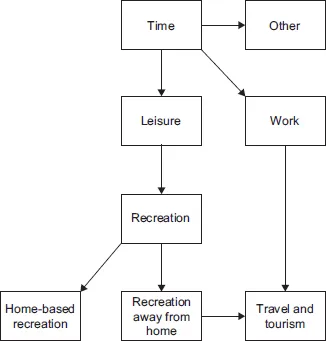
Leisure is discretionary time or the time remaining after working, commuting, sleeping and doing necessary household and personal chores that can be used in a chosen way.
Recreation covers pursuits undertaken in leisure time. Recreational pursuits include home-based activities such as reading and watching television, and those outside the home including sports, theatre, cinema and tourism.
Tourism is visiting for at least one night for leisure and holiday, business and professional or other tourism purposes. Visiting means a temporary movement to destinations outside the normal home and workplace.
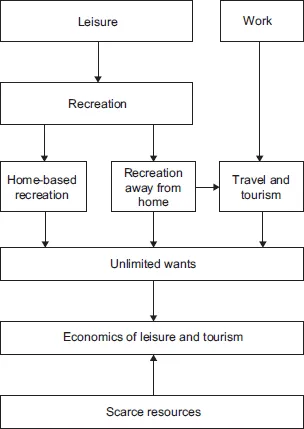
Recreation, leisure and tourism sector organizations are those producing goods and services for use in leisure time and those related to the use of leisure time. Figure 1.1 shows the relationship between recreation and tourism, and the constituent parts are discussed later.
Figure 1.1 Leisure and tourism
Home-based recreation
This includes:
listening to music
watching television and videos
listening to the radio
reading
do-it-yourself (DIY)
gardening
playing games
exercise
hobbies
leisure use of smartphones and computers.
Recreation away from home
This includes:
sports participation
watching entertainment
hobbies
visiting attractions
eating and drinking
betting and gaming.
Travel and tourism
This includes:
travelling to a destination
accommodation at a destination
recreation at a destination.
Definition, scope and methodology of economics
The nature of economics
Resources and wants
Economics arises from a basic imbalance that is evident throughout the world. On the one side, there are resources that can be used to make goods and services. These are classified by economists into
land (raw materials)
labour and
capital (machines).
Additionally, we sometimes include the entrepreneur (the person that brings factors of production together) as a resource (enterprise). On the other side, we have people’s wants. The worldwide economic fact of life is that people’s wants appear unlimited and exceed the resources available to satisfy these wants. This is true not just for people with low incomes, but for people with high incomes too. Clearly, the basic needs of rich people are generally satisfied in terms of food, clothing and shelter, but it is evident that their material wants in terms of cars, property, holidays and recreation are rarely fully satisfied.
Scarcity and choice
The existence of limited resources and unlimited wants gives rise to the basic economic problem of scarcity. The existence of scarcity means that choices have to be made about resource use and allocation. Economics is concerned with the choice questions that arise from scarcity:
What to produce?
How to produce it?
To whom will goods and services be allocated?
Opportunity cost
Since resources can be used in different ways to make different goods and services, and since they are limited in relation to wants, the concept of opportunity cost arises. This can be viewed at different levels.
At the individual level, consumers have limited income. So if they spend their income on a mountain bike, they can consider what else they could have bought with the money, such as an air ticket. Individuals also have limited time. If an individual decides to work extra overtime, leisure time must be given up. In the leisure field, Molina et al. (2016) examined preferences between reading, watching TV or listening to the radio, when relaxing at home.
At a local or national government level the same types of choices can be analysed. Local councils have limited budgets. If they decide to build a leisure centre, then that money could have been used to provide more home help to the elderly. Even if they raised local taxes to build the new leisure centre, there would be an opportunity cost since the taxpayers would have to give up something in order to pay the extra taxes. Similar examples exist at a national government level. For example, subsidizing the arts means that there is less money available for student grants. Opportunity cost analysis is discussed in Exhibit 1.1, which looks at whether museums and art galleries should charge an entrance fee.
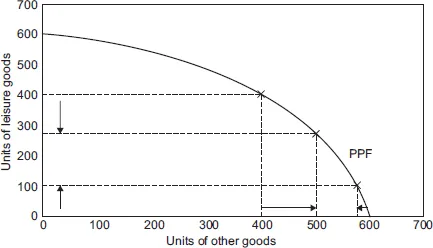
Opportunity cost is defined as the alternatives or other opportunities that have to be foregone to achieve a particular thing. Figure 1.2 illustrates this concept by use of a production possibility frontier (PPF). It is assumed first that the economy only produces two types of goods (leisure goods and other goods) and second that it uses all its resources fully.
Curve PPF plots all the possible combinations of leisure goods and other goods that can be produced in this economy. It is drawn concave to the origin (bowed outwards) since, as more and more resources are concentrated on the production of one commodity, the resources available become less suitable for producing that commodity.
Curve PPF shows that if all resources were geared towards the production of leisure goods, 600 units could be produced with no production of other goods. At the other extreme, 600 units of other goods could be produced with no units of leisure goods. The PPF describes the opportunity cost of increasing production of either of these goods. For example, increasing production of leisure goods from 0 to 100 can only be done by diverting resources from the production of other goods, and production of these falls from 600 to 580 units. Thus, the opportunity cost at this point of 100 units of leisure goods is the 20 units of other goods that must be foregone. Similarly, if all resources are being used to produce a combination of 400 units of leisure goods and 400 units of other goods, the opportunity cost of producing an extra 100 units of other goods would be 100 units of leisure goods.
Figure 1.2 Opportunity cost and the PPF
Allocative mechanisms
The existence of scarcity of resources and unlimited wants means that any economy must have a system for determining what, how and for whom goods are produced. Wherever we live in the world we probably take the system that operates for granted. The main systems for achieving this are:
free market economies (capitalism)
centrally planned economies (communism)
mixed economies.
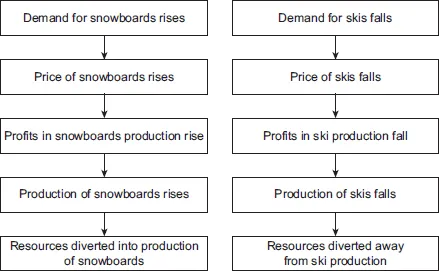
Free market economies work by allowing private ownership of firms. The owners of such firms produce goods and services by purchasing resources. The motive for production is profit and thus firms will tend to produce those goods and services that are in demand. Figure 1.3 shows the market mechanism in action and how resources are allocated away from the production of skis in favour of snowboards in response to changes in demand.
Centrally planned economies do not allow the private ownership of firms, which instead are state owned. Production decisions are taken by state planning committees and resources are mobilized accordingly. Consumers generally have some choice of what to buy but only from the range determined by state planners.
Figure 1.3 The price mechanism in action
Mixed economies incorporate elements from each system. Private ownership of firms tends to predominate, but production and consumption of goods and services may be influenced by public ownership of some enterprises and by the use of taxes and government spending.
The allocative mechanism has important implications for leisure and tourism. The collapse of communism in the eastern bloc heralded the transition of these economies from centrally planned to market systems. Tourism facilities, such as hotels and restaurants, in these countries had to revolutionize their organizational culture and become more customer oriented. The economies of Cuba and China are still nominally centrally planned, but free enterprise is well established in China, and at least on a superficial level the city of Beijing has many similarities to Los Angeles – massive freeways, extensive shopping malls, sprawling development and visible pollution. The expansion of McDonald’s into communist countries illustrates the gradual penetration of global capitalism into the communist world, followed by a succession of global leisure brands such as Nike, Apple and Disney. In 1988, McDonald’s opened its first restaurant in a communist country, in Belgrade, Yugoslavia (now Serbia). In 1990, the first Soviet McDonald’s opened in Moscow and was for a time the largest McDonald’s in the world. In the same year the first McDonald’s opened in Mainland China, in the cit...
Table of contents
Cover
Half Title
Title
Copyright
Contents
List of plates
List of figures
List of tables
List of exhibits
Preface to the sixth edition
1 Introduction
PART I Organizations and markets
PART II Further issues of demand and supply
PART III Markets in practice
PART IV The external operating environment
PART V Investment
PART VI Economic impacts
PART VII The global economy
PART VIII Environmental economics
Bibliography
Index
Trusted by 375,005 students
Access to over 1.5 million titles for a fair monthly price.
Study more efficiently using our study tools.
Frequently asked questions
Yes, you can cancel anytime from the Subscription tab in your account settings on the Perlego website. Your subscription will stay active until the end of your current billing period. Learn how to cancel your subscription
No, books cannot be downloaded as external files, such as PDFs, for use outside of Perlego. However, you can download books within the Perlego app for offline reading on mobile or tablet. Learn how to download books offline
Perlego offers two plans: Essential and Complete
Essential is ideal for learners and professionals who enjoy exploring a wide range of subjects. Access the Essential Library with 800,000+ trusted titles and best-sellers across business, personal growth, and the humanities. Includes unlimited reading time and Standard Read Aloud voice.
Complete: Perfect for advanced learners and researchers needing full, unrestricted access. Unlock 1.5M+ books across hundreds of subjects, including academic and specialized titles. The Complete Plan also includes advanced features like Premium Read Aloud and Research Assistant.
Both plans are available with monthly, semester, or annual billing cycles.
We are an online textbook subscription service, where you can get access to an entire online library for less than the price of a single book per month. With over 1.5 million books across 990+ topics, we’ve got you covered! Learn about our mission
Look out for the read-aloud symbol on your next book to see if you can listen to it. The read-aloud tool reads text aloud for you, highlighting the text as it is being read. You can pause it, speed it up and slow it down. Learn more about Read Aloud
Yes! You can use the Perlego app on both iOS and Android devices to read anytime, anywhere — even offline. Perfect for commutes or when you’re on the go. Please note we cannot support devices running on iOS 13 and Android 7 or earlier. Learn more about using the app
Yes, you can access The Economics of Recreation, Leisure and Tourism by John Tribe in PDF and/or ePUB format, as well as other popular books in Business & Business General. We have over 1.5 million books available in our catalogue for you to explore.