Multilevel modelling is a data analysis method that is frequently used to investigate hierarchal data structures in educational, behavioural, health, and social sciences disciplines. Multilevel data analysis exploits data structures that cannot be adequately investigated using single-level analytic methods such as multiple regression, path analysis, and structural modelling. This text offers a comprehensive treatment of multilevel models for univariate and multivariate outcomes. It explores their similarities and differences and demonstrates why one model may be more appropriate than another, given the research objectives.
New to this edition:
An expanded focus on the nature of different types of multilevel data structures (e.g., cross-sectional, longitudinal, cross-classified, etc.) for addressing specific research goals;
Varied modelling methods for examining longitudinal data including random-effect and fixed-effect approaches;
Expanded coverage illustrating different model-building sequences and how to use results to identify possible model improvements;
An expanded set of applied examples used throughout the text;
Use of four different software packages (i.e., Mplus, R, SPSS, Stata), with selected examples of model-building input files included in the chapter appendices and a more complete set of files available online.
This is an ideal text for graduate courses on multilevel, longitudinal, latent variable modelling, multivariate statistics, or advanced quantitative techniques taught in psychology, business, education, health, and sociology. Recommended prerequisites are introductory univariate and multivariate statistics.
In this introductory chapter, we present an overview of several conceptual and methodological issues associated with modeling individual and group processes embedded in clustered/hierarchical data structures. We locate multilevel modeling techniques within a broader set of univariate and multivariate methods commonly used to examine various types of data structures. We then illustrate how choices of analytic method can impact the optimal investigation of the data. This overview foreshadows our further development of these issues and models in subsequent chapters.
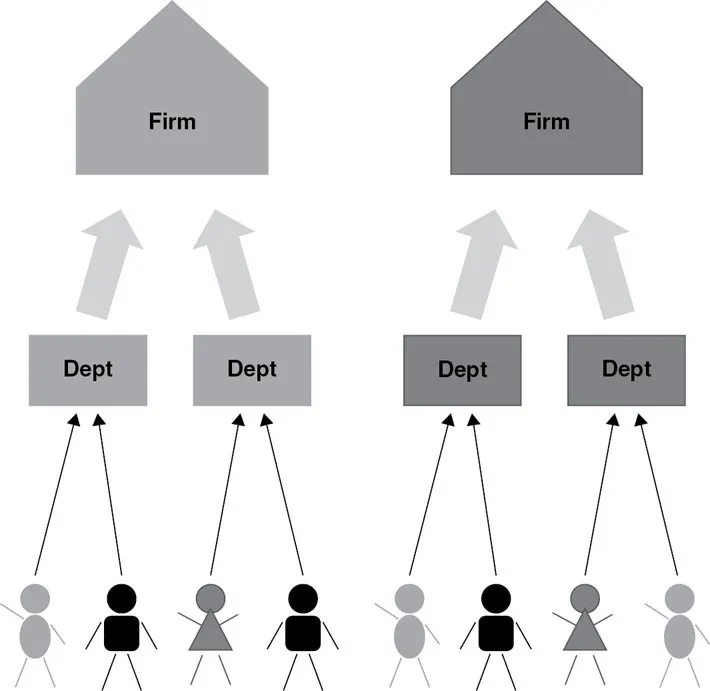
Over the past several decades, concerns in various fields with conceptual and methodological issues in conducting research with hierarchical (or nested) data have led to the development of multilevel modeling techniques. Research on organizations such as universities or product and service firms presents opportunities to study phenomena in hierarchical settings. Individuals (level 1) may work within specific formally defined departments (level 2), which may be found within larger organizations (level 3), which, in turn, may be located within specific states, regions, or nations. These individuals interact with their social contexts in a variety of ways. Individuals bring certain skills and attitudes to the workplace; they are clustered in departments or work units having certain characteristics, and they are also clustered within organizations having particular characteristics. Because of the presence of these successive groupings in hierarchical data, individuals within particular organizations may share certain properties including socialization patterns, traditions, attitudes, and work goals. Similarly, properties of groups (e.g., leadership patterns, improvement in productivity) may also be influenced by the people in them. We illustrate a fully nested hierarchical structure in Figure 1.1, where each individual is a member of a particular department and each department, in turn, is nested within a particular firm.
Figure 1.1Hierarchical data structure.
Hierarchical data also result from the specific research design and the nature of the data collected. In survey research, for example, individuals are often selected to participate in a study from some type of stratified random sampling design (e.g., individuals may be chosen from certain neighborhoods in particular cities and geographical areas). Longitudinal data collection also presents another research situation where a series of measurements is nested within the individuals who participate in the study. In turn, those individuals may be mobile between groups during the course of a study, for example, individuals seeing different therapists, students changing teachers and schools, and patients receiving care from different combinations of nurses or doctors.
In the past, researchers often had considerable difficulty analyzing data where individuals were nested within hierarchical groupings. Ignoring such data structures can lead to false inferences about the relations among variables in a model, as well as missed insights about the processes studied. Today, however, for studying individual and group phenomena, multilevel modeling is an attractive approach because it allows the incorporation of substantive theory about such individual and group processes into the clustered sampling schemes typical of large-scale survey research. It is steadily becoming the standard analytic approach for research in fields such as business, education, health sciences, and sociology because of its applicability to a broad range of research situations, designs, and data structures (e.g., hierarchical data, cross-classified data, longitudinal data). Researchers refer to multilevel modeling by various names including random coefficients models, mixed-effects models, multilevel regression models, and hierarchical linear models. This diversity of names is an artifact of the statistical theory underlying multilevel models—theory developed out of methodological work in several different fields. For this reason, there are differences in the preferences and manner in which the methods are used in each field. At their core, however, these methods are all integrally related by virtue of their primary emphasis on the decomposition of variance in a single outcome or a multivariate set of outcomes and the explanation of this variance by sets of explanatory variables that are located in different strata of the data hierarchy.
We begin with the principles that quantitative analysis really deals with the translation (or operationalization) of abstract theories into concrete models, and theoretical frameworks are essential guides to sound empirical investigation. Statistical models are not empirical statements or descriptions of actual worlds (Heckman, 2005); rather, they are mathematical representations of behaviors and attitudes believed to exist in a larger population of interest. In other words, our statistical models represent a set of proposed theoretical relations thought to exist in the population—a set of theoretical relationships that account for relationships actually observed in the sample data from that population (Singer & Willett, 2003).
Providing a Conceptual Overview
Multilevel conceptual frameworks open up new possibilities for investigating theories concerning how individuals and groups interact. We refer to the lowest level of the hierarchy (level 1) as the micro level, with all higher levels in the hierarchical data structure as the macro level. As an example, we might be interested in defining and examining relationships between individual, departmental, and organizational processes on organizational productivity. A three-level conceptual model might include variables relating to individuals at level 1 (the micro level), departments at level 2, and organizations at level 3. Of course, we could define higher organizational levels such as locales, regions, or nations at level 4 through k. From this perspective, the relationships among variables observed for the micro-level units (individuals) in a study have parameters that can take on different values from those values of the higher-level units (e.g., departments or organizations). Researchers often refer to macro levels as groups or contexts. With a contextual model, therefore, one could envision successive levels, and their associated contextual variables, extending well beyond the organization.
Each of these groupings or levels of context may exert effects on, for example, productivity in the workplace. Outcomes may be influenced by combinations of variables related to each hierarchical level of the organization including the backgrounds and attitudes of employees (e.g., experience, education and work-related skills, attitudes and motivations), the processes of organizational work (e.g., leadership, decision-making, staff development, resource allocation, socialization), and the context or setting of the organization (e.g., size, type, geographical location). There may also be variables at higher organizational levels that influence variables affecting outcomes at lower levels of the organization. We highlight some of these possible relationships in Figure 1.2.
Research strategies for dealing with the complexity of the multilevel, or contextual, features of organizations were more limited historically. Researchers did not always consider the implications of the assumptions they made about measuring variables at their natural level, or moving them from one level to another through aggregation or disaggregation. We summarize this process in Figure 1.2 with two-headed arrows. Aggregation, for example, means that the researcher combines productivity levels of individuals within departments or organizations to produce a higher-level estimate (e.g., an organizational-level mean). Successive aggregation of variables reduce...
Table of contents
Cover
Half Title
Series Information
Title Page
Copyright Page
Table of Contents
Acknowledgments
Preface
1 Introduction
2 Getting Started with Multilevel Analysis
3 Multilevel Regression Models
4 Extending the Two-level Regression Model
5 Methods for Examining Individual and Organizational Change
6 Multilevel Models with Categorical Variables
7 Multilevel Structural Equation Models
8 Multilevel Latent Growth and Mixture Models
9 Data Considerations in Examining Multilevel Models
Index
Trusted by 375,005 students
Access to over 1.5 million titles for a fair monthly price.
Study more efficiently using our study tools.
Frequently asked questions
Yes, you can cancel anytime from the Subscription tab in your account settings on the Perlego website. Your subscription will stay active until the end of your current billing period. Learn how to cancel your subscription
No, books cannot be downloaded as external files, such as PDFs, for use outside of Perlego. However, you can download books within the Perlego app for offline reading on mobile or tablet. Learn how to download books offline
Perlego offers two plans: Essential and Complete
Essential is ideal for learners and professionals who enjoy exploring a wide range of subjects. Access the Essential Library with 800,000+ trusted titles and best-sellers across business, personal growth, and the humanities. Includes unlimited reading time and Standard Read Aloud voice.
Complete: Perfect for advanced learners and researchers needing full, unrestricted access. Unlock 1.5M+ books across hundreds of subjects, including academic and specialized titles. The Complete Plan also includes advanced features like Premium Read Aloud and Research Assistant.
Both plans are available with monthly, semester, or annual billing cycles.
We are an online textbook subscription service, where you can get access to an entire online library for less than the price of a single book per month. With over 1.5 million books across 990+ topics, we’ve got you covered! Learn about our mission
Look out for the read-aloud symbol on your next book to see if you can listen to it. The read-aloud tool reads text aloud for you, highlighting the text as it is being read. You can pause it, speed it up and slow it down. Learn more about Read Aloud
Yes! You can use the Perlego app on both iOS and Android devices to read anytime, anywhere — even offline. Perfect for commutes or when you’re on the go. Please note we cannot support devices running on iOS 13 and Android 7 or earlier. Learn more about using the app
Yes, you can access An Introduction to Multilevel Modeling Techniques by Ronald Heck,Scott L. Thomas,Ronald H. Heck in PDF and/or ePUB format, as well as other popular books in Psychology & Statistics for Business & Economics. We have over 1.5 million books available in our catalogue for you to explore.