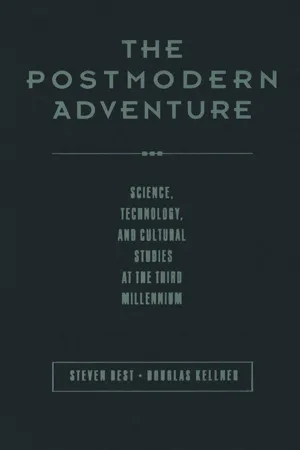
This compelling book explores the challenges to theory, politics, and human identity that we face on the threshold of the third millennium. It follows on the successor of Best and Kellner's two previous books, Postmodern Theory, acclaimed as the best critical introduction to the field - and The Postmodern Turn, which provides a powerful mapping of postmodern developments developments in the arts, politics, science, and theory. In The Postmodern Adventure, Best and Kellner analyze a broad array of literary, cultural, and political phenomena from fiction, film, science, and the Internet, to globalization and the rise of a transnational image culture.
eBook - ePub
The Postmodern Adventure
Science Technology and Cultural Studies at the Third Millennium
- 320 pages
- English
- ePUB (mobile friendly)
- Available on iOS & Android
eBook - ePub
The Postmodern Adventure
Science Technology and Cultural Studies at the Third Millennium
About this book
Trusted by 375,005 students
Access to over 1.5 million titles for a fair monthly price.
Study more efficiently using our study tools.
Information
1

THOMAS PYNCHON AND THE ADVENT OF POSTMODERNITY
May God keep us
From Single vision and Newton’s sleep.— WILLIAM BLAKE
Yet how superb, across the tumult braided. The painted rainbow’s changeful life is bending. Now clearly drawn, dissolving now and faded. And evermore the showers of dew descending! Of human striving there’s no symbol fuller: Consider, and ‘tis easy comprehending—Life is not light, but refracted color.— JOHANN VON GOETHE
Life’s single lesson: that there is more accident to it than a man can ever admit to in a lifetime and stay sane.— THOMAS PYNCHON
The alleged end of modernity and the rise of postmodernity has been much debated, but sustained analysis and grounding of claims for a postmodern divide in society and history are rarely advanced. Rather than opening with abstract theoretical formulations confronting this transition, we begin by engaging Thomas Pynchon’s novel Gravity’s Rainbow (hereafter GR) which vividly illuminates a phase between the modern and the postmodern. Portraying the origins of post-World War II society and what he calls the “Rocket State,” Pynchon delineates in GR the beginnings of the Cold War and the concomitant rise of a system of global capitalism. In our reading, Pynchon’s novel depicts the evolution of an intensified scientific and technological culture out of the industrial and military trials of World War II, which helped generate the postmodern adventure.
In addition, Pynchon’s texts exhibit the postmodern turn in the arts, science, and theory, as he cultivates a mode of postmodern writing, epistemology, and vision. The post-World War II proliferation of forms of science, technology, political and military bureaucracy, and the globalization of corporate capi- talism requires modes of writing adequate to represent the complex array of forces that have been constructing emergent postmodern constellations. We argue that Pynchon’s GR provides a historical vision and context which helps to clarify what is new and original about the postmodern adventure. Our reading of Pynchon also leads us to interrogate the difference between aesthetic and theoretical maps and to articulate the specificity and efficacy of each. Hence, we open by confronting the issues of Pynchon’s style of writing and the postmodern turn in literature, as both underscore the need for innovative theoretical and literary mappings to capture the novelties and complexities of the contemporary era.
Literary Modernism/Postmodernism
History—at best a conspiracy, not always among gentlemen, to defraud.— THOMAS PYNCHON
Everything is connected.— THOMAS PYNCHON
Since the 1950s, Pynchon has been a major literary figure whose works mark the passage from modern to postmodern literature and culture. Given the heterogeneity that characterizes the postmodern, it should be no surprise that the postmodern turn in literature has moved in opposing directions.1 While some postmodern writers take a preoccupation with linguistic experimentalism into a reified realm above sociopolitical considerations, others, such as Pynchon, William S. Burroughs, Don DeLillo, and Kathy Acker, merge their aesthetic and formal innovations with social and political concerns and engage the topics of domination and emancipation within a technocratic/bureaucratic/cybernetic/media world. Of course, contestation of conventional modes of perception can assume a political character, as they did in some forms of dada and surrealism, but socially critical postmodernists employ the formalist inventions of postmodern fiction for political ends, thereby breaking out of the self-referential funhouse of language.
For some aesthetic-oriented postmodern writers, the critique of realist texts entails a solipsistic withdrawal from the social world and any efforts to directly depict or engage it. For others, rejection of realism is only part and parcel of a larger political operation that demands some new form of “representing” the social world. Thus, it makes sense to distinguish between a ludic postmodernism (Ebert 1994), or a “postmodernism of reaction” (Foster 1983), that indulges in aesthetic play for its own sake while distancing itself from a politically troubled world, or even lending tacit or explicit support to the status quo, and a “postmodernism of resistance.” The latter acknowledges its reflexive appropriation of traditional literary forms, but also seeks to engage political issues and to change culture and society.
Pynchon’s work exemplifies a postmodernism of resistance and the abandonment of a linear narrative in favor of a fragmented, multiperspectivist form that examines the evolution of modern Western society from scientific, technological, economic, political, cultural, journalistic, historical, and mythological standpoints. The rich, multiperspectival character of Pynchon’s GR thereby naturally lends itself to a plethora of opposing interpretations, such as a Marxian or Weberian political and historical allegory, or psychoanalytic, comic, religious, or formalist readings.
We pursue a political allegorical interpretation of GR that links central Pynchonian themes to the concerns of postmodern theory.2 Our own multiperspectivist framework, however, requires us to present our reading as one against many, as our own set of optics that seeks to illuminate significant moments in the postmodern adventure, but does not preclude and in fact encourages alternative readings.3 GR demands a multiperspectivist account because it exhibits such a wealth of standpoints organized in an “encyclopedic narrative” that, like Ulysses, Moby Dick, or Faust, attempts “to render the full range of knowledge and beliefs of a national culture, while identifying the ideological perspectives from which that culture shapes and interprets its knowledge” (Mendelson 1976: 162). Pynchon’s “encyclopedia,” we would argue, not only accommodates a wealth of forms of knowledge and discourse, but an abundance of literary techniques and strategies, combining modern and postmodern forms. Moreover, by juxtaposing scientific, philosophical, religious, and literary discourses, Pynchon subverts the authority of each perspective. This procedure puts in question one-sided ways of seeing and knowing, while interrogating the limitations and value of competing conceptual schemes (such as science or religion, rationalism vs. irrationalism, theory or literature, and so on), suggesting the relativity and limitations of particular perspectives.
In writing his works of fiction, Pynchon not only references a dizzying array of sociohistorical and cultural phenomena, he employs myriad narrative styles, borrowing from such forms as the picaresque quest novel, expressionism, surrealism, pornography, and political allegory. One of the many important codes and genres he deploys is that of the “historical novel” insofar as his works focus on actual historical events that Pynchon has researched meticulously.4 Yet he privileges neither history nor fiction, showing that a novel can help comprehend specific eras and situations, but that fiction benefits from historical research and insight and other forms of knowledge in order to better portray the complexities of the epoch under question.
Pynchon frequently satirizes the specific discourses that he deploys, sabotaging their pretension to Truth. Northrop Frye proposes placing Pynchon’s work in the category of “Menippean satire” which, like Gargantua and Pantagruel, Gulliver’s Travels, Candide, and other texts, ironize the pedantry of a specific culture while simultaneously demonstrating vast learning, questioning dominant views of the culture, and subtly undermining its own cultural position (1976: 308–312). This characterization accurately describes Pynchon’s highly self-reflexive work, which both displays the monumentality and erudition of high modernism and mocks its conceits and questions its concepts of truth, certainty, and system.
In his literary work, Pynchon challenges the “old” modern way of seeing and knowing and anticipates “new” postmodern cultural forms. His writing points to the limitations of modern modes of perception and representation, and demonstrates the need to deploy multiple perspectives to better grasp history and social life. Consequently, he adopts a fragmented, multiperspectivist approach that jumps from science to media culture, from mythology to history, from comic opera to political economy. In the Pynchonian vision, modern structures and institutions invariably give way to chaos that produce both emergent forms of order and/or dissolution, entropy, and ultimately death.5 For Pynchon, the world is often stranger than it seems, and our forms of reason, structure, and reality are always haunted by their opposites. A master of the surreal, Pynchon liberally spices his narratives with the fabulous, the miraculous, and the improbable. He is also a relentless critic of the modern scientific belief that reason can completely understand and control the world. Pynchon’s literary mappings point to the limitations and illusions of conventional modern forms and paradigms of representation. His own writing, by contrast, yields alternative narrative structures that are more faithful to the complexity of experience, the turbulence of history, and the mysteries of life.
We shall see that Pynchon’s texts abound with correlations between phenomena and imply an alternative order of connections, as well as forms of causality and law, that undermine modern conceptual schemes and paradigms. His work advances a radical critique of modern mechanistic models of causality and rationality, undercutting the positivist belief that scientific experiment and laws will incrementally supply knowledge of the ultimate structures of reality and enable the scientist to control the most minute aspects of life. For Pynchon, disorder, chaos, violence, paradox, and enigma are constantly subverting such rationalist schemes and dreams. Sometimes Pynchon unfolds linkages and forms of creative order not perceived by mechanistic paradigms and theories, while other times he portrays disintegration in a universe saturated with random events, radical disorder, and possibilities for increased happiness and freedom or for destruction and barbarism.
Pynchon’s multilayered writing characteristically proceeds from depictions of the stuff of everyday experience and ordinary life, to depicting the natural, sociohistorical, political, economic, and cultural powers that envelop everyday life. In his writings, he exhibits the impact of the force of circumstances and the slaughterhouse of history on the human body and social relations, while reflecting on the ultimate historical, philosophical, and scientific mysteries of life. Written during the period of the Vietnam War, the antiwar movement and the counterculture, and dramatic social contestation in the 1960s and early 1970s, GR is part of an oppositional sensibility that confronts governing institutions and especially attacks the military, the state, and the system of corporate capitalism and imperialism that has produced endless wars and misery.
Certainly, Pynchon’s novel is much more than just a ‘60s attack on the Establishment, for it furnishes a literary articulation of the forces of history that have produced the modern world and are in the process of creating new forms of domination and destruction. This brings us, inevitably, to the themes of conspiracy and paranoia in Pynchon’s work. His writing is not “paranoid” in either a clinical or a metaphorical sense, nor is he a conspiracy monger—although there are all sorts of conspiracies in his fictive worlds. We therefore reject the conspiracy motif as an ultimate explanation or key to Pynchon’s world, arguing instead that there are many optics that can be deployed to read his work. Yet we see the paranoia and conspiracy thematics as a means to thwart hegemonic orderings and mappings, to suggest that something more might be going on and that malevolent forces may be at work. On this view, appearances are deceptive and our commonsensical everyday understandings of the world are flawed. In GR, paranoia is presented as the psychological state in which one believes everything is interrelated and part of some nefarious plot. It is distinguished from “antiparanoia” where one loses all sense of connection with the world and sees everything as self-constituted and fragmented. Antiparanoia is that psychic condition “where nothing is connected to anything, a condition not many of us can bear for long” (GR 506). A “creative paranoia” makes connections that were not hitherto apparent and thus is formally similar to dialectics which, as Fredric Jameson reminds us, is the art of making connections.6
Indeed, Pynchon’s literary mappings challenge hegemonic social schemes of ideology and interpretation, demonstrating the limitations of scientific cognition, logic, and bourgeois normality. His writings intimate that particular events unsettle standard schemes of explanation and point to dimensions of contingency, disorder, and randomness that disrupt the modern project of understanding, dominating, and reshaping the world. In the midst of a frightening and incomprehensible social reality, people often construct rigid forms of order and identity to fight off meaninglessness, chaos, and that ultimate dissipation, death itself. Pynchon’s depiction of seemingly perverse sadomasochism, fetishisms, peculiar rituals, and offbeat and weird forms of behavior portray a cornucopia of ways that people cope with chaos and contingency, and produce forms of order and meaning, however seemingly bizarre.
While Pynchon could be pointed to as an example of a postmodernism of resistance, we will argue that his work stands between the modern and the postmodern, drawing on both traditions. On the whole, postmodernist literature frequently concerns itself with banal aspects of everyday life and is playful, ironic, modest, and eschews the monumentality and lust for originality in modernism. Pynchon, by contrast, is much more of a modernist auteur with dedicated followers who hold that GR is the post-World War II novel and that his ouevre as a whole is the most significant of our time. There is a cult of Pynchon, with its Pynchon Notes, conferences, ever burgeoning publications, websites and Internet discussion lists—all revolving around an enigmatic writer who isolates himself from the public world. Moreover, GR is truly modernist in its aspirations and achievements; it is strikingly original; and its author does have a distinctive style, vision, and set of themes. He takes on the most vital issues of our time, confronting the Bomb and the Rocket State, media culture, suburbia, and the trajectory of U.S. society since World War II, as well as the global origins and vicissitudes of modernity. Pynchon’s penetrating and dazzling writing also engages the textures of everyday life and experience, offering distinctive attempts to depict post-World War II society and culture. Hence, whereas some forms of postmodernism go for little truths rather than big ones, shun signification (and resist interpretation), Pynchon’s texts are veritable meaning machines that invite multiple readings, demand interpretation, and make big statements about portentous events and phenomena.
Yet there is enough postmodernism in Pynchon’s style and texts to justify using this term to describe certain aspects of his work. Accordingly, we argue that he articulates a postmodern vision of fundamental transitions in history and society, and provides postmodern modes of vision and thought. Pynchon employs standard postmodern representational strategies such as self-reflexive narrative, effacement of the high/low art distinction, the dismantling of subjectivity and reader’s expectations, and an antideterminist worldview, while affirming political resistance and doing so in a distinctly postmodern manner that abandons traditional schemes of modern politics. His authorial stance is extremely complex, more fragmented and conflicted than the narrative style of Pound, Eliot, Hemingway, Kafka, or Joyce. Pynchon mixes more genres and voices, undermines more radically the authority of his characters and discourses, is more bitingly ironic, and draws more heavily on forms and techniques of media culture than his modernist predecessors. Crucially, as we show in our reading, Pynchon scrambles literary codes, mixing styles, genres, and discourses in a highly implosive text that disseminates portrayals of chaos, entropy, indeterminacy, and contingency, thus taking on principal themes of postmodern science and social theory (see Best and Kellner 1997; Chapter 3).
GRAVITY’S RAINBOW: MAPPING HISTORY
Radioactive poisoning of the atmosphere and hence annihilation of any life on earth has been brought within the range of technical possibilities. … In the end, there beckons more and more clearly general annihilation.— ALBERT EINSTEIN
Man’s … entire modern history has been characterized by a series of breakdowns and blurrings of boundaries. And since World War Two that process has become so intense and so extreme that we may take the year 1945 as the beginning of a new historical epoch.— ROBERT JAY LIFTON
Situating GR during the final year of World War II and the first year of the postwar scramble for power, spheres of influence, and military technology, Pynchon describes the rise of a nascent form of global capitalism based on a military–industrial complex, new technologies, a proliferation of consumer goods and services, information and entertainment, bureaucracy, and expanding systems of power and social control. Thus, GR yields a parable of the birth of the postmodern adventure in the matrix of a simultaneously decomposing and evolving modern society, reaching its apotheosis in world war and the atomic bomb.
...Table of contents
- Cover
- Half Title
- Title Page
- Copyright Page
- Table of Contents
- INTRODUCTION Between the Modern and the Postmodern
- 1 Thomas Pynchon and the Advent of Postmodernity
- 2 Modern/Postmodern Wars: Vietnam, Iraq, and Beyond
- 3 Postmodern Turns in Science
- 4 Technological Revolution and Human Evolution
- 5 Globalization and the Restructuring of Capital
- EPILOGUE Challenges for the Third Millennium
- Bibliography
- Index
- About the Authors
Frequently asked questions
Yes, you can cancel anytime from the Subscription tab in your account settings on the Perlego website. Your subscription will stay active until the end of your current billing period. Learn how to cancel your subscription
No, books cannot be downloaded as external files, such as PDFs, for use outside of Perlego. However, you can download books within the Perlego app for offline reading on mobile or tablet. Learn how to download books offline
We are an online textbook subscription service, where you can get access to an entire online library for less than the price of a single book per month. With over 1.5 million books across 990+ topics, we’ve got you covered! Learn about our mission
Look out for the read-aloud symbol on your next book to see if you can listen to it. The read-aloud tool reads text aloud for you, highlighting the text as it is being read. You can pause it, speed it up and slow it down. Learn more about Read Aloud
Yes! You can use the Perlego app on both iOS and Android devices to read anytime, anywhere — even offline. Perfect for commutes or when you’re on the go.
Please note we cannot support devices running on iOS 13 and Android 7 or earlier. Learn more about using the app
Please note we cannot support devices running on iOS 13 and Android 7 or earlier. Learn more about using the app
Yes, you can access The Postmodern Adventure by Steven Best,Douglas Kellner in PDF and/or ePUB format, as well as other popular books in Social Sciences & Human Geography. We have over 1.5 million books available in our catalogue for you to explore.