In this chapter, we introduce the field of information technology (IT), cover definitions, explore the components that make up IT, and look at IT careers. The learning objectives of this chapter are to be able to:
Information technology (IT) is an umbrella term. It is used to describe careers that use computers; to describe systems of hardware, software, and data; and to describe the staff of an organization who takes care of computer systems. Let’s look at each of these in turn.
The term IT has often been used synonymously with any career that uses computer systems. In the 1970s through the 1980s, just about any tech-oriented career was placed under the general label, IT. This included, for instance, programmers, system analysts, mechanical engineers, graphic designers, radiologists, and anyone who used a database. Today, just about every field of endeavor uses computer systems to some extent, from accounting to zoology, and so this use of the term IT is no longer useful. But careers in IT are still broader than what we might think. Table 1.1 provides a list of “IT” careers as found in such popular websites as itcareerfinder.com, allaboutcareers.com, and careerizma.com.
The list in Table 1.1 is far from complete. Careers that are more closely tied to IT as it is used today include forms of computer administration. Computer administration includes system administrators, network administrators, and database administrators. We also add help desk and computer support specialists to this list. The IT platform additionally includes the various forms of computer programmers whether they are considered computer scientists, software engineers, software developers, system developers, mobile app developers, web developers, or user interface developers. There are also network architects, cloud engineers, hardware engineers, and robotics engineers. Another category is security specialists such as IT security engineers, security architects, penetration testers, information security analysts, or forensic computer analysts.
This latter list of IT careers makes up the third definition of IT. That is, this list consists of the people who make up the IT staff (except possibly software developers). In IT, it is common that programming is handled by the administrators, engineers, and security specialists.
By shifting the term IT from anyone who uses a computer to those who administer computers tells us that the IT career is more focused today than it was in the past– specifically, the IT jobs are focusing on creating, connecting, configuring, troubleshooting, and securing computer systems. It is this third definition that we will largely concern ourselves with throughout this textbook.
What about the second usage of IT as described previously? This version of IT describes computer systems and their components. Let’s spend a little bit of time focusing on this definition by formally defining a computer system.
Did You Know?
The word computer originates from the Latin word computare meaning “programmable machine”.
A computer system is the set of hardware and software that people use for processing. The hardware must consist of a processor, if nothing else. The processor processes software, meaning that it runs or executes programs. We usually refer to programs as software. The programs instruct the processor what to do instruction-by-instruction.
People who use computers are known as end users (or just users). They are also components within computer systems. Without a person, there is nothing for the computer to do. It is the person that decides when to run a program and how to run that program (e.g., what input to use). Although we can automate when programs run, it is the user who sets this up.
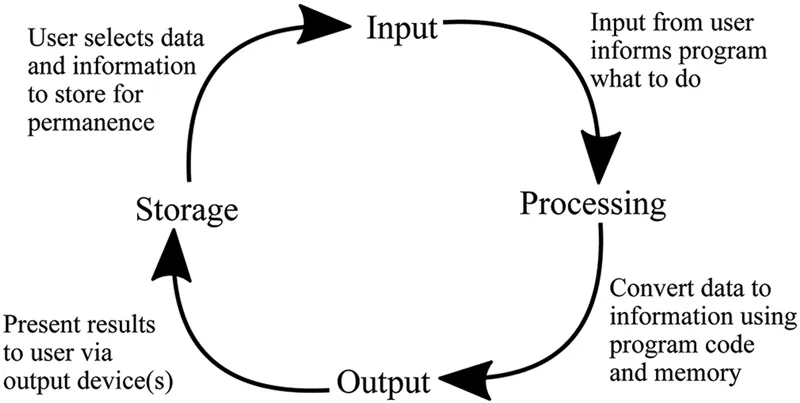
Computer systems often contain other forms of hardware: input devices, output devices, telecommunications devices, and storage devices. These four terms overlap as, for instance, storage devices and telecommunication devices allow the computer to obtain input and can be used to send or store output. In all, a computer system performs what we call the IPOS cycle: Input–Processing–Output–Storage. This is shown in Figure 1.1. Not all programs will use all four of these functions, but all four are common, and any computer must be able to perform all four. Let’s examine each of these four steps.
Input is the process of obtaining information, data, or commands from outside of the computer and bringing it into the computer. Here, “outside” and “inside” are considered the main components of the computer: processor and memory (see the next paragraph). Input devices include keyboard and mouse but also microphones, scanners, sensors, touchpads and touchpoints, joysticks, and others. A telecommunications device can deliver input to the computer as can a storage device.
Processing means to execute or run programs. The program itself is a list of instructions. Each instruction is stored in memory. Processing involves fetching the next instruction from memory, retrieving any data that the instruction will execute on, and executing the instruction on the data. There are several types of instructions: data movement, arithmetic or logic operation, branch, and input/output. Processing is handled by the processor, also known as the central processing unit (CPU), and memory.
HUMAN COMPUTERS?
Have you seen the movie Hidden Figures? NASA employed many African American women as computers. It was these women’s jobs to perform intensive calculations to double-check rocket trajectories. Why did NASA employ human computers?
In fact, the use of human computer dates back to 1935 when the National Advisory Committee for Aeronautics, NACA (NASA’s predecessor) hired women. African American women with math skills happened to be available in large numbers, and President Franklin D. Roosevelt had recently enacted legislature requiring that all federal agencies employ people irrespective of race or gender.
Output is the process of sending results of some operation(s) (or of the entire program) and delivering the results to the “outside world”. The output should also be transformed into some useful representation...