Practice Skills in Social Work and Welfare has established itself as the essential text to prepare students for the wide-ranging challenges they will face in today's human service sector. This new third edition continues the text's core strength of combining grounded theory with practical examples to build the reader's confidence and expertise in key areas of practice.Part I outlines the anti-oppressive and strengths-based practices that underpin the book's approach and provides the context for learning practice skills in a group setting, during community development projects and with individuals. Part II focuses on developing effective relationships with clients, illustrating through realistic scenarios how social work and human service workers can apply their practice skills in a range of settings. In Part III the essential elements of client assessment are explored, including risk assessment and cross-cultural perspectives. Issues surrounding intervention are examined in Part IV from working with families and groups to challenging constructively and safely, while research, evaluation and facilitating closure are covered in the final part.This third edition is fully revised and updated, and features new material on using information technology, working with Indigenous Aboriginal and Torres Strait Islander peoples and Maori, and engaging with families in the statutory system.'The main strength of the book is the consistency of its themes throughout the text.' - Karen Heycox in Australian Social Work
eBook - ePub
Practice Skills in Social Work and Welfare
More than just common sense
- 368 pages
- English
- ePUB (mobile friendly)
- Available on iOS & Android
eBook - ePub
Practice Skills in Social Work and Welfare
More than just common sense
About this book
Information
Part I
Learning practice skills—theory and context
1
INTRODUCTION: THE INTEGRATED FRAMEWORK
This text is aimed primarily at teaching and learning practice skills for social work and welfare students in Australia and New Zealand. In writing, collecting and editing these chapters, we have used material that reflects contemporary practice issues, debates and dilemmas that students are likely to encounter in their field placements. A diverse range of authors have contributed to this third edition of the text, and changes that have been made reflect recent shifts in the human service sector in Australia and New Zealand. The various case studies highlight the range of practice settings experienced and challenges faced in the current social service context. Many of the specific interpersonal skills we discuss throughout the text will be helpful for students, not only in their professional capacity as future practitioners, but also in their dayto-day encounters with colleagues, peers, family and friends. Although the content of the text is important, we believe the process taken in teaching and learning these skills is equally significant. We have therefore also aimed to create a ‘culture of learning’ within the text that will challenge, motivate and inspire students to experiment actively with practice styles and to critically examine their own values.
Our subtitle, ‘more than just common sense’, suggests that there are problems with relying on the veracity of what is called ‘common sense’. Further, it suggests that we need more than common sense in our practice. We believe it is important to have an understanding both of what common sense is, and its limitations—which, if they remain unrecognised, can have a profoundly negative impact upon practice. Common sense assumes a sound practical perception or understanding that we share. The difficulty with this view is that there is an underlying notion that common sense accords with the dominant cultural view. The implications of such a view, if left unchallenged or unacknowledged, can lead to misunderstandings between people. This is especially the case between people of differing groups, each of whom may have a markedly different understanding of common sense. These different understandings reflect human roles, social norms and values. In this text, we encourage students to look beyond this dominant notion and recognise the impact of diverse cultural understandings in and on our practice. Further, students will explore beyond common sense by grappling with different ideologies, theories, skills and phases of the work as highlighted in the Integrated Framework.
In this chapter, we explain the Integrated Framework, which has underpinned the foundation, content and theoretical approaches used throughout the text. This framework is significant, as it will help students to understand how we have interpreted and presented the use of certain skills within an explicit ideological perspective, drawing on different practice theories to assist in our understanding and work with clients. Next, we identify some similarities and differences between the Australian and New Zealand contexts for practising in welfare. We identify several debates and potential tensions related to the application of practice, and examine different theories that students may encounter in their field placements and subsequent workplaces. These tensions will be flagged and discussed so they can be related to the ensuing case scenarios and exercises. Finally, we examine some of the impacts on both countries of the current global sociopolitical context for practice. In this discussion, we address nomenclature to ensure consistent language (with reference to clients and workers) between the Australian- and New Zealand-authored chapters.
THE INTEGRATED FRAMEWORK
Figure 1.1 illustrates the Integrated Framework that we have used to understand, write about and teach practice skills for social work and welfare in this text. It has five components:
- the anti-oppressive practice (AOP) element as the foundation of the framework
- practice theories
- skills
- phases of the work
- the organisational context.
The framework is three-dimensional in that the foundation, skills, phases of helping, theoretical perspectives and organisational context are entirely interwoven. All aspects of the helping transaction are understood in relation to the others, and none of the five components of the matrix can be applied to practice in isolation. The framework is underpinned by an anti-oppressive foundation. This foundation is used throughout the text as a means of understanding and analysing the application of theory to practice, and for guiding the use of micro skills in work with individuals, families and groups. Each dimension of the framework will now be defined and explained.
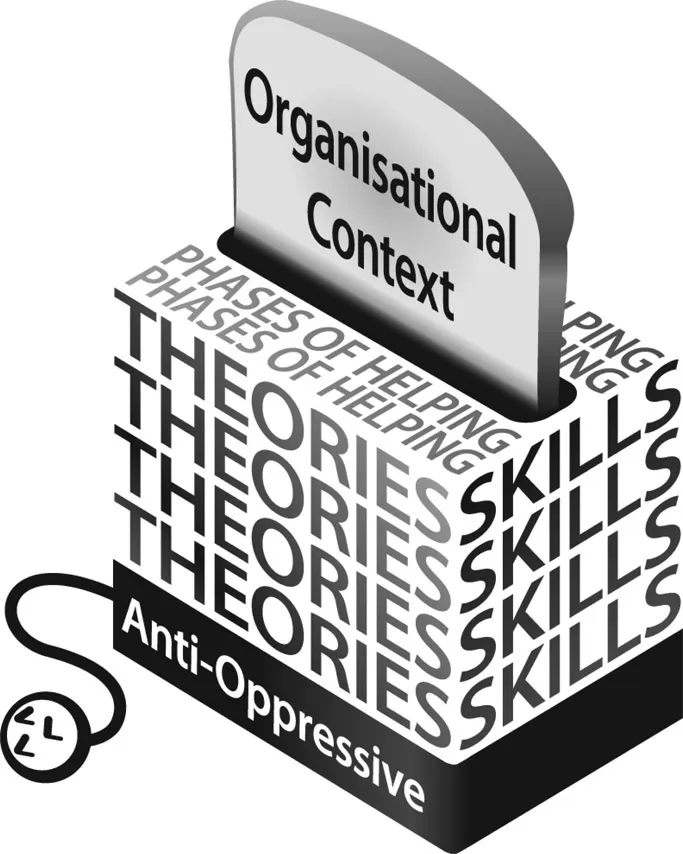
Figure 1.1 The Integrated Framework
Our understanding of teaching and learning practice skills is predicated on the notion that the source of individual problems is located within a wider societal context. Appreciation of this involves each worker understanding oppression, inequity and the impact of margin-alisation on individuals, groups and families. This entails the worker developing self-awareness in order to identify how their own values and the mandate of the agency could further contribute to or challenge oppression.
Oppression is the domination of subordinate groups in society by more powerful groups who have vested interests in maintaining the inequitable structures and social relations that ensue. We understand oppression as operating across and between three levels: structural, cultural and personal (Dominelli 2009; Mullaly 2010 and Thompson 2012).
Structural oppression refers to the means by which powerlessness and marginalisation are institutionalised in societal relations. This type of oppression refers to the ways in which social institutions, laws, policies, social processes and practices work together in favour of the dominant group at the expense of the subordinate group or groups within society (Morley et al. 2014). Cultural oppression refers to those dominant sets of knowledge, values, behaviours and customs that are privileged at the expense of others in any given society. Cultural dominance and oppression can be understood as occurring across broad social divisions, and are not limited to analysing issues of ethnicity. Discrimination occurs on the basis of gender, class, sexuality, ability or age. Personal oppression refers to the negative impact of our own thoughts and feelings which support stereotypes of ourselves that impact on our interpersonal relationships, attitudes and actions between people.
Anti-oppressive practice entails workers both acknowledging and challenging the three levels of oppression—structural, cultural and personal—in their daily practice. This understanding is incorporated into social work and welfare practice with clients by actively using strategies to bring about change at all three levels. Workers who are anti-oppressive in their practice recognise that they themselves may reproduce oppressive practices which need to be challenged. Similarly, they will also recognise that the agency mandate under which they operate may be oppressive. The process of critical reflection, described later in the chapter, enables us to explore these tensions further.
Our focus in this text is on work with individuals, groups and families. We have used the notion of ‘empowerment’ to translate anti-oppressive ideas into practice. In order to do this, most authors have drawn upon strengths-based theories (Saleebey 2012) to demonstrate how skills can be used in emancipatory practice. The strengths-based theories are embedded in an understanding of social, environmental, economic and cultural influences that impact on individuals. Strengths-based theories challenge traditional models that focus on problem identification and individual deficits by instead identifying and building upon client strengths and resources that can be used to address personal concerns.
We have encouraged all authors to locate the learning of practice skills and the application of theory within broad cultural dimensions. As noted above, these dimensions include understanding age, gender, class, indigeneity and cross-cultural dynamics within the context of helping relationships. The application of theoretical perspectives discussed in the following chapters has therefore been strongly embedded within a broad structural analysis of power, oppression and the margin-alisation of particular client groups. This ideology forms the foundation of the Integrated Framework of Practice.
UNDERSTANDING DIVERSITY
Australian and New Zealand practitioners differ in the emphasis they bring to work with Indigenous and migrant populations. In Australia, practice is located in a more culturally diverse context where emphasis has been given to understanding the delivery of welfare from this perspective through the Australian Association of Social Workers’ Code of Ethics (2010). In New Zealand, a commitment to the development of bicultural practice and the principles of the Treaty of Waitangi has become a major organising construct for practice (ANZASW 2014). For the purposes of teaching and learning practice skills, we have asked authors to focus case studies and exercises on scenarios that address issues from both bicultural and culturally diverse perspectives. You will find in these chapters that an emphasis is placed on tackling issues of culture. This focus is not confined to examining questions of ethnicity; we have endeavoured to incorporate examples that highlight diversity in terms of working with age, gender, sexuality, class and location (rural and urban). In essence, understanding diversity from this broad perspective challenges students to examine assumptions, investigate their own world-views and, in the process, become critically reflective practitioners. Chapter 2 links critical social work theory with AOP and strengths-based theories.
THEORY AND PRACTICE
Much has been written exploring the divide between theory and practice in social work and welfare delivery (Beddoe & Maidment 2009; Chenoweth & McAuliffe 2015; Wrenn & Wrenn 2009). This debate traditionally has seen academics labelled as ‘being out of touch with practice’ while workers have been described as ‘practical folk’ (Howe 1986: 2). We believe that both theory and practice can only be understood in relation to the broad societal context in which services are delivered. This context will influence social norms and expectations, political ideology and ideas of legitimacy. While there has been long-standing debate about the ascendancy of either practice or theory among students, academics and practitioners, we have conceptualised the use of skills, theory, ideology, phases and organisational context of practice as a whole, in which each aspect of the framework influences the others (see Figure 1.1, above). In this way, we do not believe that practice should be a slave to theory, or that certain skills should be used only within specific practice settings. We consider the relationship between theory and practice to be symbiotic, constantly changing and reflexive. Differing theories may inform practice but, at the same time, theoretical perspectives can be contested, developed further and changed in light of practice outcomes. This iterative process between revising practice and adapting theory is called ‘praxis’ (Morley et al. 2014). We invite you to grapple with the tensions inherent in understanding the relationship between theory and practice with a view to addressing structural inequality during the course of learning these practice skills.
Workers use sets of ideas and principles to guide and inform their practice, and together these form specific theoretical viewpoints. Practitioners rarely adhere to just one particular theoretical perspective in their work with clients. Most workers explain their practice as being informed by a blend of ideas originating from several theoretical approaches. In this text, we include explanations of, and the application of, a number of practice theories. These include predominantly strengths-based practice approaches including solution-focused, narrative, ecological/systems theory and crisis intervention.
MICRO SKILLS
This term refers to a large set of individual verbal and non-verbal communication techniques that, when combined, form the basis of the way we communicate with others. In the second part of this text, you will learn about using the following micro skills:
| listening | reflecting | clarifying | conflict management |
| responding | paraphrasing | negotiation | affirming |
| using empathy | using silence | prioritising | using immediacy |
| summarising | assertiveness | normalising | boundary-setting |
| questioning | goal-setting | challenging | confronting |
| conciliation | interpreting | universalising | recording |
| validating | externalising | ||
| transfer | verbal and non-verbal cues | ||
Learning how to recognise and use these skills takes practice. You will find a discussion of the ways to learn practice skills in Chapter 3. For the purposes of understanding the place of micro skills within the Integrated Framework, it is sufficient to note that all personal interactions are composed of an inventory of many techniques. In this text, we focus on using a selection of those techniques to facilitate and understand our communication with and among clients, and in community settings. That is, the skills demonstr...
Table of contents
- Cover
- Half Title
- Title Page
- Copyright Page
- Contents
- Tables and figures
- Acknowledgements
- Contributors
- Part I: Learning practice skills—theory and context
- Part II: Engagement
- Part III: Assessment
- Part IV: Intervention
- Part V: Evaluation and closure
- Appendix 1: Family Safety Risk Assessment Tool
- Appendix 2: Barwon Health Mental Health Risk Assessment
- Bibliography
- Index
Trusted by 375,005 students
Access to over 1.5 million titles for a fair monthly price.
Study more efficiently using our study tools.
Frequently asked questions
Yes, you can cancel anytime from the Subscription tab in your account settings on the Perlego website. Your subscription will stay active until the end of your current billing period. Learn how to cancel your subscription
No, books cannot be downloaded as external files, such as PDFs, for use outside of Perlego. However, you can download books within the Perlego app for offline reading on mobile or tablet. Learn how to download books offline
Perlego offers two plans: Essential and Complete
- Essential is ideal for learners and professionals who enjoy exploring a wide range of subjects. Access the Essential Library with 800,000+ trusted titles and best-sellers across business, personal growth, and the humanities. Includes unlimited reading time and Standard Read Aloud voice.
- Complete: Perfect for advanced learners and researchers needing full, unrestricted access. Unlock 1.5M+ books across hundreds of subjects, including academic and specialized titles. The Complete Plan also includes advanced features like Premium Read Aloud and Research Assistant.
We are an online textbook subscription service, where you can get access to an entire online library for less than the price of a single book per month. With over 1.5 million books across 990+ topics, we’ve got you covered! Learn about our mission
Look out for the read-aloud symbol on your next book to see if you can listen to it. The read-aloud tool reads text aloud for you, highlighting the text as it is being read. You can pause it, speed it up and slow it down. Learn more about Read Aloud
Yes! You can use the Perlego app on both iOS and Android devices to read anytime, anywhere — even offline. Perfect for commutes or when you’re on the go.
Please note we cannot support devices running on iOS 13 and Android 7 or earlier. Learn more about using the app
Please note we cannot support devices running on iOS 13 and Android 7 or earlier. Learn more about using the app
Yes, you can access Practice Skills in Social Work and Welfare by Jane Maidment, Ronnie Egan, Jane Maidment,Ronnie Egan in PDF and/or ePUB format, as well as other popular books in Social Sciences & Social Work. We have over 1.5 million books available in our catalogue for you to explore.