Sport is one of Australia's major industries, as well as one of our most popular pastimes. From council playing fields to Olympic competition, sport is highly organised and structured. Sport Management in Australia provides a comprehensive overview of the organisation of sport in Australia. It outlines trends in participation, the role of government and private organisations, different models of delivering sporting services, and the benefits and drawbacks of increasing commercialisation. Fully revised and updated, this fifth edition includes coverage of a wider range of sporting events, deeper coverage of corporate sport organisations, and new material on both mass participation in sport and elite sport, and also on the contribution sport makes to society.Drawing on examples and comparisons from countries around the world, and with extended case studies, Sport Management in Australia is the indispensable starting point for anyone embarking on a career in sport management.
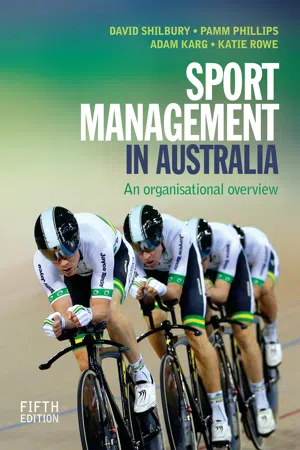
eBook - ePub
Sport Management in Australia
An organisational overview
- 432 pages
- English
- ePUB (mobile friendly)
- Available on iOS & Android
eBook - ePub
Sport Management in Australia
An organisational overview
About this book
Section 1
Sport in Australia
1
Sport in Australia
Overview
This chapter offers an introduction to and overview of the changes that have occurred during the last 45 years in the organisation and delivery of Australian sport, and establishes the rationale and purpose of this textbook. Definitions of 'sport' and 'management' are reviewed as the foundation to the study of 'sport management' and the organisations that make up the sector. Traditional and contemporary structures for national sporting organisations are also introduced to highlight the transitions in Australian sport and the increasing complexity of the sector.
After completing this chapter the reader should be able to:
- identify and define sport and sport management
- define management and recognise the functions, work and skills undertaken by managers
- recognise and discuss the merits of the delegate system of governance
- identify the transition from amateur to professional sport participation and management at the elite levels since the 1970s
- understand and recognise the size and diversity of the sport industry, and
- understand the role of the Confederation of Australian Sport and state-based sports federations.
Diamonds Defeat Silver Ferns
Australia was the bear that was poked in the preliminary rounds of the Netball World Cup, and the proud and hugely competitive beast that responded in the match that mattered. The Diamonds defeated New Zealand 58-55 to claim a third consecutive title before a world record crowd of 16 752 at Allphones Arena on Sunday. Having started brilliantly with a match-winning 16-7 first quarter, and weathered a stirring Silver Ferns comeback that closed the margin to within four goals late in the third—and it was three with 68 seconds to play. It took overtime to separate the trans-Tasman rivals four years ago in Singapore, and the difference was just one goal in both 1991 and 1999. This was not quite so close, but it was fiercely competitive to the end, the Diamonds' performance in marked contrast to the sloppy, hesitant, almost slack effort that on day three had stirred the group into action. (Pearce, 2015)
For the Diamonds it was the third consecutive world championship title, but significantly played before a world record crowd of more than 16 000 screaming fans. The Diamonds victory placed netball alongside other 2014 and 2015 world champion Australian teams such as the men's and women's cricket (Twenty20) team, the men's hockey team and the numerous individual world championship and Olympic gold medal winners in swimming, shooting, athletics, rowing, equestrian events, squash and golf. Since 1999, Australia has enjoyed continued success on the world stage, winning the 2003, 2007 and 2015 World Cricket Cup and producing individual champions such as Stephanie Rice, Libby Trickett and Leisel Jones in swimming, Chantelle Newbery and Matthew Mitcham in diving, Scott Brennan and David Crawshay in rowing, Cadel Evans, Anna Meares and Ryan Bayley in cycling and Cathy Freeman, Steven Hooker and Sally Pearson in athletics.
Netball's transition during the 1990s from strictly amateur to a professional sporting code is a good example of the change that has occurred in Australian sport since the early 1970s. It is also a particularly good example of how a sport predominantly catering to women has adapted and sought to position itself as a major sport with a high-profile professional league through the creation of the former ANZ Championship. In this case, this trans-Tasman league was created in partnership by Netball Australia and New Zealand Netball. Although this transition occurred relatively late compared with the general professionalisation of the sports sector, it clearly illustrates the progress Australian sport has made in converting what were world-class amateur competitors before 1960 into world-class professional athletes by the end of the 2000s. The announcement in 2016 that both Australia and New Zealand would introduce separate national netball leagues in 2017 in each country is further evidence of the professionalisation of netball.
Australia's acute decline in on-field success in the 1970s stimulated change towards the end of the decade. The 1980s, therefore, was a period of great change in the search for the systems that would see Australia return to prominence in the international sporting arena. By the 1990s an infrastructure, which would ultimately be responsible for the return of on-field success, had begun to crystallise, and by 2015 Australia has one of the most respected elite sports systems in the world. This has been demonstrated by the Diamonds' third consecutive World Championship win and the number of world champions Australia has produced over the last decade.
Significantly, professional athletic preparation and participation have driven changes in the management of sport. Although the adoption of professional models of management practice has been inconsistent on a sport-by-sport basis, globally there is no comparison between the sports infrastructure in place for 2015 and beyond and the one that existed before the 1970s. The lack of infrastructure to support sport in the early 1970s is plainly evident from the observations of Australia's first sports minister in 1974.
Australia’s First Sports Minister
Australian sport is among the most unorganised and uncoordinated in the world . . . in the past our champions succeeded in spite of our organisation not because of it. (Daly, 1985, p. 13)
On 28 August 1974, Australia's first federal Sports Council was formed to advise government on future directions of Australian sport. The then minister (Australia's first sports minister), Frank Stewart, made the above claim about the state of sport in Australia. Since this prophetic statement, Australian sport has steadily become more coordinated and organised. The remaining years in the period 1974 to 1979 saw government at both federal and state levels develop an interest in sport and begin to support sport through funding. For example, this process began when, in 1973, the newly formed Department of Tourism and Recreation commissioned a study entitled The Role, Scope and Development of Recreation in Australiaby Dr John Bloomfield. This was followed in 1975 by the Report of the Australian Sports Institute Study Groupchaired by Dr Allan Coles. The Coles Report was eventually responsible for the establishment of the Australian Institute of Sport in 1981. At state level, Dr John Bloomfield chaired a committee (in 1978) that produced The Development of Sport in Western Australiaon behalf of the then Community Recreation Council of Western Australia. This report was subsequently responsible for the establishment of the Western Australian Institute of Sport in 1984. A similar report was prepared in 1981 for the Victorian state government of the day. This report, entitled The Green Paper: The Development of Sport in Victoria(Dixon, 1981), contained a total of 73 recommendations on a wide range of issues relating to sport and sport management.
In 1984, the Interim Committee for the Australian Sports Commission was established as the principal coordinating agency for sport, an outcome of Labor Party policy first canvassed in 1982 in preparation for the 1983 election (Hartung, 1985a). The five members of the committee—Ted Harris, Herb Elliott, Mike Fitzpatrick, Greg Hartung and Libby Darlison—were appointed by the then minister for sport, recreation and tourism, John Brown, to provide advice on the establishment of the Commission. The Interim Committee for the Australian Sports Commission submitted their report in March 1984, but it was not released until 1985 and as Hartung (1985a) notes, the Australian Sports Commission Actwas formally proclaimed on 1 July 1985. The report of the interim committee followed a 1983 House of Representatives Standing Committee report entitled The Way We P(l)ay(Commonwealth of Australia, 1983). The scope of this inquiry was to examine efficiencies in relation to youth, sport and recreation expenditure.
By 1989 funding to sports was again the subject of an inquiry, A two-volume report, Going for Gold(Commonwealth of Australia, 1989a), and Can Sport be Bought?(Commonwealth of Australia, 1990a) focused on the administration of sport and the use of Commonwealth funding. The outcome of this inquiry was the introduction of four-year funding cycles, designed to provide stability to the operations of sporting organisations and encourage longer-term planning. Recognition of the link between funding and planning was an important outcome and one that has contributed to a cultural shift towards the adoption of more sophisticated planning processes. In late 1999 another review of Commonwealth involvement in sport and recreation was conducted, entitled Shaping Up(Commonwealth of Australia, 1999). This review was concerned predominantly with funding arrangements for sport and recreation after 2000, when it was anticipated that the additional resources obtained to prepare for the Sydney Olympic Games would be lost. The significance of this report was that it reviewed a system that performed admirably in terms of producing athletes capable of performing on the world stage. Maintaining this level of performance was central to this review, as was the need to identify alternative funding mechanisms to maintain progress at the elite levels and further expand programs and opportunities for sport participation at recreational levels.
After ten years of Liberal government policies, a change of government in late 2007 ultimately led to another review of sport, which was formally announced on 28 August 2008. The review panel was chaired by prominent businessman David Crawford and included another four leading sport business leaders. The independent panel was appointed by the Labor government to make recommendations on the specific structures, programs and reforms required to ensure the continuing robustness of the Australian sport system. The report of the independent panel, entitled the Future of Sport in Australia(Commonwealth of Australia, 2009a—referred to as Crawford Reportin this textbook), was released in November 2009 and contained numerous recommendations for the government in relation to the future of sport in Australia. These recommendations ranged from questioning the value of elite success at the Olympic Games compared with injecting more funds for community sport and the use of sport as part of a preventative health strategy, the need to reorganise and realign the Australian Sports Commission and the institute of sport network, the role of physical education and sport in the education system and the need for national sporting organisations to assume greater responsibility for the elite development of their athletes, and in general improve the management of sport. However controversial this report was in terms of questioning the direction of funding, it largely lay dormant in terms of any significant changes to sport policy in Australia. With the election of the Coalition government in 2013 most of the recommendations from this report were set aside, although there remained ongoing changes to the structure and focus of the Australian Sports Commission and Australian Institute of Sport (AIS), as will be discussed in later chapters. One change mooted in this report that was eventually implemented was returning the responsibility for managing elite sport to each NSO where funding support was provided through the AIS. The case study at the end of this chapter is an extract from the report discussing the role of national sporting organisations and the need to build the capacity of NSOs. These organisations are central to the delivery of sport in Australia, and are directlv impacted by changing government sports policy.
For our purposes, the report raises many interesting questions and issues, all of which are relevant to this textbook and for students studying sport management. A change of government usually results in policy changes. In this case, the most significant change saw the sport division of the former Department of Communications, Information Technology and the Arts moved to the Department of Health and Ageing. This alignment with health in particular was an important early sign of Labor government intentions in relation to sport policy. This realignment was an important indicator of future sports policy under a Labor government—and indeed a Liberal government as the sport portfolio remains in the Department of Health.
The federal government, initially through the Department of Tourism and Recreation (currently the Department of Health), began to provide funds for sporting organisations. Stewart (1985) notes that by 1975 the 'annual outlay for sport had increased to $7.4 million' (p. 54). Five years later (1980-81), the Going for Goldinquiry (Commonwealth of Australia, 1989a) showed that funding had increased marginally to $10 million. A peak of $72 million was achieved in 1984-85 and then dropped away to such an extent that the House of Representatives Standing Committee on Finance and Public Administration conducted an inquiry into sports funding and administration. Two volumes were produced and the first in particular was instrumental in achieving an increase in funding to $230 million over four years. The 1990-91 allocation to sport, according to the Confederation of Australian Sport (1991), was just under $59 million dollars.
The result of the financial support received from both Commonwealth and state governments allowed sports to employ staff to administer the affairs of their respective associations. According to the Australian Sports Commission's (ASC) 1989-90 Annual Report,the Commission had assisted 'a total of 102 full and part-time administrative, coaching and development positions in 58 organisations at a total cost of $3 176500' (1989/90-1999/00, p. 7). By 1997-98, 67 per cent of the Australian Sports Commission's budget ($98 million) was allocated directly to sport. This covered allocations for elite sport and AIS programs, national sporting organisation funding for programs and staff, sport science and sport medicine support, the Aussie Able program and coaching scholarships (ASC 1997/98). By 2007/08 the ASC had recognised 87 national sporting organisations and executed 63 funding and service level agreements with the national sporting organisations (ASC, 2008). In 2013/14, some $122.7 million was distributed to 65 national sport organisations...
Table of contents
- Cover
- Half Title
- Title
- Copyright
- Contents
- List of Tables and Figures
- About the Authors
- Preface
- SECTION 1 SPORT IN AUSTRALIA
- SECTION 2 GOVERNMENT SYSTEMS IN SPORT
- SECTION 3 CORPORATE SPORT
- SECTION 4 SPORT DEVELOPMENT
- SECTION 5 COORDINATING THE SPORTS SYSTEM AND THE FUTURE OF SPORT
- References
- Index
Trusted by 375,005 students
Access to over 1.5 million titles for a fair monthly price.
Study more efficiently using our study tools.
Frequently asked questions
Yes, you can cancel anytime from the Subscription tab in your account settings on the Perlego website. Your subscription will stay active until the end of your current billing period. Learn how to cancel your subscription
No, books cannot be downloaded as external files, such as PDFs, for use outside of Perlego. However, you can download books within the Perlego app for offline reading on mobile or tablet. Learn how to download books offline
Perlego offers two plans: Essential and Complete
- Essential is ideal for learners and professionals who enjoy exploring a wide range of subjects. Access the Essential Library with 800,000+ trusted titles and best-sellers across business, personal growth, and the humanities. Includes unlimited reading time and Standard Read Aloud voice.
- Complete: Perfect for advanced learners and researchers needing full, unrestricted access. Unlock 1.5M+ books across hundreds of subjects, including academic and specialized titles. The Complete Plan also includes advanced features like Premium Read Aloud and Research Assistant.
We are an online textbook subscription service, where you can get access to an entire online library for less than the price of a single book per month. With over 1.5 million books across 990+ topics, we’ve got you covered! Learn about our mission
Look out for the read-aloud symbol on your next book to see if you can listen to it. The read-aloud tool reads text aloud for you, highlighting the text as it is being read. You can pause it, speed it up and slow it down. Learn more about Read Aloud
Yes! You can use the Perlego app on both iOS and Android devices to read anytime, anywhere — even offline. Perfect for commutes or when you’re on the go.
Please note we cannot support devices running on iOS 13 and Android 7 or earlier. Learn more about using the app
Please note we cannot support devices running on iOS 13 and Android 7 or earlier. Learn more about using the app
Yes, you can access Sport Management in Australia by David Shilbury,Adam Karg,Kathryn Rowe,Pamm Phillips in PDF and/or ePUB format, as well as other popular books in Business & Management. We have over 1.5 million books available in our catalogue for you to explore.