Everyday Community Practice
eBook - ePub

Everyday Community Practice

Principles and practice

  1. 272 pages
  2. English
  3. ePUB (mobile friendly)
  4. Available on iOS & Android
eBook - ePub

Everyday Community Practice

Principles and practice

About this book

Increasingly students and practitioners in human services are asked or seek to include community engagement, participation and capacity building in their work with groups. In this book expert authors Amanda Howard and Margot Rawsthorne provide guidance on the theory and practice of working with communities, from preliminary planning and scoping before direct work with the community begins, through to evaluation. They explore key issues including developing an understanding of community life, facilitating and supporting community action, understanding and acting on structural inequity, managing negotiation and conflict, and building productive networks. They draw extensively on their own work with communities and research to create a dialogue with the reader on the interaction of task and process in everyday community practice.

Written in a friendly and accessible style and featuring the voices of community workers throughout, this is a vital guide for anyone seeking to encourage positive change in an important field of practice.

'This is a splendid addition to the community work literature, offering wise and judicious guidance for those engaged knee-deep in community practice … it acknowledges that the increasing emphasis on individualised service options has too often led to the neglect of understanding the benefits of collective action within diverse and dynamic communities.' - Dr Winsome Roberts, Honorary Senior Fellow, Department of Social Work, University of Melbourne

Trusted by 375,005 students

Access to over 1 million titles for a fair monthly price.

Study more efficiently using our study tools.

1 Introduction

QUESTIONS EXPLORED IN THIS CHAPTER INCLUDE . . .
  1. What are we aiming to do in this book?
  2. How might we think about the tricky concept of community?
  3. What do we mean by everyday community practice?
  4. Who has contributed to this book and how?
  5. How do I use this book?

Some thoughts for the beginning

There are many books published around the world on community development (Ledwith, 2016; Ife, 2013; Phillips & Pittman, 2015), community action (Oliver & Pitt, 2013), community organ-ising (Rubin & Rubin, 1986) and community work (Lane, 2013; Taylor, 2015). Some are ‘how-to’ books, some provide analysis of issues and some focus on ideas. Our work with communities (and this book of course) has benefited from these earlier books. The ideas in these books contribute to our understanding of the ways in which we live, work, act and reflect on community in all forms. In our practice we adopt what Oliver and Pitt (2013) call the relational lens: ‘a way of thinking about community that stresses the importance of relationships and connectivity to an individual’s emotional health and wellbeing’ (p. 51). Influenced by communitarian ideas, we see humans as social beings who desire to be part of a community and who find satisfaction and fulfilment in belonging (Oliver & Pitt, 2013, p. 55)—more on this later. This focus on relationships and belonging goes further—we argue that relationships and connectivity are vital to countering global challenges such as gross inequality and climate change. When we reflect on previous debates concerning community, it is clear that communities are continually evolving and changing. Hence, in this book we are seeking to consider practice with communities in contemporary, global Australia. In our discussion of context below, we seek to understand the current threads of social, political and economic life that shape the experiences of communities.
Thinking about doing work or ‘practice’ with communities or in a community context, it is easy to make assumptions about who and what makes up a ‘community’, how a ‘community’ can and does work together, and even about what is included in ‘practice with communities’. Take notice of how often you hear the term ‘community’ used or even use it yourself. Not only is it regularly used, it is also used in widely varying settings: in disasters (‘the community was devastated by floods’); in sports (‘the football community’); in politics (‘the community demands better’). Despite this, it remains very difficult to reach a consensus on the meaning of the term. The concept suffers from a nostalgic romanticism of inherent ‘goodness’. This brief engagement with the core idea of ‘community’ should act as a flag for the complexity of this practice, as the following comments reflect.
Community as a term is a tricky concept . . . from my point of view I think about a group of people united by a geography, interest or purpose is kind of the notion of community. Often what separates people just being co- located and having nothing to do with each other as opposed to a community, the sort of sense of trust and reciprocity that I think exists with communities, that sense of looking out for each other, thinking about impact on neighbours. I often think geographically, but I know community can mean sort of different constructs around communities that can be through the web or through some form of social media. (Community worker)
Community to me means support, it means care, it means people that you know by sight but don’t really know, and some that you know better. It means—to me, it’s rather like a family. You don’t always get on with everyone, you often don’t get on with people at all, but if there’s a drama or something happens . . . we will just go into a lava of action and providing and then when it’s all over, we go back to not talking to each other again and it works perfectly. We just pull it together. (Community member)
There’s so many different ways to define it [community] and I guess, for me, I’m probably a little bit resistant to making a definition because I don’t think there is one. It can be a group of four people that decided to do something about a local area. It can be a group of people that come together around a commonality of some sort and that can be face-to-face, it can be online, it can be in all sorts of different ways that people kind of come together. Sometimes it’s about a place, sometimes it’s about a passion, sometimes it’s about an identity, there’s a whole different things that come together. I think that people who are working in community need to define their own sense of what that community looks like and how their community actually interacts with other communities or expands to include other communities. (Community worker)
How we understand and engage with ‘community’ is obviously foundational to our everyday community practice. Sociologists and others have been seeking to understand the concept of ‘community’ for a very long time (see Rawsthorne & Howard, 2011 for a discussion of this history). The fact that nobody has ‘nailed it’ and that we continue to write, think and debate about ‘community’ hints at both its complexity and its importance to who we are. An important caveat is that while we use the concept of ‘community’ somewhat generically in this book, our starting point is in fact its diversity. Influenced by people such as Cohen (1985), Collins (2010) and Foucault (1980), we see ‘community’ as being produced through language, symbolically formed and, hence, fluid.
Traditionally, community development writers have thought of communities as place-based (spatial) or formed through common interests (Ife, 2013). There is a more recent acceptance of the multiplicity of connections that may form communal bonds (Dinham, 2011; Ife, 2013). In the last decade or so, we have also seen the emergence of new forms of community supported by online technologies. These newer forms of community have generational differences, with Yerbury (2012) finding that young people in her study did not have a spatial understanding of community. Taylor argues that:
it is the people who form the community and their relationships and not the technology—Facebook, Skype or Twitter—that is important. All that Facebook and the other technologies offer is the infrastructure that allows the community to blossom but Facebook in itself is not a community. (2015, p. 53)
Everyday community practice in white settler nations also needs to grapple with Indigenous or First Peoples’ understandings of ‘community’. In the Australian context, Indigenous communities understand place (land) and common interests (cultural practices) as entwined and equally significant, giving rise to another concept of community: culture community (Taylor, Wilkinson & Cheers, 2008, p. 47). Historically, professional practice in Australia has been top-down, ‘white’ and experienced as oppressive by Indigenous Australians (Walter, Taylor & Habibis, 2011). Ife (2013) reminds us of the need for self-reflection in our practice, particularly in relation to racial privilege and how this shapes our work. It is important to note that many Aboriginal people reject imposed notions of ‘community’, particularly those constructed by non-Indigenous Australians for purposes such as funding or program delivery (Taylor et al., 2008). Understanding the Aboriginal kinship system, which draws on spiritual connection to country, is an important starting point for any work with Aboriginal people. The strength of Indigenous family and kinship bonds support an array of bottom-up strategies aimed at enhancing community wellbeing and development in fields as diverse as violence prevention, educational engagement and economic self-determination. Despite the obvious ‘fit’ between Aboriginal cultural practices and community development, these approaches have failed to gain policy traction, resulting in repeated ‘pilots’ and short-term funding (Taylor et al., 2008). Kate’s observations, below, reveal that working with Aboriginal communities continues to be a field of significant challenge for everyday community practice, but is also a site in which we can build hope and reconciliation:
And making assumptions about it, particularly with the Aboriginal members of the community where someone will [say] they’re Aboriginal therefore they suit generalisations of what’s culturally appropriate and what people are comfortable with and I always find it interesting how the majority of Aboriginal people when asked have their own views . . . But just little things, like we did our cultural competence training and we were informed that to call female elders auntie, that’s all well and good if they want to be, but we’ve run an elders group and call people by what they want to be called, it shouldn’t be . . . there are several members of that group that if I as a non-Aboriginal person who is not from [here] and not their relative call them auntie they would not accept that, they would not be okay with that. (Kate, community worker)
This discussion, we hope, points to the centrality of subjective understandings in the construct ‘community’, which, as Ife argues, is ‘felt and experienced, rather than measured and defined’ (2013, p. 117). Accepting that community boundaries are not fixed but are produced symbolically (Cohen, 1985) creates exciting opportunities for our everyday community practice. In our work, we can create community narratives or tell the stories of a community, challenge unhelpful boundaries or create new forms of community. Regardless of the form of the community, the core of everyday community practice remains the social relations that bond people together (Taylor, 2015, p. 48).
It is a truism to say that work with communities is complex, but this statement also points towards some of the central questions we want to explore here. For the novice, work with communities can seem little more than common sense and quite straightforward. Very often we have heard students question whether working with communities requires anything more than good ‘people skills’; the ability to be pleasant over a cup of tea. Perversely, what might be viewed as best practice is performed in such a way that it appears simple! In this book, we argue that everyday community practice is in fact very complex. For us, taking a user’s guide approach to community work can easily overlook this complexity. Step-by-step or staged models of community development are helpful in making sense of what can seem like an amorphous and overwhelming task for new community workers. How do I work out a way into this community? What will help me start seeing what is going on? What kind of change is possible and what is my role? I can’t even see a community here, how can I do community work? ‘How-to’ models and approaches can provide some structure; a level of order and a strategy for making community work a bit more manageable. They can be a starting point for practice. Once you start feeling more confident in your practice, however, the certainties and predictability of a specific model start to be less helpful. You begin to notice that the complexities and diversity of community life’s dynamics, politics and rhythms don’t fit so well into the framework. The questions that niggled from the beginning start getting louder: why doesn’t the model fit? Why does this community seem different? Why is there only one way or approach? Why didn’t things go the way the guide suggested? Is it really just a matter of following the ‘rules’ more closely?
This is the point at which you realise that you have already started to improvise; you are starting to get a feel for how different communities work. This is the point at which everyday community practice begins. Bourdieu writes about watching sportspeople who lift their performance from excelling at technical skills to demonstrating a ‘feel for the game’ (habitus) that encompasses integration of knowledge and skills with creativity, improvisation and inventiveness (Bourdieu, 1980, 1990). In work with communities, as in sport, music or art, outstanding practice involves the seamless integration and demonstration of skills, knowledge, creativity, inventiveness, agility, tenacity and passion. Making sense of, and doing, everyday community practice, we argue, is essential if we want to develop a feel for the game. Does this mean we are in danger of promoting charismatic community work stars who thrive on individual prowess? Are we accidentally advocating individualised leadership in communities, reliant on the one or two people with a feel for the game, to carry community efforts? No, our position is that everyday community practice is something in which everyone can develop a feel for the game, as the game is diverse. In work with communities, we have found that this ‘feel’ includes recognising the capacity and contribution of diverse community members, who also have or can develop a feel for the game.
In this book, we want to spend time attending to and exploring the shape, flavour, dynamics and detail of everyday community practice. Our purposes in writing the book are to start a dialogue, to provide some questions and ideas for reflection and to set down our learning to date about the ways in which everyday community practices shape change for social justice. We hope that some of the ideas are helpful for you as you deepen your work with communities in whatever context you find yourself practising.

Individual and collective ideas in practice

For the past two decades we have been living in a social context in which individual choice, identities, experiences and responsibilities have enjoyed an increasing pre-eminence in social policy, social media and society more generally (Leadbeater, 2004). A recognition that not everyone has the same needs, histories, circumstances or struggles has brought with it enormous benefits. The idea that a good life means individuals must have decision- making power, and that support and services should be flexible and tailored to individual strengths, needs and experiences, is surely a step in the right direction. We can start to see an end to a world in which you have to take what you are given and put up with whatever you can get, however inadequate or unsuitable it may be (Beresford et al., 2011). As systems are tinkered with or, in some cases, revolutionised, there is much to be gained, and in fact much has already been gained. What we may have lost, in trading the regimentation of collective experiences for individual choice as a consumer, is less clear, although a growing body of commentary and research views the shift to individual consumer choice as ambivalent at best and deceptive at worst (Prandini, 2018).
Recently I (Amanda) was nostalgically watching a TV program, trawling through the vaults of Countdown. I remember watching this show every week, as did most other kids my age with a TV in Australia. On Monday we would all share the knowledge of what was number one on the charts that week, along with our views of the merits of this song. At the time, I remember wishing we could access a greater variety of music and becoming annoyed that our experience of songs was almost wholly determined by what the host liked and promoted. Imagine, I often thought to myself, if you could watch music videos on demand and choose what you wanted to watch and when. I could see myself with boundless time being able to choose and enjoy music that was to my taste and not the program host’s.
This is the world my generation imagined, and it is now the world we live in. Spotify and other apps mean I can rent and listen to an almos...
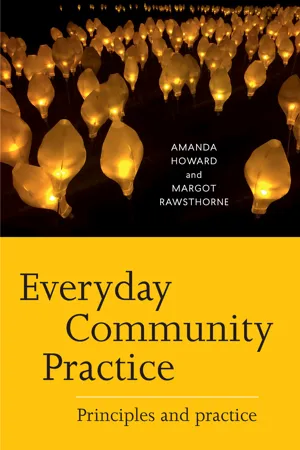
Table of contents

  1. Cover
  2. Half Title
  3. Title Page
  4. Copyright Page
  5. Contents
  6. FOREWORD: Anti-oppressive community development
  7. CHAPTER 1 Introduction
  8. CHAPTER 2 Moving beyond 'anything goes'
  9. CHAPTER 3 Listening, loitering and learning
  10. CHAPTER 4 Being visible and invisible
  11. CHAPTER 5 Putting projects/work on the ground
  12. CHAPTER 6 What change are we trying to achieve?
  13. CHAPTER 7 Risk-taking and safety
  14. CHAPTER 8 Networking, partnerships and collaboration
  15. CHAPTER 9 Taking stock, endings and renewal
  16. CHAPTER 1O Research on whether we make a difference and research to make a difference
  17. CHAPTER 11 Why does everyday community practice matter?
  18. CHAPTER 12 Exemplar projects
  19. ACKNOWLEDGEMENTS
  20. USEFUL RESOURCES
  21. REFERENCES
  22. INDEX

Frequently asked questions

Yes, you can cancel anytime from the Subscription tab in your account settings on the Perlego website. Your subscription will stay active until the end of your current billing period. Learn how to cancel your subscription
No, books cannot be downloaded as external files, such as PDFs, for use outside of Perlego. However, you can download books within the Perlego app for offline reading on mobile or tablet. Learn how to download books offline
Perlego offers two plans: Essential and Complete
  • Essential is ideal for learners and professionals who enjoy exploring a wide range of subjects. Access the Essential Library with 800,000+ trusted titles and best-sellers across business, personal growth, and the humanities. Includes unlimited reading time and Standard Read Aloud voice.
  • Complete: Perfect for advanced learners and researchers needing full, unrestricted access. Unlock 1.4M+ books across hundreds of subjects, including academic and specialized titles. The Complete Plan also includes advanced features like Premium Read Aloud and Research Assistant.
Both plans are available with monthly, semester, or annual billing cycles.
We are an online textbook subscription service, where you can get access to an entire online library for less than the price of a single book per month. With over 1 million books across 990+ topics, we’ve got you covered! Learn about our mission
Look out for the read-aloud symbol on your next book to see if you can listen to it. The read-aloud tool reads text aloud for you, highlighting the text as it is being read. You can pause it, speed it up and slow it down. Learn more about Read Aloud
Yes! You can use the Perlego app on both iOS and Android devices to read anytime, anywhere — even offline. Perfect for commutes or when you’re on the go.
Please note we cannot support devices running on iOS 13 and Android 7 or earlier. Learn more about using the app
Yes, you can access Everyday Community Practice by Amanda Howard,Margot Rawsthorne in PDF and/or ePUB format, as well as other popular books in Politics & International Relations & Health Care Delivery. We have over one million books available in our catalogue for you to explore.