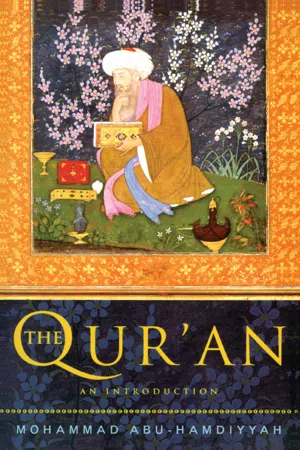
This new work presents a concise and accessible introduction to the Qur'an. Muhammad Abu-Hamdiyyah first explores the concept of deity, including the Christian and Jewish understanding of God, and second discusses the Qur'anic message from the perspective of modern knowledge. This is an ideal textbook for students with no prior knowledge of the complexities of the Qur'an's message.
- 146 pages
- English
- ePUB (mobile friendly)
- Available on iOS & Android
eBook - ePub
About this book
Information
Part I
PRELIMINARY CONSIDERATIONS AND OBSERVATIONS
1
THE QUEST FOR UNDERSTANDING OUR WORLD
The quest for understanding ourselves and the world we live in is universal among all human beings. In this study, however, our concern will be mainly with the developments that occurred in the East Mediterranean region, especially in the Arabian Peninsula and its fertile peripheries. The East Mediterranean region is the home of the ancient civilisations of Mesopotamia, Egypt and Greece (Rome), and of the Semitic peoples and their Scriptures (the Hebrew Bible, the Gospels and the Qur’an). Several centres of civilisation formed in this region in ancient times, centres which appear on the surface to be somewhat separate but which in fact were sufficiently connected so as to allow the intimate flow of information and of people, making it possible to regard them as something of a unit. This characteristic helped keep lit the torch of seeking knowledge. When the torch was extinguished in one or more of the other neighbouring centres of civilisations, it continued to shine in the remaining ones.1 It must be stressed, however, that the region was not completely isolated from developments in the quest for the meaning of life that occurred in other parts of the world, in particular India. We shall note some of these influences later on. In this part we are mainly interested in the evolution of the concept of the deity and its relationship with mankind up to the appearance of the Qur’an. This period will be divided into two interpenetrating eras: (1) the era preceding the appearance of the Scriptures (from ancient times up to about the beginning of the first millennium BCE when the practice of religion was predominantly based on nonexclusive worship and was mainly polytheistic); and (2) the period that witnessed the rise of the Scriptures (up to the seventh century CE). The latter period witnessed the spread of positive preaching of a particular worldview or belief (generally monotheistic) usually across communal boundaries. Compare, however, the discussion of the ‘axial’ period by Hick, who describes the transition state between an archial (pre-axial) period terminating at about 800 BCE and a post-axial period beginning about 200 BCE, and the fluid nature of this demarcation.2
Religion in pre-Scriptural times
As consciousness developed and humans became aware of themselves and their surroundings and realised how small and weak they were compared to the forces of nature, they began the struggle to make some sense of their transient existence and try to understand the world they live in. This led eventually to the development of mental pictures or models of worldviews as a result of their experiences and observations. Central to this endeavour is the postulation of a power (god) or powers that underlie all natural phenomena and which control everything in this world. Thus they looked towards those powers with awe and reverence and sought to propitiate them by ritual practices such as prayers and sacrifices to avert hardships and disasters in life, hoping they would bring abundance, happiness and peace. The universality of this phenomenon is well represented by Plutarch’s remarks:
Of all customs first and greatest is belief in gods … [who] sanctified men, by prayers and oaths and divinations and oracles bringing them into touch with the divine in their hopes and fears. You might find communities without walls, without letters, without kings, without houses, without money, with no need of coinage, without acquaintance with theatres and gymnasia; but a community without holy rite, without a god, that uses not a prayer nor oath, nor divination, nor sacrifice to win good or avert evil, no man ever saw nor will see … This is what holds all society together and is the foundation and buttress of all law.3
All sorts of objects, animate and inanimate (such as trees, stones, wells, springs, mountains, and so on), which humans thought were somehow associated with the gods and thus were described as holy, were revered and respected. People believed that the objects they idolised and adored had power and influence which could be brought into effect by performing the required rituals. This activity generated in time the practice of magic as a means to induce the gods to oblige and respond.4
As man’s experience grew, it was realised that there were other objects beyond the earth which might be worth adoring and idolising, such as the sun, the moon and the stars. This is well illustrated in all parts of the region under consideration. Eventually man started to think in abstract terms, with the idolised objects (the deities) transcending nature, and having power over nature and society. Initially there were specialised gods and goddesses with special powers over specified natural phenomena. These gods and goddesses became personalised, on individual, tribal and national levels. For example, a tribal god was related parentally to members of the tribe as a father (or a mother for a goddess) and was responsible for their protection and guidance. Members of the tribe named themselves as the ‘children or sons of [their] deity’.5,6 Examples of addressing the gods for various reasons and how humans looked up to them are common in the literature.7
As tribes fought and conquered each other, forming tribal hierarchies, so the gods too became hierarchical. A good example of this phenomenon, which illustrates the intimate connection of the concepts of gods with society and thus politics, is the demotion of Seth the god of Upper Egypt and the promotion of Horus the god of Lower Egypt to chief god of all Egypt when it was unified by Lower Egypt.8 Thus we find in all parts of this region, whether it is Semitic speaking, Egyptian or Greek (or Latin), a hierarchy of gods. For example, in Homer ‘the gods are arranged on the model of a human clan, with Zeus the father of gods and of humans’.9
The general development and evolution of the concept of god in Mesopotamia outside the Scriptural area has been analysed by Jacobsen, who presented the data in terms of the metaphors people used for the gods. These metaphors included rulers, parents, creators and keepers of the world order as well as the personal. These representations are typical of the whole region under consideration, and have been used in all later refinements of the concept of the deity. What the ancient gods meant to their worshippers has been described by Armstrong for the Greek world,10 but it is generally valid for the whole region.
It must be pointed out before leaving this region that in the Egyptian tradition, a sort of monotheistic concept was put forward by Akhenaten, the Pharaoh of Egypt, in the fourteenth century BCE. Akhenaten’s god, Aten, the sole God, was regarded as embodied in the sun-disk, who creates and sustains life in Egypt and in foreign lands, and who is transcendent and immanent.11 However, after Akhenaten’s departure the old polytheism returned.
The Scriptural era
Introduction
In the first millennium BCE, Zoroastrianism came into Mesopotamia from the eastern region of Iran.12 Zoroaster (Zarathustra) preached a new concept of God emphasising monotheism focused on Ahura Mazda (the Wise Lord), the creator of heaven and earth, day and night and light and darkness, together with a dualism. The dualism with the two opposing spirits of good and evil, who are regarded the twin children of Ahura Mazda, constitutes the basis of ethics. The beneficent and hostile spirits result from the choice they made between ‘truth’ and the ‘lie’, between ‘good’ and ‘bad’ thoughts (words or deeds) respectively. Although these concepts were soon diluted under the strong influence of Mesopotamian and Indian religions after the death of Zoroaster, they had lasting influence on religion in the area which affected the development of the Semitic Scriptures, particularly in the concepts of angels13 and of Satan.14
Next we note the appearance of a religious movement in Greece called Orphism, with inspired Scriptures. Orphism’s adherents believed that a human being has part of the Divine (the soul) entrapped in the human body and is doomed to transmigration if salvation is not sought.15 To escape the cycle of reincarnation they advocated following the Orphic way of life, which includes the prohibition of eating meat, purification rituals and incantations.16 It is apparent that this was a rejection of the sacrificial ritual which permeated all Greek culture. Some aspects of Orphism were taken up by Pythagoras and also later by Plato.
In this period, a definite tendency towards the consolidation of the various powers of different gods in one god began to appear in Mesopotamia. This is evident from the hymn of Ashurbanipal to Marduk, describing Marduk as holding the powers of the gods Anu, Enlil and Ea.17 An even more radical text cited by Jacobsen shows that several major gods (Ninerta, Nergal, Zababa, Nabium, Sin, Shamash and Adad) are identified as but aspects of one and the same deity (Marduk). This trend tends to show a moving away from the idea of many gods with separate and specialised functions towards a simpler conception. It also shows the tendency of moving away from a deity being local, serving a particular tribe or one people, towards a deity which is universal, serving many peoples in consonance with increased knowledge and political unification tendencies.
However, periods of constant war and instability result in the brutalisation of humanity, who in turn transfer this aspect to the gods.18 This shows again the intimate connection of the concept of the gods not only with nature but also with society and politics. This aspect has also been noted in the political struggles between two neighbouring tribes across the Jordan river in the first half of the first millennium BCE, one under Omri and his god Yhwh, the other under Mesha and his god Chamosh, as is clear from the Mesha inscription.19
On the whole, the consolidation of the concept of monotheism and the spread of positive preaching and campaigning for a specific worldview to the populace continued. This occurred in two characteristic ways in two different localities in the Eastern Mediterranean region. One way is general, universal, abstract and philosophical and thus elitist; it developed in several schools of thought (the Aristotelians, the Platonists, the Stoics, and so on), initially in Greece and then continuing in Roman times.20 The divine in these philosophies is the ground of the world’s being and of our own, that the world exhibits an order and system that give evidence of its divine principle, and that human beings are so designed that imitation of or likeness to a god is essential to their well-being.21 In this approach the ordinary people, the preponderant majority, seem to have been left to their own devices, leaving them essentially untouched by the lofty ideals of these schools. Thus the general populace continued in their polytheistic practices. Ward quotes Aristotle saying ‘that myths and rituals are for the artisans while the true philosopher will pursue a life of virtue and the contemplation of the most excellent of beings, the Prime Mover, in isolation from any social form of religious life’.22 The wisdom teachers themselves more or less continued the practice of temple and civil worship as members of their local communities.23 This is because the philosophers’ account of divinity was not by intention exclusive of divine plurality: ‘It was the ultimate ground of divine unity that mattered to Hellenic monotheists.’24
An opposite stream of thought, the school of Scepticism, appeared in the fourth century BCE, established by Pyrrho of Elis who had accompanied Alexander’s expedition to India. This school of thought taught the principle of ‘suspension of judgement’ in order not to perturb the tranquillity of the phenomenon experienced; hence the formulas ‘determine nothing’ and ‘assert nothing’.25 This is another example of Indian influence, along with the idea of transmigration of souls.
The other direction or way was taken up by Semitic-speaking prophets. This was started by the ‘later’ Hebrew prophets in the Persian period, who preached positively the notion of a single God to arouse their people to achieve the political aim of their tribe. What is new here is the concept of positive preaching using an ideological concept of God to achieve and consolidate a political aim for one particular people.
God, the Hebrew Bible and the idea of Israel
In the Arabian Peninsula and its fertile peripheries where the Semitic-speaking peoples lived, el or il (the Akkadians used ilu, with the final letter indicating the sound of the nominative case ending) designated a generic Semitic name for god by the early Semites, with the probable meaning ‘first’ in rank and might.26 By the time of the Ugaritic inscriptions, about the fourteenth century BCE, the chief god was also called el (and also ilu27). Later, the generic name became ilh or elh, pronounced ilaah among the Aramaeans, Hebrews and Arabs (or slightly differently according to the vocalisation in the Hebrew Bible).
In the Hebrew Bible, one may trace the evolution of the concept of God by following the names used in the Scriptures for the deity. These are el, the generic Semitic name for god; elim, the plural of el; eloh, god, which is equivalent to ilaah in Arabic and Aramaic and to el; elohim, the plural of eloh; elohim, taken as singular to mean god, but note both the plural and the singular senses occur sometimes in the same verse (for example, Psalm 82:1); ‘the elohim’, also taken as singular to mean god; and finally Yhwh, the God of Israel. ‘Yah’ is regarded as a variation of Yhwh. Elyon and Shaddai are regarded as attributes of the Deity.
The use of the plural elohim, ‘the gods’, as singular, with or without the definite article, must have started among the Semitic tribes as a short cut when talking about or addressing the gods of the different tribes in a given sanctuary, instead of naming each of them separately. This was common practice especially when making an oath or making a pledge, or visiting or passing by a sanctuary. Tolerance of worship was the rule rather than the exception which tallies with the general pieties of ancient peoples already noted above.28 Intolerance in worship was only introduced into Israel by the prophets.29 Separation in religious worship was introduced later after the coming of the party of the ‘Exiles’ to Jerusalem into power under the Persian rule, as is clear from reading Ezra and Nehemiah.30
The coming of the ‘Exiles’ to power in ...
Table of contents
- Cover
- Half Title
- Title Page
- Copyright Page
- Dedication
- Contents
- Preface
- Acknowledgements
- Introductory Summary
- Part I Preliminary considerations and observations
- Part II The Qur’an
- Appendix
- Notes
- Index
Trusted by 375,005 students
Access to over 1.5 million titles for a fair monthly price.
Study more efficiently using our study tools.
Frequently asked questions
Yes, you can cancel anytime from the Subscription tab in your account settings on the Perlego website. Your subscription will stay active until the end of your current billing period. Learn how to cancel your subscription
No, books cannot be downloaded as external files, such as PDFs, for use outside of Perlego. However, you can download books within the Perlego app for offline reading on mobile or tablet. Learn how to download books offline
Perlego offers two plans: Essential and Complete
- Essential is ideal for learners and professionals who enjoy exploring a wide range of subjects. Access the Essential Library with 800,000+ trusted titles and best-sellers across business, personal growth, and the humanities. Includes unlimited reading time and Standard Read Aloud voice.
- Complete: Perfect for advanced learners and researchers needing full, unrestricted access. Unlock 1.5M+ books across hundreds of subjects, including academic and specialized titles. The Complete Plan also includes advanced features like Premium Read Aloud and Research Assistant.
We are an online textbook subscription service, where you can get access to an entire online library for less than the price of a single book per month. With over 1.5 million books across 990+ topics, we’ve got you covered! Learn about our mission
Look out for the read-aloud symbol on your next book to see if you can listen to it. The read-aloud tool reads text aloud for you, highlighting the text as it is being read. You can pause it, speed it up and slow it down. Learn more about Read Aloud
Yes! You can use the Perlego app on both iOS and Android devices to read anytime, anywhere — even offline. Perfect for commutes or when you’re on the go.
Please note we cannot support devices running on iOS 13 and Android 7 or earlier. Learn more about using the app
Please note we cannot support devices running on iOS 13 and Android 7 or earlier. Learn more about using the app
Yes, you can access The Qur'an by Muhammad Abu-Hamdiyyah in PDF and/or ePUB format, as well as other popular books in Theology & Religion & Islamic Theology. We have over 1.5 million books available in our catalogue for you to explore.