Broadcast News Writing, Reporting, and Producing
eBook - ePub

Broadcast News Writing, Reporting, and Producing

  1. 320 pages
  2. English
  3. ePUB (mobile friendly)
  4. Available on iOS & Android
eBook - ePub

Broadcast News Writing, Reporting, and Producing

About this book

Now in its eighth edition, Broadcast News Writing, Reporting, and Producing is the industry's leading textbook covering all aspects of the three pillars of broadcast news.

The book discusses the key strategies and terms of newsgathering and delivery by providing real-world, professional advice for broadcast journalists in the modern-day newsroom. New to the eighth edition is the Best Apps feature, which identifies the most productive apps used by working journalists when covering stories. The book also covers the ever increasing diversity of the journalism field and brings in new voices from professionals working in the industry to discuss these topics. Other new additions include in-depth discussions of fake news, expanded coverage of social media in the newsroom, and an overview of the latest advances in technology available to television and radio news reporters.

Broadcast News Writing, Reporting, and Producing remains the best book for undergraduate students in journalism writing, producing, newsgathering, and multimedia courses.

An accompanying companion website features resources to help instructors deliver online courses, including Powerpoints, Quizlets, and a sample syllabus.
Frequently asked questions

Yes, you can cancel anytime from the Subscription tab in your account settings on the Perlego website. Your subscription will stay active until the end of your current billing period. Learn how to cancel your subscription.
At the moment all of our mobile-responsive ePub books are available to download via the app. Most of our PDFs are also available to download and we're working on making the final remaining ones downloadable now. Learn more here.
Perlego offers two plans: Essential and Complete
  • Essential is ideal for learners and professionals who enjoy exploring a wide range of subjects. Access the Essential Library with 800,000+ trusted titles and best-sellers across business, personal growth, and the humanities. Includes unlimited reading time and Standard Read Aloud voice.
  • Complete: Perfect for advanced learners and researchers needing full, unrestricted access. Unlock 1.4M+ books across hundreds of subjects, including academic and specialized titles. The Complete Plan also includes advanced features like Premium Read Aloud and Research Assistant.
Both plans are available with monthly, semester, or annual billing cycles.
We are an online textbook subscription service, where you can get access to an entire online library for less than the price of a single book per month. With over 1 million books across 1000+ topics, we’ve got you covered! Learn more here.
Look out for the read-aloud symbol on your next book to see if you can listen to it. The read-aloud tool reads text aloud for you, highlighting the text as it is being read. You can pause it, speed it up and slow it down. Learn more here.
Yes! You can use the Perlego app on both iOS or Android devices to read anytime, anywhere — even offline. Perfect for commutes or when you’re on the go.
Please note we cannot support devices running on iOS 13 and Android 7 or earlier. Learn more about using the app.
Yes, you can access Broadcast News Writing, Reporting, and Producing by Frank Barnas,Marie Barnas in PDF and/or ePUB format, as well as other popular books in Languages & Linguistics & Communication Studies. We have over one million books available in our catalogue for you to explore.
PART I
ACQUIRING THE NEWS

1 LEGAL AND ETHICAL CONSIDERATIONS

KEY WORDS
Conflict of Interest
File Footage
Truth
Fair Comment
Libel
Video News Releases
Fake News
Privilege

Introduction

This chapter focuses on the important and complex issues of law and ethics, the cornerstones of good journalism. The pillars of news reporting (accuracy, fairness, and objectivity) are among the major considerations for those who work in the news industry. Additionally, there are ongoing debates over bias, objectivity, favoritism, and a number of other legal and ethical issues.
Other concerns are also vexing to newsrooms. “Fake news” is particularly disturbing, as these false news stories are presented as factual, usually on social media accounts. Since these erroneous news stories can go viral at breakneck speed, there is often no chance to check them for accuracy, fairness, or objectivity. Even worse is when such a story is picked up by traditional news outlets, thus giving validity to a story that was false from its inception.
This chapter is split into the two broad areas of law and ethics. The law guidelines are broad (there can be differences among states and cities), but the underlying principles of accuracy and fairness are universal. The ethics discussions detail the dilemmas that appear frequently among broadcast journalists, especially in this era of nonstop social media. Before we get into either of those sections, we begin with the basic need to get the story right.

Accuracy

Accuracy means writing and reporting in a manner that is as objective and fair as possible, despite any personal feeling, belief, or attitude on the subject. Taking responsibility means
  • looking at all the issues, not just the easy or popular ones
  • examining controversies and producing special reports throughout the year, not just during the sweeps rating periods
  • covering important stories that don't always offer good pictures
  • writing and reporting with care, understanding, and compassion
  • dealing with people in a professional and civil manner.
As detailed in further chapters, many news directors require reporters to double-source and even triple-source stories before they air. This means every piece of information must be confirmed by at least two or three independent sources.
CNN Producer Courtney Fennell notes how seriously broadcast journalists must take checking facts before going on the air, saying:
My executive producer always tells us, “I don't care about getting it first. I care about getting it right,” and well, he's right. Yes, he's right for legal reasons, but also because credibility matters. Check, recheck and then recheck your story not just for accurate information but for an objective voice, and if you have even the slightest doubt, talk it over with another member of your team. Remember, it can take years to earn trust and just one mistake to lose it. #FactsFirst.
Camille Cowin, who began her career with an interest in broadcast journalism but now works as a video producer at the NASA Johnson Space Center, says her background in checking facts is vital. She says:
Researching facts before any and every production is critical. There is never a reason to skip this step. One of my jobs at NASA is to create training videos for astronauts onboard the International Space Station (ISS) and one day for our astronauts on the Moon and Mars. I work with Chief Training Officers (CTO) and Subject Matter Experts (SME) in advance to ensure that our training is effective and error-free. This research takes a great amount of time and focus, but it significantly impacts the success of our production, as well as the success of the crew in performing tasks in space—a very unforgiving environment. One mistake in my content could put the crew's safety at risk. It is my responsibility as a producer to research and provide factual content to my audience. This part will make or break my production.

Gathering News and Getting Information

Open Records and Meetings

A hallmark of broadcast journalism is covering meetings at the city council, school board, county commission, or any other local, state, or federal governmental agency. All states, plus the federal government, have enacted open records laws that guarantee access to government documents. These laws are known as “freedom of information” laws and they apply to both government meetings as well as to government files.
FAST FACT: The Freedom of Information Act (FOIA) has several exceptions, such as information about national defense, privacy, or personnel matters.
Not all meetings and government records are open to reporters. There are usually exemptions for law enforcement files, attorney–client communications between the government agency and its legal counsel, and issues that deal with minors under the age of 18. Personnel issues are another delicate area; if the city council is about to terminate the police chief, that's a human resources issue that is protected from journalists. Typically, such matters are dealt with at the end of a scheduled meeting where the council members will adjourn into a “closed session” or “executive session.” They will announce this in an open meeting, retreat into their chambers to discuss the sensitive issues in the closed session, then return to the open meeting.
BEST APPS: The First Amendment Foundation app offers information specific to the state of Florida for covering the courts and government there. See if your state has such an app for journalists.
If a reporter feels nonexempt information is being withheld by a government agency, the newsroom can readily file a Freedom of Information Act (FOIA) request. Chapter 4 of this textbook, Collecting Information from Real and Virtual Documents, details the steps to do this. Briefly, an FOIA request allows a reporter to request documents from a specific government agency if the reporter feels she should have access to the information.

Access to Courts

The issue of whether to allow camera coverage of trials is an ongoing debate. TV news representatives generally argue that cameras should be allowed in courtrooms. Those opposed argue that the cameras compromise the rights and privacy of everyone involved in a trial and could impact the outcome of the trial itself.
There are many restrictions when cameras are allowed. In some states, the judge decides depending on the legal proceeding and whether all parties consent to the trial being recorded. The range of possibilities includes the following:
  • No cameras are allowed in the courtroom (this may be expanded to include the entire courthouse) and no sketch artist is permitted.
  • No cameras are allowed in the courtroom, but a sketch artist may be used.
  • A single camera is allowed with TV stations sharing the footage on a pool basis. This minimizes intrusion and the jury members are not allowed to be videotaped.
  • Cameras and sketch artists are permitted but must remain in a designated area in the rear or side of the courtroom.
Of course, if a news director files suit arguing that a judge must allow cameras into a courtroom, the case could theoretically end up in the U.S. Supreme Court, which does not allow cameras. Sound confusing? It is.
What are the advantages and disadvantages of allowing cameras in court? The most obvious reason for cameras, in the opinion of most of the media, is the “public's right to know,” which is guaranteed by the interpretation of freedom of the press under the First Amendment. Others argue that camera coverage would educate the American people on how the jurisprudence system works. The main argument against allowing cameras in the courtroom is that the coverage may impact the trial itself and the defendant's right to a fair trial by impartial jury, which is guaranteed under the Sixth Amendment.
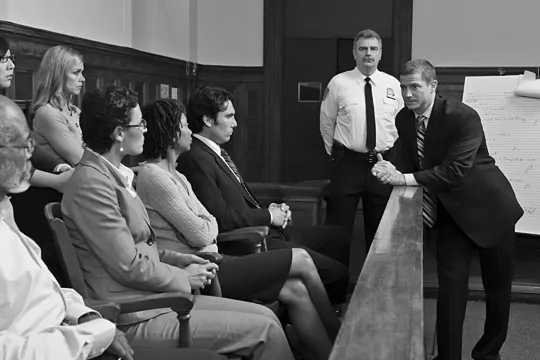
Figure 1.1
Figure 1.1A judge may restrict cameras in the courtroom.
Source: IStockPhoto 87300798
The camera rulings cover other forms of social media as well. A reporter may give up the video camera willingly at the door under the mistaken belief that tweeting updates from inside the courtroom is allowed. Again, the judge sets the rules, not just for traditional video cameras, but also for phones and laptops to eliminate Twitter, Instagram, or Facebook posts.
DEFINING TERM: The First Amendment—Congress shall make no law respecting an establishment of religion, or prohibiting the free exercise thereof; or abridging the freedom of speech, or of the press; or the right of the people peaceably to assemble, and to petition the government for a redress of grievances.

Newsgathering (Access to Places)

The type of physical property that the story happens on is critical to news coverage. For example, let's say someone's home (...

Table of contents

  1. Cover
  2. Half Title
  3. Title Page
  4. Copyright Page
  5. Contents
  6. Acknowledgments
  7. Introduction
  8. PART I Acquiring the News
  9. PART II Writing the News
  10. PART III Reporting the News
  11. PART IV Producing the News
  12. PART V Transitioning into Professional Newsrooms
  13. Glossary
  14. Index