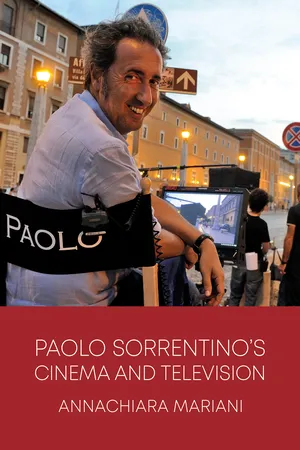
The Naples-born director and screenwriter Paolo Sorrentino has, to date, written and directed nine films, winning an Oscar, a Bafta and a Golden Globe for The Great Beauty in 2013. In 2016, he created and directed his first TV series, The Young Pope, which starred Jude Law. John Malkovich joined the cast in 2020 for the follow-up series. He has established himself as a world-leading auteur with a list of critically acclaimed and award-winning films.
This is an invaluable contribution to the existing literature on Sorrentino and is the first English language collection dedicated to this prolific director, who has emerged as one of the most compelling figures in twenty-first-century European film.
International contributors from the UK, Italy, France, The Netherlands, Australia, Israel, Canada and the United States, Italy, Israel, France, UK, Australia, Canada, offer original interpretations of Sorrentino's work. They examine his recurrent grand themes of memory, nostalgia, ageing, love, thirst for fulfilment, search for the self, identity crisis, human estrangement, marginality, irony and power. In so doing, they offer new perspectives and unique cues for discussion, challenging established assumptions and interpretations. Important and current themes such as eco-cinema and post-secularism are addressed as well as the links between Sorrentino's highly visual cinema and artistic practice such as painting and architecture.
While there are several books on Sorrentino available in Italian, none
of these provide an authoritative account of his work; and language has restricted the readership. This is the first English-language collection focussed on Sorrentino, arguably the most successful and significant contemporary Italian filmmaker.
The majority of the chapters included in this new book are original and it also includes a Foreword by Giancarlo Lombardi, Professor of Italian and Comparative Literature at CUNY, and an interview with renowned costume designer Carlo Poggioli, who has worked with Sorrentino on many productions.
Some of the chapters were previously published in a special issue of the journal JICMS – The Journal of Italian Cinema and Media Studies in 2019. The new collection makes a significant coherent contribution to the field.
Primary readership will be academics, researchers and scholars of Italian film and media studies. Also post-graduate students and upper level under-graduates.
Potential to be used as textbook or as supplementary reading for undergraduate and graduate courses
Given the subject, there is a possibility for some crossover appeal to a broader readership, but this is primarily a scholarly text.
Private Pain/Public Places: Sights, Sightings and Sounds of Nostalgia in Youth and The Young Pope
Ellen Nerenberg
Wesleyan University
Che cosa avete contro la ‘nostalgia, eh’? È l’unico svago per chi è diffidente verso il futuro, l’unico!1
– The Great Beauty (Sorrentino 2013: n.pag.)
The nostalgic directs his gaze not only backward but sideways, and expresses himself in elegiac poems and ironic fragments, not in philosophical or scientific treatises. Nostalgia remains unsystematic and unsynthesizable: it seduces rather than convinces.
– Svetlana Boym, The Future of Nostalgia (2001: 13)
Personal Reasons: Restoration, Reform and Reflection
As starting premise for a detailed comparative analysis, a scene each from The Young Pope (HBO-Sky, 2016) and Youth (2015).
Episode 9 of Paolo Sorrentino’s The Young Pope opens, with credits rolling, on the title prelate, Lenny Belardo (Jude Law), seated on the steps leading to the altar in a majestic, empty Sistine Chapel. In pristine white papal raiment, Lenny launches his fierce anti-reproductive choice campaign. He recites verses from Exodus 21 and extols, minutely, sombrely, by rote, centuries of Church teachings on the sanctity of life. His mentor, Michael Cardinal Spencer (James Cromwell) is the only other presence in this monumental location. From his wheelchair, dressed in a priest’s regular black cassock, Spencer counters each point in the pope’s argument with different theologians’ meditations. Marshalling evidence in support of his argument, the pope ambulates in the cavernous, still space. The immobilized cardinal, on the other hand, exhorts his one-time pupil to adopt a more contemporary outlook and pleads for papal compassion, empathy and a woman’s right to choose. He admonishes Lenny for not recalling the lessons of Saint Alphonsus (1696–1787), who, as concerned abortion, ‘found everyone guilty except for the woman’. Making his way to the exit, Belardo pauses to gaze upon the shrouded skeleton in the lower left quadrant of Michelangelo’s simulated Last Judgement. What, he asks Spencer, if in all things everyone was guilty except for the woman? When Spencer asks if Lenny is referring to his mother, the Pope replies, ‘Who else could I be talking about?’
The conclusion of the penultimate sequence in Sorrentino’s 2015 film Youth is punctuated by a long shot of an exterior we know is in Venice. The camera closes in to frame a window frame, which itself frames a woman’s face. She is Melanie (Sonia Gessner), Fred Ballinger’s (Michael Caine) wife, the film’s absent presence until this late scene. During Fred’s visit, she is shown only in an extreme oblique angle, which robs us of a view of her face. As she sits in her wheelchair, gazing out at the canal below, she gives the impression of preferring not to regard Fred as he speaks to her. The mobile camera tracks smoothly past her wheelchair to exit the slightly open window before stopping abruptly. The static, medium-long, reverse angle shot that replaces it gazes back on where we have just come from to frame the woman at the window. Mouth sagging horribly open, Melanie stares vacantly. The repeated framing devices (the frame of a frame) signify Fred’s efforts to contain the pain caused by seeing her.2
These two scenes announce different kinds of nostalgia. While Sorrentino’s screen projects are rife with nostalgic moments and manifestations, nostalgia as a concept is neither monolithic nor naive. Rather, nostalgia in Sorrentino’s oeuvre is a complex idea plied variously across different texts in different ways. In sometimes sweeping, transverse gestures, it portends of politics and epistemologies, while at other times it manifests in a more personalized, intimate and psychological vein. This essay centres on nostalgia in two screen texts from Sorrentino’s midcareer in order to tease out these complexities.3
Each scene ushers in the project’s nostalgic operations that span categories ranging from ‘restorative’ to ‘reflective’ (about which more directly), and which are brought together by concerns for reform. Michelangelo’s simulated memento mori in The Young Pope 1: 9 closes the sequence (Figure 1.1) and comments – albeit mutely – on Belardo’s aim to restore the Roman Catholic Church to a purer state. Fusing sight with sound, a sure link is forged between the Young Pope’s personal history, the inconsolable nostalgia he feels for the parents that abandoned him and their family idyll, and his public campaign as primate of the Catholic Church. In Youth, Melanie functions much like Michelangelo’s shrouded figure and performs a mute tableau vivant of regret and nostalgia. She is ‘the personal reason’, as Fred informs the Queen’s abashed Emissary (Alex Macqueen), for which he cannot publicly perform ‘Simple Song #3’ at the royal birthday celebration. Insensate (from a much earlier stroke, we presume), Melanie is quite the opposite of the youth the title promises, and yet, as Fred reminds her during this visit, she lies at the heart of the ‘Simple Song’, the command performance of which impels the ironically titled Youth forward to its conclusion (Figure 1.2).
FIGURE 1.1: Michelangelo Buonarotti, detail, Sistine Chapel, The Young Pope, Episode 9. Personal reasons, public spaces, global consequences.
FIGURE 1.2: ‘For personal reasons’. Melanie Ballinger, Youth.
Recalling Romano’s words from The Great Beauty, offered in epigraph at the beginning of this chapter, Sorrentino observed at the Cannes premiere, ‘The film’s idea is how we think about future, how the future always offers a possibility of liberty, and liberty is a state inherent to youth’ (Zorich 2015: n.pag.). This dual, sometimes contradictory pulsation of nostalgia distinguishes it from ‘memory’. As Walter Benjamin described Klee’s Angelus novus, the angel of history gazes backward to memory and the past. Nostalgia, on the other hand, casts its gaze also towards the future.4
Youth tells the story of two decades-long, now septuagenarian, friends Fred Ballinger and Mick Boyle (Harvey Keitel) on holiday at a spa near Davos, Switzerland.5 While Fred, a retired composer and orchestra director, suffers from ‘apathy’, Mick maintains a vigorous creative practice, working energetically – one might say ‘youthfully’ – each day (between curative spa sessions for a series of normal, age-related maladies) with a cadre of young screenwriters on the script of ‘Life’s Last Day’, his cinematic ‘testament’. Fred’s lone complaint, ‘apathy’, leads him to eschew any public display of or recognition for his musical compositions. During their sojourn, Fred and Mick, accompanied by Fred’s daughter Lena (Rachel Weisz) encounter a host of characters at the hotel: a Diego Maradona stand-in (The South American, Roly Serrano), a young Method actor, Jimmy Tree (Paul Dano) and Miss Universe (Mãdãlina Ghenea).6 When Mick’s long-time leading lady, Brenda Morel (Jane Fonda) tells him she is opting out of ‘Life’s Last Day’ for a television series and that his last good movie was three films ago, she takes the wind from his sails. Deanimated and undone, he jumps off a balcony to his death. Youth ends with Fred who, having shaken off his apathetical coil, directs the orchestra in playing his Simple Song at the performance he had declared himself unable to participate in.
The Young Pope, a 10-episode prestige serial drama follows the youthful American of the title, Lenny Belardo (Jude Law), in the first stormy months of his iconoclastic papacy as he tries to ‘correct’ the direction of the Catholic Church. None of the Vatican’s political operators, including Belardo’s mentor Cardinal Spencer (James Cromwell) and especially the Vatican Secretary of State Cardinal Voiello (Silvio Orlando) had sufficiently intelligenced this dark horse candidate during the conclave. Lenny takes his papal office by storm, striving to redeem the Church from modernity and modern relativism, and return it to a nearly pre-Lutheran theology. Although he speaks to the faithful in a number of public addresses, he refuses to show himself in public and rejects every attempt to reproduce or monetize his image. He appoints the nun who raised him in an orphanage, Sister Mary (Diane Keaton), as his personal assistant and advisor. His calls for a return to godliness and centuries-old doctrine are catalysed by his orphaned past. He looks everywhere for the parents who abandoned him and until he ‘buries two empty coffins in Venice’, as Spencer counsels in Episode 8 with reference to his parents, he will not win back the faithful and his papacy will be without a future.
The pervasive theme of nostalgia in Paolo Sorrentino’s body of work has received broad commentary in both the popular press and academic scholarship.7 Such attention is deserved, given the extent to which nostalgia as theme, topic and modality has recurred in the director’s screen texts. Nostalgia appeared from Sorrentino’s earliest efforts and gives every indication of a continued robust presence midcareer. Sorrentino’s nostalgic key prevails from its manifestation as the reminiscent (but never repentant) Tony Pisapia in L’uomo in più (One Man Up) (2001), to the homesick Titta Di Girolamo in Le conseguenze d’amore (The Consequences of Love) (2004) (both played by Toni Servillo), to the depressive man-boy goth rocker Cheyenne (Sean Penn) floundering in the quagmire of arrested development in This Must be the Place (2011). La grande bellezza (The Great Beauty) (2013) is itself a paean to the nostalgia that saturates the film thematically and across numerous visual and acoustic motifs. The expression of nostalgia in Youth (2015) activates similar mechanisms, and, in the longer narrative that serial drama provides, The Young Pope (2016) generates still others. To be sure, Sorrentino’s films are frequently ‘about’ nostalgia, memory and about remembering.8
Although catalyst of plot and story, Sorrentino’s uses of nostalgia are not limited to narrative. Rather, nostalgia is a modus faciendi pelliculas, manifesting at every semiotic level. Reading Boym’s description of the nostalgic, offered epigraphically here, one might as easily be reading a review of The Great Beauty, perhaps the acme (so far) of Sorrentinian nostalgia: elegiac poems and ironic fragments? Check. Unsystematic? Check. Sideways and backwards? If one thinks that Luca Bigazzi’s many sinuous tracking shots provide evidence for this, then, yes, check. If one finds such evidence insufficient, then perhaps remembering, with Hennessy, Jep Gambardella’s (Toni Servillo) direct address to the camera will persuade more conclusively (Hennessy 2017: 453). Sorrentino’s nostalgia makes for good box office, especially abroad, to judge from recent studies parsing the top Italian audio-visual exports worldwide in the 2007–16 period.9 Nostalgia sells, and nostalgia about Italy sells well, especially to global audiences.10
Yet however steeped in memory and nostalgia Sorrentino’s films may be (or appear to be), nostalgia itself is not a monolithic category nor does it always signify the same things or in the same ways.11 Indeed, nostalgia as a concept can vary in type quite substantially. In an attempt to historicize the fairly general concept of ‘longing for home’ and linking it, with Starobinski, to accelerated transportation and the movement of peoples in the modern age that resulted, Hutcheon indicates a shift from the spatial to the temporal, noting that ‘[t]ime, unlike space, cannot be returned to – ever; time is irreversible. And nostalgia becomes the reaction to that sad fact’ (Hutcheon 1998-2000: 19; see also Starobinski 1966: 90). Stewart has called nostalgia a ‘social disease’, describing it as ‘the repetition that mourns the inauthenticity of all repetition’ (Stewart 1984: 23). However much an individual might suffer from nostalgia, it was not limited in scope to the personal. As Boym remarks, in her influential 2001 study The Future of Nostalgia, at the close of seventeenth and in the early eighteenth centuries, when it was first becoming medicalized, nostalgia was ‘not merely an individual anxiety but a public threat that revealed the contradictions of modernity and acquired greater political importance’ (Boym 2001: 5). For Boym nostalgia prevailingly takes on two rather distinct forms: ‘restorative’ and ‘reflective’. ‘Restorative nostalgia’, Boym observes, ‘puts emphasis on nostos [home] and proposes to build the lost home and patch up memory gaps’ (Boym 2001: 41). Pushed towards more allegorical lines of interpretation, restorative memory becomes associated with a conservative (often politic...
Table of contents
Cover Page
Title Page
Copyright
Contents
Figures
Acknowledgements
Foreword
Introduction: The Creative and Artistic Trajectory of Paolo Sorrentino
PART ONE: EXAMINING AND DECONSTRUCTING SORRENTINO’S ETHOS
PART TWO: SORRENTINO’S REAL AND SYMBOLIC SPACES
PART THREE: A JOURNEY INTO SORRENTINO’S PSYCHE
PART FOUR: SORRENTINO’S POSTSECULAR POPE
Notes on Contributors
Bibliography
Back cover
Trusted by 375,005 students
Access to over 1.5 million titles for a fair monthly price.
Study more efficiently using our study tools.
Frequently asked questions
Yes, you can cancel anytime from the Subscription tab in your account settings on the Perlego website. Your subscription will stay active until the end of your current billing period. Learn how to cancel your subscription
No, books cannot be downloaded as external files, such as PDFs, for use outside of Perlego. However, you can download books within the Perlego app for offline reading on mobile or tablet. Learn how to download books offline
Perlego offers two plans: Essential and Complete
Essential is ideal for learners and professionals who enjoy exploring a wide range of subjects. Access the Essential Library with 800,000+ trusted titles and best-sellers across business, personal growth, and the humanities. Includes unlimited reading time and Standard Read Aloud voice.
Complete: Perfect for advanced learners and researchers needing full, unrestricted access. Unlock 1.5M+ books across hundreds of subjects, including academic and specialized titles. The Complete Plan also includes advanced features like Premium Read Aloud and Research Assistant.
Both plans are available with monthly, semester, or annual billing cycles.
We are an online textbook subscription service, where you can get access to an entire online library for less than the price of a single book per month. With over 1.5 million books across 990+ topics, we’ve got you covered! Learn about our mission
Look out for the read-aloud symbol on your next book to see if you can listen to it. The read-aloud tool reads text aloud for you, highlighting the text as it is being read. You can pause it, speed it up and slow it down. Learn more about Read Aloud
Yes! You can use the Perlego app on both iOS and Android devices to read anytime, anywhere — even offline. Perfect for commutes or when you’re on the go. Please note we cannot support devices running on iOS 13 and Android 7 or earlier. Learn more about using the app
Yes, you can access Paolo Sorrentino’s Cinema and Television by Annachiara Mariani, Flavia Laviosa in PDF and/or ePUB format, as well as other popular books in Medios de comunicación y artes escénicas & Películas y vídeos. We have over 1.5 million books available in our catalogue for you to explore.