- 278 pages
- English
- ePUB (mobile friendly)
- Available on iOS & Android
eBook - ePub
About this book
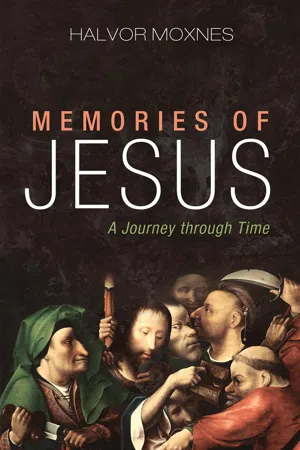
This is a different book about Jesus. It does not study the Gospels as sources for the historical Jesus, but reads them as memories about Jesus, each Gospel with its characteristic picture of Jesus. The book traces the transmission and growth of memories of Jesus in various contexts and in different historical periods. It also introduces readers to the little known counterstories to Christian memories in Jewish sources, as well as to the rival stories in the Quran. A central perspective in the book is the troubling fact that for centuries the memories of Jesus contributed to hate speech against the Jews in Europe. The passion narratives in the Gospels put the blame for the death of Jesus upon Jewish leaders, and these stories were transmitted across the centuries as historical truth. Memories of Jesus have served as identity markers not only for churches but also for societies and countries. The last chapters focus on how the memories of Jesus have played an important role in supporting the identity of oppressed and marginalized groups, in particular in the contemporary United States.
Information
Part 1: Beginnings
The first three chapters cover the origins of the memories of Jesus, from the first Christian writings and the reactions from Rabbinic and Jewish polemics, to the alternative Jesus stories in the Quran and early Islam. The geographical setting is the modern Middle East and Eastern Mediterranean, and this signals that the Jesus movement, and Early Christianity in this period, was predominantly an Eastern religion.
The beginning was the Christian stories of Jesus, his life, activities and teachings. They are read not as sources for the historical Jesus, but as sources for the memories of Jesus from his first followers. In the present day, they are read as foundational texts for Christian churches and even for Western culture and societies. Therefore, the questions of canon are important: What are the scriptures that belong in the New Testament? However, when we read the gospels as the first memories of Jesus, we find a much more fluid situation. The memories, although fixed as cultural memory in writing, continued as living memories that grew and developed. There is a large literature called apocryphal gospels, which is not clearly defined, and which fills in gaps in the gospel stories, bringing in new persons, e.g., Mary’s parents. This process starts in the second century and continues for several centuries.
At the same time as the Christians continued to create memories, the claims of the first memories were contested. The reactions from Jewish scholars and popular polemics rejected the claims that the Christians made about Jesus, and especially the way they used the Bible and Jewish history to support their claims. The situation was one of Christians telling a history of Jesus and of Jews telling counterhistories about Jesus to delegitimize the Christian stories. The seventh century saw the beginning of a third version of stories about Jesus, this time in the Quran. The Quran introduced Jesus as an Islamic prophet, while, however, rejecting the Christian claims about Jesus’ divinity.
1
Jesus in Early Christian Memory
The Gospels as Biographies of Jesus
“So his fame spread throughout all Syria.” —Matt 4:24
There can be no doubt that people told stories about Jesus already during his lifetime. These could have been stories from people who had encountered him, who had themselves experienced healings, or who had heard about such healings. There could also have been stories that people had told synagogue authorities in order to warn them about Jesus’ activities. Of course, more stories were told about Jesus after the Romans had executed him. Those who had met him and followed him kept the memories about him alive, especially those who believed that he was risen and that he was still alive. These followers believed that he continued to speak to them and interact with them. The memories of Jesus, of what he had said and done, were told in such a way that they brought him to life for new followers.
After Jesus’ death, the memories about him spread quickly, first within the Syria-Palestine area, then further to Asia Minor, Greece, and Rome, and to Egypt in the South. The first Christ followers were often recruited from among members or associates of Jewish synagogues, but they soon established their own groups, meeting in private homes.
Jesus was remembered in two distinctive ways. We find one of them in the letters of Paul or other early Christian letter writers in the form of proclamations of Jesus and his death and resurrection. We do not know how much the early missionaries had actually told about Jesus’ life, of what he had said and done. In Paul’s letters, we find very few memories about Jesus. Instead, Paul speaks directly to the addressees of his letters to explain the meaning of Jesus’ death and resurrection for them.
In addition to this way of reminding the audience of the meaning of Jesus, there was another way that created memories of Jesus through narratives of what he had said and done. We find these narratives in the gospels that were written down thirty to fifty years after Paul’s letters. These sayings and stories about Jesus were first transmitted orally within a society with strong oral traditions. This means that these narratives were not only individual memories, but also communal memories shaped by their use in worship and prayer. Readings, preaching, and teachings, as well as the rituals of baptism and the shared meal, together created a shared memory. Through all these events, the memories of Jesus became alive so that the participants experienced that Jesus was present among them, invisible but real. Thus, through the participation in these rituals, the experiences of the presence of Jesus became part of the identity of the Christ believers.
The earliest transmissions of memories of Jesus were in the form of brief sayings and short narratives. Many of them were of a similar type, and they appear quite stereotypical. This is easily understandable when we consider how popular stories were shaped through repeated oral presentations. Furthermore, common patterns of remembering were at work: short sayings, pointed comments, a striking image or parable were easy to remember. The passion narrative is an exception to this pattern of short traditions. It is the longest continuous story in the gospels, and the one that was most painful to narrate. At the same time, it was important to tell the story in such a way that Jesus’ life and death did not signify failure but had a positive meaning.
At this oral tradition continued, at the same time sayings and narratives were collected and brought together into larger collections—for instance healing stories—and were probably also written down. Many scholars think that a large collection of sayings of Jesus, called Q (from the German word for “source,” Quelle), was written down before the first Gospel, Mark. The majority of biblical scholars think that the (anonymous) author of Mark’s Gospel was the first to collect the oral traditions about Jesus and to organize them into a chronological framework. The outline, starting with the baptism by John and ending with Jesus’ death and resurrection, provided the framework for the sequence of Jesus stories and sayings. In this way, Mark provided a model for a structure that Matthew and Luke to a great extent followed. These three Gospels are called Synoptic (“seeing together”), since they have so much material in common. Even the Gospel of John follows the main outline of Jesus’ life from baptism to death and resurrection, but within that framework, it has a different structure and much separate material.
Through this process, the memories of Jesus changed in character and acquired a different function. The first oral traditions were based on reports from eyewitnesses or from people who heard about them. These reports were flexible and developed when they were retold in new contexts to respond to new situations. When these memories were written down, however, they were formalized in such a way that it was not up to individuals or a group to change them. The evangelists not only collected and transmitted memories; through the way the memories formed the Gospels, they shaped memories for their audiences. When they were written down, the memories gained a greater authority and importance: they became a “cultural memory” for a larger community.1
Shortly after the Gospels were written down, some early witnesses describe them as “memories.” The first to do so was Papias (ca. 70–120 CE), a bishop in Hierapolis in western Asia Minor. He writes that Mark, who according to tradition was the author of the Gospel of Mark, “became Peter’s interpreter and wrote accurately all that he remembered.”2 Around the middle of the second century, the Christian philosopher Justin Martyr (ca. 100–165 CE) wrote a defense of the Christians in which he described the Gospels as “th...
Table of contents
- Title Page
- Preface
- Acknowledgments
- Introduction
- Abbreviations
- Part 1: Beginnings
- Part 2: Retellings
- Part 3: Challenges
- Conclusion: Jesus—Memories for the Future?
- Suggested Readings
- Bibliography
Trusted by 375,005 students
Access to over 1.5 million titles for a fair monthly price.
Study more efficiently using our study tools.
Frequently asked questions
Yes, you can cancel anytime from the Subscription tab in your account settings on the Perlego website. Your subscription will stay active until the end of your current billing period. Learn how to cancel your subscription
No, books cannot be downloaded as external files, such as PDFs, for use outside of Perlego. However, you can download books within the Perlego app for offline reading on mobile or tablet. Learn how to download books offline
Perlego offers two plans: Essential and Complete
- Essential is ideal for learners and professionals who enjoy exploring a wide range of subjects. Access the Essential Library with 800,000+ trusted titles and best-sellers across business, personal growth, and the humanities. Includes unlimited reading time and Standard Read Aloud voice.
- Complete: Perfect for advanced learners and researchers needing full, unrestricted access. Unlock 1.5M+ books across hundreds of subjects, including academic and specialized titles. The Complete Plan also includes advanced features like Premium Read Aloud and Research Assistant.
We are an online textbook subscription service, where you can get access to an entire online library for less than the price of a single book per month. With over 1.5 million books across 990+ topics, we’ve got you covered! Learn about our mission
Look out for the read-aloud symbol on your next book to see if you can listen to it. The read-aloud tool reads text aloud for you, highlighting the text as it is being read. You can pause it, speed it up and slow it down. Learn more about Read Aloud
Yes! You can use the Perlego app on both iOS and Android devices to read anytime, anywhere — even offline. Perfect for commutes or when you’re on the go.
Please note we cannot support devices running on iOS 13 and Android 7 or earlier. Learn more about using the app
Please note we cannot support devices running on iOS 13 and Android 7 or earlier. Learn more about using the app
Yes, you can access Memories of Jesus by Halvor Moxnes in PDF and/or ePUB format, as well as other popular books in Theology & Religion & Biblical Criticism & Interpretation. We have over 1.5 million books available in our catalogue for you to explore.