2022 PROSE Awards Category Winner - Biography & Autobiography
Foreword INDIES Book of the Year Awards - 2021 BRONZE Winner for Biography
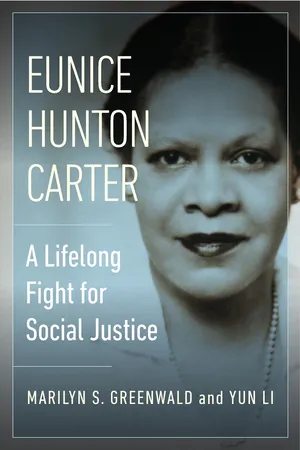
The fascinating biography of Eunice Hunton Carter, a social justice and civil rights trailblazer and the only woman prosecutor on the Luciano trial
Eunice Hunton Carter rose to public prominence in 1936 as both the only woman and the only person of color on Thomas Dewey's famous gangbuster team that prosecuted mobster Lucky Luciano. But her life before and after the trial remains relatively unknown. In this definitive biography on this trailblazing social justice activist, authors Marilyn S. Greenwald and Yun Li tell the story of this unknown but critical pioneer in the struggle for racial and gender equality in the twentieth century.
Carter worked harder than most men because of her race and gender, and Greenwald and Li reflect on her lifelong commitment to her adopted home of Harlem, where she was viewed as a role model, arts patron, community organizer, and, later, as a legal advisor to the United Nations, the National Council of Negro Women, and several other national and global organizations.
Carter was both a witness to and a participant in many pivotal events of the early and mid– twentieth century, including the Harlem riot of 1935 and the social scene during the Harlem Renaissance.
Using transcripts, letters, and other primary and secondary sources from several archives in the United States and Canada, the authors paint a colorful portrait of how Eunice continued the legacy of the Carter family, which valued education, perseverance, and hard work: a grandfather who was a slave who bought his freedom and became a successful businessman in a small colony of former slaves in Ontario, Canada; a father who nearly single-handedly integrated the nation's YMCAs in the Jim Crow South; and a mother who provided aid to Black soldiers in France during World War I and who became a leader in several global and domestic racial equality causes.
Carter's inspirational multi-decade career working in an environment of bias, segregation, and patriarchy in Depression-era America helped pave the way for those who came after her.
- 240 pages
- English
- ePUB (mobile friendly)
- Available on iOS & Android
eBook - ePub
About this book
Information
1

Heirs to the Struggle
It takes rare courage to fight a fight that more often than not ends in death, poverty or prostitution of genius…. But it is to those who make this fight despite the tremendous odds … that we must look for the breaking of the bonds now linked together by ignorance and misunderstanding.—Eunice Hunton, in Survey, March 1, 1925
AS SHE SAT IN HER OFFICE at 137 Centre Street in Manhattan in the mid-1930s, few would peg Eunice Hunton Carter as the crime buster whose work would ultimately nail the notorious and glamorous Charles “Lucky” Luciano and many in his gang. As the first Black woman to be named to the prosecutor’s office in New York City, she stood out from the White men in her office, both in physical appearance and demeanor. The low-key Carter, who usually dressed in conservative loose-fitting dresses and often wore a hat, achieved much of her success not on the streets, but behind her desk, working the phones and painstakingly reviewing thousands of documents. Soft-spoken, she didn’t boast about her accomplishments and certainly didn’t exaggerate them. And she never complained about the long hours that often led to many frustrating dead ends.
Eunice was not just another member of the twenty-person team of attorneys who busted the mob and revealed its illegal activities to the public. She was the one who linked prostitution in the city to the work of mob head Luciano, a seemingly far-fetched connection that would ultimately crack the case. Her knowledge of the streets of Harlem, combined with her innate common sense and her willingness to review thousands of pages of legal documents and testimony, led to her discovery. And even then, she had trouble persuading her boss of its importance. She managed to do so only because her colleagues respected her, so they trusted her instincts.
This finding would become Carter’s legacy and would ultimately garner more attention than the many “firsts” she achieved throughout her life: one of the first Black women to earn a law degree at Fordham University and to pass the New York bar, and the first Black person to be awarded an honorary doctorate of law at Smith College, first Black woman to pass the New York Bar, and more. And her association with the glamorous world of Luciano and other mobsters could not have been more ironic for the woman who had always buried herself in solitary work: first as a young college graduate who wrote gentle and descriptive short stories about her vague memories of early childhood in the sunny and lush South, and later as an attorney and bureaucrat who devoted herself to social-justice causes.
As with many people, Eunice’s personality was, in some ways, contradictory. She was a talented writer who gave up hopes of that creative pursuit for social work and the law, and she became a dedicated scholar and dogged attorney for whom family would be one of the most important aspects of her life.
Eunice was a third-generation member of a family of social-justice pioneers who struggled against slavery and segregation and bias. To attempt to understand her persistence, motivations, and way of thinking, one must first turn to her mother, Addie Hunton.
EUNICE SEEMS to have inherited her strong work ethic, single-minded determination, and creative, independent way of thinking from her father, William Alphaeus Hunton. William Hunton was the first top Black YMCA administrator whose pioneering work established YMCA facilities for both “colored” people and Whites. He devoted much of his life to that exceedingly difficult task, traveling around the world and spending many years in the American South during the era of codified segregation known as the Jim Crow years.
But it was her mother, Adelina “Addie” Hunton, who served as the lifelong role model for her two children, Eunice and William Jr. (known as Alphaeus), in her actions, beliefs, and determination. Addie Hunton’s life revolved around her activities as a civil rights and suffrage activist whose goal was to fight for equality and improve the lives of those who followed her. Addie spent much of her early adulthood assisting her husband in his role as a YMCA executive and activist. Throughout her life and her extensive travels, she made sure to record her activities and beliefs on paper. She was a student of the world around her, leaving behind countless writings in the form of books, journal and magazine articles, essays, and newspaper stories. Addie Hunton had a strong sense of history and early on recognized the importance of documenting the struggles—and victories—of Black people in their quest for equality. Her daughter would share this penchant for writing and recording observations, even though she would make her mark in the world as an attorney, crime fighter, and club woman.
IN 1917, ADDIE WAITES HUNTON was a widow with two teenage children: a daughter, Eunice, 18, and a son, Alphaeus, 13. Her husband of twenty-three years had died the previous year after a lengthy illness, and his care had depleted much of the family’s savings and had worn down Addie emotionally. But now she had started to get on her feet again, even though she was never one to remain stationary and tend to the home—not before she married and not as she raised her two children. Now, in the middle of World War I, she and two other Black women used their membership in the National Association of Colored Women (NACW) to contribute to the war effort through rallies, war bond campaigns, and emotional support for Black troops. In their book, Two Colored Women in World War I France, she and Kathryn Johnson described the thrill and apprehension they felt that day in June 1918 when they were called to begin a journey to the coast of France as part of the American Expeditionary Forces. The two women worked for the YMCA and under the auspices of the NACW to sail to France to provide aid and moral support to the two hundred thousand racially segregated Black troops there. The two women were moved by the “great thrilling, throbbing spirit of war.” As they indicate in the detailed memoir about the thirteen-month mission, the excitement and trepidation were palpable—even the weather that day was foreboding:
One dark afternoon, as the rain came down in torrents, the buzz of the telephone at our elbow told us our time had come. We asked no questions, for those were days of deep secrecy, but looked for the last time at the war map in the office wondering where in that war-wrecked country across the Atlantic, we would find our place of service. We breathed a little prayer, said good-bye to our fellow workers, knowing that tomorrow we would be on the ocean eastward bound…. There was no sleep that night for us.
The participation in World War I of Black troops was in itself controversial: while many Blacks at the time advocated resisting military service for a country they believed denied them basic rights, Black media organizations, the National Association for the Advancement of Colored People (NAACP), and leading intellectuals of the era, including prominent author and scholar W. E. B. Du Bois, advocated their participation in the military, believing that such service could ultimately alleviate the racial prejudice in the United States. The 92nd Division—composed of draftees and officers—and the 93rd Division—made up primarily of National Guard units—were created for Black Americans. Yet most Black soldiers were assigned to service units, based on the belief that Blacks were more suited for manual labor than combat. And, initially, only a dozen or so Black women were recruited to work with the four hundred thousand Black soldiers in Europe. Addie was sent first to a supply center in St. Nazaire, and later to the town of Aix-les-Bains in the southeast of France.
Hunton’s and Johnson’s 1921 memoir about their shocking, dramatic, and fulfilling time in France was the first of two full-length books Hunton wrote about her and her husband’s lives. Both books differ in style from what many readers would characterize as conventional memoirs because they overflow with primary source material that includes poems, letters, and memos and, in the case of Two Colored Women, written summaries of real-time conversations and excerpts of Hunton’s own thoughts of events shortly after they happened. Hunton apparently realized that because of the marginalization of Blacks of her era, direct accounts of experiences and thoughts would likely be overlooked and lost to history if they were not documented in detail as they happened. Ironically, in the foreword to Two Colored Women, Hunton and Johnson own up to the idea that their own opinions and emotions about their time in France may be biased in some ways due to their unbridled admiration and respect for the soldiers with whom they worked: “We have not refrained in our story from a large measure of loyalty and patriotic service, performed oftentimes under the most trying conditions.” Still, they say modestly that “we have no desire to attain to an authentic history but have rather aimed to record our impressions and facts in a simple way.” Yet Hunton and Johnson’s account of their time in France during World War I is a history that vividly recounts the struggles of a disenfranchised group who fought for their country but ultimately were let down by the government they supported. As the women imply in their book, their time in France was fulfilling to them but also became a disillusioning experience that prompted them to redouble their efforts on fairness and justice after they returned to the United States.
AS YMCA PROGRAM DIRECTORS, known as secretaries, Hunton and Johnson were tasked with teaching literacy classes, running kitchens, leading Bible study classes, arranging athletic events, and, in general, providing moral and emotional support to the Black troops stationed at or near the Western Front. In Two Colored Women, they describe in detail their exhaustive but rewarding months in these efforts. But the mistreatment, neglect, and general lack of humane treatment of the Black soldiers on the part of the American Command as well as YMCA officials shocked them, leading them to believe that America’s Jim Crow laws extended informally to France. Further, although the YMCA pledged equal treatment of the Black soldiers, the women were spread thin, and, at one point, three women were responsible for aiding one hundred fifty thousand men. (The YMCA ultimately sent a total of eighty-five Black social workers to France to aid in the war effort.) The terrible treatment of Black soldiers overseas enraged Blacks in the states and, for many, erased any optimism that their service in the military could ultimately alleviate racism back home. In an essay published in the NAACP journal, The Crisis, which was devoted to Black troops in World War I, Du Bois wrote that the lack of more Black welfare workers like Hunton and Johnson was intentional and designed to demoralize them so they would return home. What Du Bois did not know at the time was that Hunton and Johnson, as well as Helen Curtis and two other Black YMCA workers in France, were being investigated during their trip by Military Intelligence and the National War Work Council of the YMCA after an American heard Curtis urging Black soldiers to protest their abysmal circumstances. Investigators allowed the worker to stay overseas but urged the YMCA not to send any similar “radicals” to France.
Addie Hunton was no babe in the woods when it came to the realities of discrimination, nor was she easily deterred. A native of Norfolk, Virginia, she had traveled extensively and had spent much of her life in the South. Johnson, a field agent for the NAACP in New Orleans, also was a seasoned traveler and social worker. But the two were taken aback by what they saw in France, and they recount throughout the book individual cases of harassment of Black soldiers, inadequate housing, and propaganda by military officials about the supposed cowardice of Black soldiers. The women were quick to praise the work of some of the YMCA officials who came to France, but they also noted that many of them exhibited racist behavior. They describe an all-too-typical instance when an all-Black band led by a white bandleader came to a hut to entertain the soldiers: “Several colored soldiers followed the band into the hut. The secretary got up and announced that no colored men would be admitted.” Signs prohibiting Black soldiers from entering some areas were common, the women write, as were recommendations by American officers that the French prohibit Black soldiers from entering hotels and restaurants for fear they would interact with White women. To show Black soldiers common courtesy, some officers indicated, “not only would be dangerous, but … would be an insult to the American people.” Ironically, the French, for the most part, respected and admired the Black soldiers and treated them warmly. “The relationship between the colored soldiers, the colored welfare workers, and the French people was most cordial and friendly and grew in sympathy and understanding, as their association brought about a closer acquaintance,” the women write. That warm treatment was in direct contrast to what many of them experienced in their home country: “It was rather an unusual as well as a most welcome experience to be able to go into places of public accommodation without having any hesitations or misgivings; to be at liberty to take a seat in a common carrier, without fear of inviting some humiliating experience; to go into a home and receive a greeting that carried with it a hospitality and kindliness of spirit that could not be questioned.”
Even the Germans recognized this irony: In August 1918, they dropped leaflets over the 367th Infantry in the 92nd Division, suggesting they “come over to the German lines.” “Do you enjoy the same rights as white people do in America, the land of Freedom and Democracy, or are you treated over there as second-class citizens?” the leaflet said, asking, sarcastically, if the Black soldiers can go into restaurants “where white people dine” or “get a seat in [a] theater where white people sit” or “get a seat or a berth in a railroad car,” or “can you even ride, in the South, in the same street car with white people?” The leaflets were brutally candid: “You have been made the tool of the egotistic and rapacious rich in America, and there is nothing in the whole game for you but broken bones, horrible wounds, spoiled health, or death. No satisfaction whatever will you get out of this unjust war.”
That the soldiers would be treated with more respect and hospitality in a foreign country than in their own was, of course, noted throughout Two Colored Women. “There was being developed in France a racial consciousness and racial strength that could not have been gained in a half century of normal living in America,” they write. “Over the canteen in France we learned to know that our young manhood was the natural and struggling guardian of our struggling race. Learning all this and more, we learned to love our men better than ever before.”
Hunton and Johnson became maternal figures to the Black soldiers they met, and many of the anecdotes in the book convey the warmth and camaraderie among them. They worked to make huts and living quarters as hospitable as possible and were quick to note that their generosity was returned. “We learned to know our own men as we had not known them before, and this knowledge makes large our faith in them,” they write. The men reminisced about the women they left at home and had “an attitude of deep respect, often bordering on worship” toward Hunton and Johnson. The two note the joy many of the soldiers took through the “salvation” of music: “Those who know the native love and ability of our race for music will not marvel at the statement that colored soldiers sang, whistled, and played their way through the late war” and through days of “hunger and thirst … deathly fatigue … days filled with dense smoke and deafening uproar of battle; days when terrible discriminations and prejudices ate into the soul deeper than the oppressors knew.”
The end of the war did not ease the discrimination and ill-treatment of the Black soldiers, Hunton and Johnson imply: Black soldiers were not permitted to participate in a victory parade in France, even though many had been cited or decorated for bravery. The French did not understand the reasons, but “they gradually discovered that the colored man was not the wild, vicious character that he had been represented to be, but that he was kind-hearted, genteel and polite.”
The women’s trip home from France during the humid August of 1919 may have been emblematic of what they found when they reached American shores: Hunton, Johnson, Curtis, and sixteen Black nurses were housed in poorly ventilated second-class cabins on a deck below White nurses and secretaries making the same trip. When they asked why the assignments were segregated, they were told that some of the workers on the ship would be insulted to have Black people in the same dining room where they ate. But Hunton and Johnson focused on their work and were not sidetracked by the kind of treatment they could have predicted. Their response was to meticulously record their experiences and hope they would one day become public. Yet the two women seem oddly optimistic at the end of Two Colored Women, as they write that the war experience of the Black soldiers demonstrated what their lives could be like in their home country: “Thousands had a contact and association [with the French people] which resulted in bringing for the entire number a broader view of life; they caught the vision of a freedom that gave them new hope and new inspiration…. Some of them received the rudiments of an education through direct instruction; a thing that would not have come to them in all the years of a lifetime at home.”
Hunton and Johnson write eloquently of the importance of culture and beauty—even during an era of war and hatred: “Many hundreds had the opportunity of traveling through the flowering fields of a country long famed for its love of the beautiful, and seeing its wonderful monuments, cathedrals, art galleries, places, chateaux that represent the highest attainment in the world of architecture and art.” And, perhaps even more important to these soldiers, “While they traveled they learned that there is a fair-skinned people in the world who believe in the equality of races, and who practice what they believe,” the women write. “They also had an opportunity to give the truth a hearing before … the civilized world; the truth with regard to their conduct, their mental capacity, their God-given talents, and their ability for the leadership of men.” What the men gained, Hunton and Johnson write, “[was] quite enough to offset whatever came to them of hardship and sacrifice, of war and suffering, of mean prejudice and subtle propaganda, of misrepresentation and glaring injustice.”
Johnson and Hunton wrote Two Colored Women to quickly get on the record the first-person accounts of what they viewed as history in the making. But their motives may have also been a bit slyer than that. The advent of Plessy v. Ferguson, the 1896 Supreme Court decision that essentially codified the concept of “separate but equal” treatment in public facilities, in many ways legalized discrimination, declaring that Fourteenth Amendment protections—granting citizenship to all people born in the United States—applied to political and civil rights, but not social rights. In her book about the activism of Black women in the early and mid-twentieth century, Nikki Brown writes, “[The women] critiqued Jim Crow in an international context as race women and cultural ambassadors. Few African Americans utilized an international forum to debate American race relations…. [They] became both commentators and critiquers of white supremacy and racial discrimination in the United States. Hoping for widespread embarrassment with an international condemnation of Jim Crow, they essentially asked, how can America treat her loyal blacks this way?”
The terrible treatment of the Black soldiers in France by their own countrymen drove home to many of them the virulence and ubiquity of racial prejudice. In fact, the success of the program in which Hunton and Johnson participated may have been threatening to some Americans because it succeeded, sociologist Susan Kerr Chandler wrote decades later: “The program stood out as a fundamental challenge to the maintenance of a system of white supremacy, and white YMCA leaders were deeply threatened by it and by the growing racial pride that would in time challenge the segregated basis of social services.” To W. E. B. Du Bois, who had initially encouraged Black participation in the war, the racism displayed overseas may have exacerbated the divisions between Blacks and Whites: “This war has disillusioned millions of fighting white men—disillusioned them with its frank truth of dirt, disease, cold, wet and discomfort; maiming and hatred. But the disillusion of Negro American troops was more than this, or rather it was this and more—the flat, frank realization that however high the ideas of America or however noble her tasks, her great duty as conceived by an astonishing number of able men, brave and good, as well as of other sorts of men, is to hate ‘niggers.’”
Still, Du Bois believed that patriotism was a value that could not be diluted; he maintained that Black soldiers did not regret their service to ...
Table of contents
- Cover
- Title Page
- Copyright
- Dedication
- Contents
- Introduction
- 1. Heirs to the Struggle
- 2. Free But Not Equal
- 3. One Vision in Her Eye, One Cry in Her Soul
- 4. The Business of Reaching New Heights
- 5. From Squash Racquet to Racket Squasher
- 6. “I Must Save My Sister”
- 7. Getting Lucky: The People v. Charles Luciano
- 8. “Making History for the Race”
- 9. “A Prelude to Greater Tasks”
- 10. The Aftermath
- Acknowledgments
- Notes
- Bibliography
- Index
Trusted by 375,005 students
Access to over 1.5 million titles for a fair monthly price.
Study more efficiently using our study tools.
Frequently asked questions
Yes, you can cancel anytime from the Subscription tab in your account settings on the Perlego website. Your subscription will stay active until the end of your current billing period. Learn how to cancel your subscription
No, books cannot be downloaded as external files, such as PDFs, for use outside of Perlego. However, you can download books within the Perlego app for offline reading on mobile or tablet. Learn how to download books offline
Perlego offers two plans: Essential and Complete
- Essential is ideal for learners and professionals who enjoy exploring a wide range of subjects. Access the Essential Library with 800,000+ trusted titles and best-sellers across business, personal growth, and the humanities. Includes unlimited reading time and Standard Read Aloud voice.
- Complete: Perfect for advanced learners and researchers needing full, unrestricted access. Unlock 1.5M+ books across hundreds of subjects, including academic and specialized titles. The Complete Plan also includes advanced features like Premium Read Aloud and Research Assistant.
We are an online textbook subscription service, where you can get access to an entire online library for less than the price of a single book per month. With over 1.5 million books across 990+ topics, we’ve got you covered! Learn about our mission
Look out for the read-aloud symbol on your next book to see if you can listen to it. The read-aloud tool reads text aloud for you, highlighting the text as it is being read. You can pause it, speed it up and slow it down. Learn more about Read Aloud
Yes! You can use the Perlego app on both iOS and Android devices to read anytime, anywhere — even offline. Perfect for commutes or when you’re on the go.
Please note we cannot support devices running on iOS 13 and Android 7 or earlier. Learn more about using the app
Please note we cannot support devices running on iOS 13 and Android 7 or earlier. Learn more about using the app
Yes, you can access Eunice Hunton Carter by Marilyn Greenwald,Yun Li in PDF and/or ePUB format, as well as other popular books in Social Sciences & Social Science Biographies. We have over 1.5 million books available in our catalogue for you to explore.