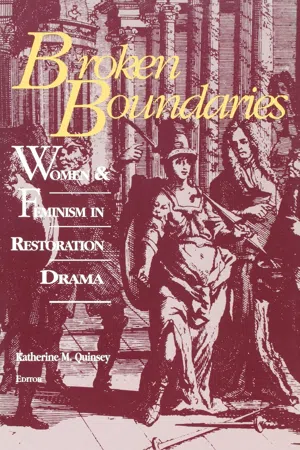
This volume of twelve original essays is the first comprehensive study of feminist issues in Restoration drama. The late seventeenth century marks a pivotal era in the history of feminism, when Renaissance assumptions about gender and patriarchy were being directly challenged. For the first time, women appeared onstage as actresses, made their presence felt as spectators and patrons, and wrote a number of the plays produced in theaters. In an unusually direct and probing way, drama of the Restoration period raised radical questions about the place of women in the family and in society, and about the essential nature of men and women. The essays examine feminist issues from a variety of historical and theoretical approaches across a spectrum of plays—comedies, tragedies, tragicomedies, and heroic drama. By addressing the acute questions of gender raised in the drama, Broken Boundaries presents a vivid portrait of the uncertainties and changing perceptions in all areas of intellectual, political, and social life during the last decades of the seventeenth century.
- 256 pages
- English
- ePUB (mobile friendly)
- Available on iOS & Android
eBook - ePub
About this book
Information
Publisher
The University Press of KentuckyYear
2021Print ISBN
9780813108711
9780813119458
eBook ISBN
9780813159997
PART 1
Instruments of Propagation: Plays by Women
Blacker Than Hell Creates: Pix Rewrites Othello
Jacqueline Pearson
If Hamlet was the Shakespearean play most central to the reading and self-fashioning of readers of the Romantic period—if William Hazlitt and his contemporaries felt that “it is we who are Hamlet” (4:23–24)—then in the Restoration the play most integral to consciousness and culture was Othello. It was the only one of Shakespeare’s major tragedies to be performed throughout the period in more or less the form that Shakespeare wrote it, with “no important variations from the original printings” (Odell 1:38), while King Lear appeared only in the fundamentally recast form of Nahum Tate’s version (1681) and Macbeth and Hamlet in somewhat less radically altered texts by Davenant (1674, 1676). New printed editions of Othello appeared in 1681, 1687, 1695, and 1705, and in the early eighteenth century it was one of the most regularly acted plays, appearing in every season but two of the thirty-one between 1710 and 1742 (Odell 1:224). Clearly something about Othello had a deep appeal to performers, readers, and audiences in the Restoration.
Some of the reasons for this are obvious. Alone among Shakespeare’s mature tragedies, Othello is a domestic play in which heterosexual love is shown in contention with, and is ultimately given priority over, a public world of war and politics. It therefore duplicates more completely than any other of the mature tragedies the typical range and interests of serious drama of the Restoration. Formally, the play’s appeal to Restoration audiences is also readily explicable. Indeed, Othello is one of the key sources for Restoration tragedy, suggesting a number of elements that became central to the development of the genre after 1660: the single action, the exotic foreign background, the sharply paired and contrasted characters, the cunning but covert villain, the importance of issues of patriarchal authority. It was even decisively influential in visual terms, by originating, for example, the potentially titillating “couch scenes” so popular in Restoration tragedy, in which the female body is displayed and fetishized.1 Finally, if Susan Staves is right in suggesting that the typical Restoration hero is “strangely passive” (42), a victim of forces beyond his control, then Othello provides an influential prototype.
Perhaps there were other reasons, too, for the special Restoration fascination for Othello and its images of exotic racial outsiders. Throughout the sixteenth and seventeenth centuries the highest classes of English society were vigorously exogamous. Charles II’s mother was French, his grandmother Danish, his wife Portuguese. Class similarity was ultimately more important than national difference, and it is possible that the idea of an ethnically different partner acquired glamorous associations with royal and aristocratic practices. Moreover, the dependence of the Royalists on foreign allies during the Civil War, and the Interregnum exile of many Royalists, might well have initiated a reconsideration of the relationship between domestic and alien, those like us and those unlike us. During this period foreigners might well be friends and lovers, fellow Englishmen rivals or opponents. (This kind of scenario is dramatized, for instance, in Aphra Behn’s The Rover.) Indeed, there was a tradition of associating the Stuarts with images of racial difference. Ben Jonson’s The Masque of Blackness (1605) was written to be performed by Anne of Denmark and her ladies, who appeared in it as “twelue Nymphs, Negro’s” (7:170–71). It is likely that in Behn’s Oroonoko (1688) the fate of the royal black protagonist is used to figure that of Charles I (see Guffey). Additionally, because of his dark complexion, Charles II acquired a number of nicknames suggestive of racial difference, like the Black Boy (Falkus 13). As a result, in Restoration literature racial difference and racially different characters might well have acquired positive associations, with aristocracy and royalism generally and with the Stuart dynasty in particular, which challenged more traditional negative ones.
It is possible, too, that Othello offered a model that was particularly attractive to women writers. Mary Pix, for instance, goes so far as to use the play and its images of racial difference as a touchstone for female taste and even chastity and marital concord. In The Innocent Mistress (1697), for example, the vulgar and shrewish Lady Beauclair hates the theater, finding it “Nonsence,” for “the first thing I saw was an ugly black Devil kill his Wife, for nothing” (24).2 This not only reveals her lack of sensitivity; it also parallels her culpable failure to live harmoniously with her husband and even predicts the comedy’s surprising conclusion, that she is actually a bigamist, for her first husband, who had been supposed dead, fortuitously reappears. We might have guessed as much, however, for no genteel woman could respond so insensitively to Othello and its images of racial and gender difference.
Interestingly, seventeenth- and eighteenth-century women writers seem to have identified less with (white, female) Desdemona than with Othello himself. Male writers might impose on women an identification with Desdemona, but this is usually patronizing or even positively insulting. The Earl of Shaftesbury in 1710, for instance, uses the comparison to highlight women’s alleged frivolity, perverse sexuality, and marginality to the world of literature, as he criticizes women’s liking for travel books by imagining their female readers as “a thousand Desdemonas” pursuing black lovers (cited in Cowhig 13). The mixture in Desdemona of disruptively assertive sexuality and passive self-denial possibly disturbed women too much for her to be a useful model for them. In any case, Shakespearean tragedy is so androcentric a mode that assertive women writers had virtually no choice in reading but to identify with male characters and viewpoints, as does, for instance, Mary Wollstonecraft (see Wolfson 18).
The characterization of Othello, however, seems to have been uniquely useful to seventeenth-century women. Quotations from and allusions to Othello are very common in the works of Restoration and early eighteenth-century women writers, and they are attributed to women in the works of men. In Charlotte Charke’s The Art of Management (1735), for instance, her fictional alter ego Mrs. Tragic identifies with and quotes Othello (19–20), and so does the jealous Belira in Delariviere Manley’s The Lost Lover (1696) (26) and the female warrior Locris in Charles Hopkins’s Friendship Improv’d; or, The Female Warrior (1700) (47). The appeal lies, I think, in the fact that Othello offers suggestive ways in which racial difference can be used to trope gender difference. Passive, manipulated, ultimately choosing the private world of love over the public world of war, a member of a disempowered group, subject to intense prejudice when he transgresses the limits of his proper sphere, Othello could be viewed as symbolically feminized, even as providing potentially resonant self-images for women writers who were also aware of prejudice and were anxious about transgressions of their assigned roles. Moreover, if women are traditionally associated with nature, men with culture (see Ortner), then the “super-subtle Venetian” Desdemona and Othello the “erring barbarian” (I.iii.356–57) might be seen to reverse this relationship, though Shakespeare’s tendency is finally repressive, since the consequence of a reversal of “normal” gender relations is catastrophic.
Women dramatists of the Restoration in fact went further than Othello and ransacked the canon of pre-1660 plays for those that concentrate on images of ethnic otherness. It does not seem to have been previously recognized that the revision of such plays forms a significant element in the corpus of women’s drama from the mid-1670s to about 1705; this does not seem so visibly the case for plays by male writers. Such plays include Aphra Behn’s Abdelazer (1676), a revision of the anonymous Lust’s Dominion; or, The Lascivious Queen (1599–1600?); The Revenge; or, A Match in Newgate (1680), probably by Behn, which rewrites John Marston’s The Dutch Courtesan (1605); and the two plays by Mary Pix that will take central place in this essay, The Conquest of Spain (1705), which rewrites William Rowley’s All’s Lost by Lust (1616–19; published 1633) but makes important alterations, and The False Friend; or, The Fate of Disobedience (1699), which seems to offer an original plot but which, I shall argue, is deeply and significantly imbued with echoes of Othello. The appeal of such plays to women dramatists probably lay in the sympathetic identification they allowed between women and other cultural outsiders. Racial and ethnic difference provided useful tropes for gender difference, and in the identification both are reformed. Women first significantly entered public, political discourse in Britain and America in the eighteenth century in the movements that opposed slavery (see Ferguson). Restoration texts in which women focus on images of ethnic difference can be read as an enabling mechanism for this emergence.
In this essay I wish to investigate the range of ways in which Restoration women use images of ethnic difference, especially to figure gender difference. I have written elsewhere about Aphra Behn’s treatment of ethnic difference and her repeated use of themes and images of racial otherness; I have examined her replacement of a privileged white, male point of view with a range of different ethnic and gendered viewpoints (“Gender and Narrative,” esp. 186); and I have been particularly interested in her dismantling of those binary oppositions through which a patriarchal culture maintains itself in power and excludes its Others. Such self-interested oppositions as black/white, male/female, are replaced with what a twentieth-century feminist has called “multiple, heterogeneous difference” (Moi 104–5), which celebrates difference rather than using it to naturalize oppressive hierarchies. Now I want to extend this examination to a less obviously radical dramatist, Mary Pix, and to show her subverting these binary oppositions with vigor but also with an extraordinary intertextual subtlety. First, however, it will be necessary to offer a brief introduction to images of ethnic otherness in male-authored seventeenth-century tragedies, in order to suggest the kind of views that playwrights like Pix and Behn could go on to subvert.
The ethnic Other in early seventeenth-century texts tends to be associated with stereotypes of “cruelty” and “lasciviousness” (Kabbani 19), and also with “credulity,” “jealousy,” and treachery (Jones 22, 79). These stereotypes are apparent even in those few plays that challenge them. Shakespeare is himself deeply interested in images of ethnic otherness and is sometimes prepared to challenge clichés. Titus Andronicus, for instance, begins by contrasting the civilized Romans with the “barbarous” Goths (I.i.28), but by the end of the first act the Gothic queen has already showed an understanding of the civilized values of mercy and compassion, while the civilized hero Titus has become “barbarous” (I.i.378). However, by the end of the play this problematization of issues of civilization and barbarism has been swamped by a fairly simple identification of the ethnic outsider with typical outlaw sexuality, rape, adultery, violence, and cruelty.3 The black Aaron, whose name associates him with Judaism and thus with religious as well as racial otherness, in particular becomes an embodiment of evil (see his speech at V.i.124–44), a “devil” (V.i.145), and, in a phrase later remembered in the characterization of (white) Iago (Othello V.i.62), an “inhuman dog” (Titus V.iii.14).
Similarly, it seems to me that in Othello Shakespeare begins by problematizing the stereotype of blackness, but he finally chooses not to pursue this and chooses instead to show Othello as the victim of his biology as well as of Iago. It has been said that Shakespeare adopts the “daring” expedient “of putting the man and the type as it were side by side on the stage” (Jones 87), presenting his audience with “a series of propositions which serve to reverse or disturb their settled notions of black people” (Cowhig 12). In the early acts of the play, despite Iago’s racist comments, Othello indeed runs heroically counter to the stereotype in almost every respect. He is not cruel or swayed by passion: he stops the fight between his supporters and those of Brabantio. He is not lustful: he even believes “the young affects” are “defunct” in him (I.iii.263–64). The Othello of the fifth act, however, reinstates some of these stereotypes: we see him as violent, irrational, and jealous, and both he and Emilia accept the traditional association of blackness with the devil, which the rest of the play has so vigorously resisted and has even relocated onto the white devil Iago (V.ii.132, 134, 278). After problematizing issues of both race and gender, Shakespeare, it seems to me, falls back to an essentialist, biology-is-destiny view of both. It is less that he depicts “a black man whose humanity is eroded by the cunning and racism of whites” (Cowhig 7) as that after testing the stereotypes, he ultimately accepts those asserting black credulity, jealousy, violence, and uncontrollable sexuality. Unlike Shakespeare, however, women writers influenced by Othello tend to carry further its problematization of stereotypes of difference.
Another aspect of the stereotypical treatment of ethnic otherness in many of these texts is revealed by the fact that it does not matter very much whether the ethnic Other is a non-English European, an African, an Asian, an Arab, or a Native American: all attract similar associations. Indeed, these various ethnic groups tend to be elided by Renaissance and Restoration playwrights. For instance, the unequivocally African Eleazar in the anonymous Lust’s Dominion is persistently associated with India—or, perhaps, America—and made to swear by “our Indian gods” (W. Carew Hazlitt, e.g., 110, 142, 143, 154). Conversely, Zelide the Aztec princess is referred to as a “Moor,” a term that technically denotes African origins (Pix, False Friend 58). This erasure of the specificity of individual ethnic groups is, of course, demeaning; one of the basic supports of English imperialism is a hierarchical division of the world into the English and everybody else. In light of this, Aphra Behn’s insistence in Oroonoko on the cultural differences between black Africans and Native Americans, and even between different tribes of Native Americans, is an important way of championing the human individuality of the colonized Other.
In the late sixteenth and early seventeenth centuries black Africans became the sharpest foc...
Table of contents
- Cover
- Half title
- Title
- Copyright
- Contents
- List of Illustrations
- Acknowledgments
- Introduction
- Part 1 Instruments of Propagation: Plays by Women
- Part 2 Chased Desire: Women and Feminism in Plays by Men
- Part 3 The Gaze Reversed: Theory and History of Performance
- Contributors
- Index
Trusted by 375,005 students
Access to over 1.5 million titles for a fair monthly price.
Study more efficiently using our study tools.
Frequently asked questions
Yes, you can cancel anytime from the Subscription tab in your account settings on the Perlego website. Your subscription will stay active until the end of your current billing period. Learn how to cancel your subscription
No, books cannot be downloaded as external files, such as PDFs, for use outside of Perlego. However, you can download books within the Perlego app for offline reading on mobile or tablet. Learn how to download books offline
Perlego offers two plans: Essential and Complete
- Essential is ideal for learners and professionals who enjoy exploring a wide range of subjects. Access the Essential Library with 800,000+ trusted titles and best-sellers across business, personal growth, and the humanities. Includes unlimited reading time and Standard Read Aloud voice.
- Complete: Perfect for advanced learners and researchers needing full, unrestricted access. Unlock 1.5M+ books across hundreds of subjects, including academic and specialized titles. The Complete Plan also includes advanced features like Premium Read Aloud and Research Assistant.
We are an online textbook subscription service, where you can get access to an entire online library for less than the price of a single book per month. With over 1.5 million books across 990+ topics, we’ve got you covered! Learn about our mission
Look out for the read-aloud symbol on your next book to see if you can listen to it. The read-aloud tool reads text aloud for you, highlighting the text as it is being read. You can pause it, speed it up and slow it down. Learn more about Read Aloud
Yes! You can use the Perlego app on both iOS and Android devices to read anytime, anywhere — even offline. Perfect for commutes or when you’re on the go.
Please note we cannot support devices running on iOS 13 and Android 7 or earlier. Learn more about using the app
Please note we cannot support devices running on iOS 13 and Android 7 or earlier. Learn more about using the app
Yes, you can access Broken Boundaries by Katherine M. Quinsey in PDF and/or ePUB format, as well as other popular books in Literature & British Drama. We have over 1.5 million books available in our catalogue for you to explore.