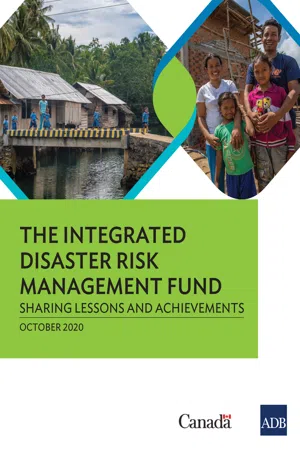
The Government of Canada and the Asian Development Bank (ADB) established the Integrated Disaster Risk Management (IDRM) Fund in February 2013. The Fund was created to advance proactive integrated disaster risk management measures on a regional basis within ADB's developing member countries in Southeast Asia, specifically, Cambodia, Indonesia, Lao People's Democratic Republic, Myanmar, the Philippines, Thailand, and Viet Nam. During its operation, the IDRM Fund funded 19 technical assistance projects with both a gender-focused approach to IDRM and that reflect regional solutions that produce cross-border disaster management. This publication discusses the lessons learned from and achievements of the IDRM Fund.
- 62 pages
- English
- ePUB (mobile friendly)
- Available on iOS & Android
eBook - ePub
About this book
Information
II OUTPUT 1: ENHANCED RISK IDENTIFICATION AND ANALYSIS

Communities as actors of their own resilience. Communities, particularly women, need to be empowered to become more effective agents and leaders of their own resilience (photo by Asian Development Bank).
A. Projects Covered by Output 1
IDRMF-IC-01: Greater Mekong Subregion (GMS) Flood and Drought Risk Management and Mitigation Project. IDRMF-TA-02: Second Greater Mekong Subregion (GMS) Corridor Towns Development Project. IDRMF-TA-04, IDRMF-TA-08: Enhanced Use of Disaster Risk Information for Decision-Making in Southeast Asia. IDRMF-DC-03: Strengthening Disaster Resilience in Selected Urban Areas of Southeast Asia. IDRMF-TA-05: Strengthening Disaster Resilience of Small and Medium Enterprises in Southeast Asia.
B. Rationale for Output 1 in the Southeast Asia Context
Any decision to invest public resources in DRM involves trade-offs with other priorities in which the same resources could be invested. At present, most countries in SEA do not systematically identify what their hazardscape is, what is at risk, who is exposed to or how they are vulnerable from natural hazard impact, let alone to account for the cost of recurrent disaster losses. While some SEA nations attempt to collect, archive, analyze, and use their hazard data, efforts are generally inconsistent or insufficient. And where information is collected, it is not always shared, even though sharing information on hazards involves relatively little expense because some government agencies already collect and analyze data on hazard and disaster risks. These, and other similar issues, mean that governments are poorly positioned to assess trade-offs implicit in their public investment decisions, and have difficulty justifying increased investment in DRM. As populations increase and rapid unrestrained development continues, especially in urban areas, vulnerability and risk will increase without greater efforts being made to frontload DRM through identification and analysis.
C. Summary of Key O utcomes
Generating Actionable Risk Information
(i)Applying risk information to decision-making in development requires adapting both content and presentation of risk information to the needs of end users. This applies to both the type and presentation of risk information, including spatial (location, size, and resolution) and temporal (timing, duration, and time frames) characteristics.
(ii)Establish compatibility between different relevant databases (e.g., land-use data, exposure data). Agree on a common scope and format in which data and information is captured. For instance, agree on geographic boundaries (e.g., administrative units, such as provinces and districts), the appropriate resolution which hazard data is represented and/or shared, and use of compatible tabular and mapping software.
(iii)End users should be involved in risk assessment processes from initial design to output finalization. Specific risk communication strategies and methods need to take account of differences between end users in terms of information needs, risk perception, and educational background.
(iv)Start with available risk information. Building up databases is important and time-consuming, but this need not delay preliminary analysis. For instance, even in the absence of vulnerability data, an analysis of hazard and exposure data can provide base layers to identify disaster risk hotspots (e.g., to appraise investment projects or preliminary land use planning). In the absence of data on exposed assets, technology such as earth-observation and tools such as Google Maps can fill gaps, which can then be addressed incrementally as better and more data is available to improve risk analysis and assessments.
(v)Recognize uncertainties. Even if it is based on excellent data sets and methods, risk information still involves varying degrees of uncertainty associated with a lack of credible data or that our understanding of natural hazards and climate change is still evolving. The extent of uncertainty needs to be communicated clearly, so that end users can make fully informed, strategic decisions. This requires disclosure of scientific evidence and any judgments about the quality and relevance of the evidence to the risk assessment.
(vi)Tap community knowledge. Communities have specific knowledge that needs to be tapped, not only to establish rounded and relevant risk information, but also to generate interest and support for risk reduction. Even the best scientific models are unlikely to fully grasp local conditions and specific factors influencing risk. Hence, qualitative, community-based assessment methods; and quantitative, scientific risk assessments can exist side by side, enrich, and even validate each other.
Key Lessons in Applying Risk Information to Development Planning Processes and Programs
(i)The risk evaluation process is the basis for risk-informed development. Risk information requires evaluating and distinguishing risks that are unacceptable from acceptable risks. These risk-layering processes are the basis for risk-informed development planning, at national and subnational levels, and are sector-specific.
(ii)Need for collaborative governance framework. Risk-informed development planning needs a collaborative governance framework in which public policy makers, technical or scientific experts, and private sector and civil society organizations work together with an informed public that demands investments in DRR and DRM. Attitudes need to change to reward resilient policy making and action, even if they do not generate clearly visible, short-term benefits. This is a long-term process and cannot be achieved through a one-off risk assessment or planning exercise.
(iii)Incentives to encourage risk reduction. Changing incentive systems to reward forward-looking investments in risk reduction needs to be based on a solid understanding of how and when investment decisions are currently made. An essential question is how development progress is currently measured, by whom, and how associated indicators influence investment decision-making.
(iv)Baseline for current disaster risk reduction investments. Risk-informed development requires a baseline of current DRR and DRM investments and necessary capacities and resources to address DRM and DRR gaps. This can help draw in individual sectors to better appreciate the relationship between their scope of work and risk reduction, and encourage collaborative risk-informed development planning frameworks that clarifies current and future roles and capacity in DRR and DRM. It can also help to prioritize and steer investments toward resilience strengthening.
(v)There is no blueprint or strictly defined sequence to design and institute a risk-informed development planning system or capacity. Depending on country contexts, it may be more practical to prioritize highly exposed and vulnerable geographic regions or sectors, develop sector-specific risk information assessment tools, and risk reduction and risk management solutions. Demonstrated evidence of the benefits of risk-informed planning and budgeting in one sector may then motivate other sectors. Similarly, such experience can provide generic development planning apex bodies, such as ministries of planning and finance, with guidance to develop risk-informed planning mechanisms and tools. Conversely, countries with centralized planning and stronger regulatory capacity may start the process at the level of national development planning apex bodies. In more decentralized contexts with strong urbanization trends, risk-informed development planning may focus initially on urban areas and spread to peri-urban and rural areas that share similar hazard exposure and vulnerabilities before defining intraterritorial and national planning arrangements and institutions.
(vi)Communities need to drive risk-informed development. Regardless of the administrative systems of countries, communities are at the frontline of resilience and risk information, and risk-informed development planning needs to address the needs of vulnerable communities. This requires bottom-up and top-down communication and coordination mechanisms to (i) facilitate the flow of actionable risk information and resources including targeted DRM investments, and (ii) ensure that risk reduction solutions that work are identified, tracked, and replicated.
(vii)Adopt adaptive pathways to deal with uncertainties. In the face of both uncertainty of risk scenarios and constrained resources, an incremental approach to climate and disaster risk reduction and management is more practical and easier to justify. The climate change community has termed the concept of “adaptive pathways” to address an uncertain future, meaning that they prioritize most likely scenarios (e.g., seasonal flooding or drought hazards), but identify alternative “pathways” and leave room for extra measures and investments if other scenarios transpire. Such an incremental approach that accommodates uncertainty, limited resources and learning may also work in the context of other hazards.
Basic Building Blocks to Create an Enabling Environment for Risk-Informed Development
(i)Build up or strengthen the understanding of disaster risks. The understanding of disaster risks requires information on hazards, exposure, and vulnerability, which builds on various base layers including data on hazards; climate; hydrological, meteorological, geological or geophysical, and topographic data; population, assets, and other infrastructure, livelihoods, and other relevant socioeconomic characteristics; and historical disaster losses and damages. This material informs the identification of hazard-prone areas and scenarios and the establishment of georeferenced data sets on population, residential buildings, land and water resources, assets (e.g., industrial assets, crops, livestock, and others), and networked infrastructure (e.g., roads and transport, energy and electricity, drainage channels, and irrigation, among others), which are critical to establishing exposure patterns, including disaster hotspots. Together with an analysis of the vulnerability of these georeferenced elements and their replacement values, a fuller picture of the characteristics and distribution of disaster risks and the extent and likelihood of damages and losses can be established.
(ii)Strengthen institutional procedures for ongoing collection, collation, analysis, and coordination of disaster risk data. Disaster risk correlates with dynamic factors such as migration, industrial development, urbanization, environmental degradation, climate change, and globalization. Hence, it is important (i) to strengthen data collection in relevant sectors (making sure there are comprehensive, systematic, and updated asset inventories and that damages and losses are continuously tracked), and (ii) regularly undertake risk analysis to monitor and reflect changes in disaster risk scenarios. Institutional arrangements include interorganizational memoranda and technical protocols about the collection, format, and transmission of data (including roles and responsibilities). It is essential to clearly allocate coordination and lead roles for risk assessments, and conventions for adopting risk assessment results. Regulations may be needed to clarify or standardize responsibilities, objectives, basic methodologies (including credible sources of base data), and intervals in which disaster risk assessments are to be conducted.
(iii)Ensure that relevant disaster risk information is effectively shared. Different users require different applications, scope, and resolution of disaster risk information. At the same time, it is important to build compatible databases and information hubs that can be easily accessed by potential end users.
(iv)Ensure disaster risk information is effectively communicated. Different communication strategies and methods are needed to reach user groups ranging from politicians, administrators, technicians, and private households. Methods need to address current risk perceptions, communication preferences, educational background, economic status, and possible social or gender barriers to accessing information. Grassroots organizations, media, educational establishments, and local governments can act as key disseminators and multipliers of disaster risk information. Partnerships with private sector agencies, such as internet providers, mobile phone companies, and insurance companies can further disseminate disaster risk information.
(v)Strengthen incentive systems for a collaborative risk governance framework. Risk-informed development requires the willingness of multiple actors (government, private, civil society) and sectors to share information and resources, adjust their own plans and programs to achieve overarching resilience objectives, and adhere to agreed-on standards and codes. Competition for limited resources or for visibility can inhibit such cooperation. Therefore, incentives that reward cooperation and participation in risk-informed development need to be designed and complemented by effective sanctions for the breach of agreed-on standards and regulations. Incentives that work are very context-specific, but good methods for incentive-driven, cooperative risk governance now exist.
(vi)Define roles and strengthen capacities of development planning apex bodies. Development planning apex bodies (e.g., ministries of planning and finance) have key roles in facilitating the design, appraisal, and implementation of risk-informed development plans, programs, and investment projects. While the roles of these entities differ from country to country, these ministries can play c...
Table of contents
- Front Cover
- Title Page
- Copyright
- Contents
- Tables, Figure, Boxes, and Map
- Acknowledgments
- Abbreviations
- Executive Summary
- I Introduction
- II Output 1: Enhanced Risk Identification and Analysis
- III Output 2: Increased Investment in Disaster Risk Reduction
- IV Output 3: Improved Access to Disaster Risk Finance, Including the Poor and, Particularly, Poor Women
- V Output 4: Scaling Up of Community-Based and Gender-Focused Approaches
- VI Output 5: Increased Regional Cooperation on Integrated Disaster Risk Management
- VII Output 6: Enhanced Knowledge and Tools for Integrated Disaster Risk Management
- Appendixes
- Footnotes
- Back Cover
Trusted by 375,005 students
Access to over 1.5 million titles for a fair monthly price.
Study more efficiently using our study tools.
Frequently asked questions
Yes, you can cancel anytime from the Subscription tab in your account settings on the Perlego website. Your subscription will stay active until the end of your current billing period. Learn how to cancel your subscription
No, books cannot be downloaded as external files, such as PDFs, for use outside of Perlego. However, you can download books within the Perlego app for offline reading on mobile or tablet. Learn how to download books offline
Perlego offers two plans: Essential and Complete
- Essential is ideal for learners and professionals who enjoy exploring a wide range of subjects. Access the Essential Library with 800,000+ trusted titles and best-sellers across business, personal growth, and the humanities. Includes unlimited reading time and Standard Read Aloud voice.
- Complete: Perfect for advanced learners and researchers needing full, unrestricted access. Unlock 1.5M+ books across hundreds of subjects, including academic and specialized titles. The Complete Plan also includes advanced features like Premium Read Aloud and Research Assistant.
We are an online textbook subscription service, where you can get access to an entire online library for less than the price of a single book per month. With over 1.5 million books across 990+ topics, we’ve got you covered! Learn about our mission
Look out for the read-aloud symbol on your next book to see if you can listen to it. The read-aloud tool reads text aloud for you, highlighting the text as it is being read. You can pause it, speed it up and slow it down. Learn more about Read Aloud
Yes! You can use the Perlego app on both iOS and Android devices to read anytime, anywhere — even offline. Perfect for commutes or when you’re on the go.
Please note we cannot support devices running on iOS 13 and Android 7 or earlier. Learn more about using the app
Please note we cannot support devices running on iOS 13 and Android 7 or earlier. Learn more about using the app
Yes, you can access The Integrated Disaster Risk Management Fund by in PDF and/or ePUB format, as well as other popular books in Biological Sciences & Local & Regional Planning Public Policy. We have over 1.5 million books available in our catalogue for you to explore.