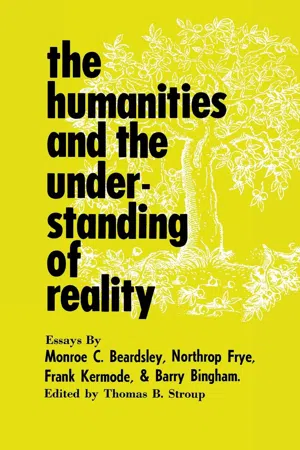
In their concern with the perennial controversy between the two great areas in which men seek knowledge, three eminent literary scholars and a distinguished journalist in these essays address themselves to the question, "Do the humanities provide a form of understanding of reality that the sciences do not?"
Monroe C. Beardsley maintains that the humanities considered as contributors to knowledge must deal with the same subject matter as the sciences, but literature and the arts can enlarge our powers of understanding human nature, although not in the way the sciences do (under empirically or logically verifiable laws). Northrop Frye, while acknowledging the difference in methodology and mental attitude, asserts that the humanities, on the other hand, express man's concern for this world most clearly in the myths by which man realizes his involvement in mankind and his responsibility for his own destiny.
Frank Kermode argues that to follow the ways of sciences in searching out repetitions such as make myths is to lose sight of the unique, particular, and concrete expressions which underlie personal participation and sharpen the sensibilities. And this experience, he maintains, is the peculiar contribution of the humanities. In the final essay, Barry Bingham, editor and publisher of the Louisville Courier-Joumal, calls for a vigorous cultivation of the liberal arts in American life.
- 96 pages
- English
- ePUB (mobile friendly)
- Available on iOS & Android
eBook - ePub
The Humanities and the Understanding of Reality
About this book
Information
Topic
PedagogíaTHE HUMANITIES AND HUMAN UNDERSTANDING

If there is a “crisis in the humanities,” as a recent book has argued,1 it is not that they are getting a bad press. Perhaps the danger is that in this atmosphere of generous good will, they will be supported uncritically—that we will be content to fall back on old, vague, and confused slogans, that in demanding of them what they are not equipped to give, we will fail to value them for their real qualities.
I do not mean to overlook the existence of a serious conflict. It was occasioned by the rise of the human sciences (by which I mean the social sciences and psychology) to a truly scientific and professional level during the first part of this century. For these rivals have arrived on the scene to dispute the humanities’ traditional claim to provide the most significant and fundamental understanding of human nature.
This challenge has long been in the making; what is new about it is that now we are on the verge of being able—with the help of work done by philosophers, social science methodologists, and critical theorists—to cope with it successfully. But that will not be easy. For the bitterness of the conflict is even greater than that of its nineteenth-century predecessor and parallel. Then the natural sciences were fighting for their rightful place among the acknowledged and respected academic disciplines, and many of the best minds—Mill, Huxley, Arnold—reflected on the possibility of conceiving liberal education broadly enough to embrace the scientific study of nature, physical and biological. When Oxford conferred honorary degrees on Faraday and Dalton, in 1832, the Professor of Poetry and churchman, John Keble, complained that the University had “truckled sadly to the spirit of the age”—as though an interest in the laws of chemical combination and electromagnetism were but a passing utilitarian fad. Compare the words of another poet, W. H. Auden, delivering his Harvard Phi Beta Kappa Poem in 1946:
Thou shalt not answer questionnaires
Or quizzes upon World-Affairs,
Nor with compliance
Take any test. Thou shalt not sit
With statisticians, nor commit
A social science.2
But those who have essayed to elevate the humanities by belittling the human sciences have not gone unchallenged. One of the most vigorous replies is still Max Eastman’s lively chapter on “The Swan-song of Humane Letters,” in The Literary Mind, where he said that current defenders of the humanities, especially literary criticism, were
fighting for the right of literary men to talk loosely and yet be taken seriously in a scientific age. . . . They are brandishing every weapon of idea they can lay hold on—brandishing God himself if they can still hang on to Him—in a vain effort to defend the prestige of humane letters against the inexorable advance of a more disciplined study of man.3
The greater discipline he referred to was the systematic application of scientific method to the understanding of human nature. Of course Eastman did not escape stern reproof from F. R. Leavis, whose attack (in the very first issue of Scrutiny) began: “Mr. Eastman . . . presents an interesting case. It is of himself that I am thinking.”4
The nineteenth-century conflict between the humanities and the natural sciences was primarily a competition for prestige and support, and the allegiance of good minds. The present conflict, between the humanities and the human sciences, is a struggle for an indivisible honor—the right to be considered the proper study of man—and it has all the rancor of civil strife. Moreover, just as class consciousness played an important role in the nineteenth-century controversy, so the current one has been much exacerbated by right-wing politicians and theorists who fear in the systematic pursuit of social science (or at least in social scientists themselves) a tendency toward liberal and social-welfare politics.
It is, by the way, a pity that C. P. Snow’s much-publicized attempt to revive the older controversy by dividing the field of learning into his two antagonistic “cultures” simply ignored the existence of the human sciences. At one point in his little book he says that some of his friends, historians and sociologists, told him that he had left something out of his intellectual scene, but Snow explains that any attempt to include them would subject his main thesis to excessive subtlety!5
When we ask a question about something, X, we do not always have to provide ourselves with a definition of the term “X” in order to be sure we understand what we are talking about. But any reasonable suspicion that the term is obscure imposes an obligation upon us to try to clarify it. And no one can deny that there are obscurities in the intension of the term “humanities.” It would be extremely helpful to us, in undertaking this inquiry, if this term had ever been adequately defined.
Now, we are not completely helpless if we can agree on the extension of the term. There are three areas of study that many people undoubtedly want to include among the humanities: philosophy, history, and the study of the arts (most especially, the study of literature). Northrop Frye has said “that literature is the central division of the humanities, flanked on one side by history and on the other by philosophy.”6
Given a clear-cut extension for a term, it is often no great task to extract a common set of characteristics that will serve as necessary conditions for applying that term, and it may be only a little harder to select enough necessary conditions to serve as a set of sufficient conditions as well—that is, as a set that will mark off that class from all other classes. But the task of defining “humanities” has not proved so simple.
In the first place, these subjects are extremely broad and various, as a group; and one of them, philosophy, comprises a distressing variety of interests—more than any one philosopher is likely to subscribe to. Combining philosophy, history, and the study of the arts may be a convenient way of bunching departments in a small college, for administrative purposes, but that doesn’t insure a fundamental rationale.
In the second place, when we ask what the humanities are to be contrasted with, it is much easier to say what the others have that the humanities don’t have than it is to say what the humanities do have that is missing from the rest. For the others are all sciences—including the social sciences. What unites the workers in all the fields of social inquiry is the effort to explain some aspect or segment of human behavior—both mental and physical—through the application of scientific method (or methods) in the broad sense: that is, the procedures of generalizing from properly selected data and constructing explanatory hypotheses to be tested by the data. I don’t want to imply that the social psychologist and the sociologist use exactly the same methods to answer exactly the same questions, but their basic canons of inquiry, their basic methodological commitments, and their basic ideals of consummated research, are convergent.
Thus, one could allow the humanities to consist of all those reasonably systematic and intensive areas of study that are not sciences. This would be a rather unsatisfactory definition, to say the least. But perhaps we are trying to go too fast. Let us ask our question in this form: what contribution to our understanding of reality is made by the three studies that, by common consent, belong in the extension of the term? But before we try to answer this question, it will be wise to pause once more—this time to consider with a little care the meaning and scope of the question itself. What kind of answer are we after in asking it?
The question before us seems to be an epistemological one—that is, a philosophical question about the legitimacy of certain claims to knowledge. Now you may wish to dispute this interpretation of the question, at once, and to say that a “contribution to understanding” is not necessarily a “claim to knowledge.” I don’t think this is true, if it means that understanding is something utterly distinct from knowledge. No doubt, as we sometimes say, it is possible to know things without understanding them. I know, say, that the television set won’t work, but I don’t understand its not working. Here I know one proposition (“the set won’t work”) but there is some other proposition I do not know (say, “the picture tube has finally given up”). It is my lack of knowledge of the second proposition that constitutes my failure to understand the situation described by the first one. So, I would say, though there can be knowledge without understanding, there can be no understanding that is not knowledge. When you understand why the set won’t work, you know what is preventing it from working.
Now, you might say, television sets are one thing, but people are different. Understanding the behavior—or misbehavior—of the former may be the same as knowing its cause; but understanding why someone steals, or dreams, or is embarrassed at a tea party, is something else. And I agree—in part. When we can explain the stealing or the dream or the embarrassment—that is, say what caused it—we have new knowledge. That’s clear. And without this knowledge, we could hardly be said to understand. Yet understanding, even if it includes knowing, may be more than knowing: it may involve entering into the other’s mind, sharing his feelings to some degree, putting yourself in his place so that you have the sense of being on the “inside,” psychologically speaking—in a way that is rather difficult to do in the case of the television set (though the metaphorical idiom I used above, designedly, when I said “the picture tube has finally given up,” embodies a little sympathy and empathy, as well as electronics). This participation in the other’s mental states is sometimes called “verstehen.”
The concept of “understanding” is a very deep and rich one, and of course these remarks are far from exhausting its meaning. But at the moment I am chiefly concerned to make two points. The first is that in so far as the humanities can claim to give us understanding of some aspect of reality, they must also claim to give us knowledge. So I believe I was right in thinking that the question before us can be construed as an epistemological one. The second is that “giving us understanding” (and hence knowledge) need not be exactly the same as “contributing to our understanding”—just as giving someone money is not the same as contributing to his ability to earn money. I concede this distinction gladly, for I think it is in fact the key to our problem. But that will appear later.
Let us, then, take our question as a question about what special kind of knowledge is to be gained from the humanities. But what is a kind of knowledge?
One answer might be that a kind of knowledge is simply knowledge of a kind of thing. There are carrots and there are radishes; so there is carrot-knowledge and radish-knowledge. These useful disciplines may be somewhat circumscribed—they don’t require a place in the curriculum—yet they are at least quite clearly distinguishable.
Can we characterize the humanities epistemologically as embodying knowledge of a certain range of phenomena? In some broad sense, it is often said, the humanities are concerned with man, with his acts and works, his thoughts and feelings, and their artifacts. But this is not an exclusive interest, for the same can be said for psychology and cultural anthropology, and for economics and archaeology, which are presumably not humanities, but sciences. Nor is it a universal interest among the humanities, for some of the important parts of philosophy are not concerned with human beings at all. What about those parts of metaphysics that are directed toward reality in general? What about inquiries into meaning and truth? Some people might be persuaded that these branches of philosophy should be excluded from the humanities. But I know quite a few philosophers who would resist this partition of their territory.
If the humanities are not a particular kind of knowledge in the sense of being knowledge of a particular kind of thing, we might try moving to a second and deeper level. We could say that a kind of knowledge is knowledge of certain selected properties of things (where properties include qualities and relations). Just as the physicist, the chemist, and the physiologist all are concerned with human organisms, among other objects, and yet are concerned with different aspects of these organisms—with physical, chemical, and organic properties—so we might tr...
Table of contents
- Cover
- Half title
- Title
- Copyright
- Introduction
- Contents
- The Humanities and Human Understanding
- Speculation and Concern
- The University and the Literary Public
- A Journalist Looks at the Humanities
Trusted by 375,005 students
Access to over 1.5 million titles for a fair monthly price.
Study more efficiently using our study tools.
Frequently asked questions
Yes, you can cancel anytime from the Subscription tab in your account settings on the Perlego website. Your subscription will stay active until the end of your current billing period. Learn how to cancel your subscription
No, books cannot be downloaded as external files, such as PDFs, for use outside of Perlego. However, you can download books within the Perlego app for offline reading on mobile or tablet. Learn how to download books offline
Perlego offers two plans: Essential and Complete
- Essential is ideal for learners and professionals who enjoy exploring a wide range of subjects. Access the Essential Library with 800,000+ trusted titles and best-sellers across business, personal growth, and the humanities. Includes unlimited reading time and Standard Read Aloud voice.
- Complete: Perfect for advanced learners and researchers needing full, unrestricted access. Unlock 1.5M+ books across hundreds of subjects, including academic and specialized titles. The Complete Plan also includes advanced features like Premium Read Aloud and Research Assistant.
We are an online textbook subscription service, where you can get access to an entire online library for less than the price of a single book per month. With over 1.5 million books across 990+ topics, we’ve got you covered! Learn about our mission
Look out for the read-aloud symbol on your next book to see if you can listen to it. The read-aloud tool reads text aloud for you, highlighting the text as it is being read. You can pause it, speed it up and slow it down. Learn more about Read Aloud
Yes! You can use the Perlego app on both iOS and Android devices to read anytime, anywhere — even offline. Perfect for commutes or when you’re on the go.
Please note we cannot support devices running on iOS 13 and Android 7 or earlier. Learn more about using the app
Please note we cannot support devices running on iOS 13 and Android 7 or earlier. Learn more about using the app
Yes, you can access The Humanities and the Understanding of Reality by Thomas B. Stroup in PDF and/or ePUB format, as well as other popular books in Pedagogía & Teoría y práctica de la educación. We have over 1.5 million books available in our catalogue for you to explore.