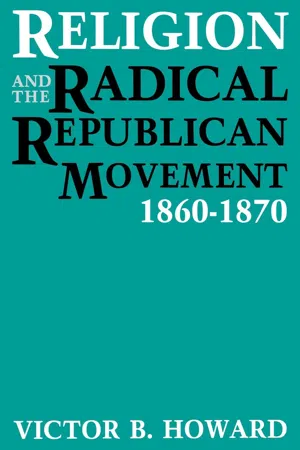
Religion and the Radical Republican Movement, 1860-1870 is a study of the interplay of religion and politics during the Civil War era. More specifically, it examines the extent to which religion set the moral tone of the North during the period of 1860 through 1870. Howard focuses on the growing influence of the evangelical and liberal churches during the period. This influence was largely exerted through the agency of the radical Republicans, a faction that took an extreme position on war measures and on reconstruction after the war. This book examines the degree to which radicalism was inspired by moral motivation and the action that followed the moral commitment.
- 312 pages
- English
- ePUB (mobile friendly)
- Available on iOS & Android
eBook - ePub
Religion and the Radical Republican Movement, 1860-1870
About this book
Information
Publisher
The University Press of KentuckyYear
2021Print ISBN
9780813156156
9780813117027
eBook ISBN
9780813181813
CHAPTER ONE
Moral Inevitability and Military Necessity
The election of 1860 came at a time when the nation had endured long months of almost unbearable tension. The American people had scarcely recovered from the economic panic of 1857 when they were deeply moved by a religious revival that roused emotions to a fever pitch and left many people with the feeling that the country was burdened with a grave national sin. The horrors of John Brown’s raid lingered in the thoughts, if not in the words, of the people. This was a dangerous time for a presidential election.1
The election campaign of 1860 took place in a milieu dominated by a transcending moral issue. In 1949 Arthur Schlesinger, Jr., observed that slavery forced upon every one, both those living at the time and those writing about it later, “the necessity for moral judgment.” The antislavery Christians had already made the same judgment before 1860 and would soon gradually convert moderates to their view. Evangelical Christians in the Civil War era were strong believers in post-millennialism, which taught that Christ would come again only after a millennium of prolonged progress and reform. Many expected the millennium to grow out of nineteenth-century revivals. Revivals were expected to bring radical social reforms, including the end of slavery. To many observers, the nation seemed to stand on the brink of an apocalyptic and providential era. Antislavery Christians saw the growth of reform and the progress of antislavery opinion as part of the program to prepare the nation for the advent of the great millennial age. In May 1860, Charles C. Sholes, a Unitarian layman, believed the country was on the eve of a moral uprising. “I see distinctly now a Providence in the election of James Buchanan” in order that “the cup of iniquity . . . might be filled to overflowing” and the people aroused to a full sense of the wrongs, “wickedness and nefarious designs of the slave oligarchy” so that the people would be driven to take radical measures against slavery.2
After Lincoln’s nomination by the Republican National Convention in May, the Protestant clergy, sectarian journals, and benevolent societies used their influence to help secure his election. In some districts of the North, the election campaign assumed the character of a religious crusade. In Michigan and Massachusetts, prominent laymen were campaigning for office in state elections. Republican gubernatorial Unitarian candidates John Andrew of Massachusetts and Austin Blair of Michigan were campaigning for election. They were Radical Republicans who were abolitionists in all but name. Andrew was a leading layman in the church of the radical James Freeman Clark, and Blair frequently delivered addresses from the pulpit. In Wisconsin and Illinois, antislavery Christians were actively campaigning in the field. Congressman John Wentworth declared that John Brown and Charles Sumner were apostles of freedom who were, like John the Baptist, crying in the wilderness. They paved the way for Lincoln, who “will break every yoke and let the oppressed go free,” Wentworth said. He was a long-time member of the Second Presbyterian Church of Chicago.3
In June, Henry Dexter, editor of the Boston Congregationalist, urged his readers “to carry religion into politics” as a duty of their faith, and in July the Congregational New York Independent implored the faithful to arouse the “conscience of the nation against the iniquity of slavery,” because there would be “a moral power in political action” which would never rest until the federal government had ceased to be connected with the institution. Eight weeks before the election, Theodore Tilton instructed the readers of the Independent regarding “the imperative duty” to rid the nation of slavery as much as “to pray and labor for the conversion of souls.” Christians should guard the ballot box “with holy jealousy” because it would decide the great issue.4 The clergy, Christian laymen, sectarian press, and religious conventions and conferences supported the Republican candidates as they had during the election of 1856. Dale Baum found that roughly three of every four Congregationalists who voted in 1860 cast ballots for Lincoln. The evangelical clergy supported Lincoln in even greater numbers.5
With the election of Lincoln over, sectional tension increased, hastening the final division of the Union. The American Anti-Slavery Society planned a convention in Boston in December to strengthen the forces against the growing spirit of compromise and asked antislavery clergy and laymen how slavery could be abolished. Joshua Giddings, an elder in the Congregational Church and president of a local Bible society, believed that slavery could be abolished only “by the advancement of Christian civilization” and the operation of “truth and justice upon the public conscience.” Henry H. Garnett, a black Calvinist clergyman, was convinced that God would end slavery in his own righteous way. Christian men need only wait for the signs and cooperate with the Providence of God. Conservatives denounced the antislavery Christians as the cause of the secession movement and urged that the antislavery convention be suppressed. The Conservatives hoped for concessions to the South, which they felt would be prevented by the radical meetings. When the antislavery meeting convened, the mayor of Boston promptly suppressed it, and a mob broke up a religious meeting in Boston that was commemorating the martyrdom of John Brown. Many liberals denounced these offenses against freedom of speech, but Elizabeth C. Stanton was sure the rioters were doing work necessary for abolition. Despite the growing concern with concessions to the South, Henry Crapo, the next radical governor of Michigan, wrote to his son: “I say no concessions.” Crapo was a vestryman in the Congregational Church and a long-time member of a local missionary society in Michigan.6
Union meetings were held by commercial people in eastern cities. The conservative clergymen gathered in several churches for prayer meetings to promote conciliation. Early in January 1861, Buchanan spoke to Congress. He insisted that the North had no more right to interfere with slavery in the South than with similar institutions in Russia or Brazil. He laid the blame for secession on the violent agitation in the North. Many Democratic journals insisted that the Northern clergy had brought on the war by their violent agitation. Most clergy refuted the charge, but Granville Moody, a Methodist minister, proudly maintained that it was true. Buchanan proclaimed a national fast day for January 4, 1861, so that the people could repent their individual sins and pray for peace. Nothing was said of slavery. “Let us implore Him [God] to remove from our hearts the false pride of opinion,” Buchanan pleaded. The radical press denounced the proclamation, which made no mention of slavery, and radical governors of eastern states issued their own proclamations asking the people to pray that their national leaders would have sufficient courage to maintain the government inviolate and to uphold the Constitution.7
A large number of clergy in the North had, for a decade, already taken to the public platform as political spokesmen against slavery, and many radical ministers refused to comply with the president’s proclamation. Charles Beecher, of the First Congregational Church in Georgetown, Massachusetts, held an earlier fast day and preached against Buchanan’s proclamation. “Let us take such a position as becomes believing men . . . who expect to meet in eternity,” he advised his congregation. At the end of the service the congregation passed resolutions accusing Buchanan of a treacherous conspiracy with rebels to overthrow the government. A Baptist minister in Holden, Massachusetts, refused to observe Buchanan’s proclamation. He also held an earlier fast day and accused the South of being unwilling to continue the Union “unless it carried slavery on its shoulder. I could as soon pray that Satan might be prospered and his kingdom come. Let there be not another inch of concession given.” God willed that slavery cease, he insisted, and the violent commotions might be an answer to the many prayers for deliverance from slavery.8
The initial step in urging conciliation of the South had been taken by Buchanan’s own denomination, the Old School Presbyterian Church. A circular letter had been addressed to the clergymen of the South, signed by more than thirty distinguished divines, of whom more than half were Old School Presbyterians from the East. The New York Observer, an Old School journal, then suggested that the moderator of the Old School Church call for a day of prayer for the country. When Buchanan’s proclamation was issued, the moderator concurred. Episcopal, Dutch Reformed, Old School Presbyterian, and some conservative Unitarian clergy preached conciliatory sermons that avoided mentioning the slavery question and urged prayer for peace and national harmony. Henry Bellows, a conservative Unitarian clergyman, blamed much of the nation’s trouble on insulting and inflammatory sermons from the pulpit. Reverend Stephen H. Tyng, of New York, one of the most outspoken antislavery Episcopal clergymen in the East, read Bishop Simon Potter’s circular letter counseling Christians to work for conciliation and compromise with the South. Tyng had nothing to say personally.9
As information was received about Lincoln’s cabinet selections, antislavery Christians expressed reservations about some of Lincoln’s conservative choices. Charles D. Cleveland, a Presbyterian layman from Philadelphia and vice president of the American Missionary Association (AMA), urged Lincoln to choose cabinet advisers with the “purest moral integrity” and expressed the hope that Simon Cameron would not be an official adviser because he would “give no moral power” to the cabinet. Other laymen, clergy, and antislavery Christians protested against the appointment of Cameron and expressed concern that the government be placed on the highest moral plane.10
In his inaugural address, March 4, 1861, Lincoln repeated his campaign pledge that there would be “no purpose, directly or indirectly, to interfere with the institution of slavery in the States where it exists.” After the attack on Fort Sumter on April 12, radical Christians took a different view. Charles L. Brace, a Congregational clergyman and secretary of the Children’s Aid Society, began bombarding the New York and Boston newspapers with correspondence saying that the war against the South should be made a holy war and that the soldiers should be taught that, like the English Puritans, they were serving God. The New England Conference of the Methodist Episcopal Church and the New York Welsh Congregational Church came out against further compromises with slavery. After the Unitarian Christian Inquirer insisted that the Civil War should deliver the death blow to slavery, James Freeman Clarke published his letter to Senator Charles Sumner, explaining why no compromise could be made with slavery. Clarke and others were simply expressing the idea John Quincy Adams had popularized earlier in the century, that the constitutional protection of slavery would cease to exist in the advent of war.11
In May, Henry Ward Beecher informed a correspondent that slavery should be destroyed. Several other Congregational clergymen took the same stand publicly. During the same month, under the lead of S.S. Jocelyn, secretary to the AMA, a petition for the abolition of slavery was circulated and was sent to Lincoln from the First Congregational Church of Brooklyn. A similar petition, which noted that slavery could be abolished by the war powers of the president, was circulated in the region of Jewett City, Connecticut, by the Congregationalists of the county, and the Congregational Association of Connecticut informed Lincoln that it reverently waited on the providence of God to remove slavery. From the Northwest came a memorial drawn up by the Fox River Congregational Association, Illinois, affirming that its members did not want the war to end until slavery had been completely eradicated. The General Association of Congregational Churches of Illinois passed resolutions to the same effect, which were sent to Lincoln.12
In his July 4 message to Congress, Lincoln reiterated his inaugural pledge that he would not indirectly or directly interfere with slavery. By this time antislavery Christians increasingly feared a compromise with slavery. George B. Cheever, pastor of the Congregational Church of the Puritans and president of the Church Anti-Slavery Society, took every occasion to persuade the nation that the war would cease if slavery were completely abolished by the federal government. If the government did not deal with the cause of the war, the nation should expect the retribution of God, he warned. Benjamin Aydelotte, a Presbyterian minister in Cincinnati, expressed the same opinion to his associates, and Moncure Conway spent the summer months of 1861 trying to persuade the Christian population of the same idea. Quick and decisive action was necessary, argued Conway, if the nation was to be redeemed. Horace Greeley, editor of the New York Tribune and an antislavery Universalist who was often a delegate to the Universalist National Convention, optimistically assured Conway that the “Father of all Good” would work out his holy ends and added that, although the end of slavery might be postponed and obscured, “this Rebellion seals the doom of slavery.”13
During the summer of 1861, the slowness of the Union forces to act, the apparent lethargy of the administration, and the failure to adopt a progressive policy concerning slavery suggested to many that a compromise with the South might be in the making. Defeat in the battle of Bull Run, July 21, 1861, heightened this fear, and the battle’s effect was instantly reflected in the almost unanimous passage on July 22 of the Crittenden Resolution, which confirmed Lincoln’s pledge not to interfere with the domestic institution. The reaction of antislavery religious sentiment was immediate. The annual conferences of the Methodist Episcopal Church resolved that they were unalterably opposed to all compromises with the South and slavery. A Methodist minister from Indiana expressed uneasiness about the lack of a government policy concerning slavery. He wrote to the Western Christian Advocate that only one of ten clergymen believed the war was being waged against slavery.14
On August 30, 1861, General John Frémont issued a proclamation freeing all slaves owned by persons in the state of Missouri who were resisting the United States. Gerrit Smith began writing to Lincoln that rebellion would have been dealt a death blow in the beginning if slavery had been abolished by the federal government. When Smith received the news, he wrote: “This step . . . is the first unqualifiedly and purely right one” which had taken place during the war. In DeKalb, Illinois, evangelical ministers of several denominations met and signed a memorial to Frémont, declaring their “unspeakable satisfaction and gratitude to God” for his immortal act. The Fox River Presbytery (Illinois) took similar action. Radical antislavery Christians were jubilant, but their mood quickly changed when, on September 2, Lincoln suggested Frémont modify his proclamation to conform with the Confiscation Act of August 6 and on September 11 ordered the change. Reaction to Lincoln’s order was not long in coming. A radical Congregationalist and president of the County Sunday School Society of Kalamazoo, Michigan, wrote to Lincoln that the president’s “order had sent much pain through Christian hearts.” He beseeched Lincoln “in the fear of God and love of your country” to retract the order. A group of Christians of several denominations, of which the majority were Methodists, met in Coldwater, Michigan, and approved a memorial to Lincoln stating that they “fully approved” Frémont’s proclamation and opposed the president’s order modifying the general’s edict. The memorial read: “Leave the consequence to God, after you have performed your duty.” A leading member of the Plymouth Congregational Church of Janesville, Wisconsin, and a son-in-law of Reverend Henry Cowles, editor of the Oberlin Evangelist, informed Lincoln that his order would anger a multitude of like-minded people.15
Kentucky responded violently to Fremont’s proclamation and demanded that Lincoln order its withdrawal. When Frémont’s decree was canceled, Ohio reacted bitterly against what many called Kentucky’s blackmail. A citizen of Chillicothe, Ohio, protested against the modification of Frémont’s proclamation and insisted that its purpose had been to appease Kentucky so that the state would not leave the Union. “Go forward, and quell insurrection,” he advised, “Leave the consequence to God, after you have performed your duty.” Another citizen of Chillicothe wrote to Lincoln in the same vein. “Pursue the right, looking to God to reward the right,” he counseled. Lincoln was informed by still another Ohioan that ninety-nine out of every hundred people had been pained by his order. “I firmly believe you are an instrument in the hands of Providence to preserve this Glorious Government,” and the peculiar institution must not be permitted to stand in the way, he wrote to Lincoln.16
A Congregational missionary in Illinois reported to the missionary society’s secretaries that the proclamation by Frémont had elicited much enthusiasm...
Table of contents
- Cover
- Half title
- Title
- Copyright
- Dedication
- Contents
- Preface
- Introduction
- 1. Moral Inevitability and Military Necessity
- 2. Radical Christians and the Emancipation Proclamation
- 3. The Election of 1862
- 4. Rise Up O Man of God!
- 5. The Election of 1864
- 6. The Churches and Presidential Reconstruction
- 7. The Christian Opposition to Johnson
- 8. The Fourteenth Amendment and the Election of 1866
- 9. Impeachment and the Churches
- 10. Black Suffrage as a Moral Duty
- 11. The Black Suffrage Referenda of 1867
- 12. The Fifteenth Amendment
- Epilogue
- Abbreviations
- Notes
- Bibliography
- Index
Trusted by 375,005 students
Access to over 1.5 million titles for a fair monthly price.
Study more efficiently using our study tools.
Frequently asked questions
Yes, you can cancel anytime from the Subscription tab in your account settings on the Perlego website. Your subscription will stay active until the end of your current billing period. Learn how to cancel your subscription
No, books cannot be downloaded as external files, such as PDFs, for use outside of Perlego. However, you can download books within the Perlego app for offline reading on mobile or tablet. Learn how to download books offline
Perlego offers two plans: Essential and Complete
- Essential is ideal for learners and professionals who enjoy exploring a wide range of subjects. Access the Essential Library with 800,000+ trusted titles and best-sellers across business, personal growth, and the humanities. Includes unlimited reading time and Standard Read Aloud voice.
- Complete: Perfect for advanced learners and researchers needing full, unrestricted access. Unlock 1.5M+ books across hundreds of subjects, including academic and specialized titles. The Complete Plan also includes advanced features like Premium Read Aloud and Research Assistant.
We are an online textbook subscription service, where you can get access to an entire online library for less than the price of a single book per month. With over 1.5 million books across 990+ topics, we’ve got you covered! Learn about our mission
Look out for the read-aloud symbol on your next book to see if you can listen to it. The read-aloud tool reads text aloud for you, highlighting the text as it is being read. You can pause it, speed it up and slow it down. Learn more about Read Aloud
Yes! You can use the Perlego app on both iOS and Android devices to read anytime, anywhere — even offline. Perfect for commutes or when you’re on the go.
Please note we cannot support devices running on iOS 13 and Android 7 or earlier. Learn more about using the app
Please note we cannot support devices running on iOS 13 and Android 7 or earlier. Learn more about using the app
Yes, you can access Religion and the Radical Republican Movement, 1860-1870 by Victor B. Howard in PDF and/or ePUB format, as well as other popular books in Politics & International Relations & Politics. We have over 1.5 million books available in our catalogue for you to explore.