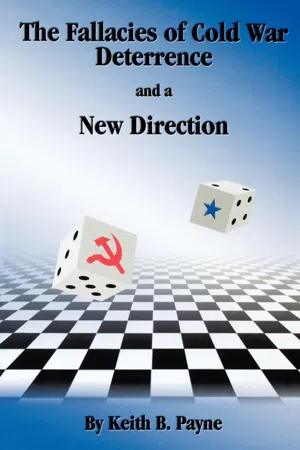
In 1938, Prime Minister Neville Chamberlain hoped that a policy of appeasement would satisfy Adolf Hitler's territorial appetite and structured British policy accordingly. This plan was a failure, chiefly because Hitler was not a statesman who would ultimately conform to familiar norms. Chamberlain's policy was doomed because he had greatly misjudged Hitler's basic beliefs and thus his behavior. U.S. Cold War nuclear deterrence policy was similarly based on the confident but questionable assumption that Soviet leaders would be rational by Washington's standards; they would behave reasonably when presented with nuclear threats. The United States assumed that any sane challenger would be deterred from severe provocations because not to do so would be foolish. Keith B. Payne addresses the question of whether this line of reasoning is adequate for the post-Cold War period. By analyzing past situations and a plausible future scenario, a U.S.-Chinese crisis over Taiwan, he proposes that American policymakers move away from the assumption that all our opponents are comfortably predictable by the standards of our own culture. In order to avoid unexpected and possibly disastrous failures of deterrence, he argues, we should closely examine particular opponents' culture and beliefs in order to better anticipate their likely responses to U.S. deterrence threats.
- 242 pages
- English
- ePUB (mobile friendly)
- Available on iOS & Android
eBook - ePub
The Fallacies of Cold War Deterrence and a New Direction
About this book
Information
Publisher
The University Press of KentuckyYear
2021Print ISBN
9780813190150
9780813122076
eBook ISBN
9780813160238
Chapter 1
INTRODUCTION
Surprise, Surprise
Surprises can be pleasant; but they are particularly unwelcome when it comes to questions of war and peace. Unfortunately, such surprises are fairly common in international relations.
In August 1941, for example, Assistant Secretary of State Dean Acheson reassured President Roosevelt that war with Japan was unlikely because “no rational Japanese could believe an attack on us could result in anything but disaster for his country.”1 Four months later Japan launched a surprise attack against the United States at Pearl Harbor. Despite Acheson’s confident prediction that Japanese leaders would never dare to strike the United States, they did exactly that, believing they were “doomed” if they did not.2 Japanese leaders calculated that they had no acceptable alternative to war with the United States.
In November 1950, U.S. forces were fighting in North Korea. At the time the CIA and Gen. Douglas MacArthur advised President Truman that China would not intervene in the Korean War, in part because they believed that Mao Zedong and, more importantly, Mao’s Soviet patrons would fear igniting a global conflict. Indeed, the CIA’s Daily Summaries (intelligence summaries for the civilian leadership) continued until November 17, 1950, to claim that China would not intervene or, if it did, would not intervene on a large scale.3
Nevertheless, days later, on November 25, 1950, China hurled 170,000 troops against the U.S. Eighth Army in North Korea, signaling a massive surprise intervention that ultimately cost China a million casualties. Instead of being deterred by the prospect of war with the United States Stalin expressed support for Chinese intervention. He stated to Mao, “If a war [with the U.S.] is inevitable, then let it be waged now.”4 Mao, in turn, saw no acceptable alternative to war because he believed U.S. intervention in Korea was part of a larger U.S. plan to encircle and ultimately attack China on three fronts, from the Korean Peninsula, across the Taiwan Strait, and from French Indochina.
As Shu Guang Zhang has observed with regard to Chinese perceptions, “The PRC leadership obviously exaggerated the U.S. threat. Having long suspected American hostility toward a Communist China, it quickly concluded that U.S. intervention in Korea and the interposition of the U.S. Seventh Fleet in the Taiwan Strait was part of a long-planned U.S. offensive. The Chinese leaders were therefore unable to understand that U.S. actions in Korea were generally defensive and reflected only limited aims.”5 American leaders clearly misunderstood Chinese expectations and fears, and were taken by lethal surprise as a result.
On September 19, 1962, less than one month before photographic evidence proved that the Soviets had placed missiles in Cuba, Special National Intelligence Estimate 85-3-62, The Military Buildup in Cuba, essentially stated that the Soviet Union would not place missiles in Cuba because doing so “would be incompatible with Soviet practice to date and with Soviet policy as we presently estimate it. It would indicate a far greater willingness to increase the level of risk in US-Soviet relations than the USSR has displayed thus far, and consequently would have important policy implications with respect to other areas and other problems in East-West relations.”6 Sherman Kent, then-head of the National Board of Estimates, stated of this mistake regarding missiles in Cuba, “There is no blinking the fact that we came down on the wrong side.” Upon reflection, Kent concluded, that “We missed the Soviet decision to put the missiles into Cuba because we could not believe that Khrushchev could make a mistake.”7
During the war in Vietnam, Washington’s civilian leaders ultimately were surprised by their general misjudgment of North Vietnam’s “breaking point.” Washington gradually escalated the conflict in hopes of finding that “breaking point.” Yet North Vietnam essentially was able to withstand far greater loss than ever thought possible by American leaders.8 Former Secretary of Defense Robert McNamara has described this surprise as the failure of the United States to anticipate North Vietnam’s willingness to absorb loss: “The North Vietnamese were prepared to absorb far greater punishment than was ever delivered by the American bombing.”9
In January 1979, Washington was shocked by the fall of the Shah of Iran. Indeed, only a year earlier President Jimmy Carter had praised Iran under the Shah as “an island of stability in one of the most troubled areas of the world.”10 Then-Director of the Central Intelligence Agency Stansfeld Turner has acknowledged that: “We didn’t adequately predict the fall of the Shah. One reason was that while we saw the Shah declining in popularity and influence in his country, we were unwilling to believe that he would not call out the troops when the crisis came and spill blood in the streets if necessary. We had pretty good data on what was happening, but we didn’t make the right assumption.”11
On August 2, 1990, Iraqi forces invaded Kuwait; this time the U.S. intelligence community ultimately had forewarned Washington of an imminent threat. Nevertheless, the prospect for an attack was discounted by senior Bush Administration officials. They were confident that Saddam Hussein would not attack Kuwait: an Iraqi invasion simply seemed too unreasonable so soon after Iraq’s long and bloody war with Iran.12 Illustrative of U.S. expectations was Ambassador April Glaspie’s reply when asked after the war why Saddam Hussein had moved against Kuwait, “We foolishly did not realize he was stupid.”13
In November 1995 the U.S. intelligence community reported that “no country, other than the major declared nuclear powers, will develop or otherwise acquire a ballistic missile in the next 15 years that could threaten the contiguous 48 states or Canada.”14 On August 31, 1998, North Korea surprised Washington with the flight-test of its three-stage Taepo-Dong I, a missile with potential ICBM range. Only following that test, and the sobering review of the emerging missile threat by the “Rumsfeld Commission,”15 did the intelligence community conclude that during the next fifteen years the United States would “most likely” face unprecedented ICBM threats from North Korea, probably Iran, and possibly even Iraq.16
Congress mandated a review of the assumptions driving the original, now-discredited 1995 prediction of a fifteen-year window of safety. That review concluded that the 1995 intelligence estimate was “politically naive,” failed to address “the motives and objectives” and possible unexpected approaches of those countries developing missiles, and placed too much weight on declared Russian and Chinese commitments not to spread missile technology.17
Finally, the Clinton Administration was shocked on May 11 and 13, 1998, when India conducted five nuclear tests. Despite considerable evidence of India’s intentions in this regard, the CIA apparently learned of the tests from a CNN broadcast and was “as shocked as anybody.”18
Clinton Administration officials were dismayed that India had so violated Washington’s norms against nuclear testing, and fumed, “We made the mistake of assuming [India] would act rationally.”19 President Clinton struck a moral tone by saying of India’s decision to test, “It is just wrong.”20 Secretary of State Madeleine Albright admonished India and Pakistan: “Don’t rush to embrace what the rest of the planet is racing to leave behind.”21
The planet is hardly racing to leave nuclear weapons behind. But, for many officials in Washington, moving away from nuclear weapons seems the only reasonable course. The fact that other leaders could be “rational” and come to the opposite conclusion was surprising. A subsequent investigation of this “intelligence failure of the decade,” led by Admiral David Jeremiah, concluded that the U.S. intelligence community had failed to see beyond its own assumptions and understand that the Indian government could place a very high value on nuclear testing.22
This brief survey of recent surprises is meant only to illustrate the fact that expectations of foreign thinking and behavior frequently are grossly inaccurate, and that such mistakes can have terrible consequences.23 Armed with hindsight, it is easy to suggest that no thinking, well-informed person should have been surprised by any of these developments that so shocked Washington at the time. Attempting to project the future in real time, however, is difficult business. Mistakes that appear obvious after the fact may not be so easily seen before the event. One must be cautious when commenting on those who were surprised by the way the future ultimately unfolded.
EXPECTING AND DEFINING RATIONALITY
A common thread runs through the above brief survey of dramatic and in some cases lethal surprises. The U.S. expectation was that foreign leaders would make decisions rationally, and that this rationality would move them toward understandable, predictable behavior. U.S. leaders failed to take seriously the prospect for, and thus to prepare for, what seemed in Washington to be highly unreasonable foreign behavior. In several cases, despite considerable evidence, they failed to anticipate “out of the box” decision-making, and thus were surprised.
When attempting to anticipate a foreign leadership’s decision-making it is important to understand the difference between rational and reasonable behavior. All too frequently, the assumption that challengers will behave rationally, which typically they do, at least in a limited sense, leads to an expectation that they will also behave reasonably, which often they do not.
Rational and reasonable in this sense are not the same: rationality is a mode of decision-making that logically links desired goals with decisions about how to realize those goals.24 For the rational decision-maker, a particular course of action is chosen because, based on available information, that course is calculated to be most suitable for achieving the preferred goal. A rational decision-maker also is expected to prioritize goals—some being more important than others—and recognize that trade-offs among goals may be necessary. That is, the pursuit of one goal may come only at the expense of another.
The judgment that another’s decision-making and behavior is “reasonable” typically implies much more than its “rationality.” Pronouncing another’s decision-making or behavior to be “reasonable” suggests that the observer understands that decision-making and judges it to be sensible based on some shared or understood set of values and standards. To assume rationality, however, and on that basis to expect behavior that is reasonable, that is behavior predictably driven by familiar, understandable norms and goals, is to risk lethal surprise.
Rationality does not imply that the decision-makers’ prioritization of goals and values will be shared or considered “sensible” to any outside observer. The goals and values underlying decision-making do not need to be shared, understood or judged acceptable by any observer for the decision-making to be rational. Nor does “rational” imply that any particular moral standards guide the route chosen to realize preferred goals and values.
A familiar example may help here. An informed, rational shopper recognizes that, given a fixed amount of money, the purchase of one item means that there will be less to spend on another item. Therefore the shopper must consciously calculate the cost versus the benefit of the desired items, d...
Table of contents
- Cover
- Half title
- Title
- Copyright
- Dedication
- Contents
- Preface
- Chapter 1. Introduction
- Chapter 2. Cold War Deterrence Theory and Practice
- Chapter 3. Why the Cold War Deterrence Framework is Inadequate
- Chapter 4. Cold War Deterrence Thought in the Post-Cold War World
- Chapter 5. The Dilemma of Popular Usage and a New Direction
- Chapter 6. Testing the Deterrence Framework
- Chapter 7. The New Deterrence Framework, Evidence and Misplaced Confidence
- Chapter 8. Lessons of This Case Study
- Selected Works Cited
- Index
Trusted by 375,005 students
Access to over 1.5 million titles for a fair monthly price.
Study more efficiently using our study tools.
Frequently asked questions
Yes, you can cancel anytime from the Subscription tab in your account settings on the Perlego website. Your subscription will stay active until the end of your current billing period. Learn how to cancel your subscription
No, books cannot be downloaded as external files, such as PDFs, for use outside of Perlego. However, you can download books within the Perlego app for offline reading on mobile or tablet. Learn how to download books offline
Perlego offers two plans: Essential and Complete
- Essential is ideal for learners and professionals who enjoy exploring a wide range of subjects. Access the Essential Library with 800,000+ trusted titles and best-sellers across business, personal growth, and the humanities. Includes unlimited reading time and Standard Read Aloud voice.
- Complete: Perfect for advanced learners and researchers needing full, unrestricted access. Unlock 1.5M+ books across hundreds of subjects, including academic and specialized titles. The Complete Plan also includes advanced features like Premium Read Aloud and Research Assistant.
We are an online textbook subscription service, where you can get access to an entire online library for less than the price of a single book per month. With over 1.5 million books across 990+ topics, we’ve got you covered! Learn about our mission
Look out for the read-aloud symbol on your next book to see if you can listen to it. The read-aloud tool reads text aloud for you, highlighting the text as it is being read. You can pause it, speed it up and slow it down. Learn more about Read Aloud
Yes! You can use the Perlego app on both iOS and Android devices to read anytime, anywhere — even offline. Perfect for commutes or when you’re on the go.
Please note we cannot support devices running on iOS 13 and Android 7 or earlier. Learn more about using the app
Please note we cannot support devices running on iOS 13 and Android 7 or earlier. Learn more about using the app
Yes, you can access The Fallacies of Cold War Deterrence and a New Direction by Keith B. Payne in PDF and/or ePUB format, as well as other popular books in History & 20th Century History. We have over 1.5 million books available in our catalogue for you to explore.