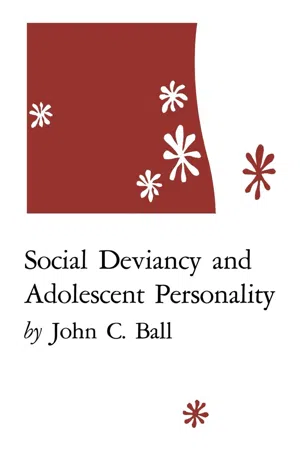
In this study, 224 ninth graders from two similar Kentucky towns were obtained by means of the Minnesota Multiphasic Personality Inventory. They were divided into various groups and analyzed in relation to a number of background factors and their resulting personality patterns. The emergence of various group patterns in this study demonstrates that the complexity of human personality necessitates complex analytic procedures.
- 136 pages
- English
- ePUB (mobile friendly)
- Available on iOS & Android
eBook - ePub
Social Deviancy and Adolescent Personality
About this book
Information
1
THE STUDY OF SOCIAL DEVIANCY AND PERSONALITY
THE PURPOSE of this study is to trace the relationship of personality to social deviancy among adolescents. In particular, the association of delinquency, minority group status, low socioeconomic status, broken homes, and failure in school with personality patterns among Kentucky boys and girls of high school age is the subject of analysis.
The problem of ascertaining the relationship of adolescent personality to various types of behavior and environmental conditions is one of far-reaching significance in the behavioral sciences. It is an important problem because we are interested in determining how personality develops. In order to accomplish this, two research approaches seem necessary:
1.Delineation of personality patterns to be found within the various segments of the youthful population. The emphasis here is upon cross-sectional studies.
2.Determination of the complex of influences and factors which produce change in the personality of children. Longitudinal studies which trace the development in personality over a period of years would be required in this instance.
These two approaches to the study of youthful personality—and behavior—are interrelated. In the first case, the objective is to establish the distribution of personality patterns in the population and to relate these characteristics to such personal and background factors as shyness, aggressiveness, intelligence, health, broken homes, and school failure. In these studies common personality patterns found among the nation’s youth are described and variations from the typical delineated. Thus, the mild rebelliousness and considerable energy among adolescents of high school age have been substantiated by objective personality measurement. Among juvenile delinquents, the dominance of an antisocial personality type has been consistently reported.1
Secondly, longitudinal studies will build upon our knowledge of general population characteristics by tracing more precise relationships between personality characteristics and influencing factors. It seems likely, however, that these more carefully controlled studies of small groups over considerable time periods will be more definitive if undertaken when the major personality patterns and variations from these patterns have been established by exploratory studies of the first type.
The present study follows the first of the two approaches described. Its objective is the delineation of personality patterns within various segments of a high school population. Personal, family, and community factors which may influence personality patterns are considered with a view to determining which of these is associated with satisfactory and which with unsatisfactory personality characteristics. Attention is focused upon such specific questions as: What effect do broken homes have upon the personality of high school students? Is there less personality maladjustment among girls than boys? Are incarcerated juvenile delinquents different in personality from public school students who have committed delinquent acts? Are Negro boys or girls more successful in academic competition in an integrated high school? To what extent is academic performance related to personality traits and to socioeconomic status? What types of students do high school teachers consider to be maladjusted?
SOCIAL DEVIANCY
In answering these and other questions pertaining to adolescent personality and behavior, the concept of social deviancy is employed. Social deviancy is defined as behavior or status which is contrary to existing social norms of what is right and desirable. It is, in American society, deviation from middle class expectations and goals. Hence, delinquency, academic failure, and being rated by teachers as maladjusted in personality are regarded as deviance. In addition, low socioeconomic status, residence in a broken home, or membership in a segregated minority group may be regarded as deviant. For the purposes of this study, all of these are termed social deviancy.
It seems appropriate to mention the limitations of the social deviancy formulation as well as to indicate its usefulness. The main source of likely confusion is semantic. It is imperative to note that the term social deviance is not being employed to make a value judgment. It is not maintained that the middle class norms are right and correct in any ultimate sense. There are, of course, some groups and societies not worth adjusting to, and genius perhaps more commonly than not is at variance with middle class norms.
The social deviancy approach has the advantage of providing a single framework within which diverse types of adolescent behavior and environment may be conveniently related to personality patterns. It permits multiple comparisons among various groups of subjects without the attribution of fundamental inferiority or superiority. The extent to which high school boys and girls are deviant in personality or behavior is a question for empirical determination, not categorical definition.
THE RESEARCH DESIGN
The study is a cross-sectional multi-group comparison of personality and behavioral interrelations. The cake is cut in as many ways as is feasible. Delinquents are compared with nondelinquents, white with Negro students, subjects of higher socioeconomic status with those of lower status, adolescents from broken homes with those from stable families, high achievers with low achievers, and those rated by teachers as maladjusted with those not so rated. The groups are analyzed and compared using background factors of age, residence, intelligence quotient, employment, and educational retardation, as well as the selection factors of delinquency, race, socioeconomic status, family composition, school achievement, and teachers’ ratings. Included in the group personality comparisons are Minnesota Multiphasic Personality Inventory data on test-taking attitudes, profile elevation, first clinical scale in code, and code configuration. Individual as well as group profiles are presented.
All in all, the purpose of this differential cross-sectional analysis is ascertainment of relative personality and behavioral similarities and differences within the adolescent population. As Sherif has said, “The task is to go beyond the general statement that everything is related to everything else within the frame of reference and laboriously to vary this factor now, that factor later, with the ultimate aim of finding the relative weights for each and finally, expressing the relations in short-cut expressions.”2 Inkeles has observed in this regard that “we need to know not only the systems of statuses but also the distribution of personality characteristics in the population at large and among the incumbents of particular roles.”3
With respect to MMPI analysis, this design has particular implications. It is frequently assumed that a given group of subjects—high achievers or delinquents, for example—possess a definite MMPI profile. In the present study, differential group comparisons demonstrate that various group personality profiles emerge from within the same sample, even though the individual MMPI profiles remain unchanged. The implications of this finding are far-reaching and suggest the limitation of one-factor analysis. Thus, in studies which compare mean scale scores of two groups, there may be the inference that the observed differences are the principal ones, whereas other factors may in fact be of greater import. This methodological problem has been neglected in the MMPI literature, although attention has been drawn to the need for studies from such additional populations as racial and religious groups.4
SUBJECTS
The subjects were 262 Kentucky adolescents. Of this number 108 were ninth grade public school boys and 116 were ninth grade public school girls. The remaining 38 subjects were incarcerated juvenile delinquents of whom 20 were male and 18 female.
Each of the two towns from which the public school samples were selected had a population in 1960 between 10,000 and 19,000. With respect to occupational distribution and median family income the two towns were similar to other urban areas of comparable size in Kentucky. From 13 to 17 percent of their 1960 populations were Negro.
The two school systems ranked in the upper one-fifth of the 215 school districts in Kentucky with regard to mean salary of teachers in 1958-1959. The school systems were, however, in the same salary range as other towns of comparable population. It is pertinent to note that the demographic and educational data reveal striking contrasts between urban and rural areas throughout Kentucky, so that it would be hazardous to generalize with respect to the entire state. For example, in 1958-1959 mean salaries of teachers by school districts ranged from somewhat over $5,000 to less than $2,000.
In each town the entire ninth grade of the city schools was included, with the exception of students absent on the day the MMPI was administered. The 21 absentee students constituted some 9 percent of the total ninth grade enrollment in both schools.
The ninth grade was selected because previous research in Minnesota had indicated that the MMPI could be successfully administered to students at this early grade level. It was considered advisable to secure as young a group as possible, since research has demonstrated the early etiology of most deviant behavior. Among boys, delinquent acts have usually commenced by age ten to fifteen.5
To secure a delinquent population for comparison, it was decided to include a group of incarcerated delinquents at the State Training School, as well as to compare public school students with and without records of delinquency. For the incarcerated delinquents, the limiting selection factor was ability to comprehend the 550 MMPI items. Enrollment at the State Training School on March 6, 1958, was 404 juveniles. Of these 302 were boys and 102 girls. This seemingly large population, however, was markedly retarded in academic achievement and considerably below average in intellectual endowment. The average I.Q. has been reported in the 75-80 range for the institution.6 Educational retardation associated with reading deficiency or illiteracy was undoubtedly even more important as a restriction at the reformatory school since there were only some 38 delinquents in the eighth grade or above. Grade placement in the reformatory school was effected by use of standard achievement tests. As a result, retardation at the Training School was even more marked than it had been before incarceration. The contention of the principal that achievement at the Training School was equal or superior to that of comparable public school grades was supported by the capacity of the delinquents to understand and complete the MMPI. The test population of 38 subjects included, then, all incarcerated delinquents who were deemed capable of comprehending the MMPI items.
The 38 incarcerated delinquents selected came from 17 counties, but 76 percent of this incarcerated group came from the 16 most urban of the 120 counties in Kentucky. The delinquents, then, were disproportionally from the urban and metropolitan areas. It may be noted, in this connection, that the two towns from which the public school samples were drawn were included in the 16 most urban counties of Kentucky.
DATA COLLECTED
Each student completed an occupational information sheet at the time the MMPI was administered. This included questions regarding his own and his parents’ employment and whether or not his parents were living together. Data on age, race, nativity, intelligence quotient, educational retardation, and school achievement were obtained from school or institutional records. In addition, each homeroom teacher was asked to evaluate his students with respect to “personality adjustment” and evidences of antisocial attitudes or behavior. Information on delinquency among the public school students was secured from court records, policemen and other officials. The offenses perpetrated by the incarcerated delinquents were taken from institutional records.
For the most part, the above information was obtained with only negligible or expected omissions. Reasons for omission included such circumstances as inability to ascertain previous school achievement because the students had recently transferred, or inadequate information upon which to establish socioeconomic status. The principal exception was that I.Q. records were quite incomplete in one of the schools. Otherwise, the background data were reasonably complete.
ADMIN...
Table of contents
- Cover
- Half title
- Title
- Copyright
- Dedication
- Foreword
- Acknowledgments
- Contents
- 1. The Study of Social Deviancy and Personality
- 2. Delinquency and Personality
- 3. Minority Group Status and Personality
- 4. Social Class and Adolescent Personality
- 5. Broken Homes, Deviancy, and Personality
- 6. Academic Failure and Personality
- 7. The Teacher, Student Deviance, and Personality
- 8. Summary and Conclusions
- Appendix
- Index
Trusted by 375,005 students
Access to over 1.5 million titles for a fair monthly price.
Study more efficiently using our study tools.
Frequently asked questions
Yes, you can cancel anytime from the Subscription tab in your account settings on the Perlego website. Your subscription will stay active until the end of your current billing period. Learn how to cancel your subscription
No, books cannot be downloaded as external files, such as PDFs, for use outside of Perlego. However, you can download books within the Perlego app for offline reading on mobile or tablet. Learn how to download books offline
Perlego offers two plans: Essential and Complete
- Essential is ideal for learners and professionals who enjoy exploring a wide range of subjects. Access the Essential Library with 800,000+ trusted titles and best-sellers across business, personal growth, and the humanities. Includes unlimited reading time and Standard Read Aloud voice.
- Complete: Perfect for advanced learners and researchers needing full, unrestricted access. Unlock 1.5M+ books across hundreds of subjects, including academic and specialized titles. The Complete Plan also includes advanced features like Premium Read Aloud and Research Assistant.
We are an online textbook subscription service, where you can get access to an entire online library for less than the price of a single book per month. With over 1.5 million books across 990+ topics, we’ve got you covered! Learn about our mission
Look out for the read-aloud symbol on your next book to see if you can listen to it. The read-aloud tool reads text aloud for you, highlighting the text as it is being read. You can pause it, speed it up and slow it down. Learn more about Read Aloud
Yes! You can use the Perlego app on both iOS and Android devices to read anytime, anywhere — even offline. Perfect for commutes or when you’re on the go.
Please note we cannot support devices running on iOS 13 and Android 7 or earlier. Learn more about using the app
Please note we cannot support devices running on iOS 13 and Android 7 or earlier. Learn more about using the app
Yes, you can access Social Deviancy and Adolescent Personality by John C. Ball in PDF and/or ePUB format, as well as other popular books in Social Sciences & Developmental Psychology. We have over 1.5 million books available in our catalogue for you to explore.