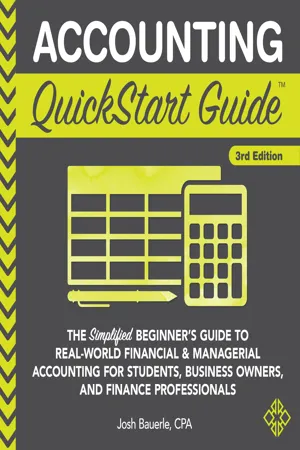
Accounting QuickStart Guide
eBook - ePub
Available until 23 Dec |Learn more

Accounting QuickStart Guide

The Simplified Beginner's Guide to Financial & Managerial Accounting For Students, Business Owners and Finance Professionals

  1. English
  2. ePUB (mobile friendly)
  3. Available on iOS & Android
eBook - ePub
Available until 23 Dec |Learn more

Accounting QuickStart Guide

The Simplified Beginner's Guide to Financial & Managerial Accounting For Students, Business Owners and Finance Professionals

About this book

THE ULTIMATE GUIDE TO ACCOUNTING FOR STUDENTS, BUSINESS OWNERS, & FINANCE PROFESSIONALS!

UPDATED AND EXPANDED 3RD EDITION The ONLY accounting book written by a CPA for both a small business owners and accounting students! ->Are you a student that wants to master the fundamentals of financial and managerial accounting?
Then you NEED this book. Buy now and start reading today! ->Are you a business owner who wants to operate a successful and financial sound operation?
Then you NEED this book. Buy now and start reading today! ->Are you a finance professional who need to understand financial statements?
Then you NEED this book. Buy now and start reading today! Meet Josh Bauerle, reluctant accounting student turned super CPA and author of Accounting QuickStart Guide, 3rd Edition. This revolutionary book expertly simplifies accounting fundamentals and is an invaluable resource for accounting students, business owners, bookkeepers, and other finance and record keeping professionals everywhere! Whether you are a business owner looking to boost your bottom line or an accounting student looking to boost your grade, this book will prove indispensable on your journey. Why do accounting students, business owners, and finance professionals love this book so much? Accounting QuickStart Guide smashes the myth that says accounting must be dry, dense, and difficult to learn. Josh Bauerle simplifies the core principles of accounting with entertaining stories and examples as well as clarifying illustrations and practice problems—all of which combine to provide learners a path to fast and effective mastery of the material. FOR BUSINESS OWNERS
Learn how to control your cash flow, audit-proof your business, and increase your profits. Accounting QuickStart Guide will teach you the key insights to boost your bottom line in an easy-to-read, informative format. FOR ACCOUNTING STUDENTS:
Learn the fundamental principles of both financial and managerial accounting in an engaging and educating format that you simply will not find in any textbook. Understand core accounting concepts such as the fundamental accounting equation, financial statements, managerial accounting and more through practical, real-world examples. Utilize Accounting QuickStart Guide to supplement existing material for high school, undergraduate, or graduate courses. YOU WILL LEARN:

  • The Logic and Methods of Classic Double-Entry Accounting!
  • Business Entity Types; Their Pros, Cons and Their Financial Statements!
  • The Principles of Financial Accounting, Managerial Accounting and Tax Accounting!
  • GAAP Standards and Why They Matter to Accountants!
  • How to Fraud-Proof Your Business Using Simple Accounting Tactics!

QuickStart Guides are books for beginners, written by experts. * FREE ACCOUNTING DIGITAL RESOURCES:
Each book includes tons of online resources including workbooks, cheat sheets, calculators reference guides, chapter summaries and more! Follow the instructions in the book to receive your free digital resources.*

Frequently asked questions

Yes, you can cancel anytime from the Subscription tab in your account settings on the Perlego website. Your subscription will stay active until the end of your current billing period. Learn how to cancel your subscription.
No, books cannot be downloaded as external files, such as PDFs, for use outside of Perlego. However, you can download books within the Perlego app for offline reading on mobile or tablet. Learn more here.
Perlego offers two plans: Essential and Complete
  • Essential is ideal for learners and professionals who enjoy exploring a wide range of subjects. Access the Essential Library with 800,000+ trusted titles and best-sellers across business, personal growth, and the humanities. Includes unlimited reading time and Standard Read Aloud voice.
  • Complete: Perfect for advanced learners and researchers needing full, unrestricted access. Unlock 1.4M+ books across hundreds of subjects, including academic and specialized titles. The Complete Plan also includes advanced features like Premium Read Aloud and Research Assistant.
Both plans are available with monthly, semester, or annual billing cycles.
We are an online textbook subscription service, where you can get access to an entire online library for less than the price of a single book per month. With over 1 million books across 1000+ topics, we’ve got you covered! Learn more here.
Look out for the read-aloud symbol on your next book to see if you can listen to it. The read-aloud tool reads text aloud for you, highlighting the text as it is being read. You can pause it, speed it up and slow it down. Learn more here.
Yes! You can use the Perlego app on both iOS or Android devices to read anytime, anywhere — even offline. Perfect for commutes or when you’re on the go.
Please note we cannot support devices running on iOS 13 and Android 7 or earlier. Learn more about using the app.
Yes, you can access Accounting QuickStart Guide by Josh Bauerle in PDF and/or ePUB format, as well as other popular books in Business & Accounting. We have over one million books available in our catalogue for you to explore.

Information

Edition
1
Subtopic
Accounting

| 1 |

Accounting as a Tool of Business

Chapter Overview

  • Business Entity Types
  • Business Activities
  • Financial Statements
  • Accounts
  • Branches of Accounting
Behind every good business is a good accountant.
– ANONYMOUS
(probably an accountant)
An online retailer, let’s call her Kathi, who sells jewelry to customers all over the world, is considering hiring five new employees to help her expand her business. Kathi would like to offer these new employees fair and competitive compensation but is unsure of how much she can afford to pay them on an ongoing basis. Last month, Kathi moved her jewelry business out of her basement and rented a workshop and retail space in a midtown shopping center with heavy foot traffic. Paying rent every month is an added business expense, but having a new walk-in customer base to supplement online sales will (Kathi hopes) provide a strong boost to the business’s revenue.
In the same shopping center, a print shop owner/franchisee, let’s call him James, has been operating at a small loss for the last four months. At a recent national conference the print shop owner met other franchisees who claimed to have restored profitability to their businesses by eliminating certain product and service offerings. James is now studying his sales records, looking for products and services that do not generate enough revenue to justify their expense.
Meanwhile, the print shop owner’s franchise-issuing parent company, a multibillion-dollar publicly held corporation, has had a very profitable quarter and would like to return some of that money to its shareholders in the form of dividend payments. But how much can the company afford to pay out? It depends on how much cash needs to remain on hand to effectively continue normal business operations and to make new investments that will help grow the business.
From newly-minted online retailers to Fortune 500 companies, fundamental accounting practices pave the way for informed and optimal decision-making. A strong grasp of basic accounting gives business decision-makers access to more precise, more relevant, and more actionable information.
Good accounting practice is also a matter of good financial maintenance. In every business there are accounting-related matters that need to be taken care of each month (or more often). A business well-inoculated against fraud will routinely balance its books and promptly investigate any discrepancies. A business that cares about its bottom line will regularly produce and review financial statements that aid in analyzing profit and loss. Businesses also use accounting to evaluate sales data, employee performance, investment opportunities, and a whole lot more. Even if you don’t have a resident bookkeeper in your company or a CPA on retainer, much of the power of accounting can be harnessed with simple-to-use accounting software, a subject we will be covering in more depth later on in this book. But first, since this is a QuickStart Guide and intended to be beginner-friendly, we’re going to begin at, well, the beginning.

Business Entity Types

One of the beautiful things about the subject of accounting is that the core concepts are readily applicable across a wide variety of business types. From online shoe retailers to industrial steel smelters, and from LLCs to S corporations, the fundamentals of good accounting do not change. Nevertheless, the selection of a legal structure for your business does have consequences, and certain of these consequences, namely the tax implications, will affect the way you manage your books. Sole proprietorships, partnerships, limited liability companies (LLCs), and corporations are all examples of legal structures, or business entity types.
In addition to affecting the way your business will be taxed, several other factors are affected by your choice of legal structure, including the following:
  • Legal standing – Some entity types, such as sole proprietorships and partnerships, have a legal standing that is essentially synonymous with the business’s owner(s). Corporations, by contrast, are treated as independent entities that can assert their own legal standing; a corporation can sue another corporation or an individual
  • Liability – Just as a corporation can sue by virtue of its own legal standing, it can also be held liable and be sued. In corporations and LLCs (limited liability companies), owners may enjoy a level of insulation from liabilities incurred by the business; not so with sole proprietorships and partnerships.
  • Costs of formation and ongoing administration – Partnerships and sole proprietorships are cheap and easy to set up and administer; LLCs and corporations require more of an investment.
Let’s take a look at each business entity type (legal structure) more closely.

Sole Proprietorship

A sole proprietorship is automatically created as soon as a business owner begins transacting business. This legal structure is the simplest to establish and the easiest to administer. It is also, in many cases, the riskiest. The owner/proprietor is personally liable for all obligations, financial and otherwise, legally incurred by the business. If the business is sued, then technically the owner is being sued. If the business is drowning in debt, then the owner’s personal assets may be at risk.
The business’s profits are treated as ā€œpass-throughā€ income and are reflected in the proprietor’s personal tax filings.

Partnership

As the name suggests, a partnership is composed of two or more people who establish a business and share in its profits, losses, and liabilities in accordance with ...

Table of contents

  1. COVER
  2. TITLE PAGE
  3. ACCESS YOUR FREE DIGITAL ASSETS
  4. INTRODUCTION
  5. | 1 | ACCOUNTING AS A TOOL OF BUSINESS
  6. | 2 | INTRODUCTION TO FINANCIAL STATEMENTS
  7. | 3 | FINANCIAL STATEMENT ANALYSIS
  8. | 4 | ASSETS = LIABILITIES + EQUITY
  9. | 5 | RECORDING BUSINESS TRANSACTIONS
  10. | 6 | MANAGERIAL ACCOUNTING
  11. | 7 | MONITORING STOCKS & INVESTMENTS
  12. | 8 | INCOME TAX ACCOUNTING
  13. | 9 | DETECTING AND PREVENTING FRAUD
  14. | 10 | SIZING UP THE SOFTWARE
  15. CONCLUSION
  16. BONUS QUIZ
  17. GLOSSARY
  18. ABOUT THE AUTHOR
  19. ABOUT CLYDEBANK MEDIA