- English
- ePUB (mobile friendly)
- Available on iOS & Android
eBook - ePub
Information
PART I: GETTING THERE
I don’t know where I’m going, but I sure know where I’ve been . . .
—White Snake
THE JOURNEY: STOP ONE
I HAD JUST EXPERIENCED my first flight in the cargo belly of an Airforce C-17 as we touched down in Uzbekistan to drop off a few soldiers from my sister platoon. At that moment, the realness of my situation truly started to hit me. As the cargo door on the tail of the plane began to open, my thoughts were consumed by memories of the last six months of my life and how I came to be here. Our pit stop was scheduled for about thirty minutes—just time enough to load some cargo—and then we were off to Afghanistan, my new home away from home. My mind was racing as I started to piece it all together.
My journey started several months earlier, in March 2002, on a rainy Tuesday. I was working at FedEx at the time and we were on a weather delay due to a late inbound shipment. I chose to take the few hours that I had available to me and head to my reserve unit company headquarters about twenty minutes away to finalize a couple of evaluations. While there, I was approached almost immediately by Frank Mann, a member of the battalion leadership team who ran the day-to-day operations of the unit as a civilian. He proclaimed that he was happy to see me and that he had an urgent question. Our command had received its first mobilization order after 9/11 and one of my sister companies in the battalion had been tasked to complete a mission to go to Fort Lewis, Washington for one year. The duty was primarily to support their ROTC (Reserve Officer’s Training Corps) mission as a backfill while one of the units stationed there was deployed overseas. That deploying unit was short one lieutenant on their command team, and he wanted to know if I was interested in filling that slot and deploying with them. Without thinking, I instantly said yes. Honestly, I don’t think there is a mission that they would have asked me to complete that I would have turned down in those days. Patriotism was high, and I wanted so badly to serve my country. And just like that, my life would forever change because of the decision that I made that day.
I spent the next few weeks getting my affairs in order and saying my goodbyes, all the while speculating what my future adventures would be. Soon enough, it was time to pack my car and head to Uniontown, Pennsylvania to start the next chapter of my life.
I knew no one in that unit, nor nothing about it walking in the door, so I carried no preconceived notions. I arrived at the unit to not much fanfare and an extremely dysfunctional situation. The unit had a civilian administrator who also served as a full bird colonel (four ranks senior to me) in the Army Reserves. He ran the day-to-day business and pretty much the weekend business, and whatever he said was the law of the land. He would not be deploying, so as I was trying to take over the unit, there was instant friction. Compounding the problem was the fact that he had ruled the unit with an iron fist for so long that none of the leaders had been able to develop. There were some good young soldiers in the unit, but they were being failed by their leadership. As a new lieutenant to the organization, I knew that I would have a mountain of a task on my hands to convince the soldiers to believe in me and to be ready to follow me. Luckily for me, I had a defining moment with the soldiers right away. Ironically this problem almost derailed the mobilization before it started for me and was my first attempt (of many) at career suicide.
This crucial situation arose from something as simple as hotel accommodations for the unit. This may sound trivial, but one of the first lessons that I ever learned in the Army as a leader was to never screw with a soldier’s food or living arrangements. One of the civilians who worked at the unit and helped us with administrative tasks had submitted our lodging packet for a local Fairfield Inn, known to be a hotel friendly to business travelers. They had a small gym, pool, and provided breakfast every morning. In his mind, it was everything that we needed. There were two issues I foresaw with this plan: it had no bar (my concern) and was the most expensive option available (taxpayer concern). The lack of a bar may not make sense to some, as we were there for a specific mission to get ready to deploy, but the last thing I needed while we were training was a bunch of drunk soldiers trying to drive back from a bar and getting DUIs. Soldiers like to blow off steam, particularly as they are preparing for their grand send-off. I wanted to make sure there was an option available to them that didn’t require driving. I wanted the Holiday Inn; it had a ton of activities included on its grounds (known at the time as a Holidome) and met the bar requirement. It was cheaper than the Fairfield Inn, too. But we got neither option. There was a bean counter who saw the request come in and the opportunity to save the taxpayers thousands of dollars on twenty rooms for fifteen nights. He found us a hotel in downtown Uniontown that did not have a brand name, but it did have a bar. In fact, it housed one of the busiest clubs in town. In the beginning, I didn’t really think anything of it. I headed to the hotel after the contract was finalized to sign for all the room keys and returned to the reserve center to pass them out. I hadn’t been working at my desk more than thirty minutes later when I noticed a line of soldiers at my door. They were in a near-riot situation over the condition of the Uncle Sam-directed rooms. They complained of broken locks, broken windows, blood stains, dirty carpets, and pubic hairs in the bathtubs. I thought that there was no way this could be the truth, so I headed to the hotel myself. It was worse than described. I couldn’t help but wonder whether this hotel was reputable or pay-by-the-hour. Sleeping there would have required my government-issued sleeping bag and not taking off my footwear. What I would have given for an iPhone back then to have been able to snap quick photos and send messages instantly. In 2002, I only had a cellular minutes plan and a phone that I could play the snake game on. So, I headed back to the reserve center to raise my complaints.
I started with my company commander, who I had never met and was apparently in the air traveling to Washington state that day as part of our advance party, so he would be no help. My next call was to my battalion headquarters to Mr. Mann, who was the reason I was here in the first place, but he was unavailable. My next call was to my brigade headquarters to the head civilian in charge there, but I could not locate him either. It was a Thursday afternoon and time was critical, so after waiting about five minutes, I escalated my request to my division headquarters. That phone call I was making was the equivalent of the nuclear option. I had just steamrolled through three levels of command and was heading to the general officer level. I knew there were some potential ramifications, but I was championing the health and welfare of my soldiers, so I went half-assed full blast. The civilian that I spoke with at that headquarters basically told me that nothing could take place that late in the afternoon. I was directed to release my soldiers to travel home if they wanted to or they could stay at the Fairfield Inn, as it was a previously approved hotel. I was also told that I needed to compile a room-by-room list of all the deficiencies that I saw and to provide a copy to the hotel. They were to have until the following day to correct the items. At this point, I released my soldiers and headed back to the hotel and started making my list. I was using my inner drill sergeant to inspect these rooms, making sure that I found enough stuff that there was no way that they would make us stay there. I finalized my deficiency dissertation, made a copy, and threw my original on the hotel office’s desk. I was super proud of my efforts and decided to retire for the evening back to the Fairfield Inn.
I returned to the hotel the following morning and, not surprisingly, nothing had been remedied. At this point, we were relieved from our obligation at this hotel. The civilian I had previously started working with reached back out and we began to work on getting everything reserved for the Holiday Inn. He told me that we had to get the rooms for a certain price or it was a deal-breaker, so I actually did the price negotiation for the government. The hotel manager agreed to my demands, so we ultimately were able to stay at the Holiday Inn. By the following Monday, all had been resolved from a housing standpoint, but I was shown a series of emails that I was not copied on. The first, was a raving recognition that the civilian who originally negotiated the stay had gotten for saving the budgetary day. The second was from that same civilian and included his assessment of the situation. Apparently, he lived in the Uniontown area and had stopped by the controversial hotel over the weekend. He stated that he found nothing wrong with the hotel, but that the command would support my decision. Again, this was a general officer level organization and they were going to let the lowly lieutenant have his way? This was truly his way of saving face. That was the good news of the story. On the opposite end of the spectrum was me. My life over the next few days involved losing several layers of skin from my ass from anyone senior to me (which was a lot of people). I got so many ass-chewings over the phone that over time I began to zone out, to the point where pretty much all I heard resembled the teacher from the old Charlie Brown cartoons: wah wah, wah wah wah. The only takeaway that I surmised after it was finally over was that my bull in a china shop, cowboy mentality was not appropriate. Officially, I had jumped over several levels of my chain of command and not let anyone help me. Unofficially though, I had been told that I had done the right thing for my soldiers. Either way, I learned a good lesson in those days about what it meant to be right, but maybe not have an appropriate reaction. There was probably a less brash way. In the end, it was all worth it. That hotel situation galvanized a bond with my new soldiers because they knew that I was willing to fight for them. Before long, with all training complete, we were boarding a plane to our next destination—my second stop on this incredible journey.
THE JOURNEY: STOP TWO
WE LEFT FOR FORT LEWIS with a lot of excitement and anticipation but landed with a thud. The day that I volunteered, I signed up for a one year deployment to Fort Lewis in support of Operation Noble Eagle. It was what my country asked me to do. I really hadn’t taken the time to actually try to figure out what that would mean. I just wanted to serve my country, even if that meant inside our continental borders. Going to Afghanistan was never part of the initial equation. That anticipation, patriotism and fervor that we all felt as we left Pennsylvania was soon stunted by extreme Army bureaucracy. I honestly cannot think of anything nice to say about my time at Fort Lewis, even nearly twenty years later. To start off, the mission that we were mobilized to complete only needed around thirty soldiers and we arrived with close to 160. One of my sister platoons had the best readiness in the unit so they would get the honor of completing that mission. The rest of us were relegated to a life of post chores that involved everything from trash clean-up to grass cutting to weapons range target building. This was in no way what I signed up for and I was angry. We all were. We deployed with an unabashed pride and within weeks, nearly all the winds had left our sails. To compound these issues were the living arrangements. The entire unit, officers, non-commissioned officers, and soldiers alike would stay in World War II-style barracks that had all the comforts you could expect from sixty-year-old, asbestos-filled government housing with poor climate control and communal bathrooms. We were not allowed to bring vehicles and were limited on baggage and comfort items that we could bring. It was basically the equivalent of a bad two-week annual training, but we were supposed to do this for a year.
And just when we thought it couldn’t get worse, we met our new command team. The commander of our new Fort Lewis battalion headquarters was pretty young, a high performer who had been promoted early twice (called a below the zone promotion). He carried himself with all of this confidence and I instantly felt like we were there to do his bidding for the next year. He could have asked only for the thirty people he needed, but instead he requested an entire organization. That was unfathomable to me.
Worst yet, he was more than happy to parade us around. I remember our “welcome to the new unit” celebration, where he decided to host an officer call for us. This was command-sanctioned drinking and, being in my early twenties, I was all in. The event itself seemed rather harmless, other than being more about our leader then the team he was introducing. I recall that there were a lot of things we discussed and many good ideas that he had for us during this drinking marathon that doesn’t end until the boss taps out. Several hours later, we piled out of this facility and into a van, somewhere between buzzed and hammered. In that moment, this all didn’t seem too bad. By the time I awoke the next morning, hazy and with a headache, all had changed. We started receiving multiple calls early on demanding actions on all his suggestions from the night before. I should have known then that this hangover was going to last.
And last it did. From a unit command standpoint, we were treated like second class citizens for the entire time we were stationed there. We carried the stench of being Reservists and we struggled to overcome that, compared to our Active Duty brothers and sisters. It felt as if we could do no right. Now, to be fair, not everyone treated us differently. I served with some fantastic soldiers from our sister Active Duty companies that were supportive of us and tried to help ease our transition, but even with their efforts, it was rough all the while. Captain James Pope, my commander, took the majority of the brunt of seemingly never-ending tirades. He did the best he could not to negatively influence our view of the command, but everyone could see how frequently both he and our entire unit were getting torn down.
I remember when I had first joined the Army, getting mentally prepared for basic training and fully expecting it to be the worst two-plus months of my life. Since I knew my end date as soon as I started, the experience, while mentally taxing, was quite easy for me. I was mentally prepared and that made the actuality of boot camp easier to endure. In contrast, my assumptions of this mobilization could not have been further from reality, and I struggled mightily. As a young lieutenant, it was my job to wear a smile while delegating tasks to my soldiers, which they felt they were getting because they were beneath their Active Duty peers. I completely agreed with them, but I could not flinch and show it. Standing in front of that formation each day absolutely wore me out mentally and emotionally.
Even with all the trials, some benefit did occur for me personally. I started to gain the trust of Captain Pope, my company commander. This was a big deal to me because I was an outsider to the unit, the only officer who was added in before the deployment. The entire command team of officers had been in place well over a year before me. With this newfound trust, I became one his primary sounding boards. While it was great to be someone he could rely upon, it also added a continual burden on me trying to ensure that my team didn’t let him down. And we didn’t. My platoon was completing all of our assigned tasks to standard and we had also made time to train. We were quickly becoming recognized as the strongest team in the company.
I was really starting to feel pretty good about my team, and I was hoping that the rumblings of a follow-on deployment overseas were true. Yes, we wanted out of Fort Lewis so badly that we were begging for a trip to Afghanistan, which just doesn’t seem realistic, but it was. In the summer that year, our battalion received a task to participate in a field training exercise at Yakima Training Center to support a National Guard brigade for their annual training. I was startled to find out that this training center was on the other side of the mountains in Washington State and that it had a desert atmosphere, so we would be able to do some real-world training. As strange as it sounds, I was elated at the possibility of a few weeks in the field doing additional trainin...
Table of contents
- Cover
- Title
- Copyright
- Contents
- Part I: Getting There
- Part II: The Life
- Part III: The Good Stuff
- Part IV: The Struggles
- Part V: The Long Road Home
- Part VI: The Leaders that Changed Me
- Acknowledgments
Trusted by 375,005 students
Access to over 1.5 million titles for a fair monthly price.
Study more efficiently using our study tools.
Frequently asked questions
Yes, you can cancel anytime from the Subscription tab in your account settings on the Perlego website. Your subscription will stay active until the end of your current billing period. Learn how to cancel your subscription
No, books cannot be downloaded as external files, such as PDFs, for use outside of Perlego. However, you can download books within the Perlego app for offline reading on mobile or tablet. Learn how to download books offline
Perlego offers two plans: Essential and Complete
- Essential is ideal for learners and professionals who enjoy exploring a wide range of subjects. Access the Essential Library with 800,000+ trusted titles and best-sellers across business, personal growth, and the humanities. Includes unlimited reading time and Standard Read Aloud voice.
- Complete: Perfect for advanced learners and researchers needing full, unrestricted access. Unlock 1.5M+ books across hundreds of subjects, including academic and specialized titles. The Complete Plan also includes advanced features like Premium Read Aloud and Research Assistant.
We are an online textbook subscription service, where you can get access to an entire online library for less than the price of a single book per month. With over 1.5 million books across 990+ topics, we’ve got you covered! Learn about our mission
Look out for the read-aloud symbol on your next book to see if you can listen to it. The read-aloud tool reads text aloud for you, highlighting the text as it is being read. You can pause it, speed it up and slow it down. Learn more about Read Aloud
Yes! You can use the Perlego app on both iOS and Android devices to read anytime, anywhere — even offline. Perfect for commutes or when you’re on the go.
Please note we cannot support devices running on iOS 13 and Android 7 or earlier. Learn more about using the app
Please note we cannot support devices running on iOS 13 and Android 7 or earlier. Learn more about using the app
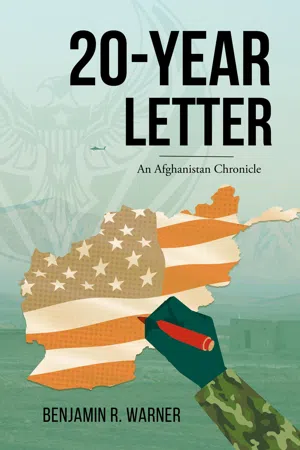
Yes, you can access 20-Year Letter by Benjamin R. Warner in PDF and/or ePUB format, as well as other popular books in History & Historical Biographies. We have over 1.5 million books available in our catalogue for you to explore.