Mahala's biography gives insight into the life and writing of Can Themba (1924–1967), an iconic figure of the South African literary world and Drum journalist who died in exile
This rich and absorbing biography of Can Themba, iconic Drum-era journalist and writer, is the definitive history of a larger-than-life man who died too young. Siphiwo Mahala's intensive and often fresh research features unprecedented archival access and interviews with Themba's surviving colleagues and family.
Mahala's biography takes a critical historical approach to Themba's life and writing, giving a picture of the whole man, from his early beginnings in Marabastad to his sombre end in exile in Swaziland. The better-known elements of his life – his political views, passion for teaching and mentoring, family life and his drinking – are woven together with an examination of his literary influences and the impact of his own writing (especially his famous short story 'The Suit') on modern African writers in turn. Mahala, a master storyteller, deftly follows the threads of Themba's dynamic life, showcasing his intellectual acumen, scholarly aptitude and wit, along with his flaws, contradictions and heartbreaks, against a backdrop of the sparkle and pathos of Sophiatown of the 1950s.
Can Themba's successes and failures as well as his triumphs and tribulations reverberate on the pages of this long-awaited biography. The result is an authoritative and entertaining account of an often misunderstood figure in South Africa's literary canon.
eBook - ePub
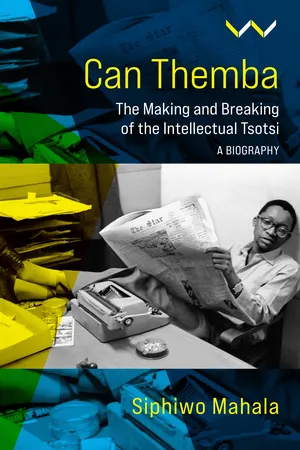
Can Themba
The Making and Breaking of the Intellectual Tsotsi, a Biography
- 312 pages
- English
- ePUB (mobile friendly)
- Available on iOS & Android
eBook - ePub
About this book
Information
Topic
HistoireSubtopic
Biographies littérairesPART I
Death and Birth of a Scribe
1
A Knock on the Door
We were those sensitive might-have-beens who had knocked on the door of white civilisation (at the highest levels that South Africa could offer) and had heard a gruff ‘No’ or a ‘Yes’ so shaky and insincere that we withdrew our snail horns at once.
Can Themba — Requiem for Sophiatown (2006), 57
He knocked on the door. There was no response. He knocked again, and listened. All was quiet. He tried to turn the doorknob and push the door open. It was locked from the inside. He knocked once more, harder this time. Nothing. He pressed his ear against the wooden door. Silence.
With one eye closed, he peeped through the keyhole. He could make out a lanky man lying in bed with his feet pointing heavenwards. It was definitely the man he was looking for. Why on earth was he not opening? He banged on the door with his fist, shouting his name: ‘Bra Can! Bra Can Themba!’ No response. He hammered on the door. Silence.
It was Friday, 8 September 1967. The 25-year-old Pitika Ntuli had travelled all the way from Lubombo, a journey of about 25 kilometres, to Manzini in Swaziland (now the Kingdom of eSwatini), where his mentor rented a flat. At the time Can Themba – full name Daniel Canodoce Themba, also known as Dorsay – was a teacher at St Joseph’s Catholic Mission School in Umzimpofu, about five kilometres outside Manzini. He often hosted young men in search of knowledge and intellectual stimulation.
Now Ntuli’s friend, Bicca Maseko, suggested that they go watch a film at the bioskop (cinema) and come back later. It was a Friday afternoon, and the schools had closed for the September holidays. Teacher Can Themba had probably drunk a little too much, a little too early, and had passed out, Maseko reasoned. With little choice, Ntuli concurred, and left reluctantly. He kept looking over his shoulder as they walked away, hoping that the door would fly open.
Ntuli, a young South African student exiled in Swaziland, was intending to visit the man who had been his role model and mentor since higher primary school days. Growing up in Witbank (now eMalahleni) in the former Eastern Transvaal (now Mpumalanga Province), Ntuli often visited Sophiatown, a culturally and politically vibrant township in Johannesburg, during holidays and over some weekends. Here he came to know of one Can Themba, a former teacher who had become famous as a journalist plying his trade with Drum magazine. Despite his fame, Themba remained humble and opened his door to everyone. He had turned his abode in Sophiatown, which he named the House of Truth, into a place for candid debate and intellectual engagement.
Themba was regarded by many as a ‘people’s person’, and by opening his house to the community of Sophiatown, he demonstrated his lifelong commitment to teaching and mentoring. The House of Truth was one of the vehicles he employed to execute his mission of intellectual engagement and education. His teaching was never confined within the walls of the classroom.
Ntuli was at first simply a curious boy who had stumbled into a hub of intellectual debate at Themba’s House of Truth, and was fascinated by how well black men like Bloke Modisane, Nat Nakasa and Themba spoke English. This exposure would prove to be a life-changing experience for him, and would play an important role in the development of his consciousness.
According to Ntuli, who had imbibed wisdom directly from the source at the House of Truth, Themba would take a nonchalantly uttered word and decipher profound meanings from it: ‘Can Themba was absolutely one of a kind, the warmness of his spirit, the sharpness, the witticism. You’d utter a statement and immediately you’ve uttered a statement, he’s going to pick one word out of that statement and turn it actually upside-down and make you realise what you’ve actually said, how profound the statement you’ve made is.’1
A culture of debate and intellectual engagement had been part of Themba’s social milieu since his days as a student at the University of Fort Hare, where he engaged in discussions with fellow students – including the likes of Robert Sobukwe, Duma Nokwe, Dennis Brutus and many others who would later become prominent political and cultural leaders of society. Former cabinet minister, leader of the Inkatha Freedom Party (IFP) and prime minister of the Zulu Kingdom, Prince Mangosuthu Buthelezi, has fond memories of Themba hosting gatherings in his room at university.2 The establishment of the House of Truth, and the activities it hosted, continued this tradition. The subjects of interest included a wide range of topics and issues, from literature to history, philosophy to politics, education to journalism, and these conversations fed into Themba’s stories.
In all his engagements, whether formal or informal, Themba’s mission was to impart knowledge. His determination to nurture young minds, inside and outside the classroom, speaks of a visionary committed to the future of the intellectual tradition in Africa. His various teaching stints, the conversations he anchored in the newsroom, the intellectual engagements he embarked upon in the House of Truth, the private lessons he offered to individuals, and his public speaking engagements bear testament to a man who was determined to share his knowledge with others. The House of Truth, a space where he could wield control, was a platform he established precisely for this purpose. It was a place not just of intellectual growth, but where strong bonds of friendship and mentorship were forged.
One man who benefited from Themba’s teachings both inside and outside the classroom was Stanley Motjuwadi, a legendary journalist in his own right. Motjuwadi was Themba’s matric student at Madibane High School in 1950. When Themba became the associate editor of Drum magazine, then news editor of the Golden City Post newspaper and editor of Africa! magazine, he recruited his former students. Motjuwadi and his friend Casey Motsisi came to work with him, both establishing themselves as formidable voices in the world of journalism. According to Motjuwadi’s tribute to Themba, published in The World of Can Themba, the House of Truth was ‘Can’s way of cocking a snook at snobbery, officialdom and anything that smacked of the formal. Everybody but a snob was welcome at The House of Truth.’3
Indeed, all and sundry were welcome at the House of Truth. It was where everything concerning human experience in Sophiatown was told with candour, often inspired by liquor. There were no secrets, or, at least, there were not meant to be any. ‘Can loved company and he was superb company himself, a sparkling conversationalist with razor-sharp repartee,’ Motjuwadi elaborated. ‘Aspiring writers, unemployed journalists, frustrated artists, women in search of a good time – all thronged to the House of Truth. The only passport to enter it was to slough off hypocrisy when stepping on the threshold.’4
Motjuwadi’s friend, former schoolmate and colleague, Casey Motsisi, was to become Themba’s right-hand man for a number of years. Motsisi commented on the contradictions presented by Themba’s influence on some of the younger people who flocked to the House of Truth. Much as he offered a platform for intellectual growth and honest debate, with the regular presence of alcohol in the conversations, it was inevitable that some would lean more towards the bottle than they did to intellectual rigour. Motsisi was nevertheless baffled by the view held by some of Themba’s detractors – that he was a ‘corruptor of youth’, primarily through exposing them to alcohol. He believed that Themba was the ‘very epitome of a man of genius’, whose major preoccupation was intellectual development, fundamental for ambitious young people.5
While clearly the House of Truth meant different things to different people, with its legacy still a sometimes contentious issue, there is no doubt that both debate and alcohol flowed freely. In our interview held in 2015, Muxe Nkondo succinctly captures the paradoxes of the House of Truth: ‘It was the only forum where the intelligentsia would meet with ordinary people to discuss issues. It went beyond just drinking beer and what have you, to providing a venue, a kind of parliament of the streets; it is where serious issues were discussed.’6
Sylvester Stein, Drum magazine editor and one of the white men who had the honour of setting foot in Themba’s abode, reflected on the debates at the House of Truth: ‘It was here in Sophiatown that Can Themba had matured in intellectual strength, and it was there at his home base, The House of Truth, where blacks and honorary blacks gathered together to debate a thousand topics ranging from Sartre’s philosophy to the vintages of hooch.’7 It is clear that for Themba, alcohol was a key ingredient in opening a path to good conversation.
At the official opening ceremony for the House of Truth, about thirty guests filled the small space, including community members, township drunkards, journalists and a lone white man. The event featured a live performance by one of the most famous women in the whole of Africa – Dolly Rathebe. Dolly was everybody’s dream girl: she had made a name for herself as a cover girl, musician and a film star. She broke into fame in 1949, when she starred in a British-produced movie, Jim Comes to Joburg, one of the first films set in South Africa that portrayed urban blacks in a positive light. She was so popular that her name found its way into the slang of the time, wherein the tsotsis would say ‘I’m Dolly’, when they meant they were fine, and ‘I’m double Dolly’, when they felt really good. Dolly was there to honour Themba, who was already celebrated as a writer and popular reporter at Drum, the most widely distributed magazine in sub-Saharan Africa. The only white man present was Anthony Sampson, whose pen vividly chronicled this particular event in his 1956 book, Drum: A Venture into the New Africa.
Themba took the occasion so seriously that before addressing the guests, he put on his academic gown from Fort Hare University, where he had graduated with a BA degree. This was, of course, after he performed his famous clockwork dance. In describing the dance, Sampson writes, ‘His whole body twisted into a sharp curve; one hand curled up behind his back, the other, tense with expression, gripped into his side. His feet jerked as if on hot coals; his body was consumed with the rhythm, lost to the world around him like an epileptic. His tongue slid between his teeth, and his face was contorted in a grimace.’8
As the master of ceremonies at his own function, Themba made a formal speech in which he explained that they were gathered there that evening to witness the christening of his ‘noble mansion’, which he had the honour to name ‘The House of Truth!’.9 It goes without saying that nothing but the truth could be uttered in the house.
His abode was not the only one that had a name in Sophiatown, but it was the only one reported to have had a formal opening ceremony. Each house name had a special significance in reflecting the vision of the proprietor. Themba’s friend and colleague, Modisane, called his house Sunset Boulevard.10 Others included the House of Commons and the House of Saints.11 The House of Truth was obviously designed to stay true to its name – to be a free space where debate was shaped by objective truths.
One of the truths is that the House of Truth at 111 Ray Street was a one-and-a-half-roomed bachelor flat. It was in fact a single room, with a dividing curtain that separated the bed from the living area. The elaborate opening ceremony was typical of Themba’s abundant wit and slapstick humour, features of both his personality and his writings. The House of Truth was to become a metaphor that epitomised Themba’s life philosophy and legacy.
Pitika Ntuli, the young man knocking in vain at the door of Themba’s Swaziland flat, imbibed more than just the culture of debate, a flair for language and passion for the written word from the House of Truth; he also adopted and replicated the idea of a forum for debate and intellectual engagement at later stages of his life. When he went into exile in Swaziland in the mid-1960s, he established his own version of the House of Truth in Lubombo.
In the 1960s, there was a large South African community in Swaziland. Following the Sharpeville massacre in March 1960, the banning of political parties and the Rivonia Treason Trial (which lasted from 1963 to 1964), many South African activists, including students, teachers, writers and other professionals, streamed out of the country, either to escape from the brutalities and crudities of apartheid, or to fight against apartheid from outside the country. Swaziland, as a British protectorate sharing borders with South Africa, was one of the frontline states to which South African activists travelled or escaped before moving on to other countries. It was not uncommon, therefore, to bump into South Africans on the streets of Mbabane, Manzini or any of the towns in Swaziland.
It was, however, a huge surprise when someone on the streets of Manzini called Ntuli to turn around. When he did so, he realised that the man hailing him was none other than Can Themba. After exchanging the normal pleasantries, Ntuli broke the news that he had established his own House of Truth in Lubombo.
Weeks later, while Ntuli was having a heated debate with his friends, with Solly Magwagwa holding the floor, the great Can Themba showed up. The discussion continued until Themba had to leave. The group arranged to meet on weekends, when the young men could visit their mentor in Manzini. The very next week, they had a discussion on the writer and philosopher Edward Said at Themba’s place in Manzini. ‘He liked talking about Edward Said; [he said] that Edward Said [was] somebody who studied English literature, but he understood that English literature [was] an embodiment of English philosophy, of its psychology, of its economic structures, of its industrial structures,’ says Ntuli.12
The man Ntuli had admired as a child, who had mentored him, and whom he had v...
Table of contents
- Cover
- Halftitle
- Title Page
- Copyright
- Contents
- List of Illustrations
- Acknowledgements
- Introduction
- Part I: Death and Birth of a Scribe
- Part II: ‘Live Fast and Die Young’
- Part III: The ‘Intellectual Tsotsi’
- Part IV: Dances with Texts: Writing and Storytelling
- Part V: A Writer’s Immortality
- Notes
- Bibliography
- Index
Trusted by 375,005 students
Access to over 1.5 million titles for a fair monthly price.
Study more efficiently using our study tools.
Frequently asked questions
Yes, you can cancel anytime from the Subscription tab in your account settings on the Perlego website. Your subscription will stay active until the end of your current billing period. Learn how to cancel your subscription
No, books cannot be downloaded as external files, such as PDFs, for use outside of Perlego. However, you can download books within the Perlego app for offline reading on mobile or tablet. Learn how to download books offline
Perlego offers two plans: Essential and Complete
- Essential is ideal for learners and professionals who enjoy exploring a wide range of subjects. Access the Essential Library with 800,000+ trusted titles and best-sellers across business, personal growth, and the humanities. Includes unlimited reading time and Standard Read Aloud voice.
- Complete: Perfect for advanced learners and researchers needing full, unrestricted access. Unlock 1.5M+ books across hundreds of subjects, including academic and specialized titles. The Complete Plan also includes advanced features like Premium Read Aloud and Research Assistant.
We are an online textbook subscription service, where you can get access to an entire online library for less than the price of a single book per month. With over 1.5 million books across 990+ topics, we’ve got you covered! Learn about our mission
Look out for the read-aloud symbol on your next book to see if you can listen to it. The read-aloud tool reads text aloud for you, highlighting the text as it is being read. You can pause it, speed it up and slow it down. Learn more about Read Aloud
Yes! You can use the Perlego app on both iOS and Android devices to read anytime, anywhere — even offline. Perfect for commutes or when you’re on the go.
Please note we cannot support devices running on iOS 13 and Android 7 or earlier. Learn more about using the app
Please note we cannot support devices running on iOS 13 and Android 7 or earlier. Learn more about using the app
Yes, you can access Can Themba by Siphiwo Mahala in PDF and/or ePUB format, as well as other popular books in Histoire & Biographies littéraires. We have over 1.5 million books available in our catalogue for you to explore.