- 224 pages
- English
- ePUB (mobile friendly)
- Available on iOS & Android
eBook - ePub
About this book
In
A School Built on Ethos: Ideas, assemblies and hard-won wisdom, James Handscombe explores how schooling is more than gaining qualifications, how learning is more than exams, and how academic success comes more readily to those who have grasped this idea.
Harris Westminster Sixth Form has had enormous success in providing an academic education for students of all socio-economic backgrounds. This success is grounded in the development of a scholarly ethos that guides students and staff into successful habits - driven by a clear vision for the community and communicated through everything that the school says and does.
In this book, founding principal James Handscombe takes readers through the school's development and illustrates its journey by sharing a selection of the assemblies that have underpinned and elucidated its ethos.
In doing so he offers guidance on how such a staple of school life can be used to shape a community, and shares transferable lessons on how assemblies can be planned and delivered effectively.
Furthermore, James discusses the challenges the school faced during its creation and offers an improved understanding of how academic and scholarly learning can be delivered and developed in a school - whether it be newly formed or already established. He also asks the fundamental question of how schools can encourage and enable disadvantaged young people to aspire to and engage in academic enquiry.
Suitable for both established and aspiring school leaders, especially those who are thinking about the kind of school they would like to run and how they can shape it.
Information
Topic
EducationSubtopic
Education GeneralChapter 1
Beginning
One of the things that people want to know when they hear about Harris Westminster is how it got started – how do you go from a world in which there is no such thing to one in which 600 students are tucked away behind a bland Westminster façade every day? The idea sprang from an alignment of the interests of the Harris Federation and Westminster School, but the first steps out of discussion and into reality (or, at the very least, into a reality that included me) were taken when a principal was advertised for in the summer of 2013. The process of recruitment was what I would later recognise as very Harris Westminster – one day of pedagogy, processes and ruthless questioning in Crystal Palace followed by a grand interview in a fourteenth century chamber once used by royals to die in (Henry IV) or to become king (Henry V, not coincidentally). That evening was (coincidentally) the Speech Day at my school and so, having been offered the job and finding myself needing to invent an answer to that question of beginning, I sat on the stage in front of a large crowd of parents and students half listening to the guest speaker and half wondering how one could go about creating from scratch the school spirit that had built up over fifty years and now permeated the community that surrounded me.
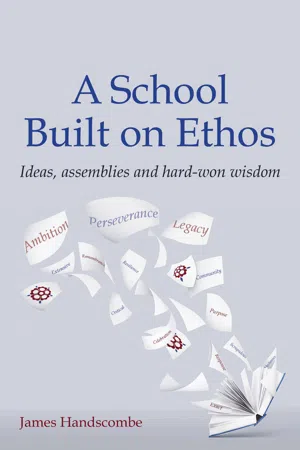
As I sat there, I found myself reaching for words – words that would encapsulate and communicate, words on which I could build, words that would create direction and allow others (hopefully, eventually) to travel with me, words that could lie at the heart of a school ethos, words that would last. Inspired by the speaker, by the prize-winning students (whose names it was my job to read out) and by a very real sense of the enormity of the task, I settled on three words: ambition, perseverance and legacy. This tricolon summed up how I felt that evening and also (starting a tradition of investing words with multiple meanings) encapsulated the qualities I thought would be most valuable in potential students. For me sitting there that evening, ambition was an excuse to dream big, to think about creating the best school in the country, to stoke the fires of self-confidence that had nudged me towards applying for the role in the first place. Legacy was the sense both that I should build for the future, create structures and traditions that could long outlive me, and that the success of the school would be seen in the mark its students made on the world and not just in their grades. And perseverance was the understanding that I had made some big promises and that keeping them would involve keeping on – I couldn’t expect every day to be a celebration of brilliance such as the one I was part of that evening. And then I wanted students who would dream big, set themselves high targets and then, upon meeting them, set higher ones; I wanted students who would go out into the world and make a difference, make it better for others and not just more comfortable for themselves; and I wanted students who would keep going, who would get over setbacks, who would help with the building of the school (metaphorically rather than physically, I hoped – the interview panel had been rather cagey about the location we would be using).
Two things came out of that evening of reflection. The first is the tricolon that still lies at the heart of the school ethos and is proudly displayed on the wall of the entrance corridor: Ambition, Perseverance, Legacy; the second is the idea that Harris Westminster Sixth Form would be a school in which words had power, resounded, were invested with meaning and shared. This is a book about those words, and particularly about the words that were shared with the whole school in assemblies, standing at the front of St Margaret’s Church or in the pulpit of Westminster Abbey, before hundreds of expectant faces – words that built and shared and communicated an ethos. In a chapter on beginnings, it is appropriate to begin with an assembly on the Harris Westminster approach to beginning. Not the very first Harris Westminster Assembly – I am afraid that has been lost in the sands of time. Two very early assemblies follow later in this chapter, but right now we begin in medias res. One of the things about which I hope to interest my readers is the development of the ethos from those three words to something that has the strength and depth to underpin an entire school. This assembly from three years in is a kind of foreshadowing for that development, a glimpse into the future that I would have loved to have had back in 2013.
You must imagine me stepping up to the pulpit of Westminster Abbey as the bongs of Big Ben fail to fade into the background (the bell having been silenced for repair), without notes (as will become apparent) and with a worried look on my face.
Beginning – 19 April 2017
I have left my notes in my office but it is nine o’clock, too late to go back. I will just begin. The beginning of summer, the beginning of a new term and a wonderful time to speak about beginnings, so I will speak to you about beginnings – or I would, but I don’t know where to begin. The sages say to start at the very beginning – it is, apparently, a very good place to start. They go on to explain that when you read you begin with ABC, but they do not, unfortunately, specify how you begin when you deliver an assembly, and so I find myself in the right place, at the right time, needing to start but not knowing where or how.
Maybe I should begin by telling you of the time I explained mechanics and purpose to the principal of Harris Battersea. He listened attentively and then said, ‘Yes – excellent. Of course, purpose is just another kind of mechanics.’ That is an interesting comment and one that is worth developing, but I know how I plan to end this assembly and I am not sure how to get there from that beginning.
I plan to end by quoting four lines from the poem on the whiteboard in my office and so maybe I should begin with some poetry. Maybe I should update you on my progress towards memorising six poems this year, but I have received criticism from one of your number that my assemblies tend to emphasise literature at the expense of maths and science; of course, I have also received criticism that my Twitter feed fetishises mathematics, so perhaps I can’t win. I value all of these areas of learning, but an assembly is fundamentally a wordy creation and it is, therefore, understandable, I hope, that I reach for the geniuses of language in order to felicitate my delivery.
Perhaps, however, and in light of the two poetry-heavy assemblies I have given recently, I should spare you too much this morning and instead begin with the information that on 13 March 1781, William Herschel discovered the planet Uranus – the first planet to be discovered by telescope. But Herschel is buried in Slough of all places and maybe I should reach for one of those memorialised in this building – Admiral Sir Cloudesley Shovel, for example. I suspect I could develop an excellent naval analogy, but too many of you will not have admired his tomb and it is hidden on the south aisle.
So, maybe I should begin with you. I could start by congratulating you on your house drama, by expressing my delight at being able to be part of that celebration of your thespian talents and by linking that celebration to this term and explaining that the exams are to your studies as the opening night is to weeks of rehearsals, and that therefore, if you have studied correctly, exams, as much as the end of exams, are a celebration. That would make this week’s Year 13 mocks a dress rehearsal and I don’t want to give the impression that I think of exams as a bit of fun. I know exams are not fun – they are deadly serious – but that doesn’t stop them from being a celebration of how clever you are.
I don’t know how to begin and now I have wittered away 500 words, so maybe I should take a deep breath, clear my decks and get started.
I love the idea of clearing my decks – a nautical term for the beginning of a combat that resonates pleasingly with the scholarly act of clearing my desk – and so, with a clear desk and cleared decks, I shall leap into a preprepared paragraph on the discovery of Neptune: something I know well and feel confident about and which will illuminate my main point once I get to it. After the discovery of Uranus, the new planet was watched carefully by astronomers who discovered that it wobbled in its orbit from what would be expected based on the laws of gravity. From this, two astronomers – John Couch Adams and Urbain Le Verrier – deduced that there must be another planet out there and were able to use mathematics to calculate its location. Simultaneously, or almost so, they pointed at an area of sky and said, ‘Look there.’ Unfortunately, there the similarities end because as students differ so do scientists, and John Couch Adams was careless in his mechanics, sloppy in his workings and messy in his laying out, whilst Urbain Le Verrier was slightly slower but careful and accurate. Adams pointed first but Le Verrier pointed to where Neptune actually was. The British establishment claimed for many years therefore that they should share the glory, but unfortunately this is not how an exam board would see it and nor, now, does the international community. The glory belongs to Le Verrier alone. They both had excellent purpose in understanding that there was a planet out there, but Le Verrier’s mechanics were better.
Le Verrier was excited by this and went on to calculate that Mercury’s orbit was also wobbly. He therefore predicted another planet, Vulcan, between the sun and Mercury. Sadly, no matter how carefully they looked (and after his success with Neptune they looked very carefully), nobody could find a planet where he was pointing. This was due to the disappointing fact that there was no planet there. Le Verrier’s mechanics were fine again – the orbit was wobbly – but his purpose let him down because he didn’t know about general relativity (living, as he did, considerably before Einstein). General relativity explains many things, one of which is the wobbliness of Mercury’s orbit.
And so we hook into the question of whether purpose and mechanics are the same thing: can you learn to do all of your studies by rote? Could a computer be programmed to pass A levels? Well, I suspect it could: I suspect that at a basic C-grade level the questions are routine, the explanations required are straightforward and most of the essays needed could be memorised, but I think that to get full marks, to get an A*, you need to properly understand, you need to be able to think around the question, you need to be able to bring something interesting and original to the analysis. There is no excuse, however, for missing out on those C-grade marks in the manner of John Couch Adams: if the examiners are willing to give you marks for memorising quotes or formulae or dates or essay structures or graphs or techniques, then you should just memorise them. If I can memorise the poems that go on my wall, then you can memorise the things you need to know for your exams. And so we return to the poem currently on my whiteboard.
It is called ‘Invictus’ and was written by William Ernest Henley. The last stanza goes like this:
It matters not how strait the gate,
How charged with punishments the scroll,
I am the master of my fate,
I am the captain of my soul.
Right now you are masters of your fate as well as captains of your souls, but time is sweeping you on and exams are a celebration of how clever you are, whether you like it or not. Every mark you gain is a testament to the hours of work you have put in, and every one you should have gained but don’t is a sad reflection on your study habits: first nights tend to show up those who haven’t learned their lines. And so we get back to the question of how should one begin on a task that seems unmanageably large, where the stakes are scarily high and where there is no obvious starting point. I have a neatly enumerated list of tips on how to begin, garnered from my experience, in this assembly on beginnings. Listen up – you all have exams this term.
■ Clear your decks and your desk. You can’t work in the middle of a mess and you can’t begin with something hanging over you. Do the jobs you have been putting off – throw out the rubbish that you neither know to be useful nor believe to be beautiful – and that is a quote from the third William of the day – William Morris.1
■ Get rid of distractions. Cancel social engagements, put the Xbox in the attic, change your Snapchat password and forget the new one, tell your friends you will see them in a couple of months. You are the captain of your soul, and the admiral will remind you that a distracted captain crashes the ship.
■ Balance mechanics and purpose but know that the quick wins are all mechanics – memorise important things, make as much as you can into a routine you can follow, learn the patterns. This is why, by the way, Year 12s need to be digging as deeply into the purpose of their subjects as they can now: by this time next year it will be too late to get your head round the really hard ideas. Treating purpose like mechanics will get you a C but no further.
■ Learn drop-ins. Like the piece on the discovery of Neptune, you can memorise a paragraph or a proof that you can then drop into an answer and gain some marks for a perfectly constructed section because you haven’t had to work it out on the day. In fact, you will have guessed that this whole assembly was constructed off site and dropped into place this morning.
■ And, finally, just begin. It is easy to put off getting started, to dither, to vacillate, to squander time and to end up being a hostage to fortune, but your ambition is wedged into one of the stones of the abbey. You know where you want to end up and you can get there if you start from here – you are the master of your fate.
By 2017, the ethos was up and running, the students had joined the school and so it was possible to have an assembly that played a little with the format (I usually read from a prepared script but, sometimes, as on this occasion, I indulge the urge to show off and commit it to memory). It was also possible to play with the jargon of the school: mechanics, purpose and celebration are all words that we have adopted and developed. At its heart, though, this assembly is a development of the thread that started at the Speech Day in 2013: words being used to educate, amuse and intrigue; words being used to model, support learning and enable the students to get better, to develop the skills that would bring them closer to their ambition.
Back to the beginning, though, and what happened next: what do you do when the euphoria of being appointed to your dream job dies down and you find yourself with a three-word ethos and little else to build a school upon? Obviously, my 2017 self would have cleared my desk, but in 2013 I hadn’t yet come across this excellent piece of advice, and, anyway, I was still employed in my previous school until 1 January 2014 and in the meantime there were plans to be made and students to recruit on top of my existing job.
I spent the summer pondering the kind of school I wanted to create – a place of learning, a sanctuary from ignorance but also a place that would send its graduates out ready to face and change the world. The idea of changing the world, of developing a generation of young people whose diversity, intelligence and passion would create a shift in the social structures of the nation (which, to this day, sounds overblown as an ambition), was in my thinking throughout those months, and it nearly became the tagline: ‘Ambition, perseverance, legacy: changing the world’.
A little reflection showed that this sounded more like voluntary service and less like the academic sixth form I was hoping to create. Our actual unofficial motto came about through an interview I gave for the Evening Standard in the autumn.2 This was the first time I had spoken to a newspaper journalist since, I think, I was 16 and in the local press for having a notable collection of GCSEs. Once again, the Harris and Westminster teams had come together to create the opportunity: the Harris communication experts from the mysteriously named 8hwe had set up the interview and it took place in the headmaster’s study at Westminster School. By this point I had gone past the point of no return; there was no mileage in being daunted – the...
Table of contents
- Praise
- Title Page
- Dedication
- Contents
- Preface
- Acknowledgements
- Chapter 1: Beginning
- Chapter 2: Teamwork
- Chapter 3: Development of an Idea
- Chapter 4: Scholarship
- Chapter 5: Important Messages
- Chapter 6: Building the Community
- Chapter 7: Hard Times
- Chapter 8: Resilience for a Better Tomorrow
- Chapter 9: Esoterica
- Chapter 10: Saying Goodbye
- Coda: A Student’s Reflection
- References
- Index of Assemblies
- About the Author
- Advertisement
- Copyright
Trusted by 375,005 students
Access to over 1.5 million titles for a fair monthly price.
Study more efficiently using our study tools.
Frequently asked questions
Yes, you can cancel anytime from the Subscription tab in your account settings on the Perlego website. Your subscription will stay active until the end of your current billing period. Learn how to cancel your subscription
No, books cannot be downloaded as external files, such as PDFs, for use outside of Perlego. However, you can download books within the Perlego app for offline reading on mobile or tablet. Learn how to download books offline
Perlego offers two plans: Essential and Complete
- Essential is ideal for learners and professionals who enjoy exploring a wide range of subjects. Access the Essential Library with 800,000+ trusted titles and best-sellers across business, personal growth, and the humanities. Includes unlimited reading time and Standard Read Aloud voice.
- Complete: Perfect for advanced learners and researchers needing full, unrestricted access. Unlock 1.5M+ books across hundreds of subjects, including academic and specialized titles. The Complete Plan also includes advanced features like Premium Read Aloud and Research Assistant.
We are an online textbook subscription service, where you can get access to an entire online library for less than the price of a single book per month. With over 1.5 million books across 990+ topics, we’ve got you covered! Learn about our mission
Look out for the read-aloud symbol on your next book to see if you can listen to it. The read-aloud tool reads text aloud for you, highlighting the text as it is being read. You can pause it, speed it up and slow it down. Learn more about Read Aloud
Yes! You can use the Perlego app on both iOS and Android devices to read anytime, anywhere — even offline. Perfect for commutes or when you’re on the go.
Please note we cannot support devices running on iOS 13 and Android 7 or earlier. Learn more about using the app
Please note we cannot support devices running on iOS 13 and Android 7 or earlier. Learn more about using the app
Yes, you can access A School Built on Ethos by James Handscombe in PDF and/or ePUB format, as well as other popular books in Education & Education General. We have over 1.5 million books available in our catalogue for you to explore.