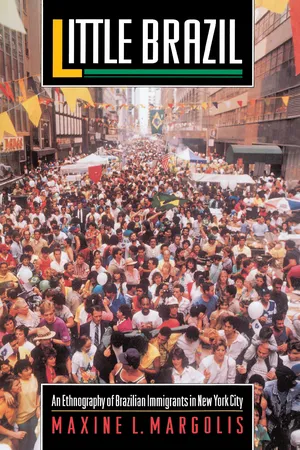
Walking west on 46th Street in Manhattan, just three blocks from Rockefeller Center, one passes Brazilian restaurants, the office of New York's Brazilian newspaper, a Brazilian travel agency, a business that sends remittances and wires flowers to Brazil, and a store that sells Brazilian food products, magazines, newspapers, videos, and tapes. These businesses are the tip of an ethnic iceberg, an unseen minority estimated to number some 80,000 to 100,000 Brazilians in the New York metropolitan area alone. Despite their numbers, the lives of these people remain largely hidden to scholars and the public alike. Now Maxine L. Margolis remedies this neglect with a fascinating and accessible account of the lives of New York's Brazilians.
Showing that these immigrants belie American stereotypes, Margolis reveals that they are largely from the middle strata of Brazilian society: many, in fact, have university educations. Not driven by dire poverty or political repression, they are fleeing from chaotic economic conditions that prevent them from maintaining amiddle-class standard of living in Brazil. But despite their class origin and education, with little English and no work papers, many are forced to take menial jobs after their arrival in the United States. Little Brazil is not an insentient statistical portrait of this population writ large, but a nuanced account that captures what it is like to be a new immigrant in this most cosmopolitan of world cities.
- 360 pages
- English
- ePUB (mobile friendly)
- Available on iOS & Android
eBook - ePub
About this book
Information
Publisher
Princeton University PressYear
2021Print ISBN
9780691000565
9780691033488
eBook ISBN
9781400851751
CHAPTER ONE
The New Voyagers
American history prepares us for exploration, strangers, and alienation. The same is true of the British and French who became world explorers and later anthropologists in their empires’ most distant territories. Nor, apparently, were the early Portuguese explorers, leaders during the age of discovery, reluctant to travel abroad. Sometime between Brazil’s settlement and today, that mentality of exploration has disappeared.
—CONRAD P. KOTTAK, Prime Time Society
Não mude do Brasil, ajude mudar o Brasil.
Don’t abandon Brazil, help Brazil change.
—Slogan from the Brazilian government's campaign against emigration
THESE QUOTES reflect two Brazilian realities. To people knowledgeable about Brazil, the word “migration” immediately brings to mind impoverished peasants fleeing from the country’s arid northeast after one of the region’s periodic droughts. Carrying their few possessions and searching for a better life, they board the crowded, open-air trucks dubbed “parrots’ perches” and head to Brazil’s industrial south. But today the word has taken on a new meaning. Over the last decade, as economic conditions in Brazil have deteriorated, many thousands of Brazilians have left their country and migrated abroad. This is an entirely new phenomenon and one that is out of character with Brazilian history and with the Brazilian ethos. “Emigration,” as the noted historian of Brazil, Thomas Skidmore, has remarked, “is a bad sign because Brazilians are famous for their optimism about the country. Even during the military regime, people who went into exile came back as soon as they could. Optimism is in short supply in Brazil.”1
Stories of the exodus fill the pages of Brazilian newspapers and magazines. Folha de São Paulo reported that in early 1989, 2,000 Japanese-Brazilians a month were leaving for Japan, including many who worked at the Japanese consulate in São Paulo. In January and February 1990, 700 Brazilians of Spanish descent sought citizenship papers at the Spanish consulate in São Paulo—up from only 90 requests for all of 1989. That city’s Italian consulate was similarly besieged and was issuing an average of 550 passports a month to Brazilians whose ancestors had come from Italy. Veja, a Brazilian news weekly akin to Time, has had two cover stories about Brazilians departing for Toronto, Lisbon, Paris, London, Rome, Sydney, and a number of U.S. cities. And according to government data, between 1986 and 1990 about 1.4 million Brazilians left the country and never returned.2
Awareness of the flight from Brazil does not depend on the news media. In inimitable Brazilian fashion, jokes about the exodus make the rounds: “There’s an easy way out of Brazil’s economic and social crisis,” goes one, “the airport.” And many people in the large cities of southern Brazil—Belo Horizonte, Rio de Janeiro, São Paulo—personally know someone who has left. During the first two or three days I was in Rio in July 1990, I met three such people: the director of a language school, who told me about a friend’s son, who is working in the United States and who just received his green card; a taxicab driver, whose daughter went to Washington, D.C., as an “adventure,” worked as a live-in nursemaid, and is now married to an American; and an employee of an art gallery, who had lived and worked in New York City a year or two earlier. The other side of the coin is the growing presence of Brazilians in many U.S. cities.
When Did It All Begin?
There are no dependable data on Brazilian immigration to New York City, so I have necessarily relied on “well-informed informants,” particularly longtime Brazilian residents of the city, to flesh out the historical picture. An official of the U.S. consulate in Rio de Janeiro said that Brazilian immigration to the United States began on a significant scale only during the mid-1980s. A Brazilian who has lived in New York for years essentially confirmed this, noting that the rate of immigration increased slowly but steadily through the 1970s and early 1980s and then took off in 1984 or 1985. Another longtime New Yorker dated the Brazilian “deluge” from 1987. Although they did not agree on the exact year, in dozens of conversations with knowledgeable informants, nearly all date the take off sometime between 1984 and 1987.
To be sure, there have always been Brazilians living in New York and in other areas of the country. The 1980 U.S. census counted some 44,000 native-born Brazilians, about 60 percent of whom lived in New York, New Jersey, Massachusetts, Florida, and California.3 During the course of my field research, I met about three dozen Brazilians who had lived in the city for fifteen, twenty, even thirty years. One longtime Brazilian resident remembers that a fair number of his compatriots lived in Newark in the late 1960s and early 1970s, doing road construction and painting bridges. Another dated the current Brazilian shoe-shining monopoly from 1969, when her brother and other mineiros, natives of the Brazilian state of Minas Gerais, began shining shoes at a kiosk in Grand Central Station. Yet another Brazilian related how she and a group of friends were brought to the United States some twenty-five years ago by wealthy Brazilian and American families to work as live-in housekeepers and nannies. And one Brazilian recalled his surprise when in 1968 or 1969, he visited a Catskill resort hotel and found some of his compatriots working as busboys in the restaurant there. In addition to these immigrant pioneers, there has long been another Brazilian presence in New York City: individuals employed by Brazilian-owned or -affiliated businesses, banks, tourist agencies, and airlines, as well as UN, trade bureau, and consular officers, students, and expatriate artists, writers, and musicians.
THEY ARE EVERYWHERE
One cannot turn around in midtown Manhattan and parts of Queens without bumping into Brazilians. On a Sunday in Central Park, a Brazilian was collecting signatures for a petition urging the prosecution of the men charged with the the murder of famed environmental activist, Chico Mendes. He was amazed, he said, at the number of Brazilians who stopped to chat. At a New York summer street fair, I met a Brazilian woman selling silk-screened T-shirts and a Brazilian family hawking their native cuisine. Walking through Bloomingdale’s, I heard frantic pleas for help in Portuguese; a Brazilian had just had her purse stolen.
A trendy Mexican restaurant on Manhattan’s East Side swarms with Brazilians—upwards of thirty work there as busboys, waiters, bathroom attendants, and cooks. At a neigborhood Italian restaurant, the coat checker was Brazilian, as were the waiter and food handler. At a French bistro on the other side of town, the waitress turned out to be Brazilian, as were the bus-boy at a popular Greek restaurant in the Chelsea district and another busboy at what is widely regarded one of the city’s most fashionable eateries.
The assistant handyman in my building was Brazilian; he was replaced by his cousin—also Brazilian—who is now a part-time doorman there. When I was going to the laundry room in the basement, I met a Brazilian in the elevator who works as a housekeeper in the building. The parking lot attendant at a nearby garage is yet another Brazilian.
The soft nasal lilt of Portuguese can be heard among the open-air booksellers on Fifth Avenue, the shoe shine stands in the World Trade Center and Grand Central Station, and the scattered food shops, newsstands, and beauty salons that dot Astoria, Queens.
Still, the recent flight from Brazil is of a different order of magnitude from the trickle of emigrants who left earlier. There are several related reasons for this growing exodus from a country that has no history or tradition of emigration. Brazilians in New York are primarily economic exiles, fleeing from conditions of hyperinflation that have gouged the middle class and made its standard of living harder to maintain. In 1990 Brazilian inflation reached 1,795 percent annually; by 1991, even after then-President Collor’s much-heralded plan to slay inflation with a “single bullet,” it was averaging 20 percent a month. Moreover, by the end of Collor’s first year in office, the Brazilian economy had shrunk by 4.6 percent, the largest drop since 1947, when the measurement was first recorded, and it was not expected to begin even a minor rebound until 1993. “The group of Brazilians who are leaving the country,” reported the respected daily Folha de São Paulo“are tired of the sequence of economic packages that didn’t turn out . . . they don’t believe in the Collor Era.”4
An inflation rate of 84 percent a month—the rate in March 1990, just prior to Collor’s economic plan—means that a person with $1 worth of Brazilian currency on March 1 has only 20 cents on March 31. It is little wonder, then, that hyperinflation causes extreme economic uncertainty. A few examples of what it is like to live under these conditions are illustrative. Over an eighteen-month period beginning in 1987, the real income of the Brazilian middle class declined by 30 percent, as rents soared by 800 percent, the price of newspapers often doubled overnight, and canned goods in grocery stores were thick with price stickers, stuck one on top of the other, as store owners frantically changed prices trying to keep up with inflation. “Restaurant patrons complain that the cost of their meals goes up as they eat,” noted an article on Brazil’s inflation in the New York Times. “Shoppers complain that prices are marked up while they wait in checkout lines.”5
That hyperinflation, and the accompanying conditions of economic uncertainty, have caused the extraordinary exodus of Brazilians, is indicated by the fact that the flood of emigration began about the time that the Cruzado plan, the Brazilian government’s earlier effort to deal with rampant inflation, failed in 1986. According to the Brazilian Federal Police, 37 percent of the Brazilians who left the country that year never returned. Or, as one Brazilian emigré in New York put it, that reform plan “was our last hope for a better life.”6
Where Are They?
Brazilians, then, have been coming to New York—and other U.S. cities—in droves. But where do they live? Is there a Brazilian residential enclave within New York, or are they scattered throughout the city? This was one of the first questions I asked when starting my research. After a year of riding the “N” and “R” subway trains to Astoria, Queens, I can answer the question definitively: Brazilians are heavily concentrated in the borough of Queens, particularly in Astoria, adjacent Long Island City, and to a lesser extent, in Jackson Heights, Sunnyside, and one or two other Queens neighborhoods. But their residential profile is more complex than that because Brazilians live in all five boroughs and in a number of cities and towns throughout the Greater New York metropolitan area.
Where Brazilians live is, in part, determined by social class and immigration status. For example, I was told by the president of the New York branch of a major Brazilian bank that Scarsdale, a lush suburb in Westchester County whose per capita income is among the top twenty-five in the nation, had become “Brazilian country.” He was alluding to the fact that the chief executives and directors of the New York offices of large Brazilian companies make their homes there, as well as in other posh communities in Westchester, such as neighboring Rye, and in Greenwich and Darien in nearby Connecticut.7
At the other end of the social spectrum are Brazilians who live in small, crowded apartments in Newark, another Brazilian bastion. This New Jersey city is home to many working-class Brazilians employed in unskilled jobs, as construction workers, truck drivers, gas station attendants, and restaurant workers. Although I lack hard data to confirm this, it appears that Brazilians living in Newark and a few other residential pockets, such as Framingham, Mass., are from working-class backgrounds and are more homogeneous socially than their compatriots in New York City.8
New York City proper attracts a wide range of Brazilians, from the very wealthy to the decidedly less well off and less well educated. Then, too, New York, as an international city—some natives insist it is the center of the universe—beckons not only immigrants who come to earn money, but artists, writers, and musicians whose hopes lie in the lyrical dictum “ ... if you can make it there, you can make it anywhere.” Still, the entire range of the Brazilian social spectrum is not represented in New York since very few poor Brazilians can afford to travel to New York or elsewhere in the United States.

Map 1.1 New York City’s Five Bor...
Table of contents
- Cover Page
- Title Page
- Copyright Page
- Dedication
- Contents
- List of Illustrations
- List of Tables
- Preface
- Chapter 1. The New Voyagers
- Chapter 2. Bye-Bye, Brazil
- Chapter 3. First Days
- Chapter 4. Who Are They?
- Chapter 5. Making a Living
- Chapter 6. From Mistress to Servant
- Chapter 7. Shoe Shine “Boys” and Go-Go “Girls”
- Chapter 8. Life and Leisure in the Big Apple
- Chapter 9. Little Brazil: Is It a Community?
- Chapter 10. Class Pictures
- Chapter 11. An Invisible Minority
- Chapter 12. Sojourner or Immigrant?
- Notes
- Glossary of Portuguese and Brazilian-American Terms
- References
- Index
Trusted by 375,005 students
Access to over 1.5 million titles for a fair monthly price.
Study more efficiently using our study tools.
Frequently asked questions
Yes, you can cancel anytime from the Subscription tab in your account settings on the Perlego website. Your subscription will stay active until the end of your current billing period. Learn how to cancel your subscription
No, books cannot be downloaded as external files, such as PDFs, for use outside of Perlego. However, you can download books within the Perlego app for offline reading on mobile or tablet. Learn how to download books offline
Perlego offers two plans: Essential and Complete
- Essential is ideal for learners and professionals who enjoy exploring a wide range of subjects. Access the Essential Library with 800,000+ trusted titles and best-sellers across business, personal growth, and the humanities. Includes unlimited reading time and Standard Read Aloud voice.
- Complete: Perfect for advanced learners and researchers needing full, unrestricted access. Unlock 1.5M+ books across hundreds of subjects, including academic and specialized titles. The Complete Plan also includes advanced features like Premium Read Aloud and Research Assistant.
We are an online textbook subscription service, where you can get access to an entire online library for less than the price of a single book per month. With over 1.5 million books across 990+ topics, we’ve got you covered! Learn about our mission
Look out for the read-aloud symbol on your next book to see if you can listen to it. The read-aloud tool reads text aloud for you, highlighting the text as it is being read. You can pause it, speed it up and slow it down. Learn more about Read Aloud
Yes! You can use the Perlego app on both iOS and Android devices to read anytime, anywhere — even offline. Perfect for commutes or when you’re on the go.
Please note we cannot support devices running on iOS 13 and Android 7 or earlier. Learn more about using the app
Please note we cannot support devices running on iOS 13 and Android 7 or earlier. Learn more about using the app
Yes, you can access Little Brazil by Maxine L. Margolis in PDF and/or ePUB format, as well as other popular books in Social Sciences & Anthropology. We have over 1.5 million books available in our catalogue for you to explore.