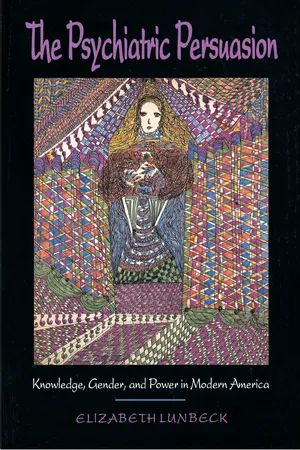
In the years between 1900 and 1930, American psychiatrists transformed their profession from a marginal science focused primarily on the care of the mentally ill into a powerful discipline concerned with analyzing the common difficulties of everyday life. How did psychiatrists effect such a dramatic change in their profession's fortunes and aims? Here, Elizabeth Lunbeck examines how psychiatry grew to take the whole world of human endeavor as its object.
- 445 pages
- English
- ePUB (mobile friendly)
- Available on iOS & Android
eBook - ePub
About this book
Information
Publisher
Princeton University PressYear
2021Print ISBN
9780691025841
9780691048048
eBook ISBN
9781400844036
PART ONE
FROM INSANITY TO NORMALITY
ONE
PSYCHIATRY BETWEEN OLD AND NEW
IN JUNE 1912, the Boston Psychopathic Hospital formally opened its doors, signifying to the city’s reform-minded psychiatrists that their profession had come of age. An imposing, four-story brick building modeled on the German psychiatrist Emil Kraepelin’s Munich-based clinic, the hospital represented in concrete form all that was new in psychiatry. It was, in the estimation of its proponents, closer in conception, design, and operation to the general hospital than to the isolated, overcrowded, and scientifically backward asylum. An urban institution, located on the outer edges of the Harvard Medical School’s complex of buildings and hospitals, it was easily accessible from all the city’s districts, a short streetcar ride from its center. Relatively small, it accommodated just over one hundred patients but had on its staff approximately twenty physicians and nearly as many medical interns, significantly more than asylums housing many more patients. Its purpose and province scientific, it was intended more for the observation and examination of patients than for their long-term incarceration, more for the treatment of those afflicted by acute and potentially curable mental diseases than for that of those recognized to be insane. The hospital presented psychiatrists with a novel arrangement of material and intellectual resources—from its laboratories and proximity to libraries and lecture halls to the “nearly normal” patients it attracted—which they assiduously pressed into service as they went about remaking their discipline.
Commentators of all persuasions have noted that at the turn of the century psychiatry was somehow transformed, agreeing that the discipline that had in the nineteenth century been visible only at the margins—in the asylum—had by the second decade of the twentieth century established itself at the center of social and cultural life. Psychopathic Hospital psychiatrists were instrumental in effecting this shift in their discipline’s fortunes, employing maneuvers that freed them from the abnormal and bizarre and brought them up against what was normal. In published papers, professional addresses, and, most important, in day-to-day practice, they fashioned a psychiatry of normality—of life’s routine aspects—that would become dominant within the American branch of the profession by the 1920s. Their attempts to remake their specialty had local accents and national resonances; the psychiatry of the twenties, which was as concerned with mental health as with disease, as focused on “social maladjustment and even unhappiness” as on insanity, was a discipline forged in many crucibles.1 Prominent psychiatrists in other cities—San Francisco, Baltimore, New York, Ann Arbor—were taking the profession in the same direction, establishing similar institutions, setting similar policies, and publishing articles that advocated similar perspectives. Still, Boston was, by many accounts, the nation’s psychiatric capital throughout the first twenty years of the century, the Psychopathic Hospital the newest star in its firmament of illustrious privately and publicly funded institutions that were routinely classed under the rubric “charitable.”2
Known as “the paradise of charities,” the city could boast of a distinguished lineage in the realm of public welfare.3 From Charles Dickens’s pleasing appraisal of its institutions—in 1842, he visited the Perkins Institute and the Institution for the Insane—as “as nearly perfect, as the most considerate wisdom, benevolence, and humanity, can make them”;4 through the proud catalogue that appeared in the city’s official history, published in 1880, of its 177 voluntary organizations, a broadly construed category encompassing universities, hospitals, relief societies, and homes for needy individuals of all sorts;5 to, in the new century, the proliferation of organizations and institutions testifying to the “quickening” of the citizenry’s social conscience:6 All offered proper Bostonians occasion to reflect on their city’s superiority. Massachusetts had early taken the lead in providing for the care of the insane at public expense, in 1833 establishing an institution—the Worcester State Lunatic Hospital—that would serve as a prototype for many other state asylums; it had also established, in 1863, the first state board of charities, a centralizing move quickly emulated by other states.7 By the century’s end, twenty-nine public and private institutions, clustered in the state’s more populous eastern half, held nearly ten thousand inmates; by 1919, Massachusetts had attained the dubious distinction of having the highest psychiatric-institution admission rate in the nation.8 In any account of American psychiatry’s progress, Boston and Massachusetts figured prominently.
The Post-Victorian City
Turn-of-the-century Boston was a city rich in contrasts. A compact, tightly packed metropolis of five hundred thousand, its prosperous neighborhoods were as elegant and its poor neighborhoods as squalid as any to be found in the nation. The disparity between the grand, bow-fronted brownstones that lined the broad avenues of the recently settled Back Bay, enclave of the city’s Yankee elite, and the tenement houses, crowded with recent Italian, Irish, and Jewish immigrants, that abutted the crooked, narrow streets and alleys of the North End testified graphically to the class and racial divisions that marked the city’s political and social life. In the political arena, the last years of the nineteenth century saw Yankee patricians and working-class Irish pols incongruously yet powerfully allied in this best-governed of cities, but the new century witnessed the demise of Yankee leadership and the ascendancy of a factional, corrupt, and patronage-ridden Irish machine. Socially, the city was home to the legendary Brahmin aristocracy, of all the nation’s urban elites possibly the most persistent, politically engaged, professionally active, and intellectually distinguished. Yet Boston was increasingly a city of immigrants. A small army of alarmist investigators pored over state and national census figures, and gleaned from them confirmation of what any city dweller knew—that a third of the city’s populace was foreign-born, and another third was of foreign extraction. As these harbingers of doom never tired of reminding their readers, three of the four faces a stroller would likely encounter on a sojourn through the city would be recognizably foreign.9
Prompted by civic pride or xenophobia, fired by muckraking zeal or reformist sentiments, a number of turn-of-the-century Bostonians took stock of their city and its place in the nation. A few wrote celebratory histories, chronicling the city’s distinctive and distinguished past, and closed them soberly with examinations of the city’s rapidly changing racial mix and its baleful political consequences.10 Others walked the streets and studied the inhabitants of the city’s slum neighborhoods, some issuing calls for economic and social justice and others producing precisely rendered accounts of daily life in the city’s poorest quarters.11 Industrious social scientists culled statistics from a flood of government reports, creatively partitioning and recombining them in such a way that tramping, crime, delinquency, drunkenness, and insanity—vices long associated with the urban poor—appeared dangerously on the increase. As they surveyed the state of their city and society, whether lamenting with a bitterly nostalgic backward glance the passing of civilization as they knew it—like the weary Henry Adams—or looking ahead to see in it signs of the divisive and leveling modernity that was sure to come, these diverse commentators could agree only that the moment was one of crisis.12
A city of distinctive neighborhoods, Boston still retained “its old-time town feeling. ”13 The horizons of many of its inhabitants were bound by the several streets they traversed each day as they went to work and to market. Yet the signs of modernity were everywhere apparent. On the streets, the new noises of the automobile mingled with the familiar pounding clatter of the iron-shod horse. Electric trolleys carried passengers, for five cents, at twice the speed of the horse-drawn cars they were gradually replacing. Incandescent mantles lit streets that first lanterns, then the naked flames of gas lights, had once illuminated. And, in the homes of the moderately well-to-do, telephones were beginning to appear.14
The smells and sounds of the city changed as its infrastructure and economy assumed more recognizably modern shape. New ordinances silenced the late-nineteenth-century peddlers’ street cries—“Wild duck, wild duck,” “Any old rags or bottles,” “Fresh mackerel,” “Sixteen bananas for a quarter”—as well as the hand organ and the street band. “The delectable music of the flute, violin and harp which played trios in front of grog-shops is not heard,” noted one observer with a touch of nostalgia, lamenting that the shriek of the streetcar’s wheels was drowning out the twitter of the sparrow, and that the stench of burning gasoline and oil was supplanting the sweet smell of horse manure.15 Still, the harsh jangling of glass milk bottles continued to rouse the wealthy from their slumbers just as the bell-like noises of tin milk cans had in the eighties and nineties.16 Cows could still be seen grazing in the pastures of South Boston.17 And the pungent odors of leather and hides from the city’s hundreds of shoemaking factories, the sweet smells of chocolate from its Dorchester-based candy factories, and the aroma of roasting coffee from its downtown district filled the air as they had for years.18
The city was, and remained, extraordinarily dirty. Residents of its poorest districts pitched trash onto filthy streets.19 Some of the wealthy piled their rubbish helter-skelter in dark alleys.20 Children dropped banana peels and orange rinds on public ways already littered with ashes and papers. Malodorous, open-topped garbage carts plied the city’s fashionable thoroughfares and dingy alleys alike. Manure—on streets and in stables—bred flies that disturbed the sensibilities of some and threatened the health of all. Insects swarmed and cats crawled over foodstuffs in the city’s poorer markets. Ignoring spittoons, tobacco-chewing men spat everywhere—on floors, streets, even the velvet carpets of railroad cars. Smoke belched from factories, settling over the metropolis like a dirty cloud, blackening clothing and dirtying buildings inside and out.21 “Filth of all kinds is continually tracked and blown into our homes and carried in on our clothing,” complained the fastidious ladies of the Women’s Municipal League in the midst of their relentless campaign against dirt.22
The ladies lived apart from the worst of the city’s filth in the fashionable Beacon Hill and Back Bay districts, on streets and avenues—Marlborough, Commonwealth, Hereford, Clarendon—graced with names meant to evoke associations with aristocratic England. Beacon Hill had been home to the elite since the early nineteenth century, when Brahmin real estate speculators had developed it, erecting family mansions that stand to this day.23 Between the late 1850s and 1880, the city, in conjunction with private investors, had filled in the Back Bay, a muddy marsh turned cesspool, and wealthy Bostonians quickly abandoned the old South End for the new area’s fine residences, churches, and public institutions.24 There stood the Boston Public Library and the Museum of Fine Arts, monuments to Brahmin gentility and class stewardship.25 Worries that the festering muck on which the Back Bay was built would adversely affect the health of its new citizens proved groundless. On every measure—infant mortality, deaths due to diphtheria, consumption, and typhoid fever—they ranked among the city’s healthiest, although this was likely due as much, one self-satisfied observer noted, “to the character of the population” as to the spacious conditions in which they lived and the sunshine that brightened the district like few others.26
The city’s South End, like the Back Bay, was built on landfill, and it, too, had been planned as a fashionable quarter for the affluent. By midcentury, developers were building narrow, high-stooped, “swell-front” brick townhouses on orderly, uniform grids of streets modeled on those of Georgian London, and for twenty years or so, until the 1870s, the city’s wealthy made the South End their home. After the panic of 1873, however, commercial establishments began to encroach on the area’s exclusively residential character and developers began to line the area’s main avenues with tenements that attracted the city’s Irish and Jewish poor. By the turn of the century, the appurtenances of the well-to-do—the “liveried coachmen and white-capped nursemaids airing their charges” of one sociologist’s memory—were long gone, the rich having fled the area “like rats.”27 Once-elegant private homes were turned into lodging houses whose exteriors still betokened gentility; even the most alert passersby might have taken them for the homes of the moderately rich.28 Elsewhere the signs of decline were more evident. In the area’s meanest precincts, families crowded into miserable two- and three-room tenement flats in which, as Mary Antin would later write in a lyrical memoir of her passage through Boston’s slums, they slept “two to four in a bed, in windowless bedrooms.”29 The life of the ghetto was to be found on the streets. There, shawl-clad older women bustled from one pushcart to another as they did their marketing; tastefully dressed young working women paraded about, displaying their finery; young children played tag and older children tempted fate by stepping in front of oncoming trolleys; and “thirsty souls” passed, seeking the solace of drink in the district’s many saloons.30 Between the Back Bay and the South End, adjacent districts, there was little commerce. The genteel serenity of the former was worlds apart from the insistent clamor of the latter. As a girl, Antin had admired her Back Bay schoolmates, but from a distance. “Innocent of envy,” she had yet “discovered something inimitable in the way the Back Bay girls carried themselves.”31
The city’s North and West Ends were, if anything, further from the imagined common life of the metropolis than was the South End. The South End’s theaters, churches, and public institutions drew a diverse crowd, and many of the area’s residents walked to work in the shops and offices of the city’s central business district. The North and West Ends, by contrast, were isolated, almost foreign territory.32 One Yankee neatly disposed of the North End, the city’s oldest residential quarter, with the observation that it offered “but little that is interesting at present.”33 “Invaded” (as the immoderate usage of the day had it) by successive waves of foreign immigrants—first Irish, then Jewish and Italian—who had displaced its original “Anglo-Saxon” inhabitants, the area and its buildings, our Yankee sniffed, had taken on “something of the seedy and degraded air of those who inhabit them.”34 By any measure, the area was extremely poor. Its mostly Italian and Jewish inhabitants occupied cramped quarters in dark, ramshackle, poorly ventilated tene...
Table of contents
- Cover Page
- Title Page
- Copyright Page
- Dedication
- Contents
- List of Illustrations
- List of Tables
- Acknowledgments
- Introduction
- Part One: From Insanity To Normality
- Part Two: Institutional Practices
- Part Three: Psychopathologies of Everyday Life
- Conclusion
- Appendix
- Note on Sources
- Notes
- Index
Trusted by 375,005 students
Access to over 1.5 million titles for a fair monthly price.
Study more efficiently using our study tools.
Frequently asked questions
Yes, you can cancel anytime from the Subscription tab in your account settings on the Perlego website. Your subscription will stay active until the end of your current billing period. Learn how to cancel your subscription
No, books cannot be downloaded as external files, such as PDFs, for use outside of Perlego. However, you can download books within the Perlego app for offline reading on mobile or tablet. Learn how to download books offline
Perlego offers two plans: Essential and Complete
- Essential is ideal for learners and professionals who enjoy exploring a wide range of subjects. Access the Essential Library with 800,000+ trusted titles and best-sellers across business, personal growth, and the humanities. Includes unlimited reading time and Standard Read Aloud voice.
- Complete: Perfect for advanced learners and researchers needing full, unrestricted access. Unlock 1.5M+ books across hundreds of subjects, including academic and specialized titles. The Complete Plan also includes advanced features like Premium Read Aloud and Research Assistant.
We are an online textbook subscription service, where you can get access to an entire online library for less than the price of a single book per month. With over 1.5 million books across 990+ topics, we’ve got you covered! Learn about our mission
Look out for the read-aloud symbol on your next book to see if you can listen to it. The read-aloud tool reads text aloud for you, highlighting the text as it is being read. You can pause it, speed it up and slow it down. Learn more about Read Aloud
Yes! You can use the Perlego app on both iOS and Android devices to read anytime, anywhere — even offline. Perfect for commutes or when you’re on the go.
Please note we cannot support devices running on iOS 13 and Android 7 or earlier. Learn more about using the app
Please note we cannot support devices running on iOS 13 and Android 7 or earlier. Learn more about using the app
Yes, you can access The Psychiatric Persuasion by E. Lunbeck in PDF and/or ePUB format, as well as other popular books in Psychology & History & Theory in Psychology. We have over 1.5 million books available in our catalogue for you to explore.