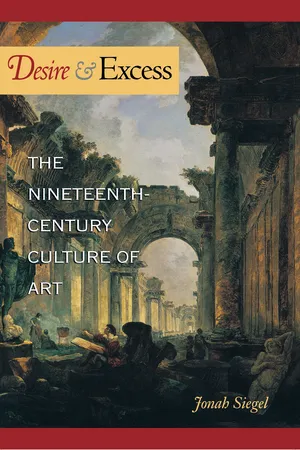
In this fascinating look at the creative power of institutions, Jonah Siegel explores the rise of the modern idea of the artist in the nineteenth century, a period that also witnessed the emergence of the museum and the professional critic. Treating these developments as interrelated, he analyzes both visual material and literary texts to portray a culture in which art came to be thought of in powerful new ways. Ultimately, Siegel shows that artistic controversies commonly associated with the self-consciously radical movements of modernism and postmodernism have their roots in a dynamic era unfairly characterized as staid, self-satisfied, and stable.
The nineteenth century has been called the Age of the Museum, and yet critics, art theorists, and poets during this period grappled with the question of whether the proliferation of museums might lead to the death of Art itself. Did the assembly and display of works of art help the viewer to understand them or did it numb the senses? How was the contemporary artist to respond to the vast storehouses of art from disparate nations and periods that came to proliferate in this era?
Siegel presents a lively discussion of the shock experienced by neoclassical artists troubled by remains of antiquity that were trivial or even obscene, as well as the anxious aesthetic reveries of nineteenth-century art lovers overwhelmed by the quantity of objects quickly crowding museums and exhibition halls. In so doing, he illuminates the fruitful crises provoked when the longing for admired art is suddenly satisfied. Drawing upon neoclassical art and theory, biographies of early nineteenth-century writers including Keats and Scott, and the writings of art critics such as Hazlitt, Ruskin, and Wilde, this book reproduces a cultural matrix that brings to life the artistic passions and anxieties of an entire era.
- 328 pages
- English
- ePUB (mobile friendly)
- Available on iOS & Android
eBook - ePub
About this book
Information
Publisher
Princeton University PressYear
2021Print ISBN
9780691049144
9780691049137
eBook ISBN
9781400849826
Topic
ArtSubtopic
Histoire de l'artPART ONE
ART IN THE MUSEUM: ARTIST AND FRAGMENT AT THE TURN OF THE NINETEENTH CENTURY
Chapter One
DAVID AND FUSELI:
THE ARTIST IN THE MUSEUM,
THE MUSEUM IN THE WORK OF ART
THE ARTIST IN THE MUSEUM,
THE MUSEUM IN THE WORK OF ART
JACQUES LOUIS DAVID’S epochal Oath of the Horatii (1785) is currently at the Louvre, continuing a centuries-old institutional affiliation; Henry Fuseli’s more modest drawing, The Artist in Despair before the Magnitude of Antique Ruins (1778-79), is to be found at the Zurich Kunsthaus. We are used to thinking about what it might mean for a work of art to be in a museum; in the late eighteenth century, it is worth reversing the question—to consider the presence of the museum in a work of art.
What is the relationship of a generation of artists to the masterworks that preceded it? A poem is written, a sculpture carved, a painting painted in one era and the work keeps or finds its power in a later period. Such, with rare exceptions, has been the best hope or promise of art—to stand outside the general decay of time, to engage the imagination of an unknown future. It is conceivable that later creative workers might look at admirable work that preceded their own with comfort, as a model of the possible longevity of their efforts; it is not self-evident that the emotional lesson of the past should be anxiety, that the backward look of admiration should result in a sense of despair at the unmatchable achievement of past artists. Nevertheless such lessons and such despair are a recurrent theme at the turn of the nineteenth century. That the imaginative relationship between contemporary artists and art of the past was a troubled one in this period has long been recognized; the anxieties of its authors and artists have been well documented and ambitiously conceptualized in the past three decades. The argument in the first part of this book follows on the work of earlier critics in literary studies and art history, but it seeks to establish the institutional causes of that previously rare complex that became widespread between the close of the eighteenth century and the beginning of the nineteenth, the sense that the achievements of the past presented a challenge unmatchable by the modern creative imagination.1 This approach allows the identification of one telling paradox: belatedness was a strikingly premature development. It is a sensibility that arose not, as might be expected, in the late stages of the life of institutions of art but was, on the contrary, connate with the establishment of the organized bodies and conceptual models that were to determine the development of art in the nineteenth century. Examination of the institutions of art at the moment of their formation quickly reveals the deep roots of the challenge of the past, its formative presence at the birth of the modern concept of the artist. I begin my discussion with neoclassicism, the movement whose recourse to antiquity allowed for the emergence of the modern figure of the artist but whose principal works of art reveal, shimmering on their surfaces, the specter of later disappointments.2
DAVID: THE OATHS
In a cool light, in an atrium of arched porticoes, three men in Roman tunics and armor stand in profile. Their feet are apart, their arms extended toward an older man who gestures above them with his right hand while raising three swords in his left. Behind him a group of women and children huddles together (fig. 6). Jacques Louis David’s Oath of the Horatii was first exhibited in David’s studio in Rome in 1785; it was subsequently shown at the Paris Salon of the same year, eliciting great public acclaim in both capitals. From early in its history the painting has been identified as a work that intersects with the history of Europe at the same time as it marks a turning point in the history of art. Provoking description as “the picture of our century” by one of its earliest reviewers, the painting has been recognized since its first public appearances as among the most successful productions of eighteenth-century neoclassicism.3 To the historian of the artist it is a remarkable work for what its production says about the new power of the artist himself.
The stark tableau gives the impression of elements deployed with rare precision. The intersection of the visual arts with literature is one characteristic of neoclassical art that is immediately apparent; the scene before us is a moment from Roman history. The question of subject was integral to neoclassicism’s ambitions of improving the social rank of painting; the theoretical antipathy of the movement for such popular genres as portraiture, still life, and landscape was due to the desire for a subject that would validate art as more than simply an object of popular pleasure or pleasant decor. In response, several critics were moved to offer lists of possible themes drawn from the classics and appropriate for representation—as the Comte de Caylus did in his Tableaux tirés d'Homère et de Virgile (1757). Even more typical subjects for neoclassical brushes than the literary moments identified by Caylus were the virtuous acts of heroes from antiquity: the generosity of Alexander, the continence of Scipio, the noble death of Germanicus. That being said, the tale that David dramatizes is not simply heroic, and its textual source is far from clear. Two families, the Horatii and the Curiatii have been chosen to fight the battles of their respective communities, Rome and Alba. Unfortunately, the families are related by a marriage and a betrothal. The picture captures the moment in which the three Horatii brothers swear an oath to their father that they will defend the honor of Rome. The women are shown on the side of the image, overwhelmed by the tragedy of the moment, anticipating its repercussions.

Fig. 6. Jacques-Louis David, Oath of the Horatii, 1785. Paris, Louvre.
Despite the simplicity of its design, and its instantaneous and wellrecognized success, the picture has proved strangely opaque to the art historian. “[T]he very function of the art historian is called into question by the genesis of this picture,” writes Anita Brookner (69).4 The problem, generally speaking, has been one of sources. Brookner’s formulation acknowledges the issue and the challenge it offers to interpretation: “The brilliant singleness of the image hides—or resolves—an unbelievable confusion of sources” (69). The moment depicted has been traced to a variety of texts; David himself cited Corneille’s Les Horaces (1640) as his inspiration. But, as many have pointed out, the focus of Corneille’s play is substantially different from that of David’s painting. The playwright focuses on the disgust of one of the sisters at the death of her fiancé, her own murder at the hands of her brother, and their father’s defense of his vengeful son when he is brought to judgment by the laws of Rome. If David did draw his inspiration from this play, he warped his source substantially in making it into that recurrent theme of history painting of the period, a heroic tale of civic duty overcoming family love. Alternatively, David may be reading far more deeply than is sometimes thought; the element of the tragedy which he illuminates in the painting is precisely the untraceable form of origins that is at stake in Corneille’s drama. As is the case with the image itself, the challenge is one of sources. Alba is the original city that predated the foundation of Rome; the battle the oath anticipates will serve to reincorporate and subsume the primal matrix into the body of the new imperial city. Sabine—born in Alba but married in Rome, sister of the eldest of the Curatii and wife of the eldest of the Horatii—gives voice to the tragic situation in a figurative address to her adoptive city during an early dialogue: “Alba is thy one source. / Stop and bethink thee that with sword thou stabbest thy mother’s breast.”5 The eerie counterpoint of elements on David’s canvas reflects the formative struggle that is at the heart of the play, the wrenching contention between origins that cannot be abandoned and a new order aspiring to claim its own foundational power.
“I Have Abandoned the Picture I Was Doing for the King”
In considering the history of the artist, there are two aspects under which this painting falls: his power and his weakness. The vexed question of sources and their use affects both aspects. To begin with, the most remarked upon point: the moment David depicts never occurs in any of the texts cited by the critics. Although various antecedents have been suggested for the representation of an oath in art, it is clear that this moment is one that David wanted or needed to depict. It is difficult to avoid the conclusion that at the heart of this masterpiece of eighteenth-century historical painting stands a fiction created by and originating from the artist himself.6 David was keenly aware that the autonomous power of creation was his to claim at this stage in his career, as is evident in a letter he wrote to one of his protectors, the marquis de Biévre, after the success of the canvas in Rome and before it came to Paris: “I have abandoned the picture I was doing for the King and have done one for myself instead. No-one will ever make me do anything detrimental to my reputation, and it now measures thirteen by ten feet. You need not doubt my desire to please the King, as I do not know whether I shall ever paint another picture like it; moreover, when I offered it to M. Pierre I told him that I was not guided by self-interest and that I would charge as much for the thirteen feet as for the ten. He said I could not do that, that it would provoke my colleagues, I did not see the matter in this light, and only considered my own development.”7 The force of David’s claim cannot be missed. He has put the king’s commission aside and done a painting for himself instead. The subject is of his own choosing and invention, and he will not even be limited as to size (an important issue in the hierarchy of French academic painting). While the evidence for the depth of David’s commitment to the ideals of the French Revolution is ultimately uncertain, I would suggest that in this letter and picture he identifies himself with a revolution in the nature of the artist—a revolution almost always implicit, and seldom as clearly visible as in this text. The point is not simply that David has placed his “own development” as an artist ahead of the (at least tacit) wishes of the king. What did it mean for an artist to make a painting for himself For himself rather than for the monarch?8 That social as well as aesthetic questions are at stake is indicated by his offer to M. Pierre: “I told him that I was not guided by self-interest and that I would charge as much for the thirteen feet as for the ten.” Behind this statement moves one of the central changes underway in the social position of art and artist alike. We might compare an exchange written by Louis de Carmontelle (Louis Carrogis), a contemporary critic and David partisan, on a work shown at the same salon as the Oath:
Painter: The artist knows his trade perfectly.
Narrator: Allthe better if painting is a trade, then we will value the work by the yard.9
This passage is quoted in Thomas Crow’s discussion of the failure of the clichés of historical painting in the eyes of radical critics such as de Carmontelle. What allows for the irony of the exchange, however, is the casting off not of the moribund aesthetic demands of the academy, but of the workmanlike paying by the yard of the craftsman. “If painting is a trade, then we will value the work by the yard.” This is the logical proposition behind David’s letter to a marquis, who would have been instantly aware of the difference between the means of paying a laboring craftsman and of rewarding a loyal intellectual vassal.10
The abandonment of craft associations was a vital prerequisite for the inclusion of the fine arts among the ranks of liberal accomplishments; as such it was a central, and anxiously reiterated, element of neoclassical thought. Speaking to his students at the Royal Academy in England in 1771, only fourteen years before David’s own confident claim, Joshua Reynolds is stark in his presentation of the options:
The value and rank of every art is in proportion to the mental labor employed in it, or the mental pleasure produced by it. As this principle is observed or neglected, our profession becomes either a liberal art or a mechanical trade. In the hands of one man it makes the highest pretensions, as it is addressed to the noblest faculties: in those of another it is reduced to a mere matter of ornament; and t...
Table of contents
- Cover Page
- Title Page
- Copyright Page
- Contents
- List of Figures
- Acknowledgments
- Preface: The Apparent Permanence of the Museum as Against Its Actual Permanence: The Nineteenth-Century Culture of Art
- Introduction: The Museum as Mortuary
- Part One: Art in the Museum: Artist and Fragment at the turn of the Nineteenth Century
- Part Two: The Author as work of Art Accumulation, Display, and Death in Literary Biography
- Part Three: Absence and Excess: The Presence of the Object
- Part Four: The Deaths of the Critics
- Afterword: Las Meninas as Cover: Foucault, Velazquez, and the Reflection of the Museum
- Notes
- IIIustration Credits
- Index
Trusted by 375,005 students
Access to over 1.5 million titles for a fair monthly price.
Study more efficiently using our study tools.
Frequently asked questions
Yes, you can cancel anytime from the Subscription tab in your account settings on the Perlego website. Your subscription will stay active until the end of your current billing period. Learn how to cancel your subscription
No, books cannot be downloaded as external files, such as PDFs, for use outside of Perlego. However, you can download books within the Perlego app for offline reading on mobile or tablet. Learn how to download books offline
Perlego offers two plans: Essential and Complete
- Essential is ideal for learners and professionals who enjoy exploring a wide range of subjects. Access the Essential Library with 800,000+ trusted titles and best-sellers across business, personal growth, and the humanities. Includes unlimited reading time and Standard Read Aloud voice.
- Complete: Perfect for advanced learners and researchers needing full, unrestricted access. Unlock 1.5M+ books across hundreds of subjects, including academic and specialized titles. The Complete Plan also includes advanced features like Premium Read Aloud and Research Assistant.
We are an online textbook subscription service, where you can get access to an entire online library for less than the price of a single book per month. With over 1.5 million books across 990+ topics, we’ve got you covered! Learn about our mission
Look out for the read-aloud symbol on your next book to see if you can listen to it. The read-aloud tool reads text aloud for you, highlighting the text as it is being read. You can pause it, speed it up and slow it down. Learn more about Read Aloud
Yes! You can use the Perlego app on both iOS and Android devices to read anytime, anywhere — even offline. Perfect for commutes or when you’re on the go.
Please note we cannot support devices running on iOS 13 and Android 7 or earlier. Learn more about using the app
Please note we cannot support devices running on iOS 13 and Android 7 or earlier. Learn more about using the app
Yes, you can access Desire and Excess by Jonah Siegel in PDF and/or ePUB format, as well as other popular books in Art & Histoire de l'art. We have over 1.5 million books available in our catalogue for you to explore.