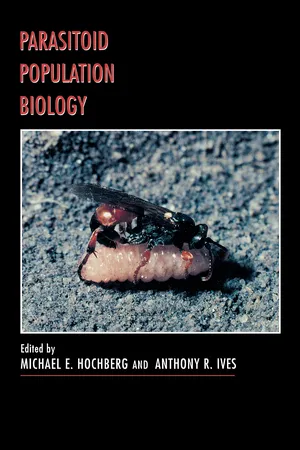
Extraordinary in the diversity of their lifestyles, insect parasitoids have become extremely important study organisms in the field of population biology, and they are the most frequently used agents in the biological control of insect pests. This book presents the ideas of seventeen international specialists, providing the reader not only with an overview but also with lively discussions of the most salient questions pertaining to the field today and prescriptions for avenues of future research.
After a general introduction, the book divides into three main sections: population dynamics, population diversity, and population applications. The first section covers gaps in our knowledge in parasitoid behavior, parasitoid persistence, and how space and landscape affect dynamics. The contributions on population diversity consider how evolution has molded parasitoid populations and communities. The final section calls for novel approaches toward resolving the enigma of success in biological control and questions why parasitoids have been largely neglected in conservation biology. Parasitoid Population Biology will likely be an important influence on research well into the twenty-first century and will provoke discussion amongst parasitoid biologists and population biologists.
In addition to the editors, the contributors are Carlos Bernstein, Jacques Brodeur, Jerome Casas, H.C.J. Godfray, Susan Harrison, Alan Hastings, Bradford A. Hawkins, George E. Heimpel, Marcel Holyoak, Nick Mills, Bernard D. Roitberg, Jens Roland, Michael R. Strand, Teja Tscharntke, and Minus van Baalen.
eBook - PDF
Parasitoid Population Biology
- 384 pages
- English
- PDF
- Available on iOS & Android
eBook - PDF
Parasitoid Population Biology
About this book
Information
Publisher
Princeton University PressYear
2021Print ISBN
9780691049823
9780691049816
eBook ISBN
9780691230894
Table of contents
- Cover Page
- Title Page
- Copyright Page
- Dedication
- Contents
- Preface
- List of Contributors
- One: Introduction
- Part One: Population Dynamics
- Part Two: Population Diversity
- Part Three: Population Applications
- References
- Index
Trusted by 375,005 students
Access to over 1.5 million titles for a fair monthly price.
Study more efficiently using our study tools.
Frequently asked questions
Yes, you can cancel anytime from the Subscription tab in your account settings on the Perlego website. Your subscription will stay active until the end of your current billing period. Learn how to cancel your subscription
No, books cannot be downloaded as external files, such as PDFs, for use outside of Perlego. However, you can download books within the Perlego app for offline reading on mobile or tablet. Learn how to download books offline
Perlego offers two plans: Essential and Complete
- Essential is ideal for learners and professionals who enjoy exploring a wide range of subjects. Access the Essential Library with 800,000+ trusted titles and best-sellers across business, personal growth, and the humanities. Includes unlimited reading time and Standard Read Aloud voice.
- Complete: Perfect for advanced learners and researchers needing full, unrestricted access. Unlock 1.5M+ books across hundreds of subjects, including academic and specialized titles. The Complete Plan also includes advanced features like Premium Read Aloud and Research Assistant.
We are an online textbook subscription service, where you can get access to an entire online library for less than the price of a single book per month. With over 1.5 million books across 990+ topics, we’ve got you covered! Learn about our mission
Look out for the read-aloud symbol on your next book to see if you can listen to it. The read-aloud tool reads text aloud for you, highlighting the text as it is being read. You can pause it, speed it up and slow it down. Learn more about Read Aloud
Yes! You can use the Perlego app on both iOS and Android devices to read anytime, anywhere — even offline. Perfect for commutes or when you’re on the go.
Please note we cannot support devices running on iOS 13 and Android 7 or earlier. Learn more about using the app
Please note we cannot support devices running on iOS 13 and Android 7 or earlier. Learn more about using the app
Yes, you can access Parasitoid Population Biology by Michael E. Hochberg, Anthony R. Ives, Michael E. Hochberg,Anthony R. Ives in PDF and/or ePUB format, as well as other popular books in Biological Sciences & Biology. We have over 1.5 million books available in our catalogue for you to explore.