Despite the supreme political and economic significance of boundaries--and ongoing challenges to existing national boundaries--scant attention has been paid to their ethics. This volume explores how diverse ethical traditions understand the political and property rights reflected in territorial and jurisdictional boundaries. It is the first book to bring together thinkers from a range of traditions, both religious and secular, to discuss the ethics of boundaries.
Each contributor represents a tradition's views on questions surrounding the use of boundaries to delimit property and political rights. What does it mean to own something? What resources should not be privately owned? What justifies the erection of political boundaries between one people and another? How ''hard'' should such boundaries be? What rights extend to minorities within a state? Should territorial boundaries coincide with social ones? Does national autonomy have an ethical basis, or is it an aspect of modern power politics? Should we aim for a more inclusive community than that afforded by modern nation-states? Cross-chapter dialogue and a substantive conclusion draw out similarities and differences among the traditions represented, traditions that include Christianity, classical liberalism, Confucianism, international law, Islam, Judaism, liberal egalitarianism, and natural law.
In addition to the editors, the contributors are Nigel Biggar, Joseph Boyle, Joseph Chan, Russell Hardin, Will Kymlicka, Loren Lomasky, Robert McCorquodale, Richard B. Miller, David Novak, Sulayman Nyang, Michael Nylan, Raul C. Pangalangan, Daniel Philpott, Jeremy Rabkin, Hillel Steiner, M. Raquibuz Zaman, and Noam J. Zohar.
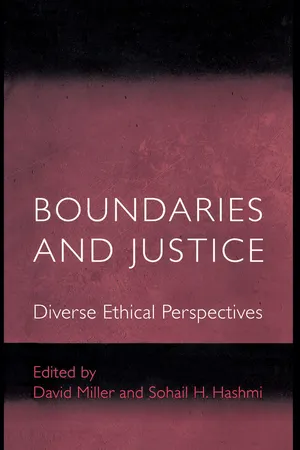
eBook - PDF
Boundaries and Justice
Diverse Ethical Perspectives
- 384 pages
- English
- PDF
- Available on iOS & Android
eBook - PDF
Boundaries and Justice
Diverse Ethical Perspectives
About this book
Information
Publisher
Princeton University PressYear
2021Print ISBN
9780691088006
9780691087993
eBook ISBN
9780691230931
Topic
PhilosophySubtopic
Political PhilosophyTable of contents
- Cover Page
- Title Page
- Copyright Page
- Contents
- Acknowledgments
- Contributors
- Introduction
- Chapter One: Christian Attitudes toward Boundaries: Metaphysical and Geographical
- Chapter Two: The Value of Limited Loyalty: Christianity, the Nation, and Territorial Boundaries
- Chapter Three: Toward a Liberal Theory of National Boundaries
- Chapter Four: Hard Borders, Compensation, and Classical Liberalism
- Chapter Five: Territorial Boundaries and Confucianism
- Chapter Six: Boundaries of the Body and Body Politic in Early Confucian Thought
- Chapter Seven: International Law, Boundaries, and Imagination
- Chapter Eight: Territorial Sovereignty: Command, Title, and the Expanding Claims of the Commons
- Chapter Nine: Islamic Perspectives on Territorial Boundaries and Autonomy
- Chapter Ten: Religion and the Maintenance of Boundaries: An Islamic View
- Chapter Eleven: Land and People: One Jewish Perspective
- Chapter Twelve: Contested Boundaries: Judaic Visions of a Shared World
- Chapter Thirteen: Territorial Boundaries: A Liberal Egalitarian Perspective
- Chapter Fourteen: Group Boundaries, Individual Barriers
- Chapter Fifteen: Boundaries, Ownership, and Autonomy: A Natural Law Perspective
- Chapter Sixteen: In Defense of Reasonable Lines: Natural Law from a Natural Rights Perspective
- Chapter Seventeen: The Ethics of Boundaries: A Question of Partial Commitments
- Index
Trusted by 375,005 students
Access to over 1.5 million titles for a fair monthly price.
Study more efficiently using our study tools.
Frequently asked questions
Yes, you can cancel anytime from the Subscription tab in your account settings on the Perlego website. Your subscription will stay active until the end of your current billing period. Learn how to cancel your subscription
No, books cannot be downloaded as external files, such as PDFs, for use outside of Perlego. However, you can download books within the Perlego app for offline reading on mobile or tablet. Learn how to download books offline
We are an online textbook subscription service, where you can get access to an entire online library for less than the price of a single book per month. With over 1.5 million books across 990+ topics, we’ve got you covered! Learn about our mission
Look out for the read-aloud symbol on your next book to see if you can listen to it. The read-aloud tool reads text aloud for you, highlighting the text as it is being read. You can pause it, speed it up and slow it down. Learn more about Read Aloud
Yes! You can use the Perlego app on both iOS and Android devices to read anytime, anywhere — even offline. Perfect for commutes or when you’re on the go.
Please note we cannot support devices running on iOS 13 and Android 7 or earlier. Learn more about using the app
Please note we cannot support devices running on iOS 13 and Android 7 or earlier. Learn more about using the app
Yes, you can access Boundaries and Justice by Sohail H. Hashmi, David Miller, Sohail H. Hashmi,David Miller, David Lee Miller, Sohail H. Hashmi in PDF and/or ePUB format, as well as other popular books in Philosophy & Political Philosophy. We have over 1.5 million books available in our catalogue for you to explore.