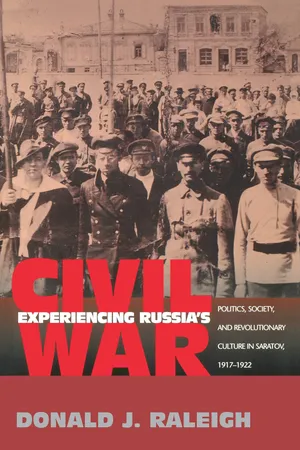
This book is the only comprehensive history of the total experience of the Russian Civil War. Focusing on the key Volga city of Saratov and the surrounding region, Donald Raleigh is the first historian to fully show how the experience of civil war embedded itself into both the people's and the state's outlook and behavior. He demonstrates how and why the programs and ideals that had propelled the Bolsheviks into power were so quickly lost and the repressive Soviet party-state was born.
Experiencing Russia's Civil War is based on exhaustive use of previously classified local and central archives. It is also bold and ambitious in its breadth of thematic coverage, dealing with all aspects of the war experience from institutional evolution and demographics to survival strategies. Complicating our understanding of this formative period, Raleigh provides compelling evidence that many features of the Soviet system that we associate with the Stalin era were already adumbrated and practiced by the early 1920s, as Bolshevism became closed to real alternatives. Raleigh interprets this as the consequence of a complex dynamic shaped by Russia's political tradition and culture, Bolshevik ideology, and dire political, economic, and military crises starting with World War I and strongly reinforced by the indelible, mythologized experience of survival in the Civil War.
Fluidly written, replete with new information, and always engaged with important questions, this is history finely wrought.
eBook - ePub
Experiencing Russia's Civil War
Politics, Society, and Revolutionary Culture in Saratov, 1917-1922
- 464 pages
- English
- ePUB (mobile friendly)
- Available on iOS & Android
eBook - ePub
Experiencing Russia's Civil War
Politics, Society, and Revolutionary Culture in Saratov, 1917-1922
About this book
Information
Publisher
Princeton University PressYear
2021Print ISBN
9780691113203
9780691034331
eBook ISBN
9781400843749
Part One
POLITICS
One
Revolution on the Volga
REVOLUTIONS always have several histories. The Russian Revolution of 1917 has Bolshevik and non-Bolshevik ones, all of which can be told in several ways, depending upon when one takes up a position in the historiography and from which political or personal vantage point. Soviet practitioners of local history made study of the Revolution thematically dependent on a larger national narrative. By providing in this chapter a thumbnail sketch of Saratov’s historical development and a summary and analysis of the local events of 1917, I proceed from the premise that the Center (St. Petersburg, later Moscow) does not determine the periphery, but the periphery determines the Center. I explain the Revolution in terms of local contexts, calling attention to Saratov’s socioeconomic structure and political life, and to the dynamic and symbiotic relationship between local and national politics. The correspondence between the two should not detract from Saratov’s distinctive texture, but should instead call attention to the enormity of Russia’s political and social crises that brought revolution in 1905 and again in 1917. In casting the Revolution as a political event, I suggest that it was also a cultural creation. I determine the impact of the Great War on the revolutionary events of 1917, especially on growing social polarization, economic breakdown, and mounting anarchy. In analyzing the nature of local political power, I throw light on the peculiar features of the October Revolution that made civil war inevitable, and on the fragile foundation on which the Bolsheviks “established” Soviet power in Saratov Province.
From Frontier Outpost to Provincial Center
Founded in 1590 as one of a chain of fortresses to protect Muscovy’s vulnerable Volga frontier, Saratov is located in the eastern tip of the fertile black-earth (chernozem) zone, where forest and steppe converge. As a military settlement guarding Muscovy’s eastern holdings, Saratov repeatedly fell under siege in the seventeenth century to marauders and peasant rebels who laid waste to and torched the stronghold. For more than a century Saratov remained a sparsely settled, vulnerable frontier outpost. When the expansion of Russia’s frontiers beyond the Volga in the eighteenth century reduced Saratov’s military importance, the fortress began to acquire new commercial significance, connected to fishing communities that arose along the Volga and later to the extraction of salt from local mines. As part of the administrative reforms implemented during the reign of Catherine the Great (1762-96), Saratov was designated the administrative center of newly created Saratov Province. By 1917, the province was the thirteenth largest in the Russian empire. Occupying 84,640 square kilometers and comprising ten districts (uezdy) – Atkarsk, Balashov, Kamyshin, Khvalynsk, Kuznetsk, Petrovsk, Saratov, Serdobsk, Tsaritsyn, and Volsk –it was roughly the size of South Carolina or Portugal.1
During the nineteenth century, the town became vitally linked to the rich black earth of the northern part of the province and to the processing and shipping of grain and agricultural products. Emerging as a commercial anchor for the Lower Volga region, Saratov registered dramatic population growth during the boom years of industrialization in the 1890s and once again after 1910. By 1897 the city’s population had reached 137,147 (92 percent of whom were ethnic Russians). Industrial expansion had pushed it to 202,848 by 1904 (a stunning growth of almost 50 percent in seven years) and to 242,425 in 1913, making it the eleventh largest city in the Russian empire (figure 1.1). Saratov was not, however, a major industrial town; in 1914 only about 25,000 of its workers were classified as members of the industrial proletariat, employed in approximately 150 small and medium-sized factories. The rest of the working class –about 55,000 strong – consisted of artisans, dockhands, domestics, and unskilled workers.
Far from being the woefully provincial town of Russian belletristic writing, Saratov boasted the third music conservatory to open in all of Russia, the first provincial art museum to welcome the unscrubbed masses free of charge, a university founded in 1909 and named after Nicholas II (figure 1.2), a progressive local government, and a broad range of newspapers and publishing houses meeting the needs of an increasingly literate reading public. To be sure, another Saratov of workers’ tenements thrown up indiscriminately straggled off along the riverfront, the town’s outer perimeter, and its two ravines, Glebuchev and Beloglinskii, which ran through the city perpendicular to the Volga, dividing it, in effect, into three distinct regions. Few of the amenities of modern urban life could be found in these densely populated, largely working-class districts decried for their poor sanitation and harsh and desperate conditions.

1.1 Saratov in the early twentieth century. Courtesy Gosudarstvennyi Arkhiv Saratovskoi Oblasti (GASO).
Saratov’s ethnic makeup revealed the territory’s frontier origin as well as the long reach of the state. Freebooters, fugitives, religious dissenters, disgruntled peasants, and others fled to the undergoverned Volga from central Russia during Saratov’s fortress days, as a result of which Slavic peasants soon composed the bulk of the population, diversified by pockets of indigenous Mordva, Tatars, Chuvash, and Kalmyks. Administrative assimilation of the area during the eighteenth century resulted in state-sponsored colonization and economic development of the province. In addition to recruiting peasants from Voronezh Province and the Ukraine to work the local salt mines, the government invited Germans and other foreigners and Old Believers to relocate to the area. Settling along the right bank of the Volga in Kamyshin, Saratov, Tsaritsyn, and Atkarsk Districts, and on the left bank in Samara Province, the Volga German element became a distinct feature of Saratov Province, while the city of Saratov functioned as the major commercial center and informal capital of the Volga German community. The Saratov region likewise served as a magnet for peasant migrants from central Russia until the second half of the nineteenth century, when out-migration – reflecting the stagnant nature of local agriculture, overpopulation, and unemployment-reversed earlier trends.2

1.2 Founded in 1909, Saratov University’s first home was in this building, which earlier housed the local feldsher’s school. Photo property of author.
As Saratov Province entered the twentieth century, its population was predominantly rural and Slavic; its ethnic minorities lived in relative isolation, linked to the Slavic majority largely by economic interaction. The 1897 census put the province’s population at 2,405,829, of whom 76.75 percent were Russians (all Slavs combined made up 83.1 percent of the total). The German minority, living primarily in Kamyshin and Saratov Districts, made up 6.92 percent of the population. The Mordva minority, accounting for 5.15 percent of the population, inhabited Petrovsk, Kuznetsk, and Khvalynsk Districts. Comprising 3.94 percent of the population, the Tatars were also concentrated in these same three uezds. In the province’s ten districts the percentage of Russians varied from Serdobsk, where they accounted for 99.7 percent of the total population, to Kamyshin, where they made up only 44.46 percent of the inhabitants. The 1897 census data demonstrate that few non-Slavs had been assimilated into the Russian population with the exception of those residing in the cities of Saratov and Tsaritsyn. For example, in Kamyshin the Volga Germans, who constituted 40 percent of the uezd’s population, lived in distinct ethnic communities. So did the Mordva, Tatars, Chuvash, and Kalmyks, most of whom were also separated from the Slavic elements by language and religion (map 1).
World War I altered Saratov’s social makeup, creating conditions that left an imprint on the political events of 1917. Roughly 25 percent of the indigenous workforce was conscripted. Polish and Latvian workers evacuated from the front as well as other refugees, including students from Kiev University, soon flooded the city. By early 1916 an estimated 41,000 refugees made up the second largest social group in Saratov, amounting to 17.9 percent of the city’s total population. Moreover, after Kazan, Saratov housed the largest garrison in the Kazan Military District. In 1917, the local garrison fluctuated in size between 30,000 and 70,000 soldiers. All of the district centers except Khvalynsk, inaccessible by rail, also housed garrisons, which in some instances were more populous than the towns themselves.3
The Revolutionary Tradition
Although Saratov’s revolutionary past ca...
Table of contents
- Cover Page
- Title Page
- Copyright Page
- Dedication
- Contents
- List of Illustrations
- List of Tables
- Acknowledgments
- Glossary and Abbreviations Used in Archival Citations
- Introduction: Experiencing Russia’s Civil War
- Part One: Politics
- Part Two: Society and Revolutionary Culture
- Conclusion
- Bibliographical Essay
- Index
Trusted by 375,005 students
Access to over 1.5 million titles for a fair monthly price.
Study more efficiently using our study tools.
Frequently asked questions
Yes, you can cancel anytime from the Subscription tab in your account settings on the Perlego website. Your subscription will stay active until the end of your current billing period. Learn how to cancel your subscription
No, books cannot be downloaded as external files, such as PDFs, for use outside of Perlego. However, you can download books within the Perlego app for offline reading on mobile or tablet. Learn how to download books offline
Perlego offers two plans: Essential and Complete
- Essential is ideal for learners and professionals who enjoy exploring a wide range of subjects. Access the Essential Library with 800,000+ trusted titles and best-sellers across business, personal growth, and the humanities. Includes unlimited reading time and Standard Read Aloud voice.
- Complete: Perfect for advanced learners and researchers needing full, unrestricted access. Unlock 1.5M+ books across hundreds of subjects, including academic and specialized titles. The Complete Plan also includes advanced features like Premium Read Aloud and Research Assistant.
We are an online textbook subscription service, where you can get access to an entire online library for less than the price of a single book per month. With over 1.5 million books across 990+ topics, we’ve got you covered! Learn about our mission
Look out for the read-aloud symbol on your next book to see if you can listen to it. The read-aloud tool reads text aloud for you, highlighting the text as it is being read. You can pause it, speed it up and slow it down. Learn more about Read Aloud
Yes! You can use the Perlego app on both iOS and Android devices to read anytime, anywhere — even offline. Perfect for commutes or when you’re on the go.
Please note we cannot support devices running on iOS 13 and Android 7 or earlier. Learn more about using the app
Please note we cannot support devices running on iOS 13 and Android 7 or earlier. Learn more about using the app
Yes, you can access Experiencing Russia's Civil War by Donald J. Raleigh in PDF and/or ePUB format, as well as other popular books in History & Russian History. We have over 1.5 million books available in our catalogue for you to explore.