In the recent past, enormous creative energy has gone into the study of American slavery, with major explorations of the extent to which African culture affected the culture of black Americans and with an almost totally new assessment of slave culture as Afro-American. Accompanying this new awareness of the African values brought into America, however, is an automatic assumption that white traditions influenced black ones. In this view, although the institution of slaver is seen as important, blacks are not generally treated as actors nor is their "divergent culture" seen as having had a wide-ranging effect on whites. Historians working in this area generally assume two social systems in America, one black and one white, and cultural divergence between slaves and masters.
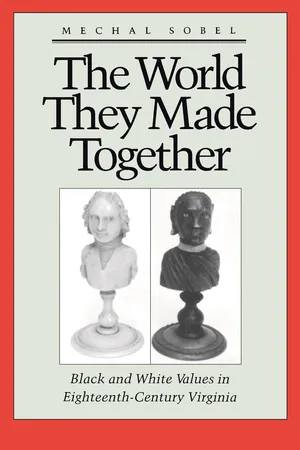
It is the thesis of this book that blacks, Africans, and Afro-Americans, deeply influenced white's perceptions, values, and identity, and that although two world views existed, there was a deep symbiotic relatedness that must be explored if we are to understand either or both of them. This exploration raises many questions and suggests many possibilities and probabilities, but it also establishes how thoroughly whites and blacks intermixed within the system of slavery and how extensive was the resulting cultural interaction.
eBook - ePub
The World They Made Together
Black and White Values in Eighteenth-Century Virginia
- 388 pages
- English
- ePUB (mobile friendly)
- Available on iOS & Android
eBook - ePub
About this book
Information
Publisher
Princeton University PressYear
2021Print ISBN
9780691006086
9780691047478
eBook ISBN
9781400820498
I
Attitudes Toward Time and Work
1. World Views in England and West Africa
THOMAS LUCKMAN includes in his definition of a world view as "an encompassing system of meaning" the existence of an inner core, which he terms the sacred cosmos, an integrated mesh of central attitudes and values. Through the internalization of such a cosmos the potentially chaotic and frightening infinity of events "falls in place" and the life of the individual assumes purpose and direction.
The relationships between the world view, the individuals, and the social structure in a given culture are dialectical. In part, the world view "routinizes and stabilizes the individual's memory, thinking, conduct and perception."2 However, the world view does more than provide "unthinking routine"; its structuring of significance provides a taxonomy, models, and goals in relation to which the individual must evaluate reality and choose action. The individual as participant becomes a coproducer, changing the world view by his or her action. Similarly, social institutions are products of the world view, but they also transform it. By stabilizing or emphasizing particular aspects of culture, institutions change the relative importance of these very aspects, leading to new responses.3
In times of unusual social change, normative processes are altered and individuals, institutions, and world views undergo change, but the nature of these developments is related to the character of the original values. Whether due to the Reformation, the new scientific discoveries, an ethic stimulated by expanding capitalism, or a combination of all these factors, world views appeared to be undergoing rapid transition in seventeenth-century England, a time when, as Christopher Hill has written, "the world turned upside down." Hill posits that by mid-century, "there was a great overturning, questioning, revaluing, of everything in England. Old institutions, old beliefs, old values came in question."4
New church affiliations became the outward sign of supposedly new values. Although some individuals remained Catholics, most became High Church or Low Church Anglicans, Puritans, Presbyterians, Baptists, Quakers, or other sectarians; many did not go to any church. The very poor and the young of all classes may have been outside the churches, as well as many others from all classes and age groups—in all perhaps some twenty percent of the population.5
Notwithstanding the wide range of creed and association, as well as nonassociation, there was, even among the affiliated, a great deal of inconsistency and incoherence. Small groups, with many new values, initiated institutional changes to which many other people were forced to adjust. For most people values changed far more slowly, and there is strong evidence that they retained a "medieval" outlook long after the English Reformation. This older world view emphasized the cyclical aspects of time and held in awe the power and charisma attached to particular places. An arational explanation of causality was still widely accepted, and it was believed that the purpose of humanity was to perpetuate the given social order.
Belief in the power of witches and wizards as well as of holy places, such as wells and even trees, had been integrally tied to the Catholic Church, whose ritual and calendar were associated with magical or holy people, places, and events. Although the Anglican Church formally abjured these practices, many Anglicans continued them. As Keith Thomas has shown, the Anglican Church itself often turned to "cunning" men and women to find thieves; Anglican ministers often ministered to the ill with all the old panoply of folk remedies, including charms and magic herbs; and the Anglican laity—as observed by Bernard Gilpin, a contemporary—practiced "idolatry, sorcery, charming, witchcrafts, [and] conjuring."6
Whereas reforming clergy changed ecclesiastical practices radically, the laity maintained traditional behavior wherever they remained in control. The formal rites at funerals, for example, were totally revised, and Puritan as well as High Church Anglican clergy eliminated most traditional aspects of memorials. With belief in purgatory denied, the fate of the dead was said to be sealed at death, and later prayers were not believed to change it. The funeral "served simply to dispose of the corpse."7 For this purpose a short, simple burial service would "do" nicely and the elaborate medieval practices were dropped.
Catholic rites had been performed at the house, in a procession to church, in the church, in a procession to the place of burial, at the grave, and on the return from the cemetery. "In all, during these rites, twenty-six psalms and twenty-nine collects were said, and the Lord's Prayer was repeated seven times, apart from the service in church, which included another twenty-one psalms."8 The Anglican Church reduced this ceremony to a relatively brief service in church, a procession, and a short committal ritual.
The laity did not follow this lead. The maintenance of traditional "rituals of eating and drinking and the distribution of gifts at the burial," all in the hands of congregants, "illustrate the survival of medieval attitudes and customs."9 This important rite of passage was continued in as traditional a fashion as was possible, as were all other lay-controlled patterns of behavior, indicating the laity's maintenance of older values. Special times, special places, magical individuals, omens, and cures were all believed in.10
Although most English people still shared aspects of the traditional world view, at one and the same time a new, modern value system was emerging, and by the seventeenth century its parameters were clear: It was almost diametrically opposed to the medieval Catholic world view. Orientation to time can be seen as the key to the differences between them.
In the modern Western world view, time was eventually perceived as linear and irreversible. (However, it was still believed that there would be a last event, the second coming of Christ, that would take the world "out of time.") In this view, no value was attached to time: No time was better than any other and all time could be used for all activities.11
Place, concomitantly, was becoming divorced from time. The earth was seen as measurable and controllable: The landscape could be made and remade, new continents explored, and a "New World" settled.
The working conception of causality in this world view was very different from the medieval one: People were regarded as quasi-free agents. A chosen action was seen as having concomitant results. God, fate, and social position were not without significance, but emphasis fell on the individual person as the crucial causative agent functioning in a "clockwork" universe with independent laws. He or she had to study the world and learn how it functioned and what the causal connections were.12
The new understanding of the purpose of life was equally different: Change rather than repetition became the goal. Individuals were expected to become their better selves and develop not toward a traditional role but to a newer, purer (and more self-controlled) form. Change or evolution in individuals and in society became the overall dynamic goal of this world view, although here too the Christian belief in the messianic End of Days remained an outside limit.
The Puritan elite were perhaps the most coherent proponents of the new world view in the seventeenth century. They had come to see themselves as establishing God's new Zion in the new world and felt they were the leading part of an ongoing and unfolding tableau of purposeful change. Their recent past was of great significance, but the messianic end they were preparing for was of ultimate concern.13 This helped them to see themselves as makers of history, who could take control of themselves and the world around them, and who should use the natural world and therefore study it and control it as well. Their use of time became central: They were hurrying to a new end.
Anglicans, with their calendar still tied to saints' days and the "cyclical remembrance and renewal of the most important events in the life" and death of Jesus, were in a transitional position.14 Special times were still set apart, but there was a new concern with the rational use of time. Rationality, in general, was emphasized, and a new attitude toward causality and the purpose of life arose. However, Anglicans were generally less likely to see themselves as God-given instruments and to suggest that their history had cosmic significance. There was therefore less emphasis on self-control and control of the world around them. Nevertheless, the present rather than the past of the traditionalists was their chief concern, and the new attitude toward time, place, and causality affected many of them seriously.
Ironically, the West Africans who were brought to America, who are generally regarded as having been a heterogeneous group, may have brought with them a more closely shared set of perceptions. West Africans certainly didn't share one culture. Gods, family structures, economic pursuits, languages, folkways, and mores all differed widely. But they apparently did share a more basic world view that made possible the melding of one Afro-American culture under the impact of North American slavery. They shared understandings of spirit power, its nature and its possible control; of human beings and their purpose; and of time and its relation to space. The analysis of West African understandings of time, space, causality, and purpose brings us to an ideal world view that was articulated differently in many cultures but on a deeper level was widely shared by West Africans.15
In the traditional African value system the present was of chief importance, but its significance was weighed in terms of its continuation of traditions. The people of the present were evaluated in relation to their forefathers and the mythical-historical example they provided.16
Time past, when marked by notable events, was important time, remembered time. Time in which nothing worthy of note occurred was not worthy of being remembered. It did not exist in terms of space occupied on a calendar or in a record.
The future did not have the reality of the past and present. It would appear that the future was not envisioned in a Western sense. Traditional Africans did not look forward to radical change or to a messianic age, but rather they "remembered" the homes of forefathers, reestablished after death by their spirits and awaiting the souls of the living. Death was seen as a time of returning home, a spiritual journey into the past and not into the future. Present and future social life was expected to be a repetition of past forms.17
In this traditional African sacred cosmos, time was viewed as having a scale of value. There were good times and bad times, times that were favorable for a particular activity and times that were inauspicious for that special action. These particular events that were tied to time were also tied further to place. Events should and have occurred at particular places on the earth, places that were auspicious for and tied to the event.18
The events that once happened in particular places hallowed them. Gods and humans became tied to a place. Soil and bones, burial grounds and village locations, and even village plans were seen as holy. Streams and rocks harbor spirits, and certain places were particularly close to the gods. Soil and herbs growing in these places made charms efficacious. Place was thus sanctified and inextricably bound to time. The gods once lived in this (or another) particular place. It was theirs as the clan living there remained theirs. The gods could best be prayed to at particular places, and particular places were marked by them as "out of bounds" or dangerous for people.19
The attitude toward causality was also tied to the orientation to time. Traditional African peoples accepted the spirit power of the forefathers who lived in time past. Africans believed spirits and forefathers affected their destiny, although a spirit worker might use power to counteract power. People thus could and should act, but they were not viewed as free agents who could cause virtually any result. They were seen as subject to fate, but they could make contact with power or with an agent who had access to such power and who might affect fate. And since each individual was a member of a particular clan, his or her forefathers wo...
Table of contents
- Cover Page
- Title Page
- Copyright Page
- Dedication
- Contents
- List of Illustrations
- Acknowledgments
- Introduction
- Part One. Attitudes Toward Time and Work
- Part Two. Attitudes Toward Space and the Natural World
- Part Three. Understandings of Causality and Purpose
- Part Four. Coda
- Notes
- Bibliography
- Index
Trusted by 375,005 students
Access to over 1.5 million titles for a fair monthly price.
Study more efficiently using our study tools.
Frequently asked questions
Yes, you can cancel anytime from the Subscription tab in your account settings on the Perlego website. Your subscription will stay active until the end of your current billing period. Learn how to cancel your subscription
No, books cannot be downloaded as external files, such as PDFs, for use outside of Perlego. However, you can download books within the Perlego app for offline reading on mobile or tablet. Learn how to download books offline
Perlego offers two plans: Essential and Complete
- Essential is ideal for learners and professionals who enjoy exploring a wide range of subjects. Access the Essential Library with 800,000+ trusted titles and best-sellers across business, personal growth, and the humanities. Includes unlimited reading time and Standard Read Aloud voice.
- Complete: Perfect for advanced learners and researchers needing full, unrestricted access. Unlock 1.5M+ books across hundreds of subjects, including academic and specialized titles. The Complete Plan also includes advanced features like Premium Read Aloud and Research Assistant.
We are an online textbook subscription service, where you can get access to an entire online library for less than the price of a single book per month. With over 1.5 million books across 990+ topics, we’ve got you covered! Learn about our mission
Look out for the read-aloud symbol on your next book to see if you can listen to it. The read-aloud tool reads text aloud for you, highlighting the text as it is being read. You can pause it, speed it up and slow it down. Learn more about Read Aloud
Yes! You can use the Perlego app on both iOS and Android devices to read anytime, anywhere — even offline. Perfect for commutes or when you’re on the go.
Please note we cannot support devices running on iOS 13 and Android 7 or earlier. Learn more about using the app
Please note we cannot support devices running on iOS 13 and Android 7 or earlier. Learn more about using the app
Yes, you can access The World They Made Together by Mechal Sobel in PDF and/or ePUB format, as well as other popular books in History & Early American History. We have over 1.5 million books available in our catalogue for you to explore.