From the acclaimed author of Unfinished Business, a story of crisis and change that can help us find renewed honesty and purpose in our personal and political lives
Like much of the world, America is deeply divided over identity, equality, and history. Renewal is Anne-Marie Slaughter's candid and deeply personal account of how her own odyssey opened the door to an important new understanding of how we as individuals, organizations, and nations can move backward and forward at the same time, facing the past and embracing a new future.
Weaving together personal stories and reflections with insights from the latest research in the social sciences, Slaughter recounts a difficult time of self?examination and growth in the wake of a crisis that changed the way she lives, leads, and learns. She connects her experience to our national crisis of identity and values as the country looks into a four-hundred-year-old mirror and tries to confront and accept its full reflection. The promise of the Declaration of Independence has been hollow for so many for so long. That reckoning is the necessary first step toward renewal. The lessons here are not just for America. Slaughter shows how renewal is possible for anyone who is willing to see themselves with new eyes and embrace radical honesty, risk, resilience, interdependence, grace, and vision.
Part personal journey, part manifesto, Renewal offers hope tempered by honesty and is essential reading for citizens, leaders, and the change makers of tomorrow.
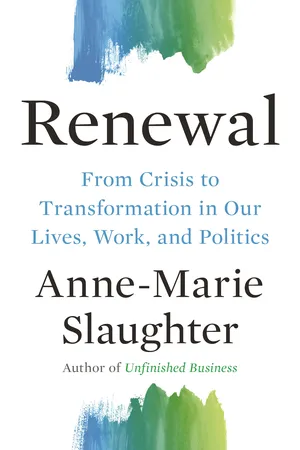
eBook - ePub
Renewal
From Crisis to Transformation in Our Lives, Work, and Politics
- 192 pages
- English
- ePUB (mobile friendly)
- Available on iOS & Android
eBook - ePub
About this book
Information
Publisher
Princeton University PressYear
2021Print ISBN
9780691210575
9780691210568
eBook ISBN
9780691213460
CHAPTER 1
Run toward the Criticism
As the crisis at New America unfolded, I spent days on the phone with staff members and board members. One of the first people I called was my friend and mentor David Bradley, the chairman of Atlantic Media, who had run New America’s search for a new leader back in 2012 and was more responsible than anyone for persuading me to take the job.
David is a superb mentor to a remarkable array of people. He seeks out young people in whom he sees some quality and brings them into his orbit, offering hard-earned wisdom and insights from a lifetime of entrepreneurship and service of many different kinds. He did not mince words when I called him—in his capacity as friend and guide as much as New America board member. We both knew I was in trouble.
He said: “run toward the criticism.” Even if you are 98 percent right and only 2 percent wrong, he elaborated, acknowledge the fault rather than insist on the virtue. Then use it as the point of departure for a “learning journey.” A journey in which I would deliberately ask for honest critique, even if deep down I wanted to run as fast as possible in the other direction.
I therefore called the twenty-odd other board members and asked each one to tell me directly what they truly thought of my leadership. Having sat on many boards myself, and as a lawyer, I well understand the difference between friendship and fiduciary duty. It is possible to like a CEO and even believe that she has done the best she could under the circumstances, and still believe that she must be censured or fired for the good of the organization. I was closer to some board members than others, so my heart was often pounding as I dialed, but the process itself drew us together. I can still remember a number of those conversations and the insights I gained, even if some made me wince.
My colleagues, junior and senior, were also willing to be honest. Not everyone had the courage to say to my face what I had reason to suspect they were saying behind my back. Still, I heard some hard truths. The board hired a consultant to interview staff members about both the incident that led to the crisis and the possibility of deeper trouble in the organization. The resulting report was studded with quotes from staff members—all anonymous, of course—some of which described a very different New America from the one I thought I led.
Some of what I heard I already knew. I was not in the office enough—because I was on the road fundraising and flying the New America flag publicly, but also because I still live in Princeton and was commuting to DC only a few days a week. I moved too fast and didn’t consult enough. I didn’t spend enough time getting to know staff members and their work; I communicated too much through email and not enough in person.
I also heard things that I did not expect, and that took me longer to accept. I was in regular contact with Hana Passen, a young woman whom I had hired right out of college and then promoted to a bigger position at New America after three years. I am her mentor, but in many ways she has mentored me as well—particularly on issues of race and social justice. Even as she had faith in me—in my intentions, my track record, and my leadership—Hana let me know that others at New America were far less willing to give me the benefit of the doubt with regard to corporate influence, favoritism, double standards, and insensitivity.
As Hana put it, even if my staff—particularly younger staff—did not exactly think I was lying, they also didn’t necessarily trust me. Earlier missteps and sore spots were quickly raised again, reinforcing negative perceptions of my leadership and New America’s culture more generally.
Looking back, I can see that many of the issues raised tap into the intergenerational differences that so many boomer bosses complain about with largely millennial workforces. We are unprepared, unsure, and often uncomfortable trying to manage a younger generation that is more radical, demanding, and impatient for change. While I naively assumed that my good intentions were both apparent and sufficient, many New America staff wanted far more action on issues of race, gender, and class. Perhaps also reflecting the dramatic trust gaps in the country as a whole, many staff members quickly defaulted to distrust in their perceptions of me, just as, if I’m honest, I did in my perceptions of them.
In short, if I chose to run toward the criticism, I didn’t have to look very far. I know now that those were the first steps toward renewal.
Renewal starts with honesty—radical honesty. It was time to let down defenses, to start acknowledging things that I knew to be true and exploring things that might be. This process was partly a version of the therapist’s mantra: “you have to name it to change it.” Yet not everything can be “fixed.” Behaviors can change, with a lot of work; personality traits, not so much.1 Still, it is surely better to face yourself honestly, even if all you can do is sit with the truth.
More concretely, “running toward the criticism” required that I widen my perspective, look beyond the present situation to earlier parts of my career. I needed to identify and face up to a larger pattern of cause and consequence, as honestly as I could. Even the most successful people have had setbacks and failures; the question should always be “what can I learn?”
As dean of Princeton’s School of Public and International Affairs from 2002 to 2009, I could point to many achievements of which I will always be proud. I recruited an entire group of top-notch international relations scholars and increased the size of the faculty as a whole by nearly one-third. These new faculty members largely came from other Princeton departments: I added experts in history, sociology, engineering, and the natural sciences to broaden the school’s focus away from pure economics and political science. I worked with faculty members to launch a number of centers and programs, most notably the Scholars in the Nation’s Service Initiative, a kind of Rhodes Scholarship for students who wanted to work in the federal government. The school’s public profile increased even as we defended successfully against a nasty and hugely time-consuming lawsuit. I upgraded school facilities and raised the morale of the administrative staff by valuing their contributions in an environment in which faculty and students typically get all the attention.
My successor as dean, Christina Paxson, was a talented and far-sighted economist who had founded the school’s Center for Health and Wellbeing. Only a few years into her tenure, she was tapped to become the president of Brown University, where she has been very successful. As she left unexpectedly, Princeton University’s then-president Shirley Tilghman needed to appoint an interim dean for a year to allow the school to run a proper search for Chris’s successor. Princeton’s typical practice in these circumstances, when a former dean has returned to the faculty, is to appoint him or her as interim dean.
I waited for the call. It didn’t come. When I went to President Tilghman to offer my services, she demurred. She had hired me in 2002, in the face of a fair amount of faculty opposition, and had been a friend, mentor, and champion during my deanship, but something had changed. When I pressed for an explanation, she essentially told me that a block of the faculty would object to my appointment as interim dean—effectively a vote of no confidence.
Looking back, given the perpetual power games of faculty politics and the opposition to my appointment in the first place, I probably should not have been surprised. I was hardly dying to be interim dean for a year, but the episode made me think about what I really did want for the next stage of my career. After three decades of focusing on foreign affairs, I was beginning to see that if the United States could not fix its mounting problems at home, it had no business trying to lead the world. I had fallen in love with civic technology and its promise of dramatically improved government services. Many new opportunities were also opening up in my life as a result of my unexpected prominence as a participant in rekindled debates about gender equality. I put academia behind me and took on the challenges of leading and building New America.
In the fall of 2017, however, when I once again realized that in the face of a major challenge to my leadership, I could not exactly point to a groundswell of support from those I led, I had to put the two episodes together and ask myself hard questions. Or, rather, ask others. I went back to Shirley, now retired, and invited her to be as honest as she could be about my flaws as a leader.
She told me, in essence, that I had put myself forward too much, which also meant not putting others forward enough. I had a tremendously talented group of faculty members, including Nobel laureates and scholars doing important work on a wide range of subjects: climate change, poverty, immigration, family policy, trade, corruption, and many others. I missed opportunities to let them shine, and, equally important, to feel that they were part of deciding the direction of the school.
As I listened to her, I could hear echoes of the critiques I had gotten while talking to board and staff members at New America. I could also feel lots of counterarguments forming in my mind. Shirley had hired me to transform the school in a number of ways; it is almost impossible to do that without making enemies—or so I thought. I had hired and empowered many different faculty members to do the work they wanted to do; I had created opportunities for them to publicize their work that they didn’t take. Et cetera, et cetera.
Above all, I kept wondering whether I would have been subject to the same criticisms had I been a man. The double standards for women leaders—in every sector—are legion. When we are decisive, we have “sharp elbows.” When we are prominent, we are “hogging the limelight.” When we earn big salaries (almost always still far less than men in comparable positions), we are greedy. Any woman leader can add to this list.
We also get mixed messages. While we are often very ready to step forward and take responsibility for our actions, vowing to do better, we hear the voices of men in our lives telling us to project certainty and confidence, to lead the way so many men traditionally have. Indeed, according to one leadership study, men and women prefer stereotypically masculine traits in leaders (confidence, ambition, competitiveness, assertiveness, decisiveness, and self-reliance) to stereotypically feminine traits (cooperation, good nature, trustworthiness, tolerance, sincerity, patience). And yet as every woman leader knows all too well, female confidence is still far too often read as unattractive egotism.2
Even as these thoughts were running through my mind, however, I was also reminding myself that Shirley was one of the best leaders I had ever seen. When she stepped down as president of Princeton, she was universally beloved. Indeed, in all the time I worked for her, I didn’t know anyone who really disliked her, even when they disagreed with her decisions. Yet, she had managed to transform the university in many different ways over her twelve-year tenure. I also thought of another mentor of mine, Nannerl Keohane, president of Wellesley College and then the first woman president of Duke, who led in much the same way. They both took the time and effort to build relationships even with those who opposed them, tempering professional tensions with personal connections.
As I have reflected on this conversation over the past couple of years, I also think back on an incident when Shirley and I traveled to meet a group of Princeton alumni on Capitol Hill. Shirley introduced me as the new dean of the Woodrow Wilson School (now the Princeton School of Public and International Affairs); I talked for a while and got an overwhelmingly positive reception. Afterward I said to Shirley, “I didn’t mean to steal your thunder.” She said, without missing a beat, “Anne-Marie, you are my thunder,” and often told the story to alumni groups after that. As it turned out, I proved less adept at letting other people be my thunder, something I could choose to change.
In the end, the balance of praise and criticism doesn’t matter. David Bradley’s wisdom is not just to run toward the things you don’t want to hear; it is to run toward them even if they are only 2 percent right and 98 percent wrong. Accept that 2, or 10, or 50 percent and embrace it as a catalyst for change.
The danger of radical honesty, at least for me, was the risk of losing my confidence. I depend on a measure of confidence to do the things I do every day, from running meetings to giving speeches. One example will tell the tale.
I make my living in part as a public speaker; I speak to large audiences for up to an hour, usually without notes. Yet I was absolutely terrified of public speaking until my mid to late thirties. In law school, I chose corporate law over litigation because I couldn’t imagine having to stand up in court. The night before I taught my first class at the University of Chicago Law School, I went to the empty classroom and practiced my opening lines for an hour, out of fear that I would get up in front of the class the next day and simply be unable to speak. When I had to sit on a panel at conferences or give a speech, I typically read from a text and my voice often shook.
I tell this story often, particularly when I am talking to groups of young women. I tell them that they simply have to put themselves out there; force themselves up on stage and speak enough that they begin to realize they can do it. As I began to get more invitations to speak, I gradually realized that speaking from a text or even detailed notes was a problem, because I would look up and ad lib for a while and then lose my place when I looked back down. I realized that in private conversation, as my brother would say, “I have no problem with word retrieval.” So, if I know w...
Table of contents
- Cover Page
- Series Page
- Title Page
- Copyright Page
- Dedication
- Epigraph
- Contents
- Preface: Let America Be the Dream the Dreamers Dreamed
- Introduction: When Leadership Means Having to Say You’re Sorry
- Chapter 1: Run toward the Criticism
- Chapter 2: Connect to Change
- Chapter 3: Rethink Risk
- Chapter 4: Lead from the Center and the Edge
- Chapter 5: Share Power
- Chapter 6: Looking Backward and Forward
- Chapter 7: Rugged Interdependence
- Chapter 8: Building Big
- Chapter 9: Giving and Finding Grace
- Chapter 10: Plures et Unum
- Coda: The America That Has Never Been Yet, Yet Must Be
- Acknowledgments
- Notes
- Index
- Series List
Trusted by 375,005 students
Access to over 1.5 million titles for a fair monthly price.
Study more efficiently using our study tools.
Frequently asked questions
Yes, you can cancel anytime from the Subscription tab in your account settings on the Perlego website. Your subscription will stay active until the end of your current billing period. Learn how to cancel your subscription
No, books cannot be downloaded as external files, such as PDFs, for use outside of Perlego. However, you can download books within the Perlego app for offline reading on mobile or tablet. Learn how to download books offline
Perlego offers two plans: Essential and Complete
- Essential is ideal for learners and professionals who enjoy exploring a wide range of subjects. Access the Essential Library with 800,000+ trusted titles and best-sellers across business, personal growth, and the humanities. Includes unlimited reading time and Standard Read Aloud voice.
- Complete: Perfect for advanced learners and researchers needing full, unrestricted access. Unlock 1.5M+ books across hundreds of subjects, including academic and specialized titles. The Complete Plan also includes advanced features like Premium Read Aloud and Research Assistant.
We are an online textbook subscription service, where you can get access to an entire online library for less than the price of a single book per month. With over 1.5 million books across 990+ topics, we’ve got you covered! Learn about our mission
Look out for the read-aloud symbol on your next book to see if you can listen to it. The read-aloud tool reads text aloud for you, highlighting the text as it is being read. You can pause it, speed it up and slow it down. Learn more about Read Aloud
Yes! You can use the Perlego app on both iOS and Android devices to read anytime, anywhere — even offline. Perfect for commutes or when you’re on the go.
Please note we cannot support devices running on iOS 13 and Android 7 or earlier. Learn more about using the app
Please note we cannot support devices running on iOS 13 and Android 7 or earlier. Learn more about using the app
Yes, you can access Renewal by Anne-Marie Slaughter in PDF and/or ePUB format, as well as other popular books in Business & Leadership. We have over 1.5 million books available in our catalogue for you to explore.