A comprehensive history of censorship in modern Britain
For Victorian lawmakers and judges, the question of whether a book should be allowed to circulate freely depended on whether it was sold to readers whose mental and moral capacities were in doubt, by which they meant the increasingly literate and enfranchised working classes. The law stayed this way even as society evolved. In 1960, in the obscenity trial over D. H. Lawrence's Lady Chatterley's Lover, the prosecutor asked the jury, "Is it a book that you would even wish your wife or your servants to read?" Christopher Hilliard traces the history of British censorship from the Victorians to Margaret Thatcher, exposing the tensions between obscenity law and a changing British society.
Hilliard goes behind the scenes of major obscenity trials and uncovers the routines of everyday censorship, shedding new light on the British reception of literary modernism and popular entertainments such as the cinema and American-style pulp fiction and comic books. He reveals the thinking of lawyers and the police, authors and publishers, and politicians and ordinary citizens as they wrestled with questions of freedom and morality. He describes how supporters and opponents of censorship alike tried to remake the law as they reckoned with changes in sexuality and culture that began in the 1960s.
Based on extensive archival research, this incisive and multifaceted book reveals how the issue of censorship challenged British society to confront issues ranging from mass literacy and democratization to feminism, gay rights, and multiculturalism.
eBook - ePub
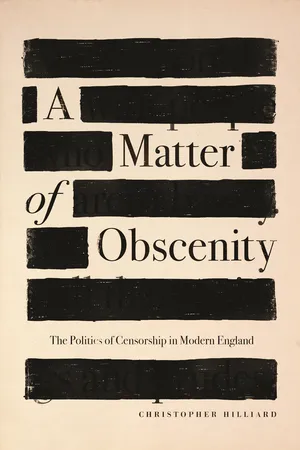
A Matter of Obscenity
The Politics of Censorship in Modern England
- 320 pages
- English
- ePUB (mobile friendly)
- Available on iOS & Android
eBook - ePub
A Matter of Obscenity
The Politics of Censorship in Modern England
About this book
Information
Publisher
Princeton University PressYear
2021Print ISBN
9780691226101
9780691197982
eBook ISBN
9780691226118
CHAPTER ONE
Obscenity, Literacy, and the Franchise
1857–1918
FOR THE VICTORIANS, censorship talk blurred into citizenship talk. Obscenity law took shape as Britain debated the extension of the franchise and as mass literacy changed expectations about politics and culture. That said, the proliferation of cheap periodicals that spurred Parliament to enact a new law against obscene publications was not so much a function of an upsurge in popular literacy—which had been increasing steadily over the course of the nineteenth century—so much as changes in urban life and commerce.1 By the time of the 1851 census, half the British population lived in towns and cities. The concentration of people in towns and cities made it hard to ignore displays of immorality, and it made plebeian cultural life more visible to middle-class observers.2 Urbanization created a hitherto unknown public of working-class readers, and it made their reading more conspicuous.
“The unknown public” was Wilkie Collins’s phrase. Writing in 1858 in Charles Dickens’s weekly Household Words, Collins described his rambles through “the second and third rate neighbourhoods” of London and the penny fiction papers he started to notice everywhere, “in fruit-shops, in oyster-shops, in lolly-pop shops.” These crudely written publications catered to a massive, unfathomable readership. Collins was conjuring with the idea of Britain as divided into two nations, the rich and the poor—or, in this case, “the customers at the eminent publishing-houses, the members of book-clubs and circulating libraries, and the purchasers and borrowers of newspapers and reviews” and the people who read romance and adventure stories in penny journals bought from confectioners.3 Collins wrote as a curious and worldly author, anticipating a time when the unknown public would become a known market for novelists like himself. In the decades to come, other commentators would repeat his gambit, buying a selection of penny papers and using their contents to generalize about popular sensibilities. These critics asked different questions from Collins. Did the appetite for sports news prevent working-class readers becoming informed citizens? Did high-society romances seduce them into an unconscious conservatism? Did the achievement of mass literacy open the way to moral corruption?4
Lord Campbell’s Act
For the better part of a century the twin pillars of English obscenity law were the Obscene Publications Act of 1857 and the judgment in the case of R v. Hicklin a decade later. The 1857 act was largely the work of Lord Campbell and delivered a solution that antivice campaigners had been calling for.
Prosecutions for obscene libel were uncommon for a long time after the 1727 Curll decision. Most of the few trials were the result of private prosecutions, as gentlemen took it upon themselves to enforce the king’s peace. As the evangelical movement grew in strength towards the end of the eighteenth century, however, prosecutions for obscene libel increased.5 Some of these proceedings were instituted by the Proclamation Society, which was founded by the most famous evangelical of all, William Wilberforce.6 By the beginning of the nineteenth century, the Proclamation Society’s mission passed to the larger Society for the Suppression of Vice. Reflecting its origins during the Revolutionary and Napoleonic Wars, the Vice Society (as it became known) was a patriotic conservative movement, exercised by vice as a force of social disorder, and not simply an evangelical body.7 In its first decade, the society concerned itself with a full suite of vices, including gambling, animal cruelty, and the use of false weights and measures, but after a crisis in its internal organization—and after the end of the Napoleonic Wars—the society regrouped and narrowed its focus to blasphemy and obscenity.8 The Vice Society pressed charges against an average of three traders in obscene publications each year and nearly always managed to secure convictions. Even if the society had had the money to prosecute every pornographer it identified, it still could not have taken all their stock off the market. When a dealer in erotica was convicted of obscene libel, the publications described in the indictment were forfeited, but the rest of the trader’s stock was safe.9 Some operators were willing to treat imprisonment a cost of doing business. The secretary of the society, Henry Prichard, explained in 1837: “When a person is convicted, he hands over, perhaps, an immense stock of books and prints, and snuff-boxes, and things of that description; he hands them over to others engaged in the trade, or else some person continues his trade at his shop for him. In some cases it has been known that the wife and a shopman have continued the trade the whole time that the dealer has been in prison under the sentence of the Court of King’s Bench.”10 What was needed, Prichard suggested, was the power to seize indecent publications independent of a conviction for obscene libel or an offense against the Vagrancy Act, which regulated “public displays,” including shop windows.11 Prichard got his way in 1857, when Lord Campbell abruptly took up the cause.
Campbell was a Whig politician and the Lord Chief Justice. He juggled court hearings with parliamentary debates. He had a good record as a law reformer. Both the Libel Act of 1843, which made truth a defense in criminal libel cases, and the Fatal Accidents Act of 1846, which authorized wrongful-death suits by relatives, were known as “Lord Campbell’s Act.”12 By the end of 1857, there would be a third piece of legislation so nicknamed: the Obscene Publications Act. On a Saturday in May that year, Campbell presided over the trials of two men prosecuted by the Vice Society for publishing or “uttering” obscene libels.13 William Dugdale and William Strange were serial defendants. Both were also veterans of the “radical underworld” in the aftermath of the Napoleonic Wars. A spy’s report in 1818 described Dugdale as “a very active incendiary of Profligate and Deistical principles.”14 Strange had been one of the leaders of the “unstamped press” of the 1830s (so called because it evaded the stamp duty, one of the “taxes on knowledge” the state imposed to inhibit radical and working-class newspapers).15 The two men were part of a cohort of London bookseller-publishers who evolved from radicals and infidels into more straightforward pornographers.16 Strange’s case alerted Campbell to the true scale of the traffic in pornography.17
Unlike Dugdale, who dealt in pricey books, Strange was selling weekly papers such as Paul Pry for a penny. Paul Pry was one of British culture’s personifications of intrusive curiosity, like Peeping Tom, or, later, Nosey Parker. Beginning as a stage character in the 1820s, he lent his name to many Victorian papers.18 The Paul Pry of the paper Strange sold was on a mission to investigate vice in London. The paper carried notes on brothels and the women who worked in them, together with gossip and reports on scandals—titillation posing not very convincingly as moral exposé. The item that the Vice Society chose as the object of the indictment described the Right Honourable Filthy Lucre’s drunken seduction of one of his female servants.19 As Lynda Nead observes, what is striking about Paul Pry and other targets of obscenity policing at this time is their “low-level smuttiness.” Nead writes: “These are not the most explicit sexual representations from the period, but are examples drawn from the borderline of Victorian commercial culture; where sensation shades into sex and where the distinction between acceptability and unacceptability must be made most emphatically.”20
Two days after the trial, Campbell took to his feet in the House of Lords to announce that as a result of the trial “he had learned with horror and alarm that a sale of poison more deadly than prussic acid, strichnine, or arsenic—the sale of obscene publications and indecent books—was openly going on.” This melodramatic flourish did not come out of nowhere: the government was preparing to introduce a bill regulating the sale of actual poisons, and Campbell used that as a pretext for raising the subject of obscene publications. Alluding to the difference between Dugdale’s case and Strange’s, Campbell went on: “It was not alone indecent books of a high price, which was a sort of check, that were sold, but periodical papers of the most licentious and disgusting description were coming out week by week, and sold to any person who asked for them, and in any numbers.”21 No prominent author expressed concern that the bill might apply to publications other than penny papers. Many of those following the debate on the Obscene Publications Bill accepted Campbell’s assurances that serious literature, including the sexually frank classical texts that were part of the cultural patrimony of educated men, would not be caught in the new law’s net.22 But the legislation outlasted its author, and in time the Obscene Publications Act would be deployed against bawdy classics and avant-garde literature.
The act empowered magistrates to issue warrants enabling the police to search premises, breaking in if necessary, for “any Obscene Books, Papers, Writings, Prints, Pictures, Drawings, or other Representations” after hearing a complaint made under oath.23 The magistrate or justices had to be satisfied that the material in the complaint was comparable to the kinds of books or prints that would support an indictment for obscene libel. Once the search was executed, the police would bring the confiscated material before the magistrate, who would issue a summons calling the owner of the house or shop that had been searched to come before the bench and argue why the papers or pictures should not be destroyed. If, after hearing the owner’s arguments, the magistrate was satisfied that the material was obscene and that the owner was selling it for commercial gain, the magistrate would issue a destruction order. These provisions were modeled on the Betting Act of 1853, which authorized the police to search suspected betting offices and seize racing lists and cards.24
The new legislation thus delivered the powers that the Vice Society had long sought; Campbell had worked with its leaders in drafting it.25 It is important to emphasize what the act did not do. It did not establish any new offenses. Statutes seldom did. In the nineteenth century, it was accepted that the criminal law was largely the responsibility of the judges, not of Parliament.26 Codification projects went nowhere near as far in England as they did in other common-law jurisdictions, including Britain’s colonies.27 The Obscene Publications Act’s “destruction orders” were proceedings in rem—that is, they involved the objects rather than their owners or handlers.28 A hawker whose stock of pornographic postcards was seized and destroyed was not personally charged with a criminal offense. In order to punish the hawker with a fine or imprisonment, a prosecutor still needed to bring an indictment for obscene libel. To justify a destruction order, the material was supposed to be bad enough to justify an indictment for obscene libel, but destruction orders were conceived as a quicker, cheaper, and more effective alternative to obscene libel prosecutions. Lord Campbell’s decision to hitch the legislation to the common-law offense in this way meant that the Obscene Publications Act did not have to define obscenity: Parliament left that to the judges and the evolving common law. English law arrived at a lasting definition of obscenity in an appeal against a destruction order a decade later.
The Hicklin Case
The destruction order in R v. Hicklin concerned a pamphlet entitled The Confessional Unmasked—a reunion of anti-Catholic propaganda a...
Table of contents
- Cover Page
- Title Page
- Copyright Page
- Contents
- Introduction
- Chapter 1. Obscenity, Literacy, and the Franchise, 1857–1918
- Chapter 2. The Censorship versus the Moderns, 1918–1945
- Chapter 3. Protecting Literature, Suppressing Pulp, 1945–1959
- Chapter 4. The Lady Chatterley’s Lover Trial, 1960
- Chapter 5. The Liberal Hour, 1961–1969
- Chapter 6. Subversion from Underground, 1970–1971
- Chapter 7. Campaigners and Litigants, 1972–1977
- Chapter 8. Philosophers and Pluralists, 1977–1979
- Conclusion
- Acknowledgments
- Abbreviations
- Notes
- Manuscript Sources
- Index
Trusted by 375,005 students
Access to over 1.5 million titles for a fair monthly price.
Study more efficiently using our study tools.
Frequently asked questions
Yes, you can cancel anytime from the Subscription tab in your account settings on the Perlego website. Your subscription will stay active until the end of your current billing period. Learn how to cancel your subscription
No, books cannot be downloaded as external files, such as PDFs, for use outside of Perlego. However, you can download books within the Perlego app for offline reading on mobile or tablet. Learn how to download books offline
Perlego offers two plans: Essential and Complete
- Essential is ideal for learners and professionals who enjoy exploring a wide range of subjects. Access the Essential Library with 800,000+ trusted titles and best-sellers across business, personal growth, and the humanities. Includes unlimited reading time and Standard Read Aloud voice.
- Complete: Perfect for advanced learners and researchers needing full, unrestricted access. Unlock 1.5M+ books across hundreds of subjects, including academic and specialized titles. The Complete Plan also includes advanced features like Premium Read Aloud and Research Assistant.
We are an online textbook subscription service, where you can get access to an entire online library for less than the price of a single book per month. With over 1.5 million books across 990+ topics, we’ve got you covered! Learn about our mission
Look out for the read-aloud symbol on your next book to see if you can listen to it. The read-aloud tool reads text aloud for you, highlighting the text as it is being read. You can pause it, speed it up and slow it down. Learn more about Read Aloud
Yes! You can use the Perlego app on both iOS and Android devices to read anytime, anywhere — even offline. Perfect for commutes or when you’re on the go.
Please note we cannot support devices running on iOS 13 and Android 7 or earlier. Learn more about using the app
Please note we cannot support devices running on iOS 13 and Android 7 or earlier. Learn more about using the app
Yes, you can access A Matter of Obscenity by Christopher Hilliard,Christopher Hilliard in PDF and/or ePUB format, as well as other popular books in History & Modern British History. We have over 1.5 million books available in our catalogue for you to explore.