A groundbreaking logic-based approach to bridging the scientific-constructivist divide in social science
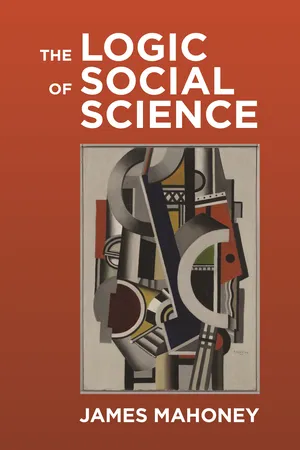
The Logic of Social Science offers new principles for designing and conducting social science research. James Mahoney uses set-theoretic analysis to develop a fresh scientific constructivist approach that avoids essentialist biases in the production of knowledge. This approach recognizes that social categories depend on collective understandings for their existence, but it insists that this recognition need not hinder the use of explicit procedures for the rational assessment of truth. Mahoney shows why set-theoretic analysis enables scholars to avoid the pitfalls of essentialism and produce findings that rest on a firm scientific foundation.
Extending his previous work and incorporating new material, Mahoney presents specific tools for formulating and evaluating theories in the social sciences. Chapters include discussions of models of causality, procedures for testing propositions, tools for conducting counterfactual and sequence analysis, and principles for knowledge accumulation. Equal focus is placed on theory building and explanatory tools, including principles for working with general theoretical orientations and normative frameworks in scientific research. Mahoney brings a novel perspective to understanding the relationship among actors, social rules, and social resources, and he offers original ideas for the analysis of temporality, critical events, and path dependence.
Bridging the rift between those who take a scientific approach and those who take a constructivist one, The Logic of Social Science forges an ambitious way forward for social science researchers.
- 384 pages
- English
- ePUB (mobile friendly)
- Available on iOS & Android
eBook - ePub
The Logic of Social Science
About this book
Information
Publisher
Princeton University PressYear
2021Print ISBN
9780691214955
9780691217055
eBook ISBN
9780691214993
PART I
Ontology and Epistemology
1
Scientific Constructivism
This chapter begins to develop a scientific constructivist approach for the social sciences. The first section identifies the contrasting subject matter of the natural sciences and the social sciences: I propose that the natural sciences are primarily concerned with the analysis of natural kinds, whereas the social sciences are primarily concerned with the analysis of human kinds. The differences between natural kinds, human kinds, and partial natural kinds are identified and discussed. I focus much attention on how social scientists—unlike natural scientists—must work with mind-dependent categories that exist by virtue of implicit collective understandings.
The second section of the chapter explores how the default essentialism of social science researchers leads them to analyze human kinds as if they exist in the world as mind-independent entities. It shows how essentialism is both a built-in human bias and an entrenched social science orientation. I argue that social scientists need research procedures that assume that categories are produced from, and refer to, an interaction between the mind and the natural world.
The third section starts to build the foundation for the alternative to essentialism: a constructivist orientation. Using insights from a variety of disciplines, I introduce a conceptual space model for understanding human categorization. The model proposes that the human mind encompasses a multidimensional hyperspace in which categories exist as conceptual spaces. These conceptual spaces can be analyzed as sets, such that categories are mental sets located in the mind’s representational space. I discuss how this approach to categories can help social scientists correct essentialist biases and treat human kinds as mind-dependent entities.
The fourth and final section briefly introduces set-theoretic analysis as a methodology for pursuing scientific research within a constructivist orientation. The section examines how set-theoretic analysis provides both a way of expressing logic and a way of applying the conceptual space model of human categorization in the design and practice of research.
Kinds of Kinds
Natural kinds and human kinds are used in classifying entities in the world (e.g., “these entities are sodium salts”; “these entities are peasant revolts”). But these classifications have different foundations. With natural kinds, one classifies entities as similar because of their shared essential properties—properties that exist independently of human minds. With human kinds, by contrast, one classifies entities as similar on the basis of characteristics that are not mind-independent properties. As a result, whereas one can study natural kinds by analyzing the essential properties that make them what they are, one must study human kinds by taking into consideration the process of mental classification that helps make them what they are.
The basic distinction developed in this section between natural kinds and human kinds is widely discussed in philosophy, in cognitive science, and, increasingly, in psychology. My summary of this distinction draws broadly from this literature, including especially the scientific realist strands within it. It would be too strong a statement to say that I have summarized the consensus view of the difference between natural kinds and human kinds; such a consensus view does not exist. However, my summary is well within the mainstream of this literature. Each component of the definitions presented here will be quite familiar to any scholar who works on the distinction between natural kinds and human kinds. The most novel aspect of my discussion is that I divide categories that are not human kinds into two groups: natural kinds and partial natural kinds. I do so because it is not clear to me that scientists have discovered any full-blown natural kinds. The category partial natural kind refers to entities that approximate the characteristics of natural kinds. Scientists have most certainly discovered many partial natural kinds, allowing human beings to exercise substantial, and sometimes extraordinary, control over the external world.
Table 1.1 provides an overview of the differences between natural kinds, human kinds, and partial natural kinds. For interested readers, an appendix at the end of this chapter discusses the distinction between natural kinds and human kinds in light of the problem of universals.
NATURAL KINDS
Natural kinds are entities that exist in nature independently of human beings. Humans may be able to discover these entities, but that discovery is not necessary for their existence. Natural kinds are ontologically prior to human beings and their activities and cognitions (Browning 1978; Ellis 2001: 63–67; cf. Hacking 1991). Examples of natural kinds plausibly include the elementary particles (e.g., quarks, leptons, bosons), the chemical elements (aluminum, hydrogen, gold), various natural properties (conductivities, wavelengths, spatiotemporal intervals), and various dynamic processes (chemical reactions, ionizations, diffractions). Such entities are our best candidates for the substances and processes that compose the mind-independent environment that is detected by our sensory organs.
TABLE 1.1. Natural Kinds, Human Kinds, and Partial Natural Kinds | ||||||
|---|---|---|---|---|---|---|
Natural Kinds | Human Kinds | Partial Natural Kinds | ||||
Degree of Mind Independence | Full | Minimal | Considerable | |||
Degree of Spatiotemporal Stability | Full | Minimal | Considerable | |||
Causal Powers | Present | Not present | Partially present | |||
Scientific Examples (substantive kinds) | Electron, helium atom, wave packet | Social movement, country, world system | Gene, igneous rock, synapse | |||
Scientific Examples (property kinds) | Spherical shape, pure quantum state, magnetic | Progressive, democratic, capitalist | Mutant, connected, schizophrenic | |||
Scientific Examples (dynamic kinds) | Photon emission, isomerization, nuclear decay | Revolution, economic growth, state formation | Accretion, eruption, neural communication | |||
Everyday Examples (substantive, property, and dynamic kinds) | NA | Teacher, generous, graduation | Dog, green, death | |||
Natural kinds are constituted by essential properties—i.e., the real essences that they possess and by virtue of which they exist (Ayers 1981; Kripke 1980; Oderberg 2007; Putnam 1975; Robertson 2009; Slater and Borghini 2011; Wilkerson 1988). These essences are immutable properties that have the same form across all times and places. Natural kinds are “eternal kinds” (Millikan 1999: 50). For example, atoms of uranium have the atomic number 92 across all spatiotemporal domains.1 Regardless of its location in space and time, an entity cannot be an atom of uranium if it lacks the atomic number 92 (Hendry 2006).
The essences of natural kinds include spectral properties that permit a range of variation among specific instances of these kinds (Ellis 1996: 23; 2001: 79–81). For example, the essence of a field includes the spectral property “strength.” Strength is a quantitative characteristic that can assume a range of possible values, some of which find empirical expression in particular fields. All specific instances of a natural kind must possess values on the spectral properties of that kind. Differences in the incidental possession of particular values on a spectral property by instances of a single kind allow for their comparison. For example, one can compare individual fields on the basis of differences in their strengths, quarks on the basis of differences in their flavors, and electromagnetic radiation emissions on the basis of differences in their frequencies.
The essential properties of natural kinds endow them with causal powers (Harré and Madden 1975; Salmon 1998; Ellis 2009; Mumford 2009; Mumford and Anjum 2011). These causal powers make the world dynamic and active, rather than stationary and passive. Sulfuric acid has the power to dissolve copper; electrostatic fields have the power to modify spectral lines; and masses have the power to curve spacetime. Causal powers are inherent dispositions; the kinds that possess them behave as their properties require them to behave. Possession of a particular spectral property (e.g., a strength or a charge) gives a natural kind certain causal powers that are different from those of other natural kinds. Incidental possession of a specific value on a spectral property (e.g., a particular strength or a particular charge) by an instance of a natural kind gives that instance a causal power that is different from that of other instances of the same kind with different values on the spectral property.
The existence of natural kinds suggests that quantification and mathematics are built into the fabric of reality. Under mathematical realism (or platonism), foundational mathematical entities such as sets, numbers, and functions are objective, eternal, indestructible, and real; they exist as abstract objects in all possible worlds, with or without human beings (Colyvan 2001; Hale 1987; Maddy 1990; Nagel 1997; Putnam 1979; Resnik 1997; Shapiro 1997, 2007).2 Mathematics is real because reality consists of entities and laws (i.e., natural kinds with causal powers) that can be expressed in a precise and general manner (Sher 2013). The reality of mathematics imposes limits on what can possibly be true in science. Mathematics disqualifies as necessarily false descriptions of reality such as 2 + 2 = 5. By the same token, mathematical realism qualifies logical reasoning as an objective basis for discovering truths about the world. To embrace mathematics is almost by definition to embrace logic; all or nearly all mathematic propositions are true by virtue of their logical form (Frege 1884/1960; Whitehead and Russell 1910/1956). Logic and mathematics exist in a fruitful relationship in which logic provides formal operators for valid reasoning and inference, while mathematics provides tools for describing the formal structure of reality (Sher 2013). Together, logic and mathematics provide essential resources not only for the scientific analysis of the natural world, but also for understanding and analyzing the human-constructed reality that constitutes the subject matter of the social sciences.
HUMAN KINDS
Human kinds lack intrinsic properties and dispositions that define them as kinds. They are ontologically dependent on human beings for their existence. Specifically, they are dependent on human brain activity; human kinds are mind-dependent kinds.3 Examples include the social roles, institutions, and events that characterize human cultures and societies (e.g., shaman, nurse, joke, marriage, supper, veto). Human kinds encompass aggregate substantive entities designated with nouns (e.g., movements, municipalities, world systems), the properties of these entities designated with adjectives (progressive, suburban, capitalist), and dynamic processes represented as events (wars, parades, surgeries, birthday parties, filibusters, state collapses). Nearly all social science concepts are human kinds. Social science can, in fact, be defined as the scientific study of human kinds.
While human kinds depend ontologically on human brains, the specific instances of these kinds are not brain states.4 Rather, the specific instances of a hum...
Table of contents
- Cover Page
- Title Page
- Copyright Page
- Dedication
- Contents
- List of Illustrations
- Preface
- Introduction
- Part I. Ontology and Epistemology
- Part II. Methodological Tools
- Part III. Explanatory Tools
- Conclusion
- Glossary
- Notes
- References
- Index
Trusted by 375,005 students
Access to over 1.5 million titles for a fair monthly price.
Study more efficiently using our study tools.
Frequently asked questions
Yes, you can cancel anytime from the Subscription tab in your account settings on the Perlego website. Your subscription will stay active until the end of your current billing period. Learn how to cancel your subscription
No, books cannot be downloaded as external files, such as PDFs, for use outside of Perlego. However, you can download books within the Perlego app for offline reading on mobile or tablet. Learn how to download books offline
Perlego offers two plans: Essential and Complete
- Essential is ideal for learners and professionals who enjoy exploring a wide range of subjects. Access the Essential Library with 800,000+ trusted titles and best-sellers across business, personal growth, and the humanities. Includes unlimited reading time and Standard Read Aloud voice.
- Complete: Perfect for advanced learners and researchers needing full, unrestricted access. Unlock 1.5M+ books across hundreds of subjects, including academic and specialized titles. The Complete Plan also includes advanced features like Premium Read Aloud and Research Assistant.
We are an online textbook subscription service, where you can get access to an entire online library for less than the price of a single book per month. With over 1.5 million books across 990+ topics, we’ve got you covered! Learn about our mission
Look out for the read-aloud symbol on your next book to see if you can listen to it. The read-aloud tool reads text aloud for you, highlighting the text as it is being read. You can pause it, speed it up and slow it down. Learn more about Read Aloud
Yes! You can use the Perlego app on both iOS and Android devices to read anytime, anywhere — even offline. Perfect for commutes or when you’re on the go.
Please note we cannot support devices running on iOS 13 and Android 7 or earlier. Learn more about using the app
Please note we cannot support devices running on iOS 13 and Android 7 or earlier. Learn more about using the app
Yes, you can access The Logic of Social Science by James Mahoney in PDF and/or ePUB format, as well as other popular books in Social Sciences & Politics. We have over 1.5 million books available in our catalogue for you to explore.