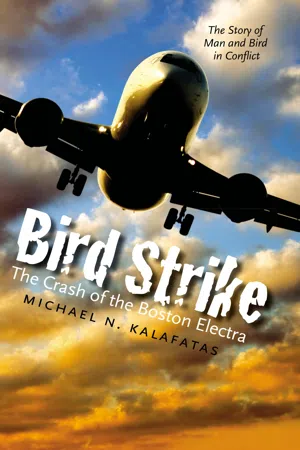
On a warm and golden afternoon, October 4, 1960, a Lockheed Electra jet turboprop carrying 72 souls took off from Logan Airport. Seconds later, the plane slammed into a flock of 10,000 starlings, and abruptly plummeted into Winthrop Harbor. The collision took 62 lives and gave rise to the largest rescue mobilization in Boston's history, which included civilians in addition to police, firefighters, skindivers, and Navy and Coast Guard air-sea rescue teams. Largely because of the quick action and good seamanship of Winthrop citizens, many of them boys in small boats, ten passengers survived what the Civil Aeronautics Board termed "a non-survivable crash." Using firsthand interviews with survivors of the crash, rescuers, divers, aeronautics experts, and ornithologists, as well as a wide range of primary source material, Kalafatas foregrounds the story of the crash and its aftermath to anchor a broader inquiry into developments in the aeronautics industry, the increase in the number of big birds in the skies of North America, and the increasing danger of "bird strikes." Along the way he looks into interesting historical sidelights such as the creation of Logan Airport, the transformation of Boston's industrial base to new technologies, and the nature of journalistic investigations in the early 1960s. The book is a rare instance when an author can simultaneously write about a fascinating historical event and a clear and present danger today. Kalafatas calls for and itemizes solutions that protect both birds and the traveling public.
- English
- ePUB (mobile friendly)
- Available on iOS & Android
eBook - ePub
About this book
Information

1 Appointment in Samarra
What happens when dreams collide?
On June 13, 1923, the first plane touched down on the 1,500-foot cinder runway of tiny Boston Airport, built by the U.S. Army on 189 acres of tidal flats in East Boston. Two decades earlier the Wright brothers had achieved humankind’s dream to defy gravity and reach for the sun-split clouds. Amazingly, for thirty-seven years Boston’s airport, one of the nation’s busiest, did not see a single fatality from a commercial aviation crash. In 1943 the airport was renamed Logan after a distinguished Boston public servant—General Edward Lawrence Logan—who reportedly never flew in an airplane.
On the warm and golden afternoon of October 4, 1960, Logan Airport’s innocence came to a ghastly end. As families along Winthrop Harbor sat down to supper and as I arrived at my job of soda jerk in South Boston, across the cheerful blue waters of Boston Harbor from the airport, a Lockheed Electra taking off slammed into a flock of ten thousand starlings and another human dream: one man’s determination to bring to the United States all the songbirds that dart across the pages of Shakespeare’s plays. That collision of dreams would take sixty-two lives and give rise to some of the greatest heroism Boston has ever witnessed—including the heroism of children.
A Feathered Bullet
A New York drug manufacturer, Eugene Schieffelin, released sixty European starlings into Central Park in 1890, and forty more birds a year later. The experiment was a stunning success: today there are 200 million starlings in North America, here because of a fleeting reference in Henry IV to the starling’s ability to mimic the human voice.
Like a flight of swallows or an exaltation of larks, a group of starlings has a special name: a murmuration of starlings. The birds mimic whatever they hear—voices, telephones, car alarms, barking dogs, other birds—and their song is a medley of squeaks, clicks, whistles, and other interpretations of the world of sound.
An average starling weighs only 2.82 ounces, about the heft of a cellphone, but in fall and winter starlings swarm together in enormous flocks containing up to a million birds, and they wheel in flight with military precision. Fast-flying and relatively dense, a single starling can be a feathered bullet; a swarm of the birds is a feathered fusillade. After a day’s foraging—finding their food on the ground, up to seventy miles away—they splash clean in water, if they can, and return to their roost at sunset. Before Boston’s Big Dig, 160,000 would fly at sunset to a favorite roost on the Tobin Bridge, jostling for a spot and murmuring away at evening commuters. Perhaps that’s where the birds were bound that fateful fall day in 1960.
On October 4, a half-hour before sunset and before the rise of a blood-red harvest moon, Eastern Airlines Flight 375, a four-engine Lockheed Electra turboprop—bound for Philadelphia; Charlotte, North Carolina; Greenville, South Carolina; and Atlanta, Georgia—rose from Runway 9 with seventy-two souls on board. Among them were fifteen newly-sworn-in marines en route to training at Parris Island, South Carolina; Philadelphians headed home after a shoe convention in Boston; baseball fans on their way to the World Series in Pittsburgh, where the Pirates would play the Yankees (Art Ditmar, born in Winthrop, Massachusetts, would be opening pitcher for the Yanks and would last only a third of an inning); and an engineer with top-secret plans for a new missile system sealed in a specially locked briefcase. Ted Williams, who six days earlier had bade Boston adieu with a home run in his last at bat, was a near miss to be on the flight.
Twenty-seven seconds after it began its takeoff and only seven seconds into the flight, the Lockheed Electra took a fusillade of feathered bullets into three of its four engines. It was a fatal shooting.
Whipped in through air scoops, starlings jammed the jet compressors and blades of the turbines (from turbo, the Latin for “whirl”), whose job it was to spin freely—as jet exhaust roared past them—to power the plane’s propellers and power and cool its compressors. A turboprop is a hybrid, part jet and part propeller, a design that is still in use, and efficient and economical in regional air traffic. With a turboprop, the jet exhaust doesn’t directly drive the plane; instead, the jet exhaust powers the propellers that drive the plane.
In the 1950s, it was my dad’s job to grind turbine blades to extremely fine tolerances for GE’s J-47 engine, used on the F-86 Sabre Jet—pride of the U.S. Air Force in Korea, with its 14:1 kill ratio over the Russian-built MiG. A slight flaw or disturbance in the balance or free-flow spin of turbine blades could cause a Sabre Jet to vibrate to death at 700 miles per hour—sending it into the Sea of Japan.
Just before the Lockheed Electra was cleared for takeoff in Boston, two Sabre Jets zoomed off from Logan to chase the shouting wind at 45,000 feet. In its initial climb off Runway 9, the Lockheed Electra struck the flock of starlings, estimated at 10,000 to 20,000 birds. The plane’s number one engine—the engine on the left wing farthest from the fuselage—shut down, giving off a puff of grey smoke. The Electra could fly on its three other engines, but then two more experienced losses of power. The number two engine—the one on the left wing closest to the fuselage—flashed flame and shut down, and the number four engine—on the right wing farthest from the fuselage—lost power. With no engine power on the left and only partial power on the right, the plane veered sharply to the left in its upward struggle and slowed to stall speed. The left wing then dropped, the nose pitched up, and the plane rolled left into a spin and plunged nearly vertically into Winthrop Harbor.
So caught by surprise were the pilot and copilot that they never uttered a word to the Logan tower. The plane struck the water halfway between the end of Runway 9 and the Winthrop shore, amid pleasure craft anchored 200 yards off the Cottage Park Yacht Club. The impact was so violent the plane burst apart, sending a geyser upward; its tail broke off and hit the water still dry; and all but two passenger seats were ripped from the plane’s floor. The main section sank in a few minutes in thirty feet of water; the tail floated and drifted—with a half-dozen bodies visible within—before it too sank a little later. Winthrop residents thought they’d heard a sonic boom.
What followed was the largest rescue mobilization Boston has ever witnessed—exceeding that of the 1942 Cocoanut Grove nightclub fire when 492 people perished and 166 were injured. The response to the plane crash was characterized by spontaneous generosity and heroism offered without a moment’s hesitation—and, most touchingly, by boys hardly out of childhood.
As of this writing, a half-century later, the Boston crash of the Electra remains the worst disaster in aviation history caused by bird strike and among the top fifty air disasters in the United States. In the chain of events that led up to the Electra’s plunge into Winthrop Harbor, any of twenty links might have been broken—by chance, human prescience, a shift forward or backward of five seconds in takeoff, or a lifting of what seemed to be a curse on the new Lockheed Electra L-188, with four crashes in nineteen months. (It was also the daughter of the Model 10E Electra, the last plane ever flown by Amelia Earhart.) Yet none of the links in the chain of events did break.
One is left to ponder inevitability or fate. One afternoon in 1960, at the soda fountain where I worked, I snagged from a slim bookstand a new edition of John O’Hara’s Appointment in Samarra, in which the foreword quotes Somerset Maugham’s recounting of an Arab legend:
Death Speaks
There was a merchant in Bagdad who sent his servant to market to buy provisions and in a little while the servant came back, white and trembling, and said, Master, just now when I was in the market-place I was jostled by a woman in the crowd and when I turned I saw it was Death that jostled me. She looked at me and made a threatening gesture; now, lend me your horse, and I will ride away from this city and avoid my fate. I will go to Samarra and there Death will not find me. The merchant lent him his horse, and the servant mounted it, and he dug his spurs in its flanks and as fast as the horse could gallop he went. Then the merchant went down to the market-place and he saw me standing in the crowd and he came to me and said, Why did you make a threatening gesture to my servant when you saw him this morning? That was not a threatening gesture, I said, it was only a start of surprise. I was astonished to see him in Bagdad, for I had an appointment with him tonight in Samarra.
2 Crimson Sunset
An inbound pilot barked, “Tower, an Electra just went into the drink.”—Time, October 17, 1960
A little after 5:15 on the afternoon of Tuesday, October 4, 1960, a small party of family and friends of Frederick Nino Abate, an 18-year-old marine recruit from Quincy, Massachusetts, climbed the stairs to the observation deck at Logan Airport to watch his plane take off. The group consisted of Freddie’s mother, father, sister, brother-in-law, friend Jack, and girlfriend, Pat Connelly. They wanted to wave good-bye to Freddie and the other boys headed off to boot camp at Parris Island. The six people in the Abate party were the only people out on the open deck. A light breeze blew out of the southeast as the huge crimson disk of the October sun began its slide to the west behind Boston’s low skyline: the stately Custom House, the old twenty-six-story John Hancock Building, and the landmark U.S. Post Office Building, now pouring out into the financial district federal workers done for the day—some of whom owed their jobs to Senator John F. Kennedy, the man they hoped would be elected president in four weeks. This Tuesday had been as stunning an autumn day as New England can muster. A Canadian high-pressure system had revolutionized Boston’s weather after an especially rainy September. Indeed, on September 29, Ted Williams’s hard-hit home run in his final at bat had to fight its way through heavy, soggy air all the way into the bullpen. But on October 4, the skies had been broomed clean and shone a brilliant blue. Only a few daring white clouds scudded by.
Lavish sunshine bathed grateful Bostonians, their rain gear finally left at home. With summer just two weeks past and a high sun, the afternoon temperature hit a perfect 70 degrees. Visibility was fifteen miles. J. D. Salinger, his fame near its apogee in 1960, had written of “a perfect day for bananafish”: a day whose stunning exterior can obscure an underlying threat. As the bright, clear sunny morning broke over eastern Massachusetts, it’s not hard to imagine that the mother of one of the marine recruits, whipping up pancakes and eggs for her son’s last breakfast at home, looked out the window and exclaimed, “What a great day to fly!”
Like Freddie Abate, most of the other fourteen young Marine recruits had graduated from high school in June, enjoyed summer with hometown buddies after deciding to join the Marine Corps, and—if they were lucky, like Freddie—were leaving behind girlfriends who would write to them at boot camp. In 1960 only 20 percent of Americans had ever flown, so for most of the young marines, this would be their first time on an airplane. In fact, it would be a day of firsts. The novelist Graham Greene wrote, “There comes a time in childhood when a door opens and lets the future in.” For the fifteen recruits this was such a time: their first day as proud new marines, first airplane flight, first trip to the South, first trip away from home and family, and facing the thrill and trepidation of boarding a Marine Corps bus at Greenville, South Carolina, to be taken to Parris Island to learn the true meaning of “Semper Fi.”
As it turned out, however, the door that opened was to the Lockheed Electra.
With sunset due at 6:21 p.m. and with a breeze now blowing in off the North Atlantic, Mrs. Abate felt a chill on the exposed observation deck. Logan is a peninsular airport, its chin bravely jutting seaward against all comers. The airfield was built on mud flats, as were many coastal city airports of that day: there were no trees to interfere with takeoffs or landings, nothing between pilot and sky except occasional startled birds.
It was unusual that the observation deck would have been almost empty on a sunny afternoon in 1960. Americans of the day were enthralled with aviation, looking to the skies and to the future. Aviation was drawing the best and brightest talent the nation had to offer. A New Englander, Alan Shepard, had recently been named one of the nation’s first seven astronauts. Ultimately, he would spend more time on the surface of the moon than anyone else so far: thirty-three and a half hours.
The observation deck at Logan was usually a crowded, giggly place—especially on Sundays, when families brought their children to the airport to watch planes take off and land, and maybe to see a jet or hear it break the sound barrier. But on October 4—while the setting sun seemed to grow in size as it changed color from gold to rose and crimson—there was only one party on the deck: six people with one purpose, to send Freddie off to boot camp with love and laughter. Despite a growing fall chill in the air, the spirits in Freddie’s party ran high. The six people gathered close to the railing; smiling and joking, they were looking down at a 45-degree angle at Freddie’s plane as it boarded. They had a good view of the aircraft: the entire left side of the plane faced them, and through the windshield they could see the pilot and copilot looking relaxed, sipping coffee as they ran through their preflight checklist.
The Lockheed Electra and its crew had arrived two hours earlier from New York as Eastern Airlines Flight 444. After a scheduled rest stop for the crew, it would be reborn as Eastern 375, with Boston as the starting point for a series of short trips, leapfrogging down the East Coast. Eastern 375 would begin in the gloaming and travel on into the night sky.
A marvel of ease and efficiency, the Lockheed Electra L-188 had joined the U.S. commercial aviation fleet two years before, its arrival much heralded: people in the aviation industry called it a miracle, an exemplar of what Willis Hawkins, president of Lockheed, wrote of airliner design at mid-century: “Airlines were stretching their dreams, the FAA faced with a new invention to approve every day.” An airliner’s thoughtful new design in action was what the Abate party now observed as the Electra rolled up its sleeves and got ready for work. The plane’s functions had been consolidated to speed turnaround at intermediate stops—to improve “on ground performance,” in aviation jargon. The left side of the aircraft was devoted to passenger boarding and deplaning, and the right side to refueling, cargo loading, toilet draining, and water replenishing.
At Logan the plane had been topped up with 24,900 pounds of fuel, and the crew calculated the Electra’s fully loaded takeoff weight to be 97,987 pounds—evenly distributed and well below maximum. As the Abate party looked on, two attractive young stewardesses—Joan Berry, twenty-two, from Prentice, Mississippi, and Patricia Davies, twenty-three, from Jacksonville, Florida—stood by the Electra’s door greeting the marines and the other passengers with their soft, reassuring Southern accents. Joan and Patricia waited for the last two passengers to make their way from asphalt to aircraft on the Electra’s new integrated staircase, one of many aeronautical design advances built into the plane. The staircase could be lowered and raised hydraulically from the Electra, with no need for ground crew to roll a staircase out to the aircraft and to fit the two pieces together. In the Electra’s design phase, which took place in California—a future-conscious state, especially in the 1950s—self-containment was a watchword for the aeronautical engineers who created the Lockheed L-188.
As the stewardesses watched, an elderly woman made her way up the staircase, followed by Freddie Abate. Freddie was the final passenger to board Eastern 375. After he stepped inside, the staircase was deftly retracted, and the stewardesses shut the Electra’s door and locked it fast. Outside the closed door, to the right and low on the fuselage in elegant font was Eastern’s new slogan for all Electra flights: “The Golden Falcon Service.” The falcon, of course, is a magnificent hunter and among the fastest of avian fliers; some falcons, like the peregrine, plummet from lofty heights at 200 miles per hour to strike small birds in midair—and among their prey is the common starling.
With four mysterious Electra crashes in nineteen months, and Congress in an uproar over the safety of the new airliner, Eastern ticket agents had taken to referring to the aircraft by the handy phrase “our Golden Falcon service.” Braniff ticket agents chose to say “our L-188s”; other airlines simply mentioned “our prop-jet service.” Air travelers focus their attention on schedule and travel time; they seldom pay attention to type of aircraft. But regular air travelers—the travelers that Eastern Airlines most cared about—had grown jittery about flying the Electra, some business firms quietly telling their traveling staff to avoid the aircraft entirely.
The press corps assigned to cover Lyndon Johnson, the Democrats’ vice presidential candidate, had been growing nervous about daily travel on his campaign plane, an Electra, doubtless prompted by calls from their loved ones about the Electra’s safety record. The first Electra crash had occurred on February 3, 1959; I will discuss it in chapter 4. In two subsequent, spectacular Electra crashes, six months apart, a wing had torn away from the aircraft in midair. In the first of these, on September 29, 1959, a Braniff Electra crashed into a farmer’s field in Buffalo, Texas, with hounds for miles around eerily howling moments before the plane split apart and fell in fiery pieces from the starry skies. The second crash came on March 17, 1960: a 105,000-pound Northwest Electra slammed into a soybean field near Tell City, Indiana, at 618 miles per hour, vanishing in a twelve-foot-deep crater, with the fuselage telescoped to a third of its original length. A total of ninety-seven people died in those two crashes. And a few weeks before the Boston crash, on September 14, 1960, an American Airlines Electra from Boston, this one bound for LaGuardia Airport in New York, had flipped over on landing and hurtled onto the Grand Central Parkway in Queens, where the plane came to a stop upside down. Miraculously, all seventy-six people aboard the full flight survived.
A few moments after Freddie boarded Eastern 375, Mrs. Abate was thrilled to see that her son had settled into a window seat over the left wing, three windows from the door. She could see hi...
Table of contents
- Cover Page
- Title Page
- Copyright
- Dedication
- Contents
- Preface: A Clear and Present Danger
- 1. Appointment in Samarra
- 2. Crimson Sunset
- 3. Fading October Light
- 4. The Case of the Boston Electra
- 5. Sharing the Skies: The Problems
- 6. Sharing the Skies: The Solutions
- 7. The Making of a Patron Saint
- Epilogue: Mozart and the Starling
- Acknowledgments
- Vital Statistics of the Boston Electra
- Select Bibliography
- Illustrations
Trusted by 375,005 students
Access to over 1.5 million titles for a fair monthly price.
Study more efficiently using our study tools.
Frequently asked questions
Yes, you can cancel anytime from the Subscription tab in your account settings on the Perlego website. Your subscription will stay active until the end of your current billing period. Learn how to cancel your subscription
No, books cannot be downloaded as external files, such as PDFs, for use outside of Perlego. However, you can download books within the Perlego app for offline reading on mobile or tablet. Learn how to download books offline
Perlego offers two plans: Essential and Complete
- Essential is ideal for learners and professionals who enjoy exploring a wide range of subjects. Access the Essential Library with 800,000+ trusted titles and best-sellers across business, personal growth, and the humanities. Includes unlimited reading time and Standard Read Aloud voice.
- Complete: Perfect for advanced learners and researchers needing full, unrestricted access. Unlock 1.5M+ books across hundreds of subjects, including academic and specialized titles. The Complete Plan also includes advanced features like Premium Read Aloud and Research Assistant.
We are an online textbook subscription service, where you can get access to an entire online library for less than the price of a single book per month. With over 1.5 million books across 990+ topics, we’ve got you covered! Learn about our mission
Look out for the read-aloud symbol on your next book to see if you can listen to it. The read-aloud tool reads text aloud for you, highlighting the text as it is being read. You can pause it, speed it up and slow it down. Learn more about Read Aloud
Yes! You can use the Perlego app on both iOS and Android devices to read anytime, anywhere — even offline. Perfect for commutes or when you’re on the go.
Please note we cannot support devices running on iOS 13 and Android 7 or earlier. Learn more about using the app
Please note we cannot support devices running on iOS 13 and Android 7 or earlier. Learn more about using the app
Yes, you can access Bird Strike by Michael N. Kalafatas in PDF and/or ePUB format, as well as other popular books in History & 20th Century History. We have over 1.5 million books available in our catalogue for you to explore.