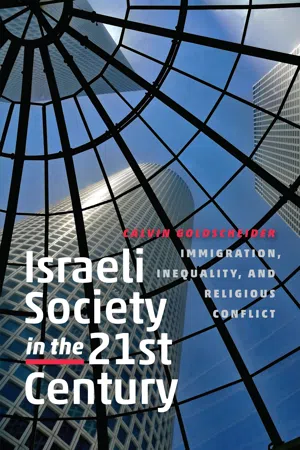
This volume illuminates changes in Israeli society over the past generation. Goldscheider identifies three key social changes that have led to the transformation of Israeli society in the twenty-first century: the massive immigration of Jews from the former Soviet Union, the economic shift to a high-tech economy, and the growth of socioeconomic inequalities inside Israel. To deepen his analysis of these developments, Goldscheider focuses on ethnicity, religion, and gender, including the growth of ethnic pluralism in Israel, the strengthening of the Ultra-Orthodox community, the changing nature of religious Zionism and secularism, shifts in family patterns, and new issues and challenges between Palestinians and Arab Israelis given the stalemate in the peace process and the expansions of Jewish settlements. Combining demography and social structural analysis, the author draws on the most recent data available from the Israeli Central Bureau of Statistics and other sources to offer scholars and students an innovative guide to thinking about the Israel of the future. This book will be of interest to scholars and students of contemporary Israel, the Middle East, sociology, demography and economic development, as well as policy specialists in these fields. It will serve as a textbook for courses in Israeli history and in the modern Middle East.
eBook - ePub
Israeli Society in the Twenty-First Century
Immigration, Inequality, and Religious Conflict
- English
- ePUB (mobile friendly)
- Available on iOS & Android
eBook - ePub
Israeli Society in the Twenty-First Century
Immigration, Inequality, and Religious Conflict
About this book
Information
Publisher
Brandeis University PressYear
2015Print ISBN
9781611687477
9781611687460
eBook ISBN
9781611687484
1|Nation-Building, Population, and Development
The state of Israel is one of the oldest new societies to have been established in the post–World War II era. Its roots are embedded in the very distant past of the Hebrew Bible and in centuries of anti-Semitism and the minority status of Jews in Christian and Moslem societies. Emerging politically out of the ashes of a European Jewry destroyed in the Holocaust, Israel was carved out of the nineteenth-century Ottoman Empire and its successor, British colonialism, and was based on European ideologies of nationalism and ethnic politics. Built on Western and Judaic foundations of justice, independence, and democracy, it has struggled continuously for political legitimacy among its neighbors, and its members have battled over its boundaries and territory, the distribution of its resources, and the treatment of its minorities. Committed to peace, it has been mired in warfare and ceaseless conflict. Though Israel is defined as a secular state and is dedicated to being an open, pluralistic, egalitarian society, religion has been an integral element of its politics, and it is a country divided by ethnicity and religion. Major sources of inequality continue to characterize Israeli communities and families in the twenty-first century. Gender discrimination and ethnic/racial prejudice are embedded in its institutions and its politics. Fiercely independent, Israel remains the major recipient of economic and military aid from the United States and from Jews around the world. Designed as a haven for the remnants of world Jewry, it contains less than half of the world’s Jewish population after more than six and a half decades of statehood, immigration, and population growth.
Israeli society has integrated over three million Jewish immigrants from an enormous range of diverse countries, the majority from Europe, has invigorated an ancient language to form a common basis of modern communication, and has developed a rich culture of literature, theater, film, and scholarship. It has become a leader in agricultural innovation and rural communal experiments, even as it is one of the most urban and most technologically sophisticated of contemporary societies. The deserts have bloomed, and modern technologies have flourished in Israel; major revolutions in the family have occurred, and extensive health-care institutions have been organized. Israel has become a model state for many Third World nations and a major source of identity for Jewish communities around the world. Characterized by heterogeneity and by intense and continuous change, Israel is a small state occupying a disproportionate share of the headlines and stories in the Western press. Indeed, contradictions and paradoxes seem to be some of the defining features of Israeli society, as does its complexity.
This book considers these complex themes in an attempt to understand Israel’s emergent society in the twenty-first century. I examine population and ethnic/religious processes, and social-economic-political-cultural developments, to describe the changes that Israel has experienced and to provide clues about the sources of these changes and their consequences. I focus on the linkages between nation-building and population growth and investigate the assimilation of immigrants from diverse societies and their mobilization into a coherent, pluralistic polity. I assess how religious conflict and cohesion blend to form one national diverse society. I document how resources are distributed and how external dependencies and internal conflicts are connected to clarify the basis of ethnic/religious and other inequalities. To grasp the complexity of the everyday life of its citizens, I review normal, recurrent life events—births, marriages and family formations, sicknesses, and deaths. I investigate the communities where people live, the jobs they have, the children they love, their schooling, and their resources, and the religion and institutions that give meaning to their lives. I outline developments in culture, politics, and religion; minority inequalities and the creation of new communities, their distinctiveness and differential access to opportunities; the significance of gender roles and the sources of family values; the relationship of Jews and Arab/Palestinians in their diasporas to Israelis and their society. Together, these themes provide a portrait of contemporary Israeli society, a canvas upon which to assess the historical roots of current patterns and the basis for conjecture about the future.
To carry out the daunting goals of understanding this complex society, I use some overall theoretical maps to orient readers with broad images in which to fit details into a coherent whole. I provide in this introductory chapter several points of entry into the complexities of understanding changes in Israeli society over the past several decades. Focusing on the first decades of the twenty-first century, I emphasize the links among nation-building, population processes, socioeconomic development, emergent ethnicity, and religious divisions. I end up with many questions challenging some of the ideas of the past and some guides for the analysis of future changes.
I make two core arguments about the patterns of nation-building in Israel: First, I argue that social-demographic transformations—changes in immigration, health and mortality, fertility and family structure, internal migration and residential concentration—have been critical in shaping nation-building and economic development in Israeli society and in that society’s generational renewal. Second, I demonstrate how the sources of inequalities within Israel have changed over time and how new divisions among Jews and between Jews and Arabs are emerging. Population processes and social-structural factors are at the core of these changing inequalities, transforming communities in the process of nation-building. At the same time, religious institutions and ideological developments that often create a common set of values and core culture have been sources of conflict and polarization within the society.
In my examination of Israel’s changing society, I note the tensions between its uniqueness and its commonalities shared with other countries. Social patterns are emerging in Israel that are similar to those of other small developing countries dependent on large and powerful nations for socioeconomic resources and political support. At the same time, other processes reflect the specifics of the Jewish condition in recent history and the relationships between Israeli and non-Israeli Jews and between Israeli Jews and Arabs. Still other patterns in Israel can be understood only in light of Israel’s particular history, related to its development and its role in the Middle East region. Israel, as other countries, is unique in the forces that have shaped its history; it is also a microcosm of population, development, and ethnic/religious relationships. It is one country that comprises many communities—a political entity unified and organized, with official boundaries (however fuzzy at times) and administrative networks. Israeli society is an example of the processes of sociopolitical development, economic dependency, and ethnic/religious pluralism; it is at the crossroads of East and West, where Western democracy and capitalism, European socialism, and Jewish and Moslem religious fundamentalism blend with Middle East culture and society.1
Yet it is striking how the social and cultural processes that have come to characterize Israeli society parallel those that have emerged elsewhere, in old and new states, in more- and less-developed nations, in Western and non-Western countries. The analyses that I present provide a basis for understanding one fascinating case study; my conclusions should be informative for comparative studies. The unique features of the Israeli case, as well as more-general patterns of social change and social inequality, should emerge at the end.
Demographic Themes
Demography is not “destiny” but plays a powerful role in understanding the formation of Israeli society and the changes that it has experienced. Among the core demographic themes are (1) the centrality of immigration in Israel’s population growth, (2) the links between increases in population size and economic development, (3) the tie between the geographic distribution of Israelis and the political legitimacy of the state, and (4) the ways that residential patterns have created ethnic and religious networks within a pluralistic society. There are other demographic themes of importance. The relative size of Jewish and Arab populations in Israel has been of central political importance. Population processes are associated with social inequalities based on ethnic origins, religion, and gender. Family values and gender roles are linked to the changing size of families; differentials in health and death are indicators of social inequalities. Population issues have been themes of Zionism, the national ideology of Israel, and cultural values and political conflict have revolved around population issues. I expand on these themes throughout my analysis. Here, I outline five basic principles of population analysis.
First, there are only two sources of change in population size—natural increase (the difference between births and deaths) and the net flow of migration. All social, economic, political, and cultural factors that affect the changing size of a population operate through these two sources. In turn, alterations in the social and economic composition of a population are influenced by the origins and selectivity of migrant flows and the differential reproduction of social groups. Entering and exiting processes indicated by fertility, migration, and mortality are the bases for understanding the changing social processes in Israeli society.
Second, communities and families, like the populations of states, are shaped by these demographic processes. The number of children people have, where they live, who their neighbors are, and their own health and welfare are important for the generational renewal of society, as are the family roles of men and women, the networks that families sustain, and the values that they convey from generation to generation. Communities shape the national society profile, and families are the building blocks of communities. Thus, our analysis focuses on changes in population size and distribution for the country as a whole, as well as for families, communities, and groups.
Third, demographic processes are interrelated: fertility, mortality, and migration (both internal and international) are linked to one another in dynamic ways. Changes in each process contribute to overall population-size changes and are likely to affect other processes. These population processes can be examined for their impact on demographic phenomena over time and in their different configurations. Each process influences the age and sex structure of populations and often cohort changes in socioeconomic and ethnic composition. Together, these interrelated demographic processes form a population system.
Fourth, marriage and family formation are significant in a demographic context, since these processes bind families together, linking the generations to each other in a web of relationships. Community is defined as a pattern of interrelated networks. The tighter the networks and the larger the number of linkages between families through marriage, residence, jobs, and cultures of origin, the greater the community cohesion and the stronger the identification with the community. Demography shapes the shared intensities of interactions within and between generations; in turn, population processes are at the core of societal cohesiveness.
Fifth, demographic processes do not operate in a vacuum. The key social dimensions of communal life—family-kinship networks and socioeconomic stratification—have systematic connections to population processes. As networks and resources change over time, demographic processes will be affected; as demographic processes unfold, social changes are likely to follow. Hence, when we examine basic demographic processes and focus on population changes, we are confronted with the fundamentals of sociological analysis. Issues of family continuity and social inequality are critical parts of the generational issues highlighted by demography.
These social-demographic themes focus attention on how population processes are at the core of nation-building, development, and national political integration in Israel’s changing society. They point to the need to investigate the changing linkages among groups and convergences in social processes among communities. They suggest the importance of population processes in the formation of social-class variation among communities and the generational transmission of inequality among ethnic communities and continuities of religious traditions. Studying demography in the contexts of nation-building, inequalities, and community provides a powerful basis for understanding Israel’s changing society.
Changing Demographic Snapshots
I begin empirically with a simple demographic profile of contemporary Israeli society in the first decade of the twenty-first century.2 A snapshot, cross-sectional view reveals a total population size in Israel in 2013 of over 8 million people—approximately 6 million Jews (75%), 1.67 million Arabs (21%), and some 340,000 defined as “others” (4.2%). Twenty years earlier in 1993 Israel had a total population of 5.3 million—4.3 million Jews and fewer than 1 million Arabs and others.3 The annual rate of total population growth was 1.9%, similar to that of the previous decades. In the 1990s, years with a high rate of immigration from the former Soviet Union, the average rate of growth was approximately 3% per year. In 2012, the rate of growth of the Jewish population was 1.7%; the rate for the Moslem population was 2.5%, for the Christian population 1.7%, and the Druze population 1.5%. The Israeli population is a relatively younger population than that of Western countries. In 2012, over one-fourth of the population was below age 15 and 10.4% was age 65 and over.
Israel is an overwhelmingly urban society: over 90% of the population live in areas so designated. During the decade between 1990 and 1999, almost 1 million immigrants arrived in Israel, over 90% from the former Soviet Union; an additional quarter of a million arrived between 2000 and 2009. Since 2005, an average of 17,000 immigrants have arrived annually, over half from the former Soviet Union. Birthrates in the state of Israel in the twenty-first century were higher than in most industrialized Western countries and lower than in Third World countries (an average of 21 births per 1,000 population and a total fertility rate of about 2.9 births per woman). Death rates were among the lowest in the world (5 deaths per 1,000 population, an infant mortality rate of fewer than 4 deaths among children under 1 year of age per 1,000 births, and a life expectancy of 80 years). The dominant ethnic-religious population in the state is Jewish, representing about 75% of the total in 2013, with a rather even split between those of European (Western) origins and those of Asian and African (Middle Eastern) origins. In 2013, about three-fourths of the Jewish population was born in Israel and over half of the Jewish population was third generation (Israelis born of Israeli-born parents). The Arab population in Israel is largely Moslem (about 8 out of 10) and is concentrated in particular regions of the country.
Changes in the demographic portrait of Israeli society can be sketched by examining these same elements in the year when the state of Israel was established. At the end of 1948, there were 872,700 persons living in approximately the same land area in Israel, mostly Jews (82%), and there was a low rate of natural growth. During the first several months subsequent to statehood, there were very high rates of immigration and a potential for continuous Jewish immigration from a wide range of countries. At the same time, there was an exodus of Arab residents as war raged between Israel and neighboring Arab countries. The state of Israel was established in part of the areas of Palestine, as territorial control was transferred from the British Mandate toward an emerging Jewish administration and political control. There was a low level of industrial activity in 1948 but a high level of urban concentration. Israel was a country without a secure future, as war and political-economic uncertainty marked its birth; it had an unknown capacity then to economically and socially integrate large numbers of immigrants. The Arab population became a demographic, political, and social minority as Jews became the dominant majority in the new state.
The demographic snapshots begin to be sharpened when one reviews the pattern of population growth. The path of demographic growth in Israel has been rather uneven since the 1950s, even as the rate has been high. Starting with a base of 650,000 in mid-1948, the population surpassed its first million within the first year and doubled to 2 million within a decade. By the end of 1970, Israeli society had over 3 million people; by 1982 it had added another million to its population. Over 5 million people lived in Israel by the end of 1992, representing a sixfold increase in the Jewish and Arab populations in 45 years. In the year 2000 there were 6.4 million Israelis and in 2012 there were 8 million Israelis, a tenfold increase in 65 years. These core population shifts were major sources of social and economic transformations.
Questions of war and economic uncertainty remain; the cultural, economic, and social integration of Israel’s immigrant/ethnic populations continue to be issues in the beginning of the twenty-first century. However, the dimensions have radically changed as the context of both immigration and the society have changed. Israel’s status as an independent state is largely unquestioned internationally and is increasingly accepted by its Arab neighbors, even as the boundaries that mark its political borders remain tentative and controversial. So, while snapshots sketch formal beginnings and outline macro changes, they omit much that has happened in the society and miss the processes underlying these changes. Snapshots cannot adequately convey the detailed nature of social and demographic changes; the dynamics of change need to be examined directly in order to understand the society and fit the population processes of Israel into a broader historical and comparative framework.
Are Israeli Demographic Patterns Unique?
The demographic transformations in Israeli society appear to recapitulate in compressed form the demographic transitions in Western, industrialized nations, historically and comparatively. They also seem to parallel the demographic processes unfolding in Third World countries over the past several decades. When we place Israeli society in comparative context, we begin to disentangle that which Israel shares with other countries and that which is unique to its development. One key to understanding these processes is to explore how the high rates of population growth reflect different combinations of demographic sources for Jews and Arabs.
The Jewish population increased primarily as a result of immigration; natural increase accounted for most of the Arab population growth since 1948. These different sources of growth imply very different population trajectories and related social processes, even as the relative size of these populations has remained remarkably steady. The general patterns are well known and include several conspicuous features: Mortality levels have declined with improvements in public health services and have been extended to all sectors of the population. There has been a transition to nuclear family structure, an increasing use of efficient contraception, and the emergence of small family size. Reductions in mortality and the shift from high to low fertility resulted in a period of rapid population growth, followed by a slowing of the population growth rate. As the population has become increasingly urban in concentration, metropolitan areas have expanded as populations have moved to suburban communities. Immigration and ethnic residential concentrations have characterized the society over time, and significant socioeconomic integration of populations from diverse countries of origin has taken place. Welfare, health, and educational services have expanded to meet the changing needs of a population w...
Table of contents
- Cover Page
- Title Page
- Copyright
- Dedication
- Contents
- List of Tables and Figure
- Preface
- Acknowledgments
- 1. Nation-Building, Population, and Development
- 2. Ethnic Diversity: Jewish and Arab Populations of Israel
- 3. Immigration, Nation-Building, and Ethnic-Group Formation
- 4. Arab Israelis: Demography, Dependency, and Distinctiveness
- 5. Urbanization, Residential Integration, and Communities
- 6. Religiosity, Religious Institutions, and Israeli Culture
- 7. Inequality and Changing Gender Roles
- 8. Education, Stratification, and Inequality
- 9. Inequality and Mortality Decline
- 10. Family Formation and Generational Continuities
- 11. Emergent Israeli Society: Nation-Building, Inequalities, and Continuities
- Appendix: Data Sources and Reliability
- Bibliography
- Index
Trusted by 375,005 students
Access to over 1.5 million titles for a fair monthly price.
Study more efficiently using our study tools.
Frequently asked questions
Yes, you can cancel anytime from the Subscription tab in your account settings on the Perlego website. Your subscription will stay active until the end of your current billing period. Learn how to cancel your subscription
No, books cannot be downloaded as external files, such as PDFs, for use outside of Perlego. However, you can download books within the Perlego app for offline reading on mobile or tablet. Learn how to download books offline
Perlego offers two plans: Essential and Complete
- Essential is ideal for learners and professionals who enjoy exploring a wide range of subjects. Access the Essential Library with 800,000+ trusted titles and best-sellers across business, personal growth, and the humanities. Includes unlimited reading time and Standard Read Aloud voice.
- Complete: Perfect for advanced learners and researchers needing full, unrestricted access. Unlock 1.5M+ books across hundreds of subjects, including academic and specialized titles. The Complete Plan also includes advanced features like Premium Read Aloud and Research Assistant.
We are an online textbook subscription service, where you can get access to an entire online library for less than the price of a single book per month. With over 1.5 million books across 990+ topics, we’ve got you covered! Learn about our mission
Look out for the read-aloud symbol on your next book to see if you can listen to it. The read-aloud tool reads text aloud for you, highlighting the text as it is being read. You can pause it, speed it up and slow it down. Learn more about Read Aloud
Yes! You can use the Perlego app on both iOS and Android devices to read anytime, anywhere — even offline. Perfect for commutes or when you’re on the go.
Please note we cannot support devices running on iOS 13 and Android 7 or earlier. Learn more about using the app
Please note we cannot support devices running on iOS 13 and Android 7 or earlier. Learn more about using the app
Yes, you can access Israeli Society in the Twenty-First Century by Calvin Goldscheider in PDF and/or ePUB format, as well as other popular books in History & Middle Eastern History. We have over 1.5 million books available in our catalogue for you to explore.