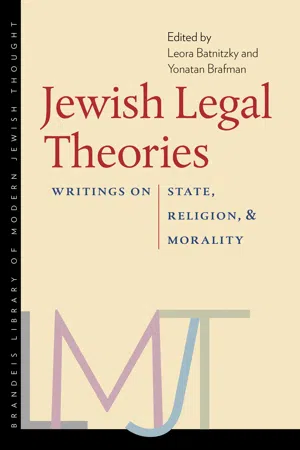
Contemporary arguments about Jewish law uniquely reflect both the story of Jewish modernity and a crucial premise of modern conceptions of law generally: the claim of autonomy for the intellectual subject and practical sphere of the law. Jewish Legal Theories collects representative modern Jewish writings on law and provides short commentaries and annotations on these writings that situate them within Jewish thought and history, as well as within modern legal theory. The topics addressed by these documents include Jewish legal theory from the modern nation-state to its adumbration in the forms of Orthodox, Conservative, and Reform Judaism in the German-Jewish context; the development of Jewish legal philosophy in Eastern Europe beginning in the eighteenth century; Ultra-Orthodox views of Jewish law premised on the rejection of the modern nation-state; the role of Jewish law in Israel; and contemporary feminist legal theory.
eBook - ePub
Jewish Legal Theories
Writings on State, Religion, and Morality
- English
- ePUB (mobile friendly)
- Available on iOS & Android
eBook - ePub
Jewish Legal Theories
Writings on State, Religion, and Morality
About this book
Information
Publisher
Brandeis University PressYear
2018Print ISBN
9781584657446
9781584657439
eBook ISBN
9781512601350
III | Ultra-Orthodoxy and the Rejection of the Modern Nation-State
In contrast to the authors in part 2, not all theorists of Jewish law accepted the privatization of Judaism and the construction of Judaism as a religious confession. A group of rabbinic decisors and ideologues—many, though not all, of whom lived in what was then the Austro-Hungarian Empire—rejected pressures to culturally integrate from the non-Jewish government and efforts to religiously reform by other Jews. Instead, they articulated a new form of Judaism—Ultra-Orthodoxy—that asserted the holistic integrity of Jewish law and the distinctiveness of the Jewish people.
Moshe Sofer is the founding figure of this conservative tradition, especially as his thought is extended and amplified by Akiva Yosef Schlesinger. Despite their differences from their predecessors and from each other, Avraham Yeshayahu Karelitz (initially in Mandatory Palestine and later in the State of Israel) and Yoel Teitelbaum (in the United States) can be seen as representatives of Ultra-Orthodoxy, in that each asserts a monolithic conception of Jewish law that is meant to govern the collective life of the Jewish people. Isaac Breuer, though set off from the mainline of this tradition by genealogy, geography, and education, gives Ultra-Orthodoxy a philosophical articulation. For him, Torah as law constitutes the Jewish nation. Yet these authors did not embrace the attempt to establish a state for this nation and its laws. Indeed, some of them were among Zionism’s most vocal critics.
The conservatism of these Ultra-Orthodox thinkers should not be mistaken for faithful preservation, however. Ultra-Orthodox legal theorists use novel arguments and controversial sources to assert their view of Jewish law. Indeed, the other figures represented in this part of the volume, though also associated with Orthodoxy, can serve as indexes of Ultra-Orthodoxy’s novelty. For instance, Zevi Hirsch Chajes’s reaction to Sofer’s rejection of innovation demonstrates how new that rejection really was. Moshe Shemuel Glasner’s dynamic view of the Oral Torah indicates the alternative trajectories that were possible from Sofer’s thought and anticipates the Zionist writers of the next part. And Moshe Feinstein’s debate with Yoel Teitelbaum highlights disagreements over the legitimate sources of Jewish law and the homogeneity of the Jewish people.
The figures in this part of the volume thus represent a third way, relative to those legal thinkers included in the previous and subsequent parts. They reject the privatization of Jewish law as well as its nationalization. Instead, in different ways, they articulate a political but nonstatist Jewish law.
19 | Selections from the Writings of Moshe Sofer and Associated Texts
Moshe Sofer (1762–1839) was the leader of what would become known as Orthodox Judaism in its formative struggles against efforts to reform Jewish practice. Born in Frankfurt am Main, in Germany, he served as the rabbi in several cities in Hungary before assuming the position of rabbi of Pressburg, where he established an important yeshiva as well as a rabbinical dynasty. Called by the name of his collection of responsa, Hatam Sofer (Seal of the scribe), his approach to Jewish law is characterized by a strict conservatism that is expressed in a statement that would become the motto of his followers: “The new is forbidden by the Torah!” Sofer asserts what he claims is the authority of an unchanged tradition, which he simultaneously constructs. Indeed, Sofer’s motto itself is based on an innovative reinterpretation of a classical rabbinic dictum.1 Sofer’s innovative conservatism is evident in his leveling of previously acknowledged legal distinctions, such as between customs and enactments and between rabbinic and biblical laws, to solidify Jewish law as a monolithic structure that must be accepted in its entirety. Indeed, Sofer argues that rabbinically instituted laws possess biblical authority and that contemporary rabbinical courts cannot modify them. Though Sofer viewed such stringency as warranted by the threat of reform, other traditional rabbis were troubled by it, as evidenced by the notes of Zevi Hirsch Chajes, a student of Naḥman Krochmal, in his correspondence with Sofer. On a sociocultural level, Sofer insisted on the maintenance of boundaries between Jews and non-Jews, an idea that would be emphasized by those who followed him.2
Moshe Sofer, She’elot u-Teshvot Hatam Sofer (Brooklyn, NY: Grossman, 1958), 1:45a–46b (translated by Elli Fischer).
Abundant peace to the honored master . . . Rabbi Avraham . . . : . . . .
Today my eyes lit up from the sweetness of your statements about the consistory of the province of Westphalia, who attempted to uproot the established rules (halakhot kavu‘ot), the instructions of our fathers and rabbis, to treat species of kitniyot3 as forbidden on the festival of Passover. Yet they stood up on their own to permit this for themselves.
. . . [P]erhaps they know why they ruled permissively, and we therefore must give them the benefit of the doubt. . . .
This is for them, but for us, who, thank blessed God, do not need this safeguard, it is clear that these species must not be permitted. It goes without saying that it is not possible [to permit them] without the release [from vows] . . . , for that is obvious; who is so prominent, who is so important, who is so perfectly tailored to uproot this enactment and this fixed practice that was established by so many of our French rabbis? For even according to the accepted stance—that a practice that did not spread throughout all of Israel can be annulled by a minor rabbinical court4—in the present case this would not apply for several reasons. First, in my humble opinion, the sages who instituted it never enacted it in the first place with the intent that it spread throughout all Israel, only to Ashkenazim.5 . . . This rationale was written by Tosafot6 in [b. Gittin] 36b. . . . And it is clear that today we have no great court that can oppose those eminences [who established the prohibition].
Furthermore, according to Maimonides’ [Mishneh Torah] “Laws of Rebels,” [2:3,]7 anything that safeguards the Torah may not even be abolished by a great rabbinical court.
Furthermore, . . . a long-standing practice nevertheless may not be permitted without reason. On the contrary, we must add fences and safeguards, since the generation is not worthy. Due to our manifold transgressions, this generation is completely licentious, and therefore it is necessary to continue boldly toward stringency and not be lenient. . . .
. . . Indeed, Shulhan Arukh,8 Yoreh De‘ah section 228:28, rules that there is no way to permit a consensus reached on a fence and safeguard. . . . Indeed, God expressed His desire for [such safeguards] when He said: “Enact precautions for precautions.”9 . . .
Rabbinical Court of Hamburg, Elu Divrei ha-Brit [These are the words of the covenant] (Altona, 1819), iii–vi and 6–11 (translated by Elli Fischer).
ANNOUNCEMENT
. . . Behold, in our sins, it has been several years since Jewish men began to scorn the word of God, the words of our sages of blessed memory, the authors of the Mishnah and Talmud. . . .
But now, due to our great sins, the malignancy has spread in the Jewish community, for some people have begun to congregate together and make evil statutes to change Jewish custom against the holy words of the sages of blessed memory. . . .
This is what they have begun to do: They have attacked the order and customs of our prayers . . . and [they] pray in the German language, against the custom of all Israel.
We have now been asked to render an opinion on this matter, that is, whether those changes to our prayer rites can be permitted. After thoroughly studying the issue, we have issued this ruling (pesak halakhah):
(A) It is forbidden to alter any formulation from the prayer rite that has been handed down to us from our late predecessors of blessed memory.
(B) It is forbidden to recite public prayers in the synagogue in any language but the Holy Tongue, as is the custom of all Israel.
(C) It is forbidden to make music in the synagogue with any instrument on Shabbat and festivals, even by means of a non-Jew who was readied before Shabbat.
We have sincerely hoped that those people would incline their ears to our words and heed the voice of their teachers, who alone are suited to render an opinion on all that pertains to what is permitted and forbidden (issur ve-heter). . . .
But our hopes were for naught, for these people disobeyed with their scheming and made themselves low with their sins. They very quickly built a house of prayer that they called a “Temple.” They published a prayer book for Shabbat and the festivals. . . . They added and subtracted from the prayer rite as they saw fit. . . . They printed most of the prayers in German, not the Holy Tongue, and worst of all is the sick wickedness that they omitted every instance in which faith in the ingathering of exiles is mentioned. . . .
One who denies this faith denies the principles of the religion (kofer be-ikkarei ha-dat). . . .
This is for you, Jewish brothers: the legal ruling (pesak din) of the most eminent rabbis of our time. . . . They all, with one voice, respond and say that these men have perpetrated an abomination with their society, called “Neuer Tempelverein.” And any man who is called a Jew is forbidden to pray from their prayer books. Away! Touch not!10 . . . Keep your sons away from their house of prayer, even for occasional visits. Keep yourself far away from her; do not come near the doorway of her house.11 . . .
From the just rabbinical court (beit din tzedek), which safeguards the Torah and worship.
Hamburg, Iyar 5579 [1819]
. . . .
A LETTER
From the great, eminent, and renowned for praise Rabbi Moshe Sofer . . .
To the just Rabbinical Court of Hamburg, etc. . . .
Innovations have come but lately,12 and one of their laws is that their house of prayer is closed up tight all week, but on Shabbat it is open. Would that they close the doors then, too, for they have altered the formulation of our prayers, which we have received from the Men of the Great Assembly,13 from the sages of the Talmuds, and from our holy forefathers. They have . . . also removed the texts on the offshoot of David, our Messiah, and on the rebuilding and renovation of the holy city of Jerusalem. They appoint a non-Jew to play an instrument for them on the holy day of Shabbat, which is forbidden to us. And most of their prayers are specifically in German.
. . . You have asked me to join the lions, the eminent rabbis of our time, who repair the breaches of the generation, and to express my opinion on whether or not the truth lies with them. What shall I respond? . . .
. . . The Mishnah of our Holy Rabbi14 and both Talmuds, which were composed after the destruction, are filled with the laws of daily prayers. . . .
It is known that in the days of the Second [Jerusalem] Temple, Israel lived on its land, and they held the ruler’s staff with greatness and glory for centuries. And they had great sa...
Table of contents
- Cover Page
- Title Page
- Copyright
- Contents
- Foreword
- Acknowledgments
- Introduction
- I | Jewish Law and the Rise of the Modern Nation-State
- II | Eastern European Views of Law: Dissolution of Jewish Communal Power
- III | Ultra-Orthodoxy and the Rejection of the Modern Nation-State
- IV | Jewish Law and the State of Israel
- V | Jewish Feminist Views of Law
- Index
Trusted by 375,005 students
Access to over 1.5 million titles for a fair monthly price.
Study more efficiently using our study tools.
Frequently asked questions
Yes, you can cancel anytime from the Subscription tab in your account settings on the Perlego website. Your subscription will stay active until the end of your current billing period. Learn how to cancel your subscription
No, books cannot be downloaded as external files, such as PDFs, for use outside of Perlego. However, you can download books within the Perlego app for offline reading on mobile or tablet. Learn how to download books offline
Perlego offers two plans: Essential and Complete
- Essential is ideal for learners and professionals who enjoy exploring a wide range of subjects. Access the Essential Library with 800,000+ trusted titles and best-sellers across business, personal growth, and the humanities. Includes unlimited reading time and Standard Read Aloud voice.
- Complete: Perfect for advanced learners and researchers needing full, unrestricted access. Unlock 1.5M+ books across hundreds of subjects, including academic and specialized titles. The Complete Plan also includes advanced features like Premium Read Aloud and Research Assistant.
We are an online textbook subscription service, where you can get access to an entire online library for less than the price of a single book per month. With over 1.5 million books across 990+ topics, we’ve got you covered! Learn about our mission
Look out for the read-aloud symbol on your next book to see if you can listen to it. The read-aloud tool reads text aloud for you, highlighting the text as it is being read. You can pause it, speed it up and slow it down. Learn more about Read Aloud
Yes! You can use the Perlego app on both iOS and Android devices to read anytime, anywhere — even offline. Perfect for commutes or when you’re on the go.
Please note we cannot support devices running on iOS 13 and Android 7 or earlier. Learn more about using the app
Please note we cannot support devices running on iOS 13 and Android 7 or earlier. Learn more about using the app
Yes, you can access Jewish Legal Theories by Leora Batnitzky, Yonatan Brafman, Leora Batnitzky,Yonatan Brafman in PDF and/or ePUB format, as well as other popular books in Law & Law Theory & Practice. We have over 1.5 million books available in our catalogue for you to explore.