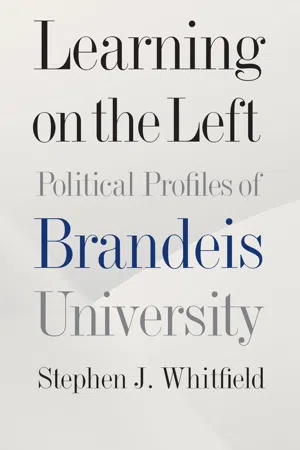
Brandeis University is the United States' only Jewish-sponsored nonsectarian university, and while only being established after World War II, it has risen to become one of the most respected universities in the nation. The faculty and alumni of the university have made exceptional contributions to myriad disciplines, but they have played a surprising formidable role in American politics.
Stephen J. Whitfield makes the case for the pertinence of Brandeis University in understanding the vicissitudes of American liberalism since the mid-twentieth century. Founded to serve as a refuge for qualified professors and students haunted by academic antisemitism, Brandeis University attracted those who generally envisioned the republic as worthy of betterment. Whether as liberals or as radicals, figures associated with the university typically adopted a critical stance toward American society and sometimes acted upon their reformist or militant beliefs. This volume is not an institutional history, but instead shows how one university, over the course of seven decades, employed and taught remarkable men and women who belong in our accounts of the evolution of American politics, especially on the left. In vivid prose, Whitfield invites readers to appreciate a singular case of the linkage of political influence with the fate of a particular university in modern America.
- English
- ePUB (mobile friendly)
- Available on iOS & Android
eBook - ePub
About this book
Information
1
Introduction
In the spring of 1982, historian Morton Keller served as Harmsworth Visiting Professor of American History at Queen’s College, Oxford. While there, he was given a chance to meet the Patroness of the College, the Queen Mother herself. Upon meeting the visitor from the United States, she inquired where he usually taught. “Brandeis, ma’am,” Keller responded. The Queen Mother sighed: “There are so many new universities today.”1 At last count, the United States harbors well over four thousand colleges and universities. This book depicts only one of them. It is not an institutional history. No scholarly history of Brandeis exists, nor is this volume bucking to be so regarded. It does not aspire to provide a record of campus activities and issues. Instead, Learning on the Left recounts part of the past of a university that is distinctive, because it hired faculty members and produced students who made a difference in American politics. They became noteworthy as political activists, as political thinkers, and as political writers. They exerted considerable influence in a nation that achieved its independence two centuries before Keller’s encounter with the Queen Mother. Within the boundaries of American politics, this particular university has punched above its weight. That is the thesis of this book.
The case presented here is cumulative, so depth must be sacrificed to breadth, though the endnotes can serve to supply a fuller paper trail. Because Brandeis was founded as recently as 1948, any historical account is bound to be
brief. Frederick M. Lawrence, who served as eighth president, liked to point out that more Americans have walked on the moon than have headed Brandeis University. Learning on the Left rarely analyzes the internal policies that presidents and deans and provosts have pursued. Yet it cannot pretend to be comprehensive in the profiles that it presents, a goal that would tax the energy of the author as well as the patience of his readers. All of the figures depicted in Learning on the Left sought to act and think politically. Ideally, that means to temper commitment with realism, earnest passion with sound judgment, the ardor of dedication with the coolness of reason. How convenient that Brand and Eis happen to be the German terms for “fire” and “ice.”2 How effectively these elements were reconciled in the lives and works of faculty and alumni can be judged from the following pages. What unites the figures portrayed in this book is of course their affiliation with the university. But no study of their political salience can be circumscribed to the campus; the careers that they forged afterward (and sometimes before) must be traced to verify the argument of this book. Their lives and their ideas testify to the significance of what these figures did when they were not inhabiting classrooms in Waltham, Massachusetts.
The portraits are therefore largely extracurricular, and the implications may well resonate beyond the Brandeis campus. They also constitute a case study of the fate of liberalism, a term that has had a heavy workout in Western thought over the span of a couple of centuries. How might it be defined? In the United States, in the second half of the twentieth century, a keen devotion to the ideal of an open society, as well as protection of disfavored minorities in particular, is what separated liberals from conservatives. The left has tended to favor change over stability, to prefer liberty over authority, to seek remedies in government rather than to cut slack to corporations, and to invest in hopes for a better future more than in reverence for the past. For the first fifteen years or so of Brandeis University, the progressivism of its faculty and students diverged from the national mood of conservatism. For the next decade or so, liberalism was subjected to pressure from a nascent militant left. Animated by greater urgency than liberals, radicals have been more sensitive than others to economic injustice, and their challenge to the limits of postwar liberalism also partakes of the story. Republicans have served on the faculty and could be found in the student body. So have conservatives. But their influence never remotely
matched the role that socialists as well as liberals played in the earliest decades of the university, and that liberals have played all the way down to the present.
In tracking how a new educational institution affected the nation’s politics, many ways of telling this story are available. Here its structure is thematic. Its span briefly includes the twenty-first century. Yet Learning on the Left is also weighted heavily toward the first three postwar decades. That is because an act of more distant historical retrieval is more urgent and more necessary than when memories are fresher and the actuarial tables have yet to take full effect. When Brandeis was tiny, with graduating classes in the low three figures, its faculty in particular took on a larger-than-life impact that was bound to be reduced as the size of the community grew. But the top-heavy chronological emphasis has a further justification. Like virtually all other American campuses, Brandeis became depoliticized by the end of the 1970s. Protests became rarer and less disruptive. Faculty and alumni continued to serve as an index of the vicissitudes of the public culture, but the political profile of the institution became much less odd and less noticeable. No emphatically conservative perspective emerged, but campus discussion of public issues became far less impassioned.
Because Learning on the Left mostly belongs to the genres of political and (somewhat less so) intellectual history, entire disciplines that are essential to a liberal arts curriculum are ignored. In 2017 two faculty members arrived in Stockholm to share a Nobel Prize in Physiology or Medicine (though Brandeis lacks a medical school). The research of neuroscientists Jeffrey Hall and Michael Rosbash in circadian rhythms has no overt political implications, so such scientists are absent from the pages that follow. So is Roderick MacKinnon ’78, a biochemistry major, who won a Nobel Prize in Chemistry in 2003 “for discoveries concerning channels in cell membranes.” The creative arts are also omitted (with a few exceptions), as are the classics. Yet even such fields as anthropology and economics are largely neglected. The most famous account of faculty-student relations at Brandeis is undoubtedly Tuesdays with Morrie: An Old Man, a Young Man, and Life’s Greatest Lesson (1997). Mitch Albom ’79, who majored in sociology, wrote this memoir of his friendship with a former professor, Morris S. Schwartz (1916–95); and the book remained on the best-seller lists in both hardcover and paperback for more than seven years.3 The apolitical Albom
produced five subsequent number 1 best sellers, but any assessment of their impact (in forty-two languages) belongs in a very different book.
Did Brandeis University decisively shape what its faculty members and alumni have said and done in American political history? How big a difference did Brandeis make in stimulating or encouraging or reinforcing the political ideas and commitments to which the men and women in this book subscribed? No answer can be satisfactory; no stab at generalization can be much more than guesswork. Coincidence cannot be discounted. Some faculty members were only briefly employed at Brandeis. Some arrived with their political views already fully formed. Take the most famous person ever to teach at Brandeis. She once confided to a friend that she would have voted socialist in 1932 (the candidate was Norman Thomas), but for the impediment that her own husband was running for the presidency too.4 His name was Franklin D. Roosevelt. Others associated with Brandeis developed their most important ideas only after leaving Brandeis, and then may have significantly revised or even repudiated them. Difficulties of generalization became evident in a 2011 monograph that the firm of Couleurs Livres published in Brussels. The ten intellectuals who were profiled personified the “nouveaux penseurs de la gauche américaine.” Three of these fresh thinkers brandished Brandeis connections: political theorist Michael Walzer ’56, political theorist Susan Moller Okin, and sociologist Richard Sennett. But because John Rawls, born exactly nine decades earlier, could hardly have been called a “new” theorist, and because Charles Taylor is a Canadian, the space allotted on this list to Brandeis looms even larger. And yet the commonalities it might have fostered cannot easily be tabulated.
Even when the undergraduate experience can be deemed formative, that phase of life usually lasts no more than four years. Consider, for example, the close friendship of the political theorist Michael J. Sandel ’75 and the journalist Thomas L. Friedman ’75. They happen to have met as classmates in Hebrew School in Minneapolis, where, as seven-year-olds, they co-starred in a Purim play, and a little over a decade later linked up at Brandeis.5 It would be foolish to conjecture that, had they matriculated elsewhere, Sandel and Friedman would have occupied different (or lesser) niches in public life. The achievements of these two alumni can hardly be ascribed to their indebtedness to the institution that certified the completion of their degree requirements. On the
other hand, it cannot be entirely irrelevant that the men and women portrayed in these pages attended Brandeis, or taught there, as opposed to, say, Brigham Young or Texas Christian or Ole Miss. Communists believed that the forces of history could be deciphered, and typically began their analyses by proclaiming that “it cannot be an accident, comrades . . .” Such is the supposition of this book too. Incontestable proof of crucial institutional influence is elusive, but such disproportionate political involvement of Brandeis professors and alumni is suggestive.
If so many new universities (as well as older ones) exist today, what distinguishes Brandeis from the others? Is there a way to solve the riddle of singularity? Jewish auspices and atmosphere certainly made Brandeis unique among the secular institutions of higher learning in America. But how Jewish values have actually operated and how they might be applied have been contested from the beginning, and no consensus has ever quite emerged. The quest for the meaning of that legacy is not likely to be fulfilled. The arguments that it has inspired have not ceased, and perhaps that irresoluteness is for the best. The story of Brandeis is embedded within a broader struggle, by which American Jewry fought for the right to be equal while also asserting the freedom to be different. But not everyone portrayed in this book is Jewish, and not everyone who is Jewish displayed interest in the implications of that identity. The Jewish sponsorship of the university has nevertheless been very important; and its Jewish milieu—even if not quite entirely definable—has been recognizable. But to account for the pronounced leftward tilt of the faculty and alumni, a religious explanation should not be overstated. In making the case for the necessity of Brandeis, founding president Abram Leon Sachar (1899–1993) highlighted the eagerness of Jews to join the philanthropic procession that began with the denominational backing of the seminaries of the colonial era. This slant characterizes his own indispensable memoir, A Host at Last (1976), an account that packs far more information into it than any other volume about the institution that he headed for the first two decades. Sachar sought to present its creation as a perpetuation of the colonial tradition, as a replay of the formation of seminaries that were intended to train the Protestant ministry. He wanted Brandeis to be appreciated as an extension of an academic legacy that entwined scholarship and salvation.6
Brandeis was therefore to be a gift, offered to the nation by the most
conspicuous minority in the annals of Christendom. The men and women portrayed in this book, whether as reformers or as radicals, as insiders or as incendiaries, might therefore be understood as pumping life into the lineage of dissidence in the vicinity of the Pilgrims’ pride. But Sachar’s claim was also misleading. For what is so exasperatingly peculiar about the Jews is that they are not merely a religious group. They do not constitute the counterpart of the Congregationalists, Presbyterians, and others who created what would become some of the most admired centers of learning in the world. Jews are also an ethnic group. Though membership can be voluntary (through a process of religious conversion), they have primarily been an ancestral group that has normatively transmitted identity through the mother. The enmity that modern Jews have aroused has not only—or commonly—been motivated by their rejection of the divinity of Christ. Even Jews professing no religious faith have been historically subjected to hostility, and the founders of this liberal arts institution—a university that has never trained or ordained rabbis—were secular. Thus the circumstances that spurred its formation, in the immediate wake of the greatest crime ever committed against the Jewish people, differed sharply from the origins of, say, Dartmouth. The pivotal scholars in Jewish studies in the early years of Brandeis had all been German-speaking refugees, and several of their colleagues in other academic departments personified the “Judeo-Bolshevism” of Nazi vitriol. The impetus for the founding of Brandeis cannot be separated from the problem of antisemitism, which midcentury American Jews generally experienced as social barriers erected on the right, located at entrenched and established bastions of the republic.
The liberal atmosphere of the campus was intended to be both a riposte to bigotry and a refuge from it; and a clue to the progressive orientation of the university can be found in the credo that President Jehuda Reinharz PhD ’72 enunciated in defining the mission of the institution—“a Jewish-sponsored nonsectarian university, open to all and dedicated to scholarly excellence and education for social responsibility.” In 1977, when members of the first graduating class returned to the campus after a quarter of a century, Newsweek noticed not only the “largely liberal” politics of the faculty and the “strong emphasis on social issues.” The magazine also reported that “an astonishing number of graduates turn out to be activist intellectuals and social critics.”7 This book can be read as an attempt to validate that observation.
2
The Origins
American history discloses very few instances of official persecution of Jews, though not until after World War II was the full force of law brought to bear against private acts of discrimination. Not until late in the nation’s history was the persistence of antisemitism in the private sector deemed an official concern. That indifference meant that the founding of Brandeis University inevitably bore the imprint of the experience of social constraints that few Jews of the era could escape. Abram Sachar was right to describe the impulse behind the founding of the university as an expression of gratitude for the liberty and refuge that the United States gave its Jewish minority. Such patriotic appreciation was as understandable as it was genuine.
But the scars that antisemitism inflicted—the opportunities blocked, the barriers to ambition erected, the false promises dangled before a tiny and often embattled group—could not be easily healed. And in announcing that at least one university would be immune to religious, racial, and other forms of prejudice in admissions and in hiring, Brandeis was claiming that it would not yield to the bigotry that was then widely believed to be ineradicable—or at least what posterity in some distant era would remedy. The creation of this particular institution of higher learning would highlight the liberalism that promoted the ideal of a more tolerant America, and would serve as a rebuke to discrimination elsewhere. If liberalism meant anything, it meant the enhancement of opportunity, the expansion of rights, and the repudiation of unearned privilege. The ideology that pervaded the university and that promoted a more open society was therefore inseparable from an opposition to judeophobia.
However benign in comparison to the murderous venom that Jewish singularity incited elsewhere, the sting of antisemitism constituted a domestic phenomenon that could not be ignored. It reinforced the determination to found a Jewish-sponsored university. The idea was first broached during the decade known as “the tribal Twenties,” when the status of Jews was not unambiguously secure, and when the democratic ideal was tarnished by raw expressions of nativism, racism, and other forms of intolerance. During the 1920s, when many children of Eastern European immigrants began applying to colleges and universities, “the Jewish problem” seemed to become especially acute. The increase in Jewish applicants for admissions—and the tenor and tempo that such students were injecting into campus life—stirred anxiety among the upper crust, who took their dominance of the nation’s educational citadels for granted. The elite assumed that this land was their land. Even a prairie populist like William Jennings Bryan, a three-time presidential candidate on the ticket of the Democratic Party, had weighed in on the employment policies of higher education: “No teacher should be allowed on the faculty of any American university unless he is a Christian.”1 Shouldn’t the Jewish community therefore respond to exclusion by sponsoring a nonsectarian college or university?
The idea had first been articulated at the dawn of the twentieth century, though not in the United States but instead in Central and Eastern Europe, where severe quotas on the admission of Jewish applicants to universities were imposed. Tsarist Russia raised the most notorious barriers, but at the turn of the century, institutions in Switzerland and in the Second Reich were devising limitations on Jewish applicants as well. In 1902 the Zionist tribune Chaim Weizmann, then based in Geneva, joined the philosopher Martin Buber, then living in Vienna, as well as another Zionist functionary, Berthold Feivel (also spelled Feiwel), then living in Zurich, in publishing a pamphlet entitled Eine jüdische Hochschule (A Jewish University). This Hochschule would be not only a conventional institution of higher learning, but a vocational and technical college as well. The authors wanted to establish it in Palestine; but temporary sites under consideration also included Switzerland and England, with Jewish studies as well as standard academic subjects included in the curriculum. Weizmann in particular continued to champion the idea, which was realized a generation later, in 1925, when the Hebrew University conducted a dedication ceremony on Mount Scopus in Jerusalem. Albert Einstein, based in Berlin, joined the first board of governors (as did Freud).2 Fleeing Nazi persecution, Buber began teaching at the Hebrew University in 1938.
In the United States, philosemitism initiated the impetus for the idea of a Jewish university; the proponent was a gentile, the noted psychologist G. Stanley Hall. In the era of World War I, he envisioned “a new school of the prophets” to promote a spirit of internationalism. The year 1917 was hardly a propitious year to activate such a spirit. But Hall also argued that Jewish culture could best be preserved through the formation of a Jewish university. It would be a “monument of the Jewish race, of its past and future, a repository of its learning, and a conservator of its loftiest spirit.” Hall, who served as president of Clark University, did not envision his proposed institution as an alternative to the existing examples of secular higher education, but as a university that should simply be ava...
Table of contents
- Cover Page
- Title Page
- Copyright Page
- Dedication
- Contents
- 1. Introduction
- 2. The Origins
- 3. Early Atmospherics
- 4. Champions of Human Rights
- 5. Two Americanists
- 6. Thinking about Justice
- 7. Foreign-Born Radicals
- 8. Two Magazines
- 9. The Sixties
- 10. Champions of Civil Rights
- 11. Racial Grievance: January 1969
- 12. Native-Born Outlaws
- 13. Spasms of Violence
- 14. Thinking about Capitalism
- 15. The Travail of Reform
- 16. Conclusion
- Acknowledgments
- Notes
- Index
- About the Author
Trusted by 375,005 students
Access to over 1.5 million titles for a fair monthly price.
Study more efficiently using our study tools.
Frequently asked questions
Yes, you can cancel anytime from the Subscription tab in your account settings on the Perlego website. Your subscription will stay active until the end of your current billing period. Learn how to cancel your subscription
No, books cannot be downloaded as external files, such as PDFs, for use outside of Perlego. However, you can download books within the Perlego app for offline reading on mobile or tablet. Learn how to download books offline
Perlego offers two plans: Essential and Complete
- Essential is ideal for learners and professionals who enjoy exploring a wide range of subjects. Access the Essential Library with 800,000+ trusted titles and best-sellers across business, personal growth, and the humanities. Includes unlimited reading time and Standard Read Aloud voice.
- Complete: Perfect for advanced learners and researchers needing full, unrestricted access. Unlock 1.5M+ books across hundreds of subjects, including academic and specialized titles. The Complete Plan also includes advanced features like Premium Read Aloud and Research Assistant.
We are an online textbook subscription service, where you can get access to an entire online library for less than the price of a single book per month. With over 1.5 million books across 990+ topics, we’ve got you covered! Learn about our mission
Look out for the read-aloud symbol on your next book to see if you can listen to it. The read-aloud tool reads text aloud for you, highlighting the text as it is being read. You can pause it, speed it up and slow it down. Learn more about Read Aloud
Yes! You can use the Perlego app on both iOS and Android devices to read anytime, anywhere — even offline. Perfect for commutes or when you’re on the go.
Please note we cannot support devices running on iOS 13 and Android 7 or earlier. Learn more about using the app
Please note we cannot support devices running on iOS 13 and Android 7 or earlier. Learn more about using the app
Yes, you can access Learning on the Left by Stephen J. Whitfield in PDF and/or ePUB format, as well as other popular books in History & Education Biographies. We have over 1.5 million books available in our catalogue for you to explore.