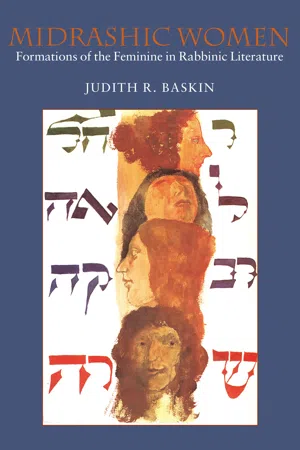
While most gender-based analyses of rabbinic Judaism concentrate on the status of women in the halakhah (the rabbinic legal tradition), Judith R. Baskin turns her attention to the construction of women in the aggadic midrash, a collection of expansions of the biblical text, rabbinic ruminations, and homiletical discourses that constitutes the non-legal component of rabbinic literature. Examining rabbinic convictions of female alterity, competing narratives of creation, and justifications of female disadvantages, as well as aggadic understandings of the ideal wife, the dilemma of infertility, and women among women and as individuals, she shows that rabbinic Judaism, a tradition formed by men for a male community, deeply valued the essential contributions of wives and mothers while also consciously constructing women as other and lesser than men. Recent feminist scholarship has illuminated many aspects of the significance of gender in biblical and halakhic texts but there has been little previous study of how aggadic literature portrays females and the feminine. Such representations, Baskin argues, often offer a more nuanced and complex view of women and their actual lives than the rigorous proscriptions of legal discourse.
- English
- ePUB (mobile friendly)
- Available on iOS & Android
eBook - ePub
About this book
Information
Publisher
Brandeis University PressYear
2015Print ISBN
9781584651789
9781584651772
eBook ISBN
9781611688696


DISTINGUISHING DIFFERENCES: THE OTHERNESS OF WOMEN IN RABBINIC LITERATURE
Rabbinic literature evolved over a long sweep of time and reflects influences from a variety of cultural settings. Ostensibly an expansion and adumbration of divine revelations received at Sinai, this extensive body of writings encompasses a range of competing interpretations and opinions; while majority views are privileged, minority opinions are preserved as well. Rabbinic writings are not historical documents.1 Highly edited over many centuries, this multivocal literature was created by men whose personal piety, individual experiences of the world, and vivid imaginations shaped an idealized social order which often had scant connection to the actual realities of Jewish life in the environments in which they lived.
Rabbinic views about women are as varied as rabbinic opinions on other subjects, but they rest on the conviction of women’s essential otherness from men. The talmudic statement that “women are a separate people” (B. Shabbat 62a) conveys the basic rabbinic conviction that females are human entities created by God with physical characteristics, human qualities, and social functions inherently dissimilar from those of males. Moreover, the ways in which women are perceived to be essentially different are not only ineradicable but problematic for men. It is not surprising that women occupied a subordinate place in rabbinic Judaism’s visionary world view in which free unblemished Jewish males alone participated fully in Israel’s covenant with God.2
Woman as Other
The differences between the status and roles of men and women in rabbinic social policy were so marked that some rabbis believed that female alterity began at conception. In M. Niddah 3:7, a mishnah discussing how long a woman remains in a state of ritual impurity following a miscarriage, R. Ishmael explained that postpartum female ritual impurity is significantly longer following the birth of a daughter3 because “a male is fully fashioned on the forty-first day [after conception] while the female is not fully formed until the eighty-first day.” Although this opinion is ultimately rejected by the majority of the sages, who maintain “that both the fashioning of the male and the fashioning of the female take the same course, each lasting forty-one days,” the preservation of R. Ishmael’s minority position indicates that it accorded with rabbinic views about the essential differences between male and female.
The patently appealing notion that the process of fashioning a female took twice as long as fashioning a male is also considered at length in B. Niddah 30b, part of the extensive talmudic discussion about human conception and embryology based on M. Niddah 3:7 in B. Niddah 30a–31b. Here, too, R. Ishmael’s view is finally rejected, this time on the grounds that “The duration of the fashioning period cannot be derived from that of [the period of] uncleaness.” Nevertheless, even if a majority of rabbis could not find convincing evidence that the essential distinctions between male and female were reflected in each gender’s development from the moment of conception, dominant views confirm that the dissimilar social roles and destinies of each gender were evident from birth.
The following segment of B. Niddah 31b, in particular, raises many of the areas of woman’s profound otherness from man that will be discussed in detail in this chapter:
R. Isaac citing R. Ammi further stated: As soon as a male comes into the world peace comes into the world, for it is said, “Send a gift (khar) to the ruler of the land” (Isa. 16:1), [and the Hebrew word for] “male” (zakhar) [is composed of the consonants of the words for] “this is a gift” (zeh khar). R. Isaac citing R. Ammi further stated: When a male comes into the world his provisions come with him, [the Hebrew for] “male” (zakhar) [being composed of the consonants for the words for], “this is provision (zeh khar),” for it is written, “And he prepared a great provision (kherah) for them” (2 Kings 6:23). [Conversely] a female has nothing with her, [the Hebrew for] “female” (n’qevah) implying “she comes with nothing” (n’qiyyah ba’ah). Unless she demands her food nothing is given to her, for it is written, “Name (naq’vah) the wages due from me and I will pay you” (Gen. 30:28).R. Simeon b. Yohai was asked by his disciples: Why did the Torah ordain that a woman after childbirth should bring a sacrifice? He replied: When she is giving birth she swears impetuously that she will never again have intercourse with her husband. The Torah, therefore, ordained that she should bring a sacrifice4. . . . And why did the Torah ordain that in the case of giving birth to a male [a woman may resume sexual relations with her husband] after seven days but in the case of a female [relations may not resume until] after fourteen days? [On the birth of] a male, with whom all rejoice, she regrets her oath after seven days, [but on the birth of] a female, about whom everybody is upset, she does not regret her oath [of abstaining from sexual relations] until after fourteen days. And why did the Torah ordain circumcision on the eighth day? In order that the guests should not enjoy themselves while his father and mother are not in the mood for it.It was taught: R. Meir used to say, Why did the Torah ordain that the uncleanness of menstruation should continue for seven [additional] days? Because being in constant contact with his wife [a husband might] develop a loathing towards her. The Torah, therefore, ordained: Let her be unclean for seven days in order that she shall be beloved by her husband as at the time of her first entry into the bridal chamber.5R. Dostai son of R. Jannai was asked by his disciples: Why does a man go in search of a woman and no woman goes in search of a man? This is analogous to the case of a man who lost something. Who goes in search of what? He who lost a thing [his rib] goes in search of what he lost. And why does the man lie face downwards [during sexual intercourse] and woman face upwards towards the man? He [faces the elements] from which he was created and she [faces the man] from whom she was created. And why is a man easily pacified and a woman is not easily pacified? He [derives his nature] from the place from which he was created and [she derives hers] from the place from which she was created. Why is a woman’s voice sweet and a man’s voice is not sweet? He [derives his] from the place from which he was created and she [derives hers] from the place from which she was created. Thus it is said, “Let me hear your voice; / For your voice is sweet / And your face is comely” (Song of Songs 2:14).
A number of themes having to do with distinctions between males and females are raised in this passage. They include the views that the birth of a male excites celebration while the birth of a female is a cause for disappointment. Males are said to come into the world well equipped to function fully in society and to leave progeny after them. Women, conversely, come into the world with nothing; they are dependent upon male largesse for their very survival and, as empty wombs, they must wait for male agency in order to become bearers of children. A male child is circumcised on the eighth day of life to the great delight of all; indeed, on that day his parents may resume sexual relations. No rituals await new born daughters and, as a sign of grief at her gender, marital relations may only resume fourteen days after her birth. Women must be separated from their husbands during their menstrual periods, and, as the halakhah evolved, for a week afterward. R. Meir is credited with the view that this enforced hiatus maintains marital romance since it prevents the husband from finding his wife distasteful.
The final segment of B. Niddah 31b attributes distinctions between man and woman to differences in their modes of creation, a topic discussed in depth in chapter 2 of this book. The passage suggests that the preferred position for sexual intercourse is that in which the man, on top, looks towards his origins in the earth (i.e., to the cosmic substance from which God created him) while the woman, facing upward, looks toward the man from whose body she was created. Men communicate directly with God and the cosmos while women experience that relationship only vicariously, if at all, through their subordinate relationship to their husbands.6 Moreover, because woman was created from a bone, which can be used as a musical instrument, her voice is described here as sweet. A woman’s sweet voice can be as much of a sexual incitement as her physical beauty and B. Niddah 31b concludes with a proof text from Song of Songs evoking the pleasant and the problematic aspects of woman’s sexual attractiveness to men, both of which play significant roles in rabbinic formations of the feminine.
The Centrality of Men
The interpreters and expositors of rabbinic Judaism were men, and the divinely mandated society they imagined was decidedly oriented towards their own sex. As B. Niddah 31b elucidates, rabbinic Judaism literally saw men as God’s gift to the world. When female voices are heard in rabbinic literature, they are usually mediated through male assumptions of female difference and inferiority. Women did not play any active part in shaping rabbinic Judaism’s idealized design for an androcentric communal life centered on worship, study, and governance according to divinely revealed mandates. In this religious system, men expound the divine rulings that affect women’s lives; women, the objects of some these directives, have no standing to legislate for themselves or others.7 One of the most succinct statements of the difference in the status of men and women in rabbinic Judaism is found in B. Menahot 43b, in a discussion of the various ritual obligations incumbent on the adult male Jew:
It was taught: R. Judah [in some sources R. Meir] used to say, A man is bound to say the following three blessing daily: “[Blessed are you . . . ] who has not made me a gentile,” “who has not made me a woman,” and “who has not made me a brutish man,” R. Aha ben Jacob once overheard his son saying “[Blessed are you . . . ] who has not made me a brutish man,” whereupon [struck by the arrogance of the statement since brutish men are also bound by the commandments] he said to him, “And this too?” Said the other, “Then what blessing should I say instead?” [He replied] “. . . who has not made me a slave.” [Objectors asked] and isn’t that the same as a woman [since a woman and a slave are of the same status regarding performance of commandments]? [It was answered] A slave is more contemptible.
These three blessing ultimately became part of the daily liturgy for morning prayers in traditional Jewish practice, enshrining the difference in the status of men and women in rabbinic Judaism for centuries to come.8
Certainly there were rabbinic voices sympathetic to women and their situations. Scholars including Judith Hauptman and Jacob Neusner have demonstrated how rabbinic legislation enhanced women’s rights in various areas of social and economic life, eliminated glaring injustices, and often eased problematic legal situations.9 Such mitigations, however, should not be understood as indicating any fundamental alterations in the overwhelming rabbinic consensus of women’s essential otherness and lesser capabilities. Moreover, neither women’s important economic activities, nor their religious rituals, which undoubtedly existed, nor female understandings of their lives, experiences, or spirituality are retrievable in any significant way from this male-centered literary corpus, which represents an idealized vision of how life should be lived more than it reflects the actual realities of everyday existence.10
B. Niddah 31b suggests that a man, despite all his advantages, is somehow incomplete without a woman; she was formed from his rib and he must recover what he has lost in order to fulfil his legal obligation to procreate. To devalue women in comparison with men is not to devalue them altogether. Rabbinic literature affirms that individual women, who are indispensable to reproduction and are required to provide essential family support services, were not only necessary for the smooth functioning of everyday life in the present and for Jewish continuity in the future, but could also be cherished beings who were loved and protected by specific men. Indeed, as long as women satisfied their essential domestic expectations, they were revered and honored for enhancing the lives of their families, and particularly for enabling male relatives to fulfil their religious obligations of prayer and study. B. Berakhot 17a relates that women earn merit “by making their sons go to the synagogue to learn Scripture, and their husbands to the studyhouse to learn Mishnah, and by waiting for their husbands until they return from the studyhouse.”11 B. Yoma 47a preserves several anecdotes attributing the achievements of high priests to the valor and modesty of their mothers.
While numerous texts condemn immodest and light minded women who do not conform to patriarchal expectations, rabbinic literature praises the supportive, resourceful, and self-sacrificing wife and mother, and expresses concern for her physical and emotional needs and welfare.12 Rabbinic jurisprudence frequently moved beyond biblical precedents in its efforts to ameliorate some of the disadvantages and hardships women faced as a consequence of biblical legislation, particularly in extending protection to women in personal status areas.13 Moreover, many halakhic authorities sought to be flexible in easing difficulties which individual women encountered because of their disadvantaged position in rabbinic legislation, including complications resulting from levirate marriage, desertion, and the inability to divorce a husband or to contest an undesired divorce.14 Still, despite some willingness to consider an individual woman’s personal situation sympathetically, the purport of rabbinic opinion is that a woman best contributes to a smoothly functioning society when she is submissive to and supportive of male authority. As B. Niddah 31b advises, woman, who is inherently inflexible due to her creation from the bone of a rib, must look to the more adaptable man from whose body she was created for guidance and security.
Circumcision and Male Potency
Male anxiety about female corporeality and its functions played a significant part in the relegation of women to a secondary place in rabbinic Judaism’s public and ritual life. Many rabbinic authorities believed women’s bodies were irredeemably deficient since they lacked the ability to generate life. As B. Niddah 31b put it, a woman comes into the world with nothing while man is well equipped for his stay on earth. Essentially passive, a female depends on male potency for everything, including the produ...
Table of contents
- Cover Page
- Title Page
- Copyright
- Dedication
- Contents
- Acknowledgments
- Note on Translations and Abbreviations
- Introduction
- 1. Distinguishing Differences: The Otherness of Women in Rabbinic Judaism
- 2. Constructing Eve: Midrashic Revisions of Human Creation
- 3. Eve’s Curses: Female Disadvantages and Their Justifications
- 4. Fruitful Vines and Silent Partners: Women as Wives in Rabbinic Literature
- 5. “Why Were the Matriarchs Barren?”: Resolving the Anomaly of Female Infertility
- 6. “A Separate People”: Rabbinic Delineations of the Worlds of Women
- Afterword
- Notes
- Bibliography
- Subject Index
- Index of Primary Sources
Trusted by 375,005 students
Access to over 1.5 million titles for a fair monthly price.
Study more efficiently using our study tools.
Frequently asked questions
Yes, you can cancel anytime from the Subscription tab in your account settings on the Perlego website. Your subscription will stay active until the end of your current billing period. Learn how to cancel your subscription
No, books cannot be downloaded as external files, such as PDFs, for use outside of Perlego. However, you can download books within the Perlego app for offline reading on mobile or tablet. Learn how to download books offline
Perlego offers two plans: Essential and Complete
- Essential is ideal for learners and professionals who enjoy exploring a wide range of subjects. Access the Essential Library with 800,000+ trusted titles and best-sellers across business, personal growth, and the humanities. Includes unlimited reading time and Standard Read Aloud voice.
- Complete: Perfect for advanced learners and researchers needing full, unrestricted access. Unlock 1.5M+ books across hundreds of subjects, including academic and specialized titles. The Complete Plan also includes advanced features like Premium Read Aloud and Research Assistant.
We are an online textbook subscription service, where you can get access to an entire online library for less than the price of a single book per month. With over 1.5 million books across 990+ topics, we’ve got you covered! Learn about our mission
Look out for the read-aloud symbol on your next book to see if you can listen to it. The read-aloud tool reads text aloud for you, highlighting the text as it is being read. You can pause it, speed it up and slow it down. Learn more about Read Aloud
Yes! You can use the Perlego app on both iOS and Android devices to read anytime, anywhere — even offline. Perfect for commutes or when you’re on the go.
Please note we cannot support devices running on iOS 13 and Android 7 or earlier. Learn more about using the app
Please note we cannot support devices running on iOS 13 and Android 7 or earlier. Learn more about using the app
Yes, you can access Midrashic Women by Judith R. Baskin in PDF and/or ePUB format, as well as other popular books in Social Sciences & Gender Studies. We have over 1.5 million books available in our catalogue for you to explore.