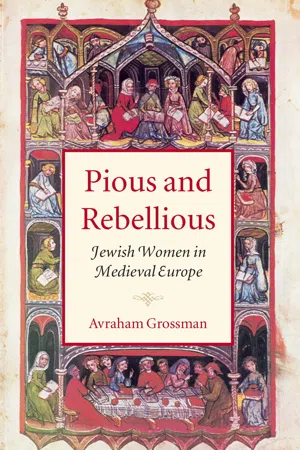
This volume, an amazing act of historical recovery and reconstruction, offers a comprehensive examination of Jewish women in Europe during the High Middle Ages (1000–1300). Avraham Grossman covers multiple aspects of women's lives in medieval Jewish society, including the image of woman, the structure of the family unit, age at marriage, position in family and society, her place in economic and religious life, her education, her role in family ceremonies, violence against women, and the position of the divorcée and the widow in society. Grossman shows that the High Middle Ages saw a distinct improvement in the status of Jewish women in Europe relative to their status during the Talmudic period and in Muslim countries. If, during the twelfth century, rabbis applauded women as "pious and pure" because of their major role in the martyrdom of the Crusades of 1096, then by the end of the thirteenth century, rabbis complained that women were becoming bold and rebellious. Two main factors fostered this change: first, the transformation of Jewish society from agrarian to "bourgeois," with women performing an increasingly important function in the family economy; and second, the openness toward women in Christian Europe, where women were not subjected to strict limitations based upon conceptions of modesty, as was the case in Muslim countries. The heart of Grossman's book concerns the improvement of Jewish women's lot, and the efforts of secular and religious authorities to impede their new-found status. Bringing together a variety of sources including halakhic literature, biblical and talmudic exegesis, ethical literature and philosophy, love songs, folklore and popular literature, gravestones, and drawings, Grossman's book reconstructs the hitherto unrecorded lives of Jewish women during the Middle Ages.
- English
- ePUB (mobile friendly)
- Available on iOS & Android
eBook - ePub
About this book
Information
Publisher
Brandeis University PressYear
2012Print ISBN
9781584653929
9781584653912
eBook ISBN
9781611683943
Index
R. Abahu (amora), 155–56, 161
Abandoned wives. See Anchored wives
Abbaye (amora), 263
Abélard, Peter, 60–61, 168
R. Abraham ben David of Posquières (Rabad), 10; on barrenness, 238; on levirate marriage, 97; on sexual relations of spouses, 129; on violence against women, 220, 224
R. Abraham ben R. Nathan Hayarhi, 54
Abstinence: in Christian cultures, 248–49, 304n7, 304n21; in Jewish culture, 9
Adam, 14–15, 31
Adultery, 135, 136, 141–44. See also Concubinage; Prostitution
Age at marriage, 33–48, 50, 63; child marriage, 37–44, 285–86nn1–2, 287n27; divorce rate, 247; economic considerations, 45–46, 288n31; education of women, 47, 167; of males, 43–44, 56–57, 286n3; number of widows, 253; violence against women, 230
Aggadah, 308
Ahimaaz, 58–59
R. Akiva, 255
Pope Alexander III, 61–62
R. Alexander Zuslin ha-Cohen, 144, 226
Al-Magribi. See Samau’al ben Judah Ibn Abbas
Rav Ami, 69
Amoraim, 307
Anchored wives, 45, 50, 291n26; commercial travel of males, 74–76, 80–83, 249–50; monetary penalties for abandonment, 80–83; widowhood, 253, 270
Annulment of marriage, 42–43
Aqedat Yizhaq, 135
Aristotle, 23–24, 284n13
Armelder, 7, 271
Rabbanit Asenath Barzani, 163
R. Asher ben Yehiel (the Rosh), 71–72, 112–13; on custody of children, 132; on deviations from sexual norms, 140–41; dislike of rationalism, 270; on divorce, 238, 239–40, 245, 250; on female mohel, 190; on levirate marriage, 92; on meat eating, 193; on the “murderous” wife, 267–72; on religious practices of women, 182
Rav Ashi, 263
Ashkenaz Europe: commercial activities of women, 274–75; community leadership of women, 194–95, 275; concubinage, 133–35, 141–47; deviations from sexual norms, 144; divorce, 244–47; education, 115, 132–33, 167–70, 298n19; Gentile maidservants, 141–44, 296nn42–44; inheritance of daughters, 150–51; levirate marriage, 93–97; migrations of Jews, 73, 145; modesty and freedo...
Table of contents
- Cover Page
- Title Page
- Copyright
- The Tauber Institute for the Study of European Jewry Series
- Brandeis Series on Jewish Women
- Contents
- Preface
- Introduction
- One: The Image of the Woman: Partner or the “Other”?
- Two: Age at Marriage
- Three: Engagement, Betrothal, and the Choice of a Marriage Partner
- Four: Monogamy and Polygamy
- Five: Feminine Modesty and Women’s Role in Supporting the Family
- Six: Woman as Wife and Mother and Her Economic Status
- Seven: Women’s Culture and Education
- Eight: The Role of Women in Religious Life and in Family Ceremonies
- Nine: Women’s Role in Jewish Martyrdom in Europe in the Eleventh to Thirteenth Centuries
- Ten: Violence Toward Women
- Eleven: The Divorcée and the “Rebellious Wife”
- Twelve: The Widow and the “Murderous Wife”
- Thirteen: Summary: Woman’s Status in Historical Perspective
- Notes
- Glossary
- Bibliography
- Index
Trusted by 375,005 students
Access to over 1.5 million titles for a fair monthly price.
Study more efficiently using our study tools.
Frequently asked questions
Yes, you can cancel anytime from the Subscription tab in your account settings on the Perlego website. Your subscription will stay active until the end of your current billing period. Learn how to cancel your subscription
No, books cannot be downloaded as external files, such as PDFs, for use outside of Perlego. However, you can download books within the Perlego app for offline reading on mobile or tablet. Learn how to download books offline
Perlego offers two plans: Essential and Complete
- Essential is ideal for learners and professionals who enjoy exploring a wide range of subjects. Access the Essential Library with 800,000+ trusted titles and best-sellers across business, personal growth, and the humanities. Includes unlimited reading time and Standard Read Aloud voice.
- Complete: Perfect for advanced learners and researchers needing full, unrestricted access. Unlock 1.5M+ books across hundreds of subjects, including academic and specialized titles. The Complete Plan also includes advanced features like Premium Read Aloud and Research Assistant.
We are an online textbook subscription service, where you can get access to an entire online library for less than the price of a single book per month. With over 1.5 million books across 990+ topics, we’ve got you covered! Learn about our mission
Look out for the read-aloud symbol on your next book to see if you can listen to it. The read-aloud tool reads text aloud for you, highlighting the text as it is being read. You can pause it, speed it up and slow it down. Learn more about Read Aloud
Yes! You can use the Perlego app on both iOS and Android devices to read anytime, anywhere — even offline. Perfect for commutes or when you’re on the go.
Please note we cannot support devices running on iOS 13 and Android 7 or earlier. Learn more about using the app
Please note we cannot support devices running on iOS 13 and Android 7 or earlier. Learn more about using the app
Yes, you can access Pious and Rebellious by Avraham Grossman in PDF and/or ePUB format, as well as other popular books in Social Sciences & European Medieval History. We have over 1.5 million books available in our catalogue for you to explore.