Paul R. Katz has composed a fascinating account of the fate of Chinese religions during the modern era by assessing mutations of communal religious life, innovative forms of religious publishing, and the religious practices of modern Chinese elites traditionally considered models of secular modernity. The author offers a rare look at the monumental changes that have affected modern Chinese religions, from the first all-out assault on them during the 1898 reforms to the eve of the Communist takeover of the mainland. Tracing the ways in which the vast religious resources (texts, expertise, symbolic capital, material wealth, etc.) that circulated throughout Chinese society during the late imperial period were reconfigured during this later era, Katz sheds new light on modern Chinese religious life and the understudied nexus between religion and modern political culture. Religion in China and Its Modern Fate will appeal to a broad audience of religionists and historians of modern China.
- English
- ePUB (mobile friendly)
- Available on iOS & Android
eBook - ePub
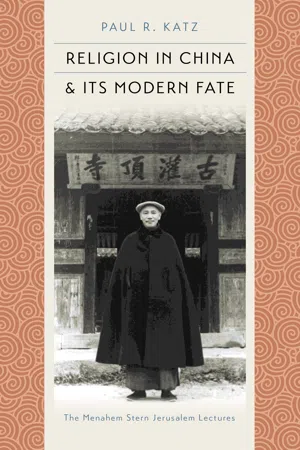
Religion in China and Its Modern Fate
About this book
Information
Publisher
Brandeis University PressYear
2014Print ISBN
9781611685435
9781611685428
eBook ISBN
9781611685442
Topic
Theology & ReligionSubtopic
20th Century History1
STATE VERSUS SOCIETY
TEMPLE DESTRUCTION CAMPAIGNS
This chapter examines temple destruction campaigns in China from 1898 to 1948, including the tearing down of temple buildings or converting part of their premises into schools or other nonreligious edifices, as well as outlawing their ritual activities and the specialists who participated in them. The chapter is divided into three sections. The first section provides a critical overview of the different campaigns that targeted temples and their rituals (not to mention other forms of traditional religious life), including “build schools with temple property” (miaochan xingxue 廟產興學), “eradicating superstitions” (pochu mixin 破除迷信), and “rectifying customs” (fengsu gailiang 風俗改良), as well as related undertakings such as the New Culture Movement (Xin wenhua yundong 新文化運動) and the New Life Movement (Xin shenghuo yundong 新生活運動). The second section of the chapter considers the roles played by the different actors who supported or opposed these campaigns, as well as the outbreaks of resistance provoked by their efforts. The third section assesses the effects of these campaigns in southern China, especially Shanghai 上海, parts of northern Zhejiang 浙江 (most notably Hangzhou 杭州 and Ningbo 寧波), and Wenzhou 溫州 in southern Zhejiang. We know that during this period China’s central, regional, and local governments frequently labeled temples and their rituals (especially festivals) as forms of “superstition” (mixin 迷信) and launched a series of campaigns both to seize their property and to assert the state’s authority over communal society. Some of these temple cults have reemerged since the 1980s, but what happened in between is, in the current state of scholarship, anybody’s guess. Yet the extent to which these facets of communal religion were destroyed during the fifty years covered by this book makes a vital difference in explaining their revival or lack thereof. In this chapter, I use archival data, newspaper articles, and other primary sources to assess the ways in which China’s temple cults and festivals strove to adapt to the challenges of this era.
TEMPLE DESTRUCTION CAMPAIGNS: AN OVERVIEW
In his article about the state regulation of religion in China, Pitman B. Potter observed that, “The relationship between religion and state power in China has long been contested.”1 As scholars such as Hsiao Kung-ch’üan have documented, the Chinese imperial state endeavored to control local society and culture through a combination of coercive and persuasive policies that were essentially a utopian project to enforce a top-down cosmic moral order.2 Daniel Overmyer’s research indicates that during the imperial era the Chinese state possessed a strong commitment to ritual practice, with imperial authority in part deriving from sacrifices to imperial ancestors and nature spirits that only the emperor and his officials could worship. According to the Book of Rites (Liji 禮記):
The son of Heaven [the king] sacrifices to Heaven and Earth; to the [spirits presiding over the] four quarters; to [the spirits of] the hills and rivers; and offers the five sacrifices of the house [i.e., to the door, the stove, the middle pillar, the gate, and the well]—all in the course of a year. The feudal princes present oblations, each to [the spirits presiding over] his own quarter, to [the spirits of] its hills and rivers, and offer the five sacrifices of the house—all in the course of the year. Great officers present the oblations of the five sacrifices of the house—all in the course of the year. [Other] officers present oblations to their ancestors. A sacrifice that is not proper to offer, and yet is offered, is called an illicit/improper sacrifice [yinsi 淫祀].3 A licentious sacrifice brings no blessings.4
By the Ming dynasty (1368–1644), these regulations had been modified to specify that the sacrifices of commoners were to be limited to their ancestors, the unruly dead, and the stove god, with exceptions to be made for the worthy. One 1368 decree ordered officials to seek out and make annual offerings to the spirits of “famous mountains and great rivers, sage emperors, enlightened kings, loyal officials, and brave officers, and all who have performed meritorious service for the nation, and who have acted in loyalty and love among the people.”5
When it came to specific religious traditions, the state attempted to regulate Buddhist and Daoist clergies,6 while it also launched suppression campaigns against sectarian religions and the so-called “secret societies,” groups that openly espoused millenarian ideologies possessing the potential to overthrow the established order, with such campaigns eventually being directed at some Christian groups as well.7 As for communal religious traditions, while the state had the authority to label unsanctioned temple cults as “illicit/improper sacrifices,” it could also co-opt popular local deities and include them in official registers of sacrifice (sidian 祀典), which meant annual offerings and occasional state-funded temples. Temple cults that the state chose to support generally were perceived as adhering to “orthodox” or Confucian ideals and practices (including making meat offerings to the gods) that the state promoted in order to “standardize” local religion and “superscribe” its agendas onto local society.8 The state generally followed a five-part strategy in dealing with temple cults, which encompassed absorption, patronage, acceptance, tolerance, and suppression, with the success or failure of these efforts varying depending on its strength in a particular region at a certain point in time.9
These policies and procedures shifted dramatically during the Republican era because of the adoption of the Western distinction between “religion” and “superstition” described in the introduction, which meant that cults to deities that originally had been approved or simply tolerated were now targeted for state suppression. Be that as it may, the attacks on temples and their rituals during this era did not necessarily constitute one continuous phenomenon, being undertaken more vigorously during some periods of time than in others. Based on his long-term research about these campaigns, Fu Haiyan 付海晏 maintains that they can be divided into the following periods: 1) late Qing (1898–1911), 2) early Republican (1911–1927), 3) Nanjing government (1927–1937), 4) War of Resistance against Japan (1937–1945), and 5) final years of the Republic (1945–1949).10 Further subdivisions are also possible, as can be seen in research by Chen Jinlong 陳金龍 that categorizes the “build schools with temple properties” campaign from 1928 to 1937 according to three distinct phases. The first phase (beginning in April 1928) had the greatest impact on the Jiangnan region, while the second (November 1930) witnessed the advent of more restrictive policies, and the third phase (August 1935) was more widespread with policies being effectively enforced.11 However, the campaigns persisted even during wartime and are documented as late as 1948.12 The temporal flows of these campaigns could also vary by place. In the case of Shanghai, for example, research by Ai Ping 艾萍 delineates three phases, with the first (1919–1927) witnessing a shift from rigid to periodic enforcement of relevant policies, the second (1927–1934) attempting to distinguish between temples to be preserved and destroyed, and the third (1934–1937) assuming a largely laissez-faire attitude toward temple cults and their festivals.13
As Vincent Goossaert and David Palmer have observed, the most thorough state effort to destroy temple cults occurred during the decade from 1928 to 1938, when the Nationalist government had reached the acme of its power following the Northern Expedition. Accordingly, the authorities proved willing to recognize the legitimacy of groups that conformed to the Western/Christian category of “religion,” especially those possessing elites able to found organizations that would negotiate with the state, while also doing their utmost to eliminate religious phenomena belonging to the “superstition” category.14 These campaigns, led by officials such as Minister of the Interior Xue Dubi 薛篤弼 (1890–1973) and educators such as Tai Shuangqiu 邰爽秋 (1896–1976), were undergirded by a wide range of policies (described in detailed studies by Rebecca Nedostup and Poon Shuk-wah), including the “Regulations for Registering Temples” (Simiao dengji tiaoli 寺廟登記條例, 1928), “Regulations for Managing Temples” (Simiao guanli tiaoli 寺廟管理條例, 1929), and “Regulations for Overseeing Temples” (Jiandu simiao tiaoli 監督寺廟條例, 1929). These policies were most notable for advocating the establishment of civic committees to oversee temple property, as well as for allowing temples to be declared “abandoned” and then taken over by the state.15 Perhaps the most influential policy of all was the “Standards to Determine Temples to Be Destroyed and Maintained” (Shenci cunfei biaozhun 神祠存廢標準), which was enacted in November 1928. The “Standards” divided temples into four categories. The first two types of temples, dedicated to “former sages” (xianzhe 先哲) and deities of the five state-recognized religions (zongjiao 宗教: Buddhism, Daoism, Catholicism, Protestantism, and Islam), were to be preserved. The latter two, namely temples for the worship of “ancient deities” (gushen 古神, encompassing a wide range of local cults, especially to nature deities and heroes) and those placed in the traditional category of “illicit/improper shrines” (yinci 淫祠) were to be eradicated. Regulations were also enacted to eliminate divination and geomancy (for example, the Feichu bushi xingxiang wuxi kanyu banfa 廢除卜莁星相巫覡堪輿辦法, 1928) as well as the manufacture and sale of ritual items deemed to be “superstitious” (Qudi jingying mixin wupin banfa 取締經營迷信物品辦法, 1929). While actual enforcement of these rules varied considerably by place and time, nonetheless they exerted immense pressure on many forms of Chinese religious life.16
At the same time, the Nationalist regime also launched an active and widespread program to reform local customs. According to a lengthy manifesto entitled “The Significance of and Methods for Destroying Superstitions” (Pochu mixin de yiyi yu fangfa 破除迷信之意義和辦法), temple destruction campaigns were related to policies such as the adoption of the Western calendar (also one form of “rectifying customs”), encouraging widespread literacy, and launching propaganda campaigns with catchy slogans to attract popular attention.17 Some of these efforts ranged from the sublime to the ridiculous. For example, one set of regulations about door gods (menshen 門神), enacted by the Fujian provincial authorities in 1935, strongly objected to the use of the term “deity” (shen 神) but proved willing to allow their continued use so long as the paintings of the door gods were limited to historical exemplars such as Yue Fei 岳飛 (1103–1142), Wen Tianxiang 文天祥 (1236–1283), and Qi Jigua...
Table of contents
- Cover Page
- Title Page
- Copyright
- Contents
- Foreword by Meir Shahar
- Preface
- Introduction
- 1. State Versus Society: Temple Destruction Campaigns
- 2. Time and A Word: New Forms of Religious Publishing
- 3. Secular Yet Sacred: The Religious Lives of Modern Chinese Elites
- Conclusion
- Notes
- Index
Trusted by 375,005 students
Access to over 1.5 million titles for a fair monthly price.
Study more efficiently using our study tools.
Frequently asked questions
Yes, you can cancel anytime from the Subscription tab in your account settings on the Perlego website. Your subscription will stay active until the end of your current billing period. Learn how to cancel your subscription
No, books cannot be downloaded as external files, such as PDFs, for use outside of Perlego. However, you can download books within the Perlego app for offline reading on mobile or tablet. Learn how to download books offline
Perlego offers two plans: Essential and Complete
- Essential is ideal for learners and professionals who enjoy exploring a wide range of subjects. Access the Essential Library with 800,000+ trusted titles and best-sellers across business, personal growth, and the humanities. Includes unlimited reading time and Standard Read Aloud voice.
- Complete: Perfect for advanced learners and researchers needing full, unrestricted access. Unlock 1.5M+ books across hundreds of subjects, including academic and specialized titles. The Complete Plan also includes advanced features like Premium Read Aloud and Research Assistant.
We are an online textbook subscription service, where you can get access to an entire online library for less than the price of a single book per month. With over 1.5 million books across 990+ topics, we’ve got you covered! Learn about our mission
Look out for the read-aloud symbol on your next book to see if you can listen to it. The read-aloud tool reads text aloud for you, highlighting the text as it is being read. You can pause it, speed it up and slow it down. Learn more about Read Aloud
Yes! You can use the Perlego app on both iOS and Android devices to read anytime, anywhere — even offline. Perfect for commutes or when you’re on the go.
Please note we cannot support devices running on iOS 13 and Android 7 or earlier. Learn more about using the app
Please note we cannot support devices running on iOS 13 and Android 7 or earlier. Learn more about using the app
Yes, you can access Religion in China and Its Modern Fate by Paul R. Katz in PDF and/or ePUB format, as well as other popular books in Theology & Religion & 20th Century History. We have over 1.5 million books available in our catalogue for you to explore.