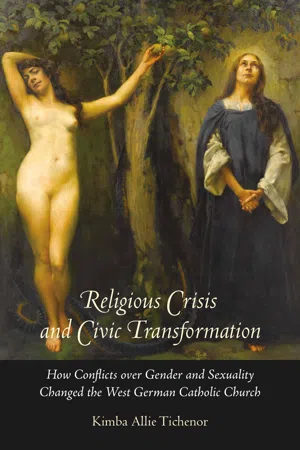
This book offers a fresh interpretation of the connection between the West German Catholic Church and post-1950s political debates on women's reproductive rights and the protection of life in West Germany. According to Tichenor, Catholic women in West Germany, influenced by the culture of consumption, the sexual revolution, Vatican II reforms, and feminism, sought to renegotiate their relationship with the Church. They demanded a more active role in Church ministries and challenged the Church's hierarchical and gendered view of marriage and condemnation of artificial contraception. When the Church refused to compromise, women left en masse. In response, the Church slowly stitched together a new identity for a postsecular age, employing an elaborate nuptial symbolism to justify its stance on celibacy, women's ordination, artificial contraception, abortion, and reproductive technologies. Additionally, the Church returned to a radical interventionist agenda that embraced issue-specific alliances with political parties other than the Christian parties. In her conclusion, Tichenor notes more recent setbacks to the German Catholic Church, including disappointment with the reactionary German Pope Benedict XVI and his failure in 2010 to address over 250 allegations of sexual abuse at twenty-two of Germany's twenty-seven dioceses. How the Church will renew itself in the twenty-first century remains unclear. This closely observed case study, which bridges religious, political, legal, and women's history, will interest scholars and students of twentieth-century European religious history, modern Germany, and the intersection of Catholic Church practice and women's issues.
eBook - ePub
Religious Crisis and Civic Transformation
How Conflicts over Gender and Sexuality Changed the West German Catholic Church
- English
- ePUB (mobile friendly)
- Available on iOS & Android
eBook - ePub
Religious Crisis and Civic Transformation
How Conflicts over Gender and Sexuality Changed the West German Catholic Church
About this book
Information
Publisher
Brandeis University PressYear
2016Print ISBN
9781611689099
9781611689082
eBook ISBN
9781611689709
Topic
HistoriaSubtopic
Historia alemana
The Male Celibate Priesthood and Woman’s Place in the Church
CHAPTER 1
Celibacy for the Kingdom of Heaven and Earth
The postwar debate on mandatory clerical celibacy in the Catholic Church did not begin in earnest until 1968. Against the backdrop of the release of the papal encyclical Humanae Vitae banning artificial contraception and calls for liberalizing the legal sexual order in West Germany, an internal Catholic debate on the charismatic nature of celibacy metamorphosed into a public debate, in which non-Catholics took an active role. For reform-minded Catholics and non-Catholics in the 1970s, the clerical celibacy requirement became emblematic of the Church’s intransigence on artificial contraception and more generally of its negative valuation of sexuality. Resentful of the Church’s active resistance to ecclesial and secular reforms concerning sexual morality, Catholic reformers and non-Catholics utilized the issue of celibacy to challenge the religious and secular authority exercised by the institutional Church in West Germany. In this challenge, the media played a critical role.
For the Church hierarchy, the celibacy debate posed multiple theological and practical challenges. Theologically, as we shall see, any challenge to the celibacy requirement had the potential to destabilize the priesthood, the relationship between clergy and laity, and marital morality. But maintaining clerical celibacy was fraught with peril for practical reasons. The immediate postwar era witnessed a dramatic increase in the shortage of priests. Initially, few Church or secular experts associated this shortage with the celibacy requirement. However, by the late 1960s, this link had been made; moreover, as Germans embraced more liberal attitudes about sexuality, they began to view the celibate priesthood as unhealthy, even perverse. This assessment was given credence by the secular media’s coverage of the debate, which centered on titillating stories about the sexual exploits of priests and behind-the-scene political intrigues involving celibacy. The Church found itself caught in a public relations nightmare, despite the valiant efforts of some bishops and theologians to utilize psychology to show that celibacy constituted a viable choice that did not compromise the health of its adherents. But fewer and fewer Catholics and non-Catholics found these arguments convincing as a growing number of dissident priests and theologians aired the Church’s dirty laundry in public. These insider accounts of sexual intrigue reinforced public perceptions of a corrupt, patriarchal church whose influence on mainstream society should be curtailed. For the West German Catholic Church, these exposés made attracting new candidates to the priesthood even more difficult.
The Church’s public image was further damaged when Catholic women entered the debate in the 1980s. For reform-minded Catholic women, the maintenance of a male celibate priesthood reinforced women’s oppression in the Church and in society. They demanded that women be given more offices in the Church; in particular, they called for the creation of a female diaconate. When the West German episcopate would not or could not institute the desired changes because of universal Church doctrine, many women stopped engaging in Church life or created niches within the Church where they could voice discontent. Alternatively, conservative women saw the celibacy debate as indicative of moral collapse in the Church and in German society; for these women, the maintenance of clerical celibacy in conjunction with Church doctrine on marriage, birth control, and abortion became a rallying point; an embattled German hierarchy would choose to support this conservative core, as did the universal Church beginning with John Paul II’s papacy. Under John Paul II, disciplinary actions against dissident theologians and priests increased dramatically, and the theological arguments advanced to support celibacy and to reject women’s ordination, artificial contraception, abortion, and NRTs became more entangled. This interpenetration of theological arguments meant that the Church found itself embroiled in an escalating series of crises from the 1960s onward, as increasingly its views on sexual morality no longer coincided with secular views.
Clerical Celibacy’s Significance for Catholicism
To understand the post–World War II celibacy debate, some information on the meaning the Catholic Church assigns to clerical celibacy is required. The word “celibacy” simply refers to the state of living unmarried.1 But in Catholicism, celibacy means much more than bachelorhood. Since the Catholic Church considers all sexual activity outside of marriage sinful, celibacy also implies chastity. Celibacy is a requisite of clerical office, but it is also considered an eschatological sign of and stimulus for the call to ministry. The celibate priest is understood to be both bride and bridegroom in the suprasexual nuptial relationship between Christ and Church. He is a chaste bride of Christ and a “living sign” of the world to come in which “the children of the resurrection neither marry nor take wives.”2 He is also the bridegroom of the Church, “his bride,” with whom he has entered into an indissoluble marriage contract. Thus, as Tina Beattie pointed out, the female body is excluded from the suprasexual relationship between Christ and the Church.3 This exclusion informs both the Church’s understanding of marriage and the exalted status accorded the celibate priesthood.
For centuries, the Church taught that celibacy, as a form of spiritual marriage with God, constituted a state superior to that of earthly marriage.4 Although marriage represented a gift from God, in its sexuality it was tainted by original sin and consequently intended for those Christians who could not practice continence. In the teachings of Thomas Aquinas, sexual intercourse prior to the Fall was a function of reason. Afterward, sexual intercourse became corrupted by lust, and the emphasis shifted to man’s loss of control over the sexual organs.5 Eve’s role as temptress and instigator of human suffering meant that marriage was intended not only as a means of controlling human sexuality, but more specifically as a means of controlling women.6 To this end, the Catholic Church taught that the primary purpose of marriage was the generation and rearing of offspring.7 This conception of marriage as an inferior form of Christian life defined by parturition helped justify the celibate male clergy’s authority over the laity, particularly in the bedroom.
Untainted by sexual intercourse, the priest was a man apart from and above his congregation. Franz Franken, a laicized priest, described the pre–Vatican II public image of the priest: “A priest was not seen as a collaborator or mediator, but as a magical numinous being with special hidden access to God, a being to which one could attach one’s most secret wishes and hopes, like the devotional objects of pilgrimage sites . . . so that at the time of Vatican II, a priest who no longer lived a celibate life was frequently branded and condemned in the Catholic public sphere as the most terrible disgrace of the Holy Catholic Church.”8 The Church went to great lengths to safeguard the sexual purity of its priests. Both codes of canon law valid during the time span covered by this monograph—those of 1917 and 1983—advised priests to avoid persons who might jeopardize their celibacy. The 1917 Code of Canon Law identified such persons specifically as women. In Germany, the 1954 Cologne Diocesan Synod established detailed rules governing interactions between priests and women. For example, young priests on vacation were prohibited from swimming with groups of young girls, and seminary students were not allowed to have any contact with girls during holidays.9 One priest reported that, during his seminary training, he was advised to avoid interactions with his sister because this too could be fraught with danger!10 The priest’s authority was based on his otherness, and the most visible manifestation of that otherness was his celibacy.
In addition to establishing rules regulating interactions between priests and women, both codes delineated punitive measures to be taken against those who broke the celibacy vow. Under these codes, the celibacy vow was binding for life. A priest who was removed from office or resigned from office remained obligated to practice celibacy. A priest could be released from his celibacy vow only if he applied for and received a dispensation from the Apostolic See; dispensation from celibacy did not automatically accompany laicization. Prior to the 1983 code, a former priest who married without dispensation was automatically excommunicated, as was his wife. Under both codes, such priests were removed from office, returned to the lay estate, and barred from holding any future office in the Church—including most offices open to the laity.
The Pre–Vatican II Era: Celibacy and the Clerical Shortage
The Latin Church has not always demanded celibacy or continence of its priests. There is evidence that, beginning in the third century, many bishops and priests were married and had children. In fact, until the fourth century, no law was promulgated by Church authorities concerning clerical marriage or continence. The Council of Elvira in roughly AD 305 would be the first to decree that married priests practice continence; however, it did not exclude married men from the priesthood. Celibacy became mandatory for priests in the Latin Church only after the Second Lateran Council in 1139. Between the twelfth and the sixteenth centuries, the celibacy requirement in the Latin Church was subject to multiple challenges; this state of affairs ended when Pius V (1566–1572) made it clear that the matter was closed. Although the issue surfaced from time to time, particularly during the French Revolution, the celibacy requirement and the elevated status assigned to the celibate state had been largely quiescent within the Latin Church from the late eighteenth century until the late 1960s.11
That said, this renewed celibacy debate did not develop overnight; it had its origins in the dynamic interplay between theological innovations, latent contradictions in existing Church doctrine, and social changes reshaping Europe in the early twentieth century. In the late 1920s, the elevated status assigned to celibacy by the Latin Church experienced a significant challenge when theologians such as Dietrich von Hildebrand, Herbert Doms, and Norbert Rochol began reconsidering the Church’s gendered and hierarchical understanding of marriage in response to the emergence of more companionate models of marriage in late-nineteenth-century Europe.12 Instead of emphasizing the primary and secondary purposes of marriage, these theologians focused on the primacy of the human subject. Although they reserved a central role in marriage for procreation and childrearing, the development of the relationship between the man and woman took precedence. In The Meaning of Marriage, Herbert Doms, perhaps the most influential critic of the scholastic understanding of matrimony, denied that marriage entailed subservience to a purpose outside the spouses: “It consists in the constant vital ordination of husband and wife to each other until they are one.”13
As Susan A. Ross has argued, in making the relationship between husband and wife one of mutuality and one in which gender roles were of minimal importance, Doms inadvertently called into question clerical authority. Marriage is one of the primary lenses through which the Catholic Church defines itself. Repeated references are made to the Church’s nuptial relationship to God; the priest’s nuptial relationship to the Church; the Christ-like authority of the husband; and the receptive character of the wife and the laity. An understanding of marriage that did not include a gendered conception of primary and secondary purposes jeopardized the masculine power of a celibate clergy to lead and instruct a receptive laity—if marriage was between two equals, the implication was that the relationship between clergy and laity was also between equals.14
In 1944, the Rota Romana banned the continued publication of Herbert Doms’s On the Meaning of Marriage because the book placed the secondary ends of marriage on the same level as its primary ends. But personalism did not disappear. In fact, Pope Pius XI incorporated a modified version of this approach into his encyclical on marriage, Casti Connubii—as will be discussed in greater detail in the chapter on birth control.15 Suffice it to say for now that a more positive valuation of the institution of marriage led some Catholics to challenge the pronouncements of a celibate clergy on marriage and reproduction. In a 1968 interview with Auxiliary Bishop Walther Kampe of Munich, some young Catholics went so far as to make the following analogy: “You can compare the advice of a celibate priest on marriage to that of a swimming instructor who gives instructions from the shore, without ever having swam himself.”16
Theological innovation was not the only internal dynamic that informed renewed debates on clerical celibacy i...
Table of contents
- Cover Page
- Title Page
- Copyright
- Contents
- Foreword
- Acknowledgments
- List of Abbreviations
- Introduction
- Part I. The Male Celibate Priesthood and Woman’s Place in the Church
- Part II. The Catholic Church and Reproductive Politics
- Epilogue
- Appendixes
- Notes
- Selected Bibliography
- Index
Trusted by 375,005 students
Access to over 1.5 million titles for a fair monthly price.
Study more efficiently using our study tools.
Frequently asked questions
Yes, you can cancel anytime from the Subscription tab in your account settings on the Perlego website. Your subscription will stay active until the end of your current billing period. Learn how to cancel your subscription
No, books cannot be downloaded as external files, such as PDFs, for use outside of Perlego. However, you can download books within the Perlego app for offline reading on mobile or tablet. Learn how to download books offline
Perlego offers two plans: Essential and Complete
- Essential is ideal for learners and professionals who enjoy exploring a wide range of subjects. Access the Essential Library with 800,000+ trusted titles and best-sellers across business, personal growth, and the humanities. Includes unlimited reading time and Standard Read Aloud voice.
- Complete: Perfect for advanced learners and researchers needing full, unrestricted access. Unlock 1.5M+ books across hundreds of subjects, including academic and specialized titles. The Complete Plan also includes advanced features like Premium Read Aloud and Research Assistant.
We are an online textbook subscription service, where you can get access to an entire online library for less than the price of a single book per month. With over 1.5 million books across 990+ topics, we’ve got you covered! Learn about our mission
Look out for the read-aloud symbol on your next book to see if you can listen to it. The read-aloud tool reads text aloud for you, highlighting the text as it is being read. You can pause it, speed it up and slow it down. Learn more about Read Aloud
Yes! You can use the Perlego app on both iOS and Android devices to read anytime, anywhere — even offline. Perfect for commutes or when you’re on the go.
Please note we cannot support devices running on iOS 13 and Android 7 or earlier. Learn more about using the app
Please note we cannot support devices running on iOS 13 and Android 7 or earlier. Learn more about using the app
Yes, you can access Religious Crisis and Civic Transformation by Kimba Allie Tichenor in PDF and/or ePUB format, as well as other popular books in Historia & Historia alemana. We have over 1.5 million books available in our catalogue for you to explore.