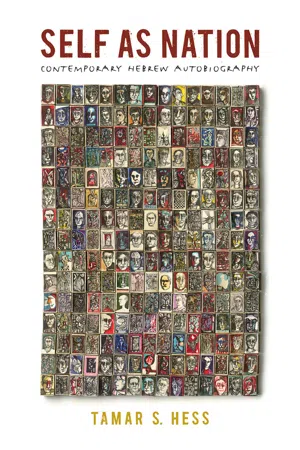
Theorists of autobiography tend to emphasize the centrality of the individual against the community. By contrast, in her reading of Hebrew autobiography, Tamar Hess identifies the textual presence and function of the collective and its interplay with the Israeli self. What characterizes the ten writers she examines is the idea of a national self, an individual whose life story takes on meaning from his or her relation to the collective history and ethos of the nation. Her second and related argument is that this self—individually and collectively—must be understood in the context of waves of immigration to Israel's shores. Hess convincingly shows that autobiography is a transnational genre deeply influenced by the nation's literary as well as cultural history. This book makes an additional contribution to the history of autobiography and contemporary autobiography theory by analyzing the strategies of fragmentation that many of the writers Hess studies have adopted as ways of dealing with the conflicts between the self and the nation, between who they feel they are and what they are expected to be. Hess contrasts the predominantly masculine tradition of Hebrew autobiography with writings by women, and offers a fresh understanding of the Israeli soul and the Hebrew literary canon. A systematic review of contemporary Hebrew autobiography, this study raises fundamental questions essential to the debates about identity at the heart of Israeli culture today. It will interest scholars and students of contemporary Israeli culture, as well as those intrigued by the literary genre of autobiography.
- English
- ePUB (mobile friendly)
- Available on iOS & Android
eBook - ePub
About this book
Information
Publisher
Brandeis University PressYear
2016Print ISBN
9781611688801
9781611688795
eBook ISBN
9781611689662
INDEX
Abramovitch, Shalom Ya‘akov. See Sforim, Mendele Mocher
Abu-Much, Huda, 164
Aciman, André, 153
“Adon Olam” (hymn), 53–54
Agnon, Shmuel Yosef, 82, 96, 186n37, 286n37; Sipur pashut (A Simple Story), 5
Alterman, Nathan, 57
Amichai, Yehuda, 49
Am Oved publishers, 77
Anderson, Benedict, 1
anecdote as narrative unit, 39–40, 71, 74, 188n56
Angel, Sarah, Malakh o satan (Angel or Devil; 1993), 173n47
Appelfeld, Aharon, 89–102; Ballas compared, 75–77, 79, 81–82, 89, 100–102; on biographical writing, 76–77; body and identity in works of, 95–96; cafés in narratives of, 90–91, 98; “Edut” (Testimony; 1979), 190n27; embodied subjectivity of, 95–96, 192n9; Mikhvat ha-or (1980), 94; national identity and immigration to Israel, 11, 36, 57, 75–76, 91, 92–96, 99–102; Od ha-yom gadol (A Table for One; 2001), 75, 90–91, 92, 93, 94–96, 98–99, 100–101, 102; place in Israeli literature, 76, 92–93; reconstruction of past in present, 96–98; Shoah and, 75, 89, 93, 98, 99; on Sinai War, 191n38; Sipur Haim (1998; The Story of a Life, 2004), 79, 89–102; on Six Day War, 100–101; Zionist movement criticized by, 76
Appelfeld, Meir (painter and son of Aharon), 90, 99
Arab and Middle Eastern Jewish immigrants to Israel, terminology for, 77–78, 189n7
Augustine of Hippo, Confessions, 2, 47, 89, 168n5
autobiography, Hebrew. See Hebrew autobiography
Azaryahu, Sarah, 169n14
Bach, Johann Sebastian, “Little” Fugue, 27–28, 179n50
Bakhtin, Mikhail, 169–70n21
Ballas, Abud (brother of Shimon), 83
Ballas, Shimon, 76–88; Appelfeld compared, 75–77, 79, 81–82, 89, 100–102; Ash‘ab me-Baghdad (Ashab from Baghdad; 1970), 88; Ba-ir ha-tahtit (The Lower City), 75, 84; Be-guf rishon (First Person Singular; 2009), 78–88, 101–2; on biographical writing, 76, 77–78; birth, parentage, and childhood, 80–81, 84–86; “The Childhood of the Imagination,” 84–86; communism and, 78, 79, 82–84, 86, 87, 91, 100,...
Table of contents
- Cover Page
- Title Page
- Copyright
- Dedication
- Contents
- Acknowledgments
- Introduction: Hebrew Autobiography — Nation, Relation, and Narration
- One: “To Be a Jew among Jews”: The Reluctant Israeli Native in Yoram Kaniuk
- Two: “I Have a Pain in My Mother”: Natan Zach and Haim Be’er
- Three: Languages of Immigration: Shimon Ballas and Aharon Appelfeld
- Four: Gendered Margins: Narrative Strategies, Embodied Selves, and Subversion in Women’s Autobiography
- Conclusion: Prophets and Hedgehogs
- Notes
- Credits
- Index
Trusted by 375,005 students
Access to over 1.5 million titles for a fair monthly price.
Study more efficiently using our study tools.
Frequently asked questions
Yes, you can cancel anytime from the Subscription tab in your account settings on the Perlego website. Your subscription will stay active until the end of your current billing period. Learn how to cancel your subscription
No, books cannot be downloaded as external files, such as PDFs, for use outside of Perlego. However, you can download books within the Perlego app for offline reading on mobile or tablet. Learn how to download books offline
Perlego offers two plans: Essential and Complete
- Essential is ideal for learners and professionals who enjoy exploring a wide range of subjects. Access the Essential Library with 800,000+ trusted titles and best-sellers across business, personal growth, and the humanities. Includes unlimited reading time and Standard Read Aloud voice.
- Complete: Perfect for advanced learners and researchers needing full, unrestricted access. Unlock 1.5M+ books across hundreds of subjects, including academic and specialized titles. The Complete Plan also includes advanced features like Premium Read Aloud and Research Assistant.
We are an online textbook subscription service, where you can get access to an entire online library for less than the price of a single book per month. With over 1.5 million books across 990+ topics, we’ve got you covered! Learn about our mission
Look out for the read-aloud symbol on your next book to see if you can listen to it. The read-aloud tool reads text aloud for you, highlighting the text as it is being read. You can pause it, speed it up and slow it down. Learn more about Read Aloud
Yes! You can use the Perlego app on both iOS and Android devices to read anytime, anywhere — even offline. Perfect for commutes or when you’re on the go.
Please note we cannot support devices running on iOS 13 and Android 7 or earlier. Learn more about using the app
Please note we cannot support devices running on iOS 13 and Android 7 or earlier. Learn more about using the app
Yes, you can access Self as Nation by Tamar S. Hess in PDF and/or ePUB format, as well as other popular books in Literature & Historical Literary Criticism. We have over 1.5 million books available in our catalogue for you to explore.