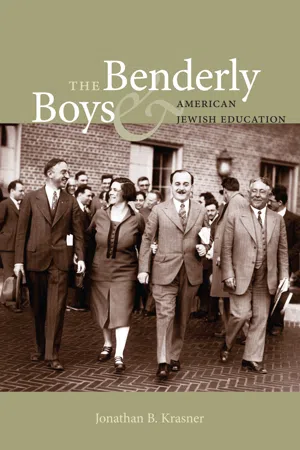
Samson Benderly inaugurated the first Bureau of Jewish Education in 1910 amid a hodgepodge of congregational schools, khayders, community Talmud Torahs, and private tutors. Drawing on the theories of Johann Pestalozzi, Herbert Spencer, and John Dewey, and deriving inspiration from cultural Zionism, Benderly sought to modernize Jewish education by professionalizing the field, creating an immigrant-based, progressive supplementary school model, and spreading the mantra of community responsibility for Jewish education. With philanthropist Jacob Schiff and influential laymen financing his plans, Benderly realized that his best hope for transforming the educational landscape nationwide was to train a younger generation of teachers, principals, and bureau leaders. These young men became known collectively as the "Benderly Boys," who, from the 1920s to the 1970s, were the dominant force in Jewish education—both formal and informal—in the United States.
- English
- ePUB (mobile friendly)
- Available on iOS & Android
eBook - ePub
The Benderly Boys and American Jewish Education
About this book
Information
Publisher
Brandeis University PressYear
2012Print ISBN
9781584659839
9781584659662
eBook ISBN
9781611682939
Index
Note: Page numbers in italics refer to figures.
AAJE. See American Association for Jewish Education
Aaronson, Rebecca. See Brickner, Rebecca Aaronson
Abrams, Samuel, 13
Abramson, Frances, 253
academic schedule, standardization of, 96
accommodationism, accusation of, against Benderly, 114–16
acculturation: debate on, 219; and Jewish education, 96; postwar trend toward, 8. See also Americanization
Ackerman, Walter: on Benderly program, 3, 6, 7, 10, 205; on central agencies, challenges facing, 379; on Central Jewish Institute, 260–61; on JEC consultation, 390–91; on Jewish education, 128, 130, 418–19
Addelston, Susan, 285, 319
Adler, Cyrus, 38, 134
Adventures of K’tonton (Weilerstein), 236
afordability of education, Benderly’s focus on, 113–16, 407–8
After You—What? A Message to the Jewish Mothers of America (Benderly), 231
Agronsky, Gershon, 85
Agudath Ha-Morim Ha-Ivrim B’Nu York V’Sevivoteha (Hebrew Teachers Union of New York and Vicinity), 47–49, 56, 177, 179, 213, 219
Agudath Morim Muvtalim (Union of Unemployed Teachers), 179
Ahad Ha-Am (Ginsberg, Asher): Hashiloah and, 34; influence on Benderly and group, 4, 23, 25–26, 78, 291; influence on Berkson, 245, 249, 262; Kaplan (Mordecai) on, 77; on Palestine cultural center, 249
Aitz Chaim Congregation, 425n9
AJC. See American Jewish Committee
Akiba Academy (Philadelphia), 392
Alkabetz, Solomon Halevi, 410
Allen, Isaac, 383, 385 American, Sadia, 209
American Association for Jewish Education (AAJE), 181–83, 352–53
American Council for Judaism, 343
American Indians, playing of, in Jewish culture camps, 313–15, 314
Americanization: Benderly’s support for, 27, 35, 100, 115–16; community theory of (Berkson), 244–46; as conscious product of Jewish education, 345; critics of, 205; day schools and, 392, 393, 396; food and, 301; Jewish culture camps and, 301, 302, 312–13; JTA acceptance of, 214; Principals Association support for, 96. See also Jewish-American identity
Americanized Zion...
Table of contents
- Cover Page
- Title Page
- Copyright
- Brandeis Series in American Jewish History, Culture, and Life
- Contents
- Acknowledgments
- Introduction
- I Making Order out of Chaos, 1900–1939
- II Jewish Learning for Jewish Living, 1910–1945
- III Between K’lal Yisrael and Denominationalism, 1940–1965
- Conclusion: The Benderly Revolution
- Notes
- Index
Trusted by 375,005 students
Access to over 1.5 million titles for a fair monthly price.
Study more efficiently using our study tools.
Frequently asked questions
Yes, you can cancel anytime from the Subscription tab in your account settings on the Perlego website. Your subscription will stay active until the end of your current billing period. Learn how to cancel your subscription
No, books cannot be downloaded as external files, such as PDFs, for use outside of Perlego. However, you can download books within the Perlego app for offline reading on mobile or tablet. Learn how to download books offline
Perlego offers two plans: Essential and Complete
- Essential is ideal for learners and professionals who enjoy exploring a wide range of subjects. Access the Essential Library with 800,000+ trusted titles and best-sellers across business, personal growth, and the humanities. Includes unlimited reading time and Standard Read Aloud voice.
- Complete: Perfect for advanced learners and researchers needing full, unrestricted access. Unlock 1.5M+ books across hundreds of subjects, including academic and specialized titles. The Complete Plan also includes advanced features like Premium Read Aloud and Research Assistant.
We are an online textbook subscription service, where you can get access to an entire online library for less than the price of a single book per month. With over 1.5 million books across 990+ topics, we’ve got you covered! Learn about our mission
Look out for the read-aloud symbol on your next book to see if you can listen to it. The read-aloud tool reads text aloud for you, highlighting the text as it is being read. You can pause it, speed it up and slow it down. Learn more about Read Aloud
Yes! You can use the Perlego app on both iOS and Android devices to read anytime, anywhere — even offline. Perfect for commutes or when you’re on the go.
Please note we cannot support devices running on iOS 13 and Android 7 or earlier. Learn more about using the app
Please note we cannot support devices running on iOS 13 and Android 7 or earlier. Learn more about using the app
Yes, you can access The Benderly Boys and American Jewish Education by Jonathan B. Krasner in PDF and/or ePUB format, as well as other popular books in Social Sciences & History of Education. We have over 1.5 million books available in our catalogue for you to explore.