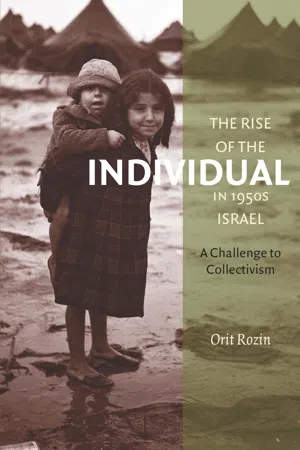
In this sharply argued volume, Orit Rozin reveals the flaws in the conventional account of Israeli society in the 1950s, which portrayed the Israeli public as committed to a collectivist ideology. In fact, major sectors of Israeli society espoused individualism and rejected the state-imposed collectivist ideology. Rozin draws on archival, legal, and media sources to analyze the attitudes of black-market profiteers, politicians and judges, middle-class homemakers, and immigrants living in transit camps and rural settlements. Part of a refreshing trend in recent Israeli historiography to study the voices, emotions, and ideas of ordinary people, Rozin's book provides an important corrective to much extant scholarly literature on Israel's early years.
- English
- ePUB (mobile friendly)
- Available on iOS & Android
eBook - ePub
About this book
Information
Publisher
Brandeis University PressYear
2011Print ISBN
9781611680812
9781584658924
eBook ISBN
9781611680829
NOTES
Introduction
1. Ma’ariv, October 4, 1950.
2. See Sivan 1991, 55–101.
3. Gorni 1990, 14–15.
4. Anita Shapira 5757, 253; Ya’ar and Shavit 2001, 1:127.
5. For various approaches to this issue, see Weinreb 5714, 278; Molad, October 1960, 423; Lissak 5726; Y.Shapira 1977, 160; Eisenstadt 1989, 135–40, 162; Dan Horowitz and Lissak 1990, 153–56; Anita Shapira 5757; Y. Shavit 2003.
6. Avraham Shapira 1996, 46.
7. Dan Horowitz and Lissak 1990, 156; Anita Shapira 5757, 261. See also Rozin 2005b.
8. Gorni 1997, 365.
9. Anita Shapira 5757, 261.
10. Ibid., 262–64.
11. Ibid., 261–63.
12. Almog 2002.
13. Almog 5764, 362–65; Rozin 2006a.
14. Anita Shapira 5757, 252–59; Almog 1997, 231–34; Dan Horowitz and Lissak 1990, 179–80.
15. Molad, October 1960, 413–31; Dan Horowitz and Lissak 1990, 179.
16. See, for example, BGAD, January 10, 1951, and July 10, 1953;
MSA, 14-1950-25-2, December 14, 1950; Hapo’el Hatza’ir, June 5, 1951, 11.
17. Arieli 5759.
18. Ezrahi 1997, 79–80; Rozin 2006a.
19. E. Gross 1998, 81–83.
20. Lahav 5752, 481–82; Likhovski 1999; Barak-Erez 1999. See also Rozin 2006a.
21. Sharfman 1997, 50.
22. An earlier version of chapters 2 and 3 was published as Rozin 2005a.
1. Austerity
1. An austerity program had been declared in December 1947. Beterem, March 1, 1948, 39–40; Ma’ariv, May 24, 1948; Gilayon minhelet ha’am, tzavim vehoda’ot, May 10, 1948; Hamemshala hazmanit, Iton rishmi, June 30, 34; July 7; and July 21, 1948, 37.
2. N. Gross 1997; Zweiniger-Bargielowska 2000, 6.
3. Elhanati interview, October 11, 2004.
4. For an exceptional response, see Ha’ishah Bamedina, May 4, 1949.
5. IDIGA, Hamakhon Lecheker Da’at Hakahal, Mipi Nashim, mekhkar bein akrot bayit al kitzuv mezonot ve’aspka, May 1949.
6. Ma’ariv, January 23 and January 25, 1950; Naor 1986; Genchovski 1986; N. Gross 1997, 140–42.
7. See the discussion in chapter 2. See also Ma’ariv, February 22 and February 27, 1950; Ha’aretz, February 28, 1950; Divrey Haknesset 4:898–903, March 1, 1950; Ha’aretz, March 2 1950; Ma’ariv, March 13, 1950; Haboker, March 20, 1950; Ha’aretz, March 30, 1950; Haboker, October 5, 1950.
8. Bell and Valentine 1997, 25–42. See also Counihan 1999, 76–92; Almog 1999, 26–27.
9. Nelson 1993, 104; Zweiniger-Bargielowska 2000, 44.
10. Divrey Haknesset 1:402, April 26, 1949.
11. Ibid.
12. Ibid. 1:399, April 26, 1949.
13. Ibid. 1:419, April 27, 1949.
14. See, for example, ibid. 1:450–51, May 2, 1949.
15. Lupton 1996, 37.
16. Divrey Haknesse 1:418, April 27, 1949.
17. As proposed by Uri Zvi Greenberg’s use of the term tzena. See Divrey Haknesset 1:417, April 27, 1949.
18. Ibid.
19. Dvar Hapo’elet, Elul 5711, 164. Other fronts concerned raw materials for construction and industry, and products for agriculture; in both those cases, there were also severe shortages accompanied by a black market.
20. La’isha, February 1, 1950; Gorni interview, October 6, 1998; Az’ya interview, winter 1997.
21. See Molad, September 1951, 290–91; GYB 5711, 376–77. See also PLA, IV 230–5-32, December 1942; Dvar Hapo’elet, Cheshvan 571...
Table of contents
- Cover Page
- Title Page
- Copyright
- Contents
- Acknowledgments
- Introduction: The First Years
- I At Home and on the Street
- II In the City Square
- III Somewhere in the Transit Camp
- Conclusion
- Notes
- References
- Index
Trusted by 375,005 students
Access to over 1.5 million titles for a fair monthly price.
Study more efficiently using our study tools.
Frequently asked questions
Yes, you can cancel anytime from the Subscription tab in your account settings on the Perlego website. Your subscription will stay active until the end of your current billing period. Learn how to cancel your subscription
No, books cannot be downloaded as external files, such as PDFs, for use outside of Perlego. However, you can download books within the Perlego app for offline reading on mobile or tablet. Learn how to download books offline
Perlego offers two plans: Essential and Complete
- Essential is ideal for learners and professionals who enjoy exploring a wide range of subjects. Access the Essential Library with 800,000+ trusted titles and best-sellers across business, personal growth, and the humanities. Includes unlimited reading time and Standard Read Aloud voice.
- Complete: Perfect for advanced learners and researchers needing full, unrestricted access. Unlock 1.5M+ books across hundreds of subjects, including academic and specialized titles. The Complete Plan also includes advanced features like Premium Read Aloud and Research Assistant.
We are an online textbook subscription service, where you can get access to an entire online library for less than the price of a single book per month. With over 1.5 million books across 990+ topics, we’ve got you covered! Learn about our mission
Look out for the read-aloud symbol on your next book to see if you can listen to it. The read-aloud tool reads text aloud for you, highlighting the text as it is being read. You can pause it, speed it up and slow it down. Learn more about Read Aloud
Yes! You can use the Perlego app on both iOS and Android devices to read anytime, anywhere — even offline. Perfect for commutes or when you’re on the go.
Please note we cannot support devices running on iOS 13 and Android 7 or earlier. Learn more about using the app
Please note we cannot support devices running on iOS 13 and Android 7 or earlier. Learn more about using the app
Yes, you can access The Rise of the Individual in 1950s Israel by Orit Rozin in PDF and/or ePUB format, as well as other popular books in History & Middle Eastern History. We have over 1.5 million books available in our catalogue for you to explore.