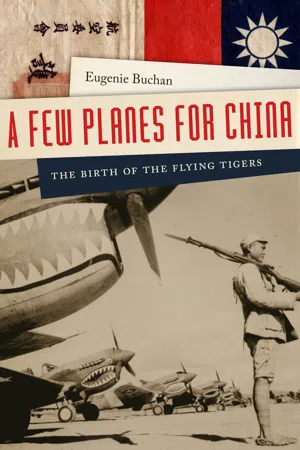
On December 7, 1941, the surprise attack on Pearl Harbor plunged the United States into armed conflict with Japan. In the following months, the Japanese seemed unbeatable as they seized American, British, and European territory across the Pacific: the Philippines, Singapore, Hong Kong, the Dutch East Indies. Nonetheless, in those dark days, the US press began to pick up reports about a group of American mercenaries who were bringing down enemy planes over Burma and western China. The pilots quickly became known as Flying Tigers, and a legend was born. But who were these flyers for hire and how did they wind up in the British colony of Burma? The standard version of events is that in 1940 Colonel Claire Chennault went to Washington and convinced the Roosevelt administration to establish, fund, and equip covert air squadrons that could attack the Japanese in China and possibly bomb Tokyo even before a declaration of war existed between the United States and Japan. That was hardly the case: although present at its creation, Chennault did not create the American Volunteer Group. In A Few Planes for China, Eugenie Buchan draws on wide-ranging new sources to overturn seventy years of received wisdom about the genesis of the Flying Tigers. This strange experiment in airpower was accidental rather than intentional; haphazard decisions and changing threat perceptions shaped its organization and deprived it of resources. In the end it was the British—more than any American in or out of government—who got the Tigers off the ground. On the eve of Pearl Harbor, the most important man behind the Flying Tigers was not Claire Chennault but Winston Churchill.
- English
- ePUB (mobile friendly)
- Available on iOS & Android
eBook - ePub
About this book
Information
Chiang’s Rotten Air Force 1
In early February 1939, Generalissimo Chiang Kai-shek and Madame Chiang invited to their residence in Chungking the new British air attaché in China, Group Captain Robert Stanley Aitken of the Royal Air Force. Over tea, he hoped to find out more about their requests to buy British aircraft and bring RAF advisers to China to reform the air force.1 Madame interpreted for her husband in flawless English with a slight southern accent. She told Aitken that the administration of the air force was “absolutely rotten” and offered poor value for money. On Chiang’s behalf she stated, “We have had to do without a Navy, we would be better off without a rotten Air Force.” She claimed that the British would have “carte blanche” to reorganize China’s air ministry, the Commission on Aeronautic Affairs (CoAA), and the air force.2
This was not the first time that the Chinese Air Force and its “ministry” had been labeled as rotten. In October 1936, Aitken’s predecessor, Wing Commander Harold Kerby, reported that China’s ruling couple were “thoroughly disgusted” by standards at the main flight school at Hangchow and described its white buildings as “a cloak for the rottenness within.”3 At the end of the month, the generalissimo appointed his wife as chairman of the CoAA. Chiang’s chief air adviser at that time was General Silvio Scaroni of Italy’s Regia Aeronautica. He warned Madame Chiang, “Your Air Force is rotten and as a weapon of war, it is entirely useless.”4
Rarely if ever did foreign military attachés have anything good to say about China’s air force or army. The founding father of such critiques was Major John Magruder, who served as the US military attaché in Peking from 1926 to 1930. He would later return to China in the autumn of 1941 as the head of the American Military Mission to China (AMMISCA). In an April 1931 article for Foreign Affairs, Magruder described the Chinese as “practical pacifists.”5 Whereas Japan had a deep reverence for the fighting man, according to Magruder, the Chinese had no martial spirit, and with the exception of an increased use of machine guns, the Chinese had hardly modernized their armed forces. Military aviation was in a “period of transition from military stage property to a moral auxiliary,” and the Chinese army did not regard it as “a necessary arm”; owing to the inferior performance of army air bureaus, the air force was an “an overrated scarecrow.”6
CAF pilots fought bravely in the first three months of the Sino-Japanese War but lacked leadership as well as reserves to prolong the war in the air. When the conflict began on July 7, 1937, Japan’s air forces had outnumbered the CAF by four to one: Japan had 620 army planes with 25 percent reserves, and 600 navy aircraft, all produced by Japanese manufacturers. The Chinese had only 250 airworthy planes, all of which were imported: 230 came from the United States, the rest from Italy or Germany.7 By the end of November 1937, the CAF had lost all its prewar stock and was down to about 27 planes.8
After the air force collapsed, the Chinese started to rely on Russian airplanes and pilots. In August 1937, Chiang had signed a nonaggression pact with the Soviet Union, which became the basis for military assistance. The terms of the pact featured low-interest loans with which the Chinese could buy hardware, especially aircraft. Planes began to arrive in November 1937. Over the next three years the Nationalists received a total of nine hundred Soviet planes, of which 80 percent were delivered by the end of 1939.
With equipment came advisers, and the mission known as Operation Zet began to expand. In the Soviet Union the pilots achieved heroic status comparable to that of the Flying Tigers in the United States.9 In January to February 1938, Russian crews carried out 150 bombing missions against the enemy.10 By the end of the year, three hundred Russians were involved in Chinese military aviation.11 Nor was their service risk-free: from 1937 to 1940 some two hundred Russian volunteers died in China.12
Operation Zet was so well established by 1938 that the Chinese Air Force seemed to have transferred its loyalty from the Chiangs to the Russians. Such was the conclusion of the assistant US naval attaché, Marine Corps captain James McHugh, who during a long tour in China for the Office of Naval Intelligence (ONI) reported in detail not only about military aviation but also about the intrigues of the generalissimo’s family circle involving his various Soong in-laws.13 McHugh was of enormous influence in shaping how the US Navy perceived the shifts of power in the Nationalist regime, as well as at the State Department through his special reports to the US ambassador, Nelson Johnson.14
At the end of February 1938, Madame Chiang gave up her chairmanship of the CoAA. Exhausted and in ill health, she retired from aviation affairs and persuaded her brother T. V. Soong to take over as chairman of the CoAA. As McHugh reported, Soong was content to let the Russians assume responsibility for the country’s air defense because they provided much-needed credit and better airplanes than the “superseded models” available from the United States.15 In a letter to Bill Pawley, Bruce Leighton also observed that Dr. Kung was “relinquishing all initiative in the purchase of aircraft . . . and passing it all over into the hands . . . of T. V.”16 From 1933 to 1938, Dr. Kung in his role as finance minister had handled nearly all negotiations with Bill Pawley of Intercontinent to buy Curtiss-Wright “Hawk” fighter planes. In 1933, Pawley and Kung set up a joint venture between three American partners—Intercontinent, Curtiss-Wright, and Douglas Aviation—and the Nationalist government: the Central Aircraft Manufacturing Company (CAMCO) was designed to save the Chinese government money on the cost of importing planes in their large principal parts—fuselage, wing, and motor. The arrangement was to take advantage of lower labor costs and local raw material to make certain parts in China and assemble the planes there.
This business model worked well until the outbreak of war, which had the effect of greatly increasing the cost of plane parts from the United States and inducing the Chinese to rely on less-costly Russian equipment. In April 1938, Leighton noted that the USSR provided planes at costs that were much lower than anything Intercontinent could offer. Therefore, the prospects for selling American planes were “far from brilliant.”17 By October 1938, the Nationalists had 207 airworthy combat planes, of which 95 were Russian and 80 were American. There also were 14 French Dewoitines, 10 British Gloster Gladiators, and 8 German Henschel bombers.18
T. V. Soong willingly accepted dependence on Soviet aid, but others in the family circle were uneasy about it, especially Dr. Kung and Madame Chiang and her closest confidant, W. H. Donald.19 Donald gave special briefings to British diplomats, particularly the air attachés. At the end of 1937, Harold Kerby reported Donald’s suspicions that the Russians and Japanese would settle their differences and carve up China between themselves.20 Two years later, Aitken, the air attaché, discovered that “mention of the Russians was not welcome”: Madame Chiang flatly commented that “they [the Russians] look after themselves,” while others confirmed that “they will not talk.”21 Aitken surmised that absolute secrecy was one of the conditions of Soviet aid, and if that condition were broken, Stalin might withdraw his helping hand. There were reports that Russian pilots were just using China as a “sort of training ground.” Even so, the Russians inspired universal respect for their courage and efficiency when they chose to fight; they appeared to be in China for the long term, as some eighty Sino-Russian interpreters were teaching Chinese personnel to speak Russian.22
Donald had invited Aitken to come to Chungking and arranged his appointments. He too told the new British air attaché that the air force was in a hopeless state, mainly because of its incompetent officers: Donald singled out for special sanction General Mao Pang-chu (also known as Peter or P. T. Mow), the head of air operations.23 Because General Mao was “irresponsible and corrupt,” Chiang had appointed General T. C. Chien (Chien Ta-chun), a loyal and honest army officer, to replace him as head of the air force.24 General Chien, however, knew so little about aviation that he had to rely on Mao for guidance. Madame Chiang asked Aitken to keep the real nature of his visit a secret from T. C. Chien, who proved to be equally cagey toward Aitken. When the latter asked for hard numbers about air force capability, the former said that he could not possibly release these to a British air attaché.25
To his surprise, Aitken found that General Mao spoke more common sense about aviation than anyone else, even if he was a “corrupt scoundrel.”26 His was a pragmatic approach to combat: pilots engaged the enemy only if they had a reasonable chance of success, and they were not allowed to “indulge in heroic deeds against impossible odds.”27 He showed Aitken a new air force chart that featured at the top the generalissimo, Madame Chiang, and her brother T. V. Soong, as well as a few military men. In Aitken’s view the organization was nothing more than “a heterogeneous collection of terminologies bunched indiscriminately in groups.”28
At Kunming, the capital of Yunnan Province, Aitken met the senior CAF officer in charge of flight instruction, General Chow (Chou Chih-jou), as well as the chief instructor, an American called Colonel Chennault.29 The conversation was hampered by language difficulties, the evasiveness of Chow, and the deafness of Colonel Chennault.30 When Aitken asked Chennault what he thought of Mao’s new organization chart, the latter dismissed it as “hopeless” but had no views on improving it: Aitken surmised that “organization was not his forte.”31
Aitken understood that there were a dozen or so American Army Air Corps reserve officers training CAF cadets.32 By all accounts, however, the Americans had poor relations with their students as well as with Chinese officers, who resented the Americans telling them how to teach. There had been a “mutiny” at one school when Chinese instructors told cadets that once they had flown solo, they did not have to mind their American superiors.33
One of the American instructors was William MacDonald, an old flying companion of Chennault. In the mid-1930s, Mac had been a wingman in the latter’s AAC aerobatic trio, Three Men on a Flying Trapeze. Although Mac refused to admit that he had flown combat missions, he nonetheless alluded to one: he had tried to instill a true sense of loyalty and duty in Chinese crews, but the first time that he led them against an equal number of Japanese (nine), they deserted him immediately.34 Aitken understood that MacDonald received a handsome reward for each enemy aircraft that he brought down. When the Chinese reduced his bonus to “a thousand dollars...
Table of contents
- Cover Page
- Title Page
- Copyright
- Dedication
- Contents
- Introduction
- 1. Chiang’s Rotten Air Force
- 2. Burma Roads
- 3. Plane Aid
- 4. Bruce Leighton’s Guerrilla Air Corps
- 5. Business, the Chinese Way
- 6. T. V. Soong’s Mission to Washington
- 7. A Few Planes for China
- 8. Roosevelt’s Dilemma
- 9. Bombing Japan
- 10. Tomahawks for China
- 11. Robbing Churchill to Pay Chiang
- 12. The Private Military Contractor
- 13. Diplomatic Skirmishes
- 14. Reinforcing the Philippines
- 15. Favoring Currie
- 16. The Mercenary’s Contract
- 17. Recruiters and Recruited
- 18. The International Air Force
- 19. Staying on in Burma
- 20. Squabbling over Bullets
- 21. AVG Summer Camp
- 22. The Short-Term Air Program for China
- 23. Currie Gets in a Jam
- 24. Magruder’s Mission
- 25. Countdown to War
- Epilogue
- Acknowledgments
- Notes
- Index
- Illustrations
Trusted by 375,005 students
Access to over 1.5 million titles for a fair monthly price.
Study more efficiently using our study tools.
Frequently asked questions
Yes, you can cancel anytime from the Subscription tab in your account settings on the Perlego website. Your subscription will stay active until the end of your current billing period. Learn how to cancel your subscription
No, books cannot be downloaded as external files, such as PDFs, for use outside of Perlego. However, you can download books within the Perlego app for offline reading on mobile or tablet. Learn how to download books offline
Perlego offers two plans: Essential and Complete
- Essential is ideal for learners and professionals who enjoy exploring a wide range of subjects. Access the Essential Library with 800,000+ trusted titles and best-sellers across business, personal growth, and the humanities. Includes unlimited reading time and Standard Read Aloud voice.
- Complete: Perfect for advanced learners and researchers needing full, unrestricted access. Unlock 1.5M+ books across hundreds of subjects, including academic and specialized titles. The Complete Plan also includes advanced features like Premium Read Aloud and Research Assistant.
We are an online textbook subscription service, where you can get access to an entire online library for less than the price of a single book per month. With over 1.5 million books across 990+ topics, we’ve got you covered! Learn about our mission
Look out for the read-aloud symbol on your next book to see if you can listen to it. The read-aloud tool reads text aloud for you, highlighting the text as it is being read. You can pause it, speed it up and slow it down. Learn more about Read Aloud
Yes! You can use the Perlego app on both iOS and Android devices to read anytime, anywhere — even offline. Perfect for commutes or when you’re on the go.
Please note we cannot support devices running on iOS 13 and Android 7 or earlier. Learn more about using the app
Please note we cannot support devices running on iOS 13 and Android 7 or earlier. Learn more about using the app
Yes, you can access A Few Planes for China by Eugenie Buchan in PDF and/or ePUB format, as well as other popular books in History & World History. We have over 1.5 million books available in our catalogue for you to explore.