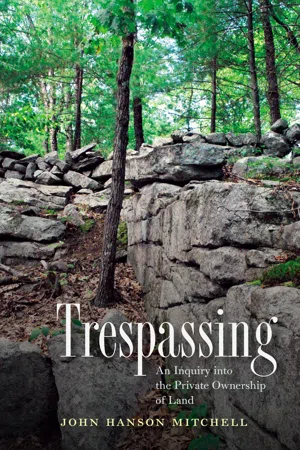
Trespassing, "a thoughtful, beautifully written addition to environmental and regional literature" (Kirkus Reviews), is a historical survey of the evolution of private ownership of land, concentrating on the various land uses of a 500-acre tract of land over a 350-year period. What began as wild land controlled periodically by various Native American tribes became British crown land after 1654, then private property under US law, and finally common land again in the late twentieth century. Mitchell considers every aspect of the important issue of land ownership and explores how our attitudes toward land have changed over the centuries.
- English
- ePUB (mobile friendly)
- Available on iOS & Android
eBook - ePub
About this book
Information
CHAPTER FIFTEEN
Their Heirs and Assigns Forever
As much land as a man tills, plants, improves, cultivates, and can use the product of, so much is his property. He by his labour does, as it were, enclose it from the common.
—John Locke, Second Treatise on Government, 1690
I set out one March day to walk over to the site from the center of town and crossed, en route, the land belonging to Mr. Couper. The lion brown fields behind his house were just warming after the winter; you could see the little mouse trails running through the long, snow-flattened grass, and the hummocks and hollows were still oozing with winter melt-water. In a section of old apple trees, just to the north of the field I was in, I saw a bearlike form under the trees moving slowly on all fours over the ground. Slowly this bear emerged into human form on its hands and knees, and I saw that it was no less than Mr. Couper himself, creeping through the trees.
God, I thought, he’s gone around the bend, finally, and transformed himself into one of his beloved animal allies. As I got closer, I could see that he was patiently parting the grasses with his hands as he crawled.
“God-awful mice,” he said. “They’ll girdle every damn tree in the universe if they get a chance. The Lord should have created more snakes and fewer mice if you ask me.”
Like many of his age, Mr. Couper is a great raconteur of past events. Unlike some of the older farmers in this area, however, he hardly requires drawing out and is effusive in his accountings, giving details in such profusion and with so many sidebars, and meanderings, and names of those long dead, that it is sometimes difficult to follow his stories or even to determine what century he’s talking about.
While I stood talking with him under the trees, I was eyeing the back of his old hulk of a barn. It was an angle I was not used to, and I was admiring the view. Mr. Couper saw me looking and told me that some time ago a whole wagon had fallen through the floor of that barn, carrying with it his truly and a good dog to boot. The two of them were half buried in cow manure and had to be hoisted out by his passing father, who, Mr. Couper explained, “was of a mind to leave me there to cook for a while.” It was then that I realized that this event had taken place not this past winter but back in 1924, when Mr. Couper was twelve.
That would have been about the same time that Virginia Mills drowned in Nagog Pond, the same years in which the dark-haired queen of the Isle of the Dead would spirit across the pastures and orchards on her white horse. It was also during this period that Mr. Couper’s cousin, Chicken John, would have been working on his father’s dairy west of Nashobah and that the old patriarch, Francis Flagg, still knew where to find the springs and the old foundations of the Indian fort that had been built at the Christian Indian village site to save the Nashobah people from the raiding parties of Mohawks.
In the twenties, the site of the fort was known as Speen’s Point, named for John Speen, a contemporary of Sarah’s, and one of the last survivors of Indians associated with Nashobah. Mr. Couper and his cousins knew the area around the point well. He would draw water from the spring, he told me, when they were haying the back fields of his uncle’s properties. That got him onto the subject of haying, which got him onto the subject of pastureland, which got him onto the subject of farms and the shortage thereof in this fast-developing town, and that got him onto what was apparently a favorite memory of his—the great spring drives of heifers and dry cows up the Great Road to the high pastures of New Hampshire.
Farmers in the town would assemble their cattle in a selected pasture and then, herded by the local swains and, according to Mr. Couper, a few hardy dairymaids as well, the whole band would move up the rural road to the town of Ashby, where the farmers had rented pasturelands. The journey, which today can be done in forty-five minutes or so, took two or three days. The swains and the dairymaids would camp along the way in roadside fields, and these were, said my informant, as fine an opportunity as one had to get away on vacation for a few days. Other old-timers in the Nashobah region used to tell me about these drives with equal relish. And indeed, since most of the drivers were teenagers, they must have been spirited events. In some ways the drives were the last of the communal efforts that used to take place in farming communities—shared lands and shared work.
Some drives came in the other direction, when sheep and even turkeys were brought down to the Boston markets on the hoof rather than in trucks. One of the things about the drives is that they would hold up traffic. The drovers would do their best to get the herds over to one side of the road or the other to allow cars to pass, but, inasmuch as cows are mindful creatures, sometimes long lines of black Fords would fetch up behind them and crawl along at a cow’s pace—or in autumn, a turkey space.
These roadblocks are a phenomenon that still occur in rural Portugal and northern Scotland. But there is a twenty-first-century version even around Nashobah. Every June, immense, overloaded hay trucks, stacked high with the first cutting, pull out onto the Great Road and rumble along at twenty miles an hour, spilling hay as they move. This parade, which often takes place later in the day, after the hay is loaded, often holds up the speedy little cars of computer company workers. You will see them there, pulling out into the left lane to get a view around the truck and then ducking back in at the last minute like fighter planes.
There was a rumor that Mr. Couper, who is not known for his speed on the roads and drives a very old white Buick with broken back windows and a dragging muffler, chooses to drive to town at rush hour at his appointed rate of speed, that is to say, twenty miles per hour in a zone marked thirty-five. The young, fast-lane computer workers who otherwise take this stretch at fifty, sometimes more, line up bumper to bumper behind him.
One member of the Nashobah jester chorus, having witnessed this phenomenon on several occasions, has even named the odd parade: “Couper’s Choochoo.”
“All gone now,” Mr. Couper said when I asked him about some of the people who would go with him on the cattle drives. “Except for Chicken John and a few others. Most all gone.”
I mentioned that I had spoken with Chicken John not long ago.
“Well, he’ll be gone soon enough,” Mr. Couper said. “Him, Morrison, Junior. We’ll all be gone soon enough. And what’s to become of this world then?” he asked himself
Mr. Couper meant Nashobah, I thought, not the world at large, which would no doubt carry on with or without Mr. Couper or, for that matter, any of us. But I asked him just to make sure.
“What will become of Nashobah, you mean?”
“Well yes, and I suppose this place here’ll carry on, I’ve taken care of that. But the rest, things as they are, I don’t know.”
Mr. Couper was always attentive to matters of land and had for years maintained his farm under a state law, Chapter 61 A, that reduced taxes for those using the land for agricultural purposes. He had also probably taken care, although I was almost afraid to ask, to make certain that his part of the world would carry on as a farm. As for the other farms, one would be pressed to say.
. . .
But at least things were looking up at the Frost Whitcomb property.
Linda was not the first impediment to the sale of this property, it turned out. The land had been on the market, off and on, for years, but in the past, every buyer had been wary because of the questionable drainage in the area. The current developer had hoped to circumvent this problem by putting in a localized sewage treatment plant that would take care of the waste for the entire development. But he had conveniently overlooked the fact that such plants are controversial and that there was a moratorium on their construction in the town. After he pulled out, the land was back on the market, and suddenly Linda and her group, rather than barriers to sale, became the great hope of the sellers. The owners never were in favor of a big housing development anyway. They even lowered the price when it became apparent that the land might be preserved. What had been a million-dollar sale was now offered at $700,000. It only remained for the Friends of Open Space to convince the town to spend the money.
There are unanticipated economic consequences to breaking up large tracts of land, which, if they ever became common knowledge among town officials, might slow development of single-family houses. It is cheaper for a town to buy land for conservation than to let it become a housing development. Open space does not incur any expenses for a community other than theoretical lost tax revenue. If, on the other hand, a given tract of land is sold for new houses, even though the householders pay taxes, because of the increased costs for schools, roads, fire, police, and the like, the town will not necessarily cover its costs with taxes. This accounting has been known since the 1970s, but so far the message has not reached the consciousness of many town officials, at least not in the towns around Nashobah. So Linda and company were facing a hard sell.
One of the legacies of the Puritan founders was the concept of the town meeting, a more or less sacrosanct institution to which the entire community is invited each year to vote on the business of the town. This eminently democratic system, a sort of rite of the New England spring, can stir the dormant passions of a town whenever there is an issue worth fighting over. Even a single individual citizen can get an article voted on in the meeting if he or she can get thirteen petitioners to sign a request for the article. With this in mind, the Friends of Open Space drew up a petition and began circulating it in the weeks before the Littleton town meeting to get an article on the agenda proposing that the town spend $700,000 to buy the 113-acre tract.
Getting the signatures was no problem; the Friends, by this time, had a major network in the town. Everyone knew someone, who knew someone else, and in a very short time they had more than the necessary signatures and had assured themselves a vote at town meeting. But that was the easy part. Getting the article passed was another matter, partly because of internal manipulations.
There were a few in the community who questioned the idea of spending yet more town funds on conservation lands, although, for the most part, town officials supported the idea, albeit cautiously. But as usual in small-town politics, there was the question of money. Seven hundred thousand dollars was a lot for a small town, and although the money could be paid over a period of time, and although there was a state bond to help small towns purchase open space, the fiscally conservative “bean counters,” as Linda called them, were balking and putting up impediments and asking questions. Furthermore, Linda and a few others in her group came to believe that there were certain officials in the town who, although publicly supporting the purchase, were in fact opposed to it and were working behind the scenes to defeat it.
Much chatter in the town. Many late-night meetings, many phone calls and gossipings and accusations. Rumors of alcoholism, of affairs, of secret real estate deals, personal aggrandizement, profit mongering. “The usual,” said the Solicitor.
Then came the big night.
The good people of the community began filing into the school gymnasium, where the meetings are held, and by the time the meeting began, the place was filled. The evening droned on with many boring discussions over line items in the town budget. Discussions of sewage, of schools, and of lighting for playing fields.
One of the issues the Friends of Open Space had to deal with was where on the agenda the vote on the land would fall. Early in the meeting, you get a good crowd. But as the evening plods along, the tedium and the discomfort set in and people begin to leave. Late in the night some town meetings have less than half their original participants. There had been charges that the article on the land had been shifted—purposely—to a late position in order to weed out the indifferent voters, most of whom, it was argued, would have supported the purchase.
One of the other issues was that the selectmen, for reasons that were never made entirely clear, at least not in the eyes of the Friends of Open Space, had proposed a purchase of their own. They wanted to buy only one of the two properties, leaving the other up for development. The proposal weakened considerably the position of the Friends.
“Some kind of end run or something,” Linda said. “I don’t know what the hell they’re thinking. Put in a school or something, once you’ve got the land as open space. We want it for open space, so people can walk there and enjoy flowers and the woods and fields. We don’t want a school. Schools are ugly. That’s not the point. you’ve got to breathe.”
Fortunately, at the last minute the selectmen decided to withdraw their article.
The meeting moved on slowly, article by article. Fully half, if not more, of the participants had come this night specifically because of the open space vote, and discussion over the other articles was decidedly lackluster. One after another, without prolonged debate, the articles were proposed, voted on, and passed or failed. Then finally around eleven o’clock Linda’s hour arrived.
The Friends, armed with maps and charts and financial statements, slowly presented their case. Linda showed slides of the property, spoke of the benefits of preserving open space in general, the lack of new open spaces over the past few years, and the unique quality of this particular site, with its open fields, its rare grassland birds, and its wild, lakeside banks. Then the debate was opened to the floor.
There were many passionate defenders in attendance, and not many opponents, or at least not many who spoke out. One of the finest presentations came from a man who was head of the Massachusetts Association of Conservation Commissions but who happened to live in the town. Given his position, he had seen many such fights across the region, he knew of the difficulties in acquiring open space, and he made it clear that this was a unique opportunity, that open space was disappearing, lot by lot, field by field, across the whole United States. “If not now,” he intoned, at the end of his presentation, “if not now, when?”
Thunderous applause from the assembled. Much pounding of the gavel from the moderator.
More speeches, more support. Then a few small whimpering voices questioning the proposal, primarily because of the money, which, no matter how you looked at it, wasn’t much—individually.
While these sort of meetings carry on, the officials of the town—th...
Table of contents
- Cover
- Series Page
- Title Page
- Copyright
- Dedication
- Epigraph
- Contents
- Preface to the New Edition
- Acknowledgments
- Chronology
- Players
- Prologue
- One: A Certain Tract of Land
- Two: Owners and Outcasts
- Three: Should Trees Have Standing?
- Four: The Cords of Christ’s Tent
- Five: To Have and to Hold
- Six: Common Ground
- Seven: Cross-Lot Walking
- Eight: Terra Nullius
- Nine: Holding Ground
- Ten: Out of the Quiver of the Scriptures
- Eleven: The Last of the Commons
- Twelve: Islands of the Dead
- Thirteen: Who Really Owns North America?
- Fourteen: The Tawny Vermin
- Fifteen: Their Heirs and Assigns Forever
- Sixteen: The Intelligence of Salamanders
- Seventeen: The Landing
- Eighteen: Drawn and Quartered
- Epilogue
Trusted by 375,005 students
Access to over 1.5 million titles for a fair monthly price.
Study more efficiently using our study tools.
Frequently asked questions
Yes, you can cancel anytime from the Subscription tab in your account settings on the Perlego website. Your subscription will stay active until the end of your current billing period. Learn how to cancel your subscription
No, books cannot be downloaded as external files, such as PDFs, for use outside of Perlego. However, you can download books within the Perlego app for offline reading on mobile or tablet. Learn how to download books offline
Perlego offers two plans: Essential and Complete
- Essential is ideal for learners and professionals who enjoy exploring a wide range of subjects. Access the Essential Library with 800,000+ trusted titles and best-sellers across business, personal growth, and the humanities. Includes unlimited reading time and Standard Read Aloud voice.
- Complete: Perfect for advanced learners and researchers needing full, unrestricted access. Unlock 1.5M+ books across hundreds of subjects, including academic and specialized titles. The Complete Plan also includes advanced features like Premium Read Aloud and Research Assistant.
We are an online textbook subscription service, where you can get access to an entire online library for less than the price of a single book per month. With over 1.5 million books across 990+ topics, we’ve got you covered! Learn about our mission
Look out for the read-aloud symbol on your next book to see if you can listen to it. The read-aloud tool reads text aloud for you, highlighting the text as it is being read. You can pause it, speed it up and slow it down. Learn more about Read Aloud
Yes! You can use the Perlego app on both iOS and Android devices to read anytime, anywhere — even offline. Perfect for commutes or when you’re on the go.
Please note we cannot support devices running on iOS 13 and Android 7 or earlier. Learn more about using the app
Please note we cannot support devices running on iOS 13 and Android 7 or earlier. Learn more about using the app
Yes, you can access Trespassing by John Hanson Mitchell in PDF and/or ePUB format, as well as other popular books in History & North American History. We have over 1.5 million books available in our catalogue for you to explore.