When did kindess become a sign of weakness? What if kindness actually has the power to change the world? Culture is at a crossroads when it comes to kindness. These days we either view kindess as an inert act based on the absence of being a jerk, or we see acts of kindness as heroic and herculean, beyond the reach and capability of mere mortals. Choosing kindness is also exhausting. The public and private back-and-forth exchanges of hatred and de-humanizing that is more about ratings, retweets, and winning than relationships and community is taking a toll on our motivation to even contemplate kindness as a valid response. In Defense of Kindness makes a case that we each can choose kindness as a way to experience community and wholeness in new ways. With a playful spirit, tender heart, and unwavering commitment to justice, "kindness enthusiast" Reyes-Chow explores the many ways in which kindness can bring about healing, wholeness, and hope in ourselves and the world. Through unfiltered sharing of his own experiences, Bruce invites the reader into an adventure of discovery and rediscovery of kindness of heart, mind, spirit, and action.
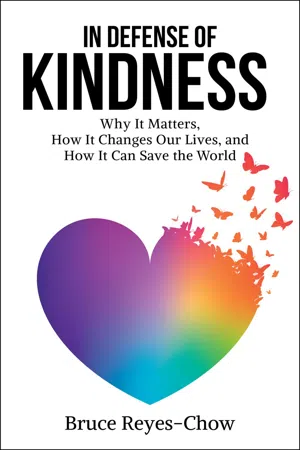
eBook - ePub
In Defense of Kindness
Why It Matters, How It Changes Our Lives, and How It Can Save the World
- 144 pages
- English
- ePUB (mobile friendly)
- Available on iOS & Android
eBook - ePub
In Defense of Kindness
Why It Matters, How It Changes Our Lives, and How It Can Save the World
About this book
Information
Topic
Personal DevelopmentSubtopic
Mental Health & WellbeingKindness and the Public Square
I will never forget where I was on election night 2016. This was one of the first elections processes in which my three children were truly engaged, and they were excited about the possibility of the United States having its first female president. We were all sitting on the couch as the results started rolling in, and as it became clear that Donald Trump was going to be elected president, I looked over and saw my youngest daughter weeping uncontrollably in her mother’s arms.
My parental heart was torn, and the last thing I was feeling was kindness.
At that point, this would have been one of the most challenging chapters on kindness to write. My notes for the chapter looked like this:
- List names Trump has called his enemies.
- List instances of aggression and bullying.
- List instances of violent and dehumanizing rhetoric.
- List the lists of things at which he has been the best president ever.
But I did not give him either the time or the space. I leave that to Wikipedia.
Breathe, Bruce. Just breathe.
I am still not a Trump supporter. Contrary to what he shouted from the rooftops, his leadership style, his policies, and his behavior have not been some positive shakeup of a political system, but an attempt to destroy whatever fragile agreements society had about what was acceptable behavior within mainstream US culture and the global community. His term in office has redefined norms in ways that are not liberating. They have brought death and anguish to communities of color; have emboldened racist, misogynist, xenophobic, Islamophobic, and transphobic behavior; and have extolled dehumanizing, lying, and mockery as legitimate, valid, and even acceptable modes of human interaction.
He is not just a schoolyard bully; he is a bully with actual power.
What I do believe he has done is changed the unspoken rules and societal norms about how we engage with one another when it comes to disagreeing about just about everything under the sun: preferences, lifestyles, and politics.
“Hey, Feelings Fred, that avocado toast you are dripping on your hipster neckbeard is a gateway food to socialism, ten-dollar hemp vegan tacos, and wearing socks with Birks! Why do you hate America—and straws? You coddled, liberal-tears-crying, treasonous traitor!”
Or…
“Nice one, Ammunition Amy. That purity cross you are wearing clashes with your MAGA hat, and the only thing it is saving you from is acknowledging that your son and his Brown ‘roommate’ have sex, and they are not even married. Why do you hate love—and Hamilton? You faux-persecuted, white evangelical, right-wing nutjob!”
And while I am just kidding—or am I?—this is tame considering what most of us have seen and heard over these past years. The name-calling, the violence, the dismissiveness, the dehumanization; the pandemic press conference temper tantrums; the inability to admit that he was wrong; his fascination with TV ratings and his abuse of the media; his subtle and not-so-subtle misogyny, racism, and xenophobia—the list goes on and on and on.
Damn you, Donald Trump!
I mean, “I am very disappointed in you, Mr. Created and Complex Human Being, President Donald Trump.”
Nope, not the same.
As part of a family that has always rigorously and publicly engaged in the political process, what we have become in the public square both makes my head want to explode with rage toward the cavalier ways we treat one another and makes my heart heavy with sadness and grief for what we have lost.
Yes, President Trump is an easy target, but there is collateral damage and other ways that this devolved and destructive rhetoric has become the norm. Dehumanizing is sinister and insidious because it provides short-term if not bankrupt feelings of power. It begins to shape the ways that we perceive ourselves and those around us. We begin to think that all that matters is what we have felt or experienced, and damn however this might impact anyone else. It gives authority and influence to the most outrageous, and worse yet it feeds the idea that the endgame is always victory over others or, at the very least, crushing our opponent’s spirit into submission. To combat this new public square reality, we not only have to hold accountable the main perpetrator but also—and in many ways, more importantly—have to understand that this has now become a disease in our world.
Here are just a few examples.
Women and gender nonconforming people get the worst of this. When people come after me in a direct message, email, or comment, rarely is it about my looks or my love life. And never are sexually violent comments subtly or aggressively directed toward me. No, this misogyny is not new, but from the microaggressions that focus on women’s bodies to outright threats of sexual assault, women have had to bear a great deal of the weight of this now acceptable way to engage in the public square.
This treatment also has a not-so-subtle homophobic tone as well, for any behaviors, relationships, or perspectives that do not ascribe to rigid understandings of maleness are somehow less than. This is one way in which men are often attacked using sexual violence, but again, it is built on the idea that the worst thing one can be is female.
So men, if your female colleagues don’t take your “jokes” well, or you are challenged on your own language or lack of commitment to holding your male colleagues accountable, do you blame those women? While you may see and perceive actions as “not that big of a deal,” many (most) know firsthand what comes next.
People of color, especially Brown and Black communities, seem to have borne the rest of the weight of this new rhetorical norm that has overtaken the public square. These communities have to deal with the public fetishism that makes theater of the actual violence perpetrated upon their bodies, the double standards of treatment by law enforcement and a disproportionate number of Black and Brown people incarcerated in the US prison system, and xenophobia that leads to scapegoating and the use of immigrants as political pawns. On top of all that, these communities also have to deal with white folks and self-proclaimed allies who want to make issues of race about themselves. As well intentioned as some white folks and other allies may be, they decenter the conversation off Black and Brown bodies and make it about them. This is often played out when “woke” white folks respond to a situation of racism by beginning with some version of, “I know what you mean. One time I was the only white person in the room, and…” This new rhetoric has so calcified sides that to call someone out on this behavior generates feelings of ingratitude at best and abdication at worst. If you are a white person who does this and are not sure why your Black friends react the way the...
Table of contents
- Praise for In Defense of Kindness
- Copyright
- Dedication
- Preface
- An Introduction
- Kindness Defined
- Kindness Debunked
- Kindness as Commodity
- Kindness as Competition
- Kindness and Privilege
- Kindness and Conflict
- Kindness and Those Closest to Us
- Kindness and the Public Square
- Kindness and the Everyday
- Kindness and Institutional Change
- Kindness and Resistance
- Kindness and Walking Away
- Kindness and Forgiveness
- Kindness and Saviorism
- Kindness and the Internet
- Kindness and the Impossible
- Won’t You Choose Kindness?
- Acknowledgments
- Keep in Touch
- About the Author
Trusted by 375,005 students
Access to over 1.5 million titles for a fair monthly price.
Study more efficiently using our study tools.
Frequently asked questions
Yes, you can cancel anytime from the Subscription tab in your account settings on the Perlego website. Your subscription will stay active until the end of your current billing period. Learn how to cancel your subscription
No, books cannot be downloaded as external files, such as PDFs, for use outside of Perlego. However, you can download books within the Perlego app for offline reading on mobile or tablet. Learn how to download books offline
Perlego offers two plans: Essential and Complete
- Essential is ideal for learners and professionals who enjoy exploring a wide range of subjects. Access the Essential Library with 800,000+ trusted titles and best-sellers across business, personal growth, and the humanities. Includes unlimited reading time and Standard Read Aloud voice.
- Complete: Perfect for advanced learners and researchers needing full, unrestricted access. Unlock 1.5M+ books across hundreds of subjects, including academic and specialized titles. The Complete Plan also includes advanced features like Premium Read Aloud and Research Assistant.
We are an online textbook subscription service, where you can get access to an entire online library for less than the price of a single book per month. With over 1.5 million books across 990+ topics, we’ve got you covered! Learn about our mission
Look out for the read-aloud symbol on your next book to see if you can listen to it. The read-aloud tool reads text aloud for you, highlighting the text as it is being read. You can pause it, speed it up and slow it down. Learn more about Read Aloud
Yes! You can use the Perlego app on both iOS and Android devices to read anytime, anywhere — even offline. Perfect for commutes or when you’re on the go.
Please note we cannot support devices running on iOS 13 and Android 7 or earlier. Learn more about using the app
Please note we cannot support devices running on iOS 13 and Android 7 or earlier. Learn more about using the app
Yes, you can access In Defense of Kindness by Bruce Reyes-Chow in PDF and/or ePUB format, as well as other popular books in Personal Development & Mental Health & Wellbeing. We have over 1.5 million books available in our catalogue for you to explore.