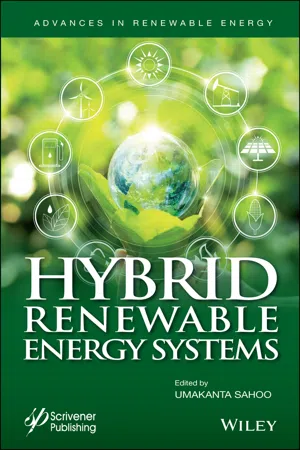
Hybrid Renewable Energy Systems
eBook - ePub

Hybrid Renewable Energy Systems

  1. English
  2. ePUB (mobile friendly)
  3. Available on iOS & Android
eBook - ePub

Hybrid Renewable Energy Systems

About this book

The energy scene in the world is a complex picture of a variety of energy sources being used to meet the world's growing energy needs. There is, however, a gap in the demand and supply. It is recognized that decentralized power generation based on the various renewable energy technologies can, to some extent, help in meeting the growing energy needs. The renewable energy landscape has witnessed tremendous changes in the policy framework with accelerated and ambitious plans to increase the contribution of renewable energy such as solar, wind, bio-power, and others.

Hybrid renewable energy systems are important for continuous operation and supplements each form of energy seasonally, offering several benefits over a stand-alone system. It can enhance capacity and lead to greater security of continuous electricity supply, among other applications. This book provides a platform for researchers, academics, industry professionals, consultants and designers to discover state-of-the-art developments and challenges in the field of hybrid renewable energy.

Written by a team of experts and edited by one of the top researchers in hybrid renewable systems, this volume is a must-have for any engineer, scientist, or student working in this field, providing a valuable reference and guide in a quickly emerging field.

Frequently asked questions

Yes, you can cancel anytime from the Subscription tab in your account settings on the Perlego website. Your subscription will stay active until the end of your current billing period. Learn how to cancel your subscription.
No, books cannot be downloaded as external files, such as PDFs, for use outside of Perlego. However, you can download books within the Perlego app for offline reading on mobile or tablet. Learn more here.
Perlego offers two plans: Essential and Complete
  • Essential is ideal for learners and professionals who enjoy exploring a wide range of subjects. Access the Essential Library with 800,000+ trusted titles and best-sellers across business, personal growth, and the humanities. Includes unlimited reading time and Standard Read Aloud voice.
  • Complete: Perfect for advanced learners and researchers needing full, unrestricted access. Unlock 1.4M+ books across hundreds of subjects, including academic and specialized titles. The Complete Plan also includes advanced features like Premium Read Aloud and Research Assistant.
Both plans are available with monthly, semester, or annual billing cycles.
We are an online textbook subscription service, where you can get access to an entire online library for less than the price of a single book per month. With over 1 million books across 1000+ topics, we’ve got you covered! Learn more here.
Look out for the read-aloud symbol on your next book to see if you can listen to it. The read-aloud tool reads text aloud for you, highlighting the text as it is being read. You can pause it, speed it up and slow it down. Learn more here.
Yes! You can use the Perlego app on both iOS or Android devices to read anytime, anywhere — even offline. Perfect for commutes or when you’re on the go.
Please note we cannot support devices running on iOS 13 and Android 7 or earlier. Learn more about using the app.
Yes, you can access Hybrid Renewable Energy Systems by Umakanta Sahoo in PDF and/or ePUB format, as well as other popular books in Physical Sciences & Energy. We have over one million books available in our catalogue for you to explore.

Information

Year
2021
Print ISBN
9781119555575
eBook ISBN
9781119555612
Edition
1
Subtopic
Energy

1
Resource Assessment and Implementation of Hybrid Renewable Energy Systems for Food Preservation in Agro-Tropical Areas: A Techno-Economic Approach

M. Edwin1*, M. Saranya Nair2 and S. Joseph Sekhar3
1Department of Mechanical Engineering, University College of Engineering, Nagercoil, Anna University Constituent College, Nagercoil, India
2School of Electronics Engineering, Vellore Institute of Technology, Chennai Campus, Chennai, India
3Mechanical Section, Department of Engineering, Shinas College of Technology, Shinas, Sultanate of Oman
Abstract
In tropical countries, approximately 75% of people are involved in the production of dairy and agricultural goods. About 45% of agricultural produce loses its value in rural areas due to the lack of adequate storage and transport facilities. Therefore, cooling systems that work with locally available renewable energy resources are essential to preserving the perishable agricultural products in isolated tropical regions. By implementing a suitable vapour absorption cooling system, the heat energy from the available renewable energy resources can be used to satisfy the cooling demand. This chapter examines the techno-economic viability of the number of configurations of producer gas, biogas and gobar gas energy sources that operate a chilling system. The analysis has been performed with the use of MATLAB software, and the suitable hybrid energy systems have been predicted for serving a community in tropical regions. The results indicate that producer gas/biogas/gobar gas combinations in hybrid renewable energy-operated 35 kW vapour absorption cooling system shows the minimum operating cost (INR 0.81–0.88 million), simple payback time (2.8–3.2 years) and life cycle cost (INR 44.5–48.4 million), and effectively achieves a positive net present cost and the maximum overall efficiency (0.19–0.24).
Keywords: Hybrid energy system, bioenergy, absorption chiller, payback time, net present cost, life cycle cost

1.1 Introduction

Energy demand is increasing at an unprecedented rate all over the world. A major part of the world’s current energy generation is from fossil fuels, resulting in the continuous depletion of this resource. In tropical countries, approximately 75% of the population is engaged in the production of milk and agro products. About 25-45% of agricultural produce loses its value in rural areas due to the lack of adequate storage and transport facilities. At the local village level, this spoilage can be avoided by providing suitable cooling systems for short-term preservation [1]. Integration of available renewable energy sources for energy systems in remote tropical areas has become an area of current interest in the renewable energy sector. A major part of India’s population lives in rural areas and many such villages in those areas are disconnected from the grid connectivity. The extension of grid power to these villages may not be feasible due to real-time situations; however, a stand-alone hybrid renewable energy system can be implemented to overcome such issues [2]. Cleaner energy in the electricity grid is necessary to mitigate the rising greenhouse gases. Due to the fluctuating nature of renewable energy, its outputs are subject to variation and hence it is important to plan as much buffer as possible in the portion of renewable energy in any energy system [3]. Several works have been carried out regarding the feasibility of hybrid renewable energy-operated refrigeration systems, and its implementation issues, capacity, efficiency, optimisation and combinations with other renewable energy technologies. Normally hybrid energy is considered the working of primary renewable energy systems with conventional energy sources. The renewable energy hybrid system will be cost-competitive for rural areas, instead of stand-alone systems [4]. Moreover, their optimum combination would reduce environmental pollution, capital and operating expenses [5]. The combined impacts of several variables, including expense, productivity, social impact, acceptance, reliability and demand are the essential parameters for the implementation of a hybrid energy system [6]. Synergistic advantages can be obtained by integrating multiple forms of energy resources in the generation of heat and electricity. When settling on the viability of a given arrangement, close attention must be paid to many crucial considerations such as the origin of the source, access to different renewable energy sources, co-location of the sources, handling issues in the energy source, etc. While deciding the feasibility of a hybrid system, the possibility of combining the different energy sources in a particular area of the application is more essential [7].
It is noted that the suitable mixtures of solar, biomass and biogas system would improve the techno-economic and socio-economic status in remote areas. The integration of a biomass and biogas energy system can reduce the accessibility issue...

Table of contents

  1. Cover
  2. Table of Contents
  3. Title Page
  4. Copyright
  5. 1 Resource Assessment and Implementation of Hybrid Renewable Energy Systems for Food Preservation in Agro-Tropical Areas: A Techno-Economic Approach
  6. 2 Implementation of Hybrid Renewable Energy Projects in Rural India—A Case Study
  7. 3 Techno-Economic Analysis of Hybrid Renewable Energy System with Energy Storage for Rural Electrification
  8. 4 Modeling and Energy Optimization of Hybrid Energy Storage System
  9. 5 Techno Commercial Study of Hybrid Systems for the Agriculture Farm Using Homer Software
  10. 6 Experimental Investigation of Solar Photovoltaic Cold Storage With Thermal Energy Storage
  11. 7 Estimation of Fault Voltages in Renewable Energy–Based Microgrid
  12. 8 Optimization of PV-Wind Hybrid Renewable Energy System for Health Care Buildings in Smart City
  13. 9 Hybrid Solar-Biomass Gasifier System for Electricity and Cold Storage Applications for Rural Areas of India
  14. Index
  15. Also of Interest
  16. End User License Agreement